Posted in Posts and podcasts

The art of making rebels – 1920

Connacht Tribune 3rd July 1920 p4
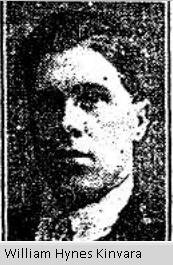
William Hynes Kinvara. Photo: Connacht Tribune 1920
Photo: Connacht Tribune 1920

(abridged) How the Government Persecuted a Kinvara man and his friends. Mr William Hynes, Kinvara, one of the hunger strikers recently released from Wormwood Scrubbs, was arrested at Abbey, Loughrea, early in spring and confined in Galway prison. He was remanded on a few occasions while “The minions of the law” were trying to make a case against him, but subsequently he was released without a stain on his character. The Government, not to be outdone, arrested him a few weeks later, and deported him to Wormwood Scrubbs along with Mr Patrick Kilkelly, now the chairman of the Gort District council, and hundreds of others. Mr Hynes is the youngest son of Mr Patrick Hynes, Doongora, Kinvara and comes of a good old stock of fighting Nationalists. He is grandson of the late “honest Bartly Hynes,” of Killina, the first man in Ireland to be prosecuted for having his name in Irish printed on his cart, and who, to credit be it said, refused to pay the fine imposed by a pair of British “Removables.” His brother Mr Michael Hynes, was arrested after the Rebellion of 1916, and imprisoned at Frongoch. His cousin, the late Mr Patk Hamberry was jailed, following the Rebellion, and died as a result of his cruel treatment immediately after his release.
Posted in Posts and podcasts

Kinvara promenade and swimming pool – 1959

Connacht Tribune 5th December, 1959 p.10

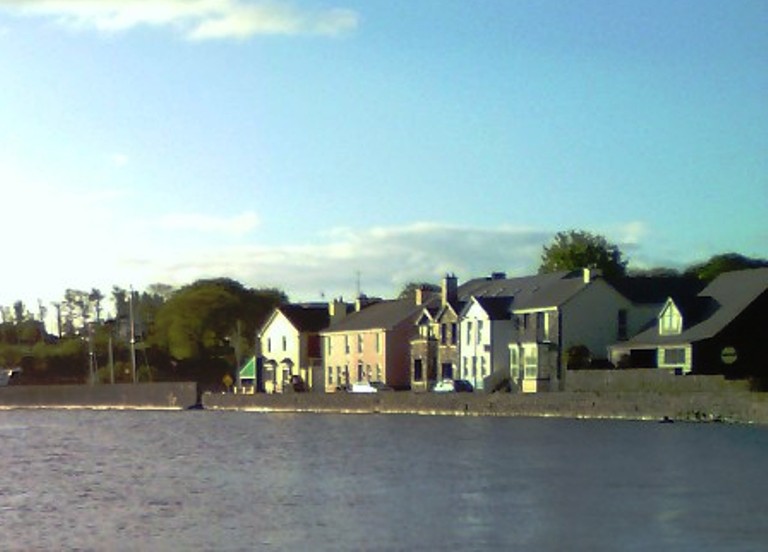
Kinvara  Photo: EO'D
Photo: EO’D

Galway County Council decided,on the proposition of Senator R. Lahiffe, to approach Bord Failte with a view towards; (a) giving a grant towards the building of a promenade along the convent road from the quays at Kinvara and the erection of a swimming pool opposite Seamount College; (b) giving a grant towards the development of the beach at Traught, Kinvara.

Posted in Posts and podcasts

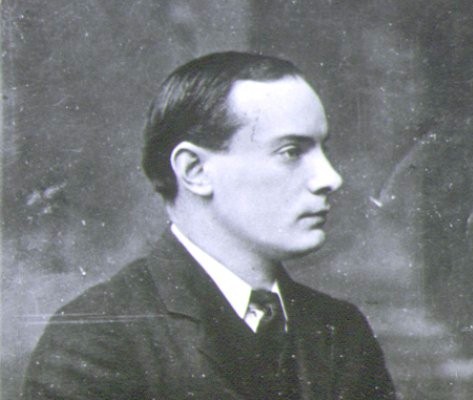
Patrick Pearse and the Kinvara hero – 1919

Tuam Herald 22nd February 1919 p.4

Patrick Pearse Wikimedia Commons
Patrick Pearse
Wikimedia Commons

(abridged)
Patrick Pearse was a barrister, but he may be said not to have practiced as he gave himself up to the work of education at which he was most successful. He once appeared in a Galway case. It was to defend the Kinvara Hero who, despite the law, persisted in having his name painted in Irish on his cart. The police prosecuted him and he was duly fined but he triumphed. Lady Gregory and Edward Martyn took up his case and Pearse ably fought it in the Dublin courts with the result that such stupid and silly prosecutions were abandoned and the brave Kinvara man, Bartley Hynes  became a hero in spite of himself.

Posted in Posts and podcasts

Kinvara Carnival – 1961

Connacht Tribune 24th June, 1961 p6

Kinvara G.A.A.
Kinvara G.A.A.

Kinvara’s Big Day
Sunday marks the opening of Kinvara Carnival which runs for three weeks and ends with the opening of the £3,500 Gaelic pitch which, with previous carnivals, it helps to pay for.
Begun three years ago this new pitch, the only enclosed playing pitch in the South Board area, requires only a successful carnival “run” to clear it of debt.
The Carnival opens on Sunday at Kinvara Pier at 5 p.m. when the Kinvara Dramatic Society arrives by boat and performs a pageant based on an adaptation of Lady Gregory’s “Rising of the Moon” by Mrs Thomas Donnellan, N.T. At the conclusion of the performance the Queen of the Pageant will be crowned and a fancy dress parade will take place through the streets of the town.
The dancing marquee is the main attraction of the Carnival and a Fancy Dress Ball will be held on Tuesday night, July 4th.
The new G.A.A. pitch will be formally opened on Sunday, July 16th when two games will be played, one between Fohenagh, 1960 County Champions, and Liam Mellowes.
The St. Patrick’s Brass Band, Galway, will be in attendance for the occasion.

Posted in Posts and podcasts

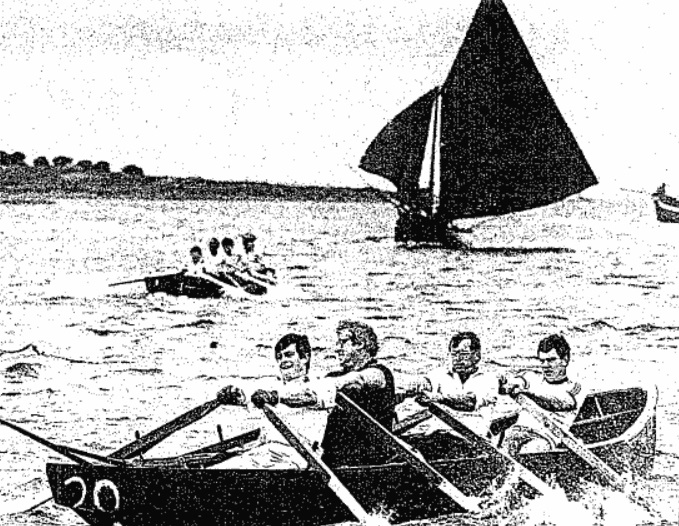
Cruinniú na mBád

Connacht Tribune 14th August, 1987 p.22

Photo: Connacht Tribune

(abridged)
For the curious there is a fascinating connection between Connemara badoirí and Kinvara Pier – pointed out by that brilliant Cruinniú organiser and founder, Tony Moylan.
Along the pier wall is a capping of concrete applied in the 19th century. Here and there in the concrete are footprints. The legend is that while the concrete was drying some boats of turf arrived from Connemara and the badoirí in clambering ashore sank their footwear in it.

Posted in Posts and podcasts

No turf in Kinvara – 1919

Connacht Tribune 23rd August, 1919 p.4

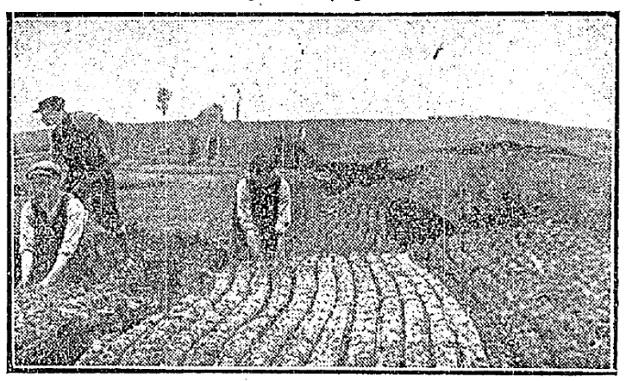
Photo: Irish Independent 2nd October, 1919.

Kinvara is presently suffering from a turf famine, which is attributed to a notice put up under the heading of “Kinvara Sinn Fein Club”, fixing the price, owing to the exorbitant prices hitherto paid for seven cart loads at £6. Turf sellers have decided not to bring any further supplies to the village until the price – hitherto £7 10s per six cart load – be fixed.

Posted in Posts and podcasts

Greene’s Hotel, Kinvara

Connacht Tribune 6th June 1975 p.29 (abridged)FREEN
After speaking at “The Crane”, Kinvara Maud Gonne McBride and Mary McSwiney came to the Greene’s hotel for refreshments. Apart from Dun Guaire, it is said to be both the oldest house and the oldest hostelry in Kinvara. Sean McBride stayed there for two weeks when trying to found the Clann na Poblachta Party. Michael Davitt addressed his Kinvara supporters from an upstairs window in the hotal.

Another caller was Patsy Conry (Padraic O Conaire) whose Asal Beag Dubh had Kinvara associations.  In 1848 John Dillon escaped capture via the Quay, Kinvara, steered by John Holland from Kinvara.

Nearby is a large warehouse which was once owned by Persse’s of Galway for storing their whiskey. John Greene remembers Baron de Basterot’s young son in Duras House. The locals persuaded the young lad to try standing “on his head” and while some praised him for his efforts, others made off with the coins that fell from his pockets. Across from Greene’s hotel is an old parish church and graves, one with a curious inscription:
James O’Farrell lies under this stone,
Pray for him ye Christians
To sin he was prone.

Posted in Posts and podcasts

Kinvara Fancy Dress – 1953

Connacht Tribune 25th April, 1953 p.21

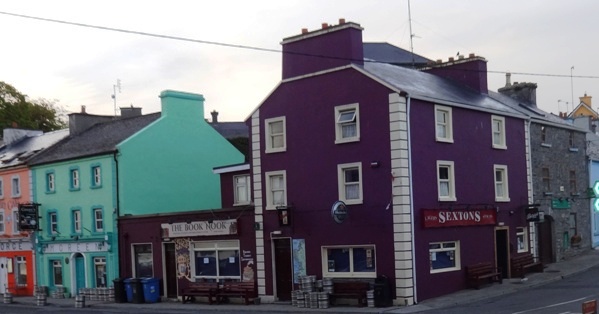
The Book Nook, Sextons Kinvara Photo: EO'D
The Book Nook, Sextons
Kinvara
Photo: EO’D

The south Galway genius for colourful characterisation has seldom been better displayed than at the Tostal Dance in Kinvara.
First prize went to Mr Sean Keane of Caherawoneen as “Ould Stock of Gort.” A humourous fantasy, “She’s too fat for me,” by Mr Toddy Byrne and Miss Carmel Sexton, both of Kinvara, took the second award, while Mr and Mrs Tom Doyle of Kinvara took third prize as “The National Pastimes,” with Mrs Doyle as a camogie player and Mr Doyle as a hurler.
Other costumes noted were “The Long Black Hand,” by Miss Martha Leech; “Sheriff O’Sullivan,” by Mr Kieran Moylan; “Sean-Padraig,” by Miss Mary McMahon; “Mr and Mrs O’Sullivan come to An Tostal,” by Mr Alfred Byrne and Mr Michael Connolly; and “The Ould Plaid Shawl,” by Miss Ann Flatley. Miss Dora Quinn was a fetching “Hula-Hula Girl.”

Posted in Posts and podcasts

The Stone Window – Kinvara – 1972

Connacht Tribune 8th September, 1972 p.17

Kinvara Quay Photo: EO'D
Kinvara Quay
Photo: EO’D

Until such time as a professional archaeologist pronounces on the fine stone window and doorway discovered last week at The Quay, Kinvara, there is nothing to dispel the rumours and opinions circulating concerning their origin.
Their discovery was made by workmen demolishing the first of the old buildings at The Quay, the beginning of the £250,000 housing scheme planned for the town by a private company.
The three-foot window is obviously a church window and it stands fifteen feet from the ground, directly above a stone doorway which is nine feet high. On top of the window are inscribed the figures 1782.
The question is; Where did this window come from? Did it come from St Coman’s Church in the centre of the town at the rear of the main cluster of houses? Were the window and doorway part of a clergyman’s residence in the 18th Century? If this residence was once a Protestant clergyman’s home – and there is a local opinion that a Protestant Bishop lived there – were the ornate stone window and doorway incorporated into the original building? Or were they added to the building having been taken from a nearby church?
The intention of the demolition men at present is to leave these monuments in situ. The discovery of the monuments opens up a vista into a forgotten portion of Kinvara heritage. There is a most interesting history attached to The Quay over which has been passed by Galway County Council for the erection of houses.
It would be a great pity if the once hallowed precincts were to disappear without proper recording under the new structures.