Geraldton Guardian 15th April, 1924
The Bishop of Galway in a speech advised the parents of wayward girls to ‘lay the lash across their backs.’ Referring to the shameful lack of chastity among youngsters he said; ‘I blame the girls themselves. They are not innocent and are not misled. Some of our Irish girls are becoming regular devils and a disgrace to the countywide. If it were not for the boys’ purity, there would be more scandals than now.’
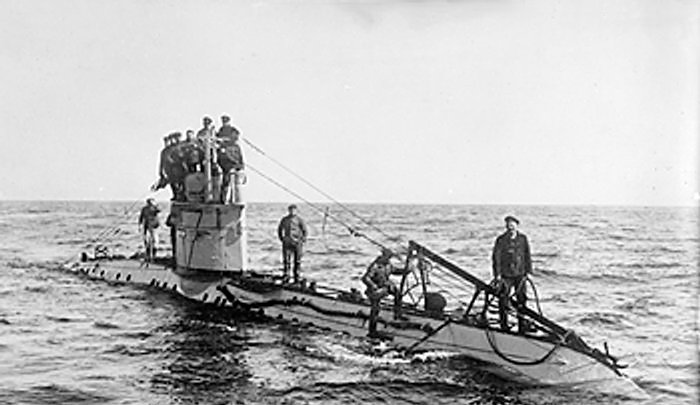
The crew of a German UC-1 class submarine on deck. wikimedia commons
The Advertiser 30th May, 1918
LATEST CABLE NEWS
MAROONED (abridged)
The Cork correspondent of the “Daily Chronicle” gives details of the arrest of a man who was put ashore from a German submarine and who is now in the Tower of London awaiting a court martial.
On April 13 near the cliffs of Moher, County Clare two fishermen noticed a man on a barren islet waving a handkerchief violently. When rowed ashore he said his name was O’Brien, and he was the survivor of a torpedoed ship. After he had been provided with food and clothing the authorities became suspicious. O’Brien was arrested and the police soon found that the torpedoing story was untrue. He had a good deal of English silver in his pockets. Moreover, a collapsible boat was found wrecked near the cliffs at Moher. Evidently the spy had landed on the islet at night, mistaking it for the mainland. He endeavored to destroy the boat and only discovered at daylight that he had marooned himself.
The Daily Express thus describes the Floating Hospital for Dublin which has been built by Messrs. Walpole, Webb, and Bewley, and which was launched on Saturday, November 8:
‘ The vessel, which has been, built in about the space of six weeks, is of rectangular shape, fifty- seven feet in length overall and twenty-eight feet broad. It is simple in appearance, very substantially built, and well suited to its purpose. A broad ladder is fastened to one end of the deck, which can be let down when required for the admission of patients. Another broad staircase leads from the deck, or, so to speak, the roof of the hospital, to the wards below, of which there are three, the vessel being divided into three compartments, which, by means of sliding doors, can be completely shut off from each other, if necessary. Each ward hold six beds, and might be made to hold more. There is at one end a kitchen and a nurses’ room. At the other is the surgery. The sides are devoted to stores and to various other minor details of construction. The height from the floor of the wards to the skylight, which runs along the centre of the upper deck or roof, is ten feet six inches. The general look of the floating hospital is cheerful and lightsome.
Sydney Chronicle 29th July 1848 p8 The Rock of Cashel
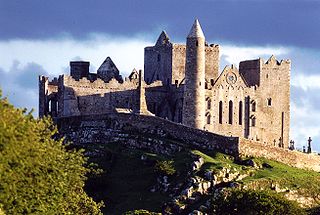
It is with much concern that we have received the intelligence of the fall of a portion of this time honored structure. On Wednesday last, at one o’clock, p. m., the tower, through which was the principal entrance, burst asunder, from top to bottom, and fell with a tremendous crash. Large masses of the building were precipitated down the hill to the very bottom. A crack had been perceived for many years in the tower, but no danger was apprehended. We regret to learn that much more of the noble fabric is in imminent danger and that its fall is certain unless active means be employed for its security. It would surely be a national disgrace if funds be not forthcoming to avert such a catstrophe of which not only antiquarians, but every Irishman, must deprecate the idea. The building fortunately still belongs to the See of Cashel, so that any works undertaken must be sanctioned by ecclesiastical authority.
There is said to be an old prophecy in Ireland. that when the Rock of Cashel falls, there will be a revolution in England.
The Grenfell Record and Lachlan District Advertiser 9th April, 1934 p4
GOLD COLLAR FOUND.
MADE 2500 YEARS AGO. (abridged)
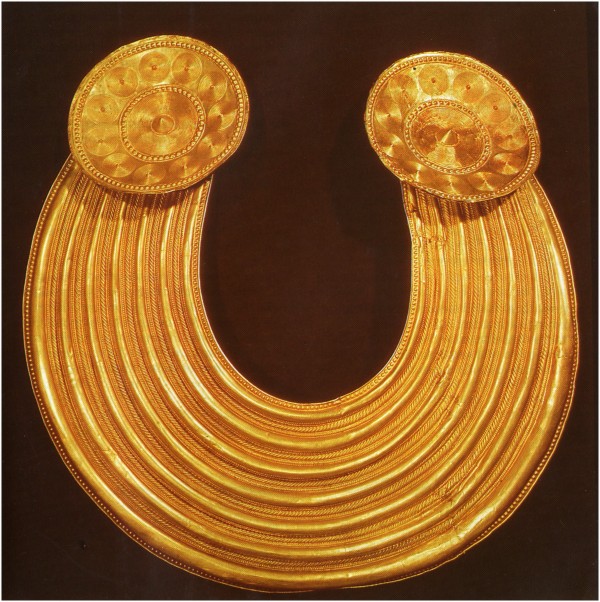
A collar of pure gold which is believed to have been made about 700 B.C., has been found at Burren, County Clare, says the ‘Manchester Guardian.’ The discoverer was a local farmer who noticed it glittering in a cleft of rock. The National Museum has claimed it as a treasure trove. Dr. Mahr, Keeper of Irish Antiquities in the National Museum, has confirmed the belief of its antiquity.
The type is well known, he said in an interview, and four similar ones are in the museum. Three were found in the area through which the Shannon flows. A fourth, like the one now discovered at Burren, has circular bosses and is believed to have been found in Armagh. Two collar’s containing bosses were found in the Rhine, near Worms, and these had probably been exported from Ireland in the middle of the last millennium B.C.
The Burren collar, or gorget, Dr. Mahr said, was the most beautiful find in Clare within the last thirty or forty years. Clare is famous for discovery. When the Limerick Ennis railway was being constructed in 1854 a large hoard was found near a stone fort at Megane, Ballykilty, Quin. Laborers removing a stone which was in their way uncovered a number of gold articles weighing about 160 ounces underneath. ‘Unfortunately, there was nobody to advise them,’ Dr. Mahr said, ‘as to how they should dispose of the articles, and they were mostly bought by local jewellers and melted down, to the great loss of Irish archaeology and kindred studies.’
Only thirteen of the articles reached the museum in Dublin, while about two dozen went to the British Museum.
The Catholic Press 6th January, 1921 p9
IRELAND’S SADDEST TRAGEDY.
Young Mother Shot by uniformed assassins. (abridged)
Mrs. Ellen Quinn, who was shot on November 1 while sitting on the lawn in front of her farmhouse at Kiltartan, Gort, bled to death the same night. She leaves three children, the eldest of whom is not yet four years old. Rev. Father Considine, C.C., Gort, wired Mr. Arthur Griffith, T.C., on November 2:
‘Woman within two months of childbirth,and holding a child in her arms was shot by Galway police here Monday evening. Died few hours afterwards. Have wired Greenwood.”
At the time of the shooting Mr. Quinn, who is a farmer, was away. A messenger, who went for the priest and doctor, broke the painful news to him. Another messenger going to Ardrahan for Dr. Foloy was, it is reported, wounded by a stray bullet. Uniformed men passed into Gort subsequently, firing shots. When the lorry passed the house where the dying woman lay the terror-stricken occupants fled by the back way.
Rev. Father Considine gave a Dublin ‘Freeman’s Journal’ correspondent who called on him a graphic description of Mrs. Quinn ‘s last moments.
“It is too awful, too inhuman, to contemplate.”
These were Father Considine’s opening remarks concerning the tragedy. Pressed to explain what occurred, Father Considine said:
“I have read of Turkish atrocities; I have read of the death of Jean of Arc; I have read of the sufferings of Nurse Cavell, and as I read those things I often felt my blood boil, and I often prayed that the good God might change the minds and the hearts of those cruel monsters. Little did I then dream that I should witness a tragedy, an atrocity more hideous, more revolting, more frightful, more brutal, more cruel than any of those things, and here in our own little peaceful parish of Gort. My God, it is awful!
“About 3 o’clock on Monday, November 1, Malachy Quinn, weeping bitterly, called for me. ‘Father said he, ‘I have just heard that my wife has been shot. Will you run down immediately.’
I procured a motor car, and hurried to the scene. At the gateway there we beheld a large pool of blood. In the yard another pool, and the porch leading to the kitchen was covered with blood.
I entered the room. Oh God! What a sight! There lay the poor woman, the blood oozing out through her clothes. She turned her eyes towards me and said:
‘Oh, Father John, I have been shot.’
‘Shot!’ I exclaimed.
‘Yes,’ she replied.
‘By whom?’ I asked.
‘Police,’ she answered.
‘By police?’ ‘Yes,’ she replied, emphatically.
‘Did you see them?’
‘Yes.’
‘Where?’
‘On a lorry.’
‘How many lorries?’
‘Two.’
‘From which lorry did the shot come?’
‘From the first.’
Photo: Juni Wikimedia Commons
She then became weaker, Father Considine explained, and on rallying exclaimed:
‘Father John, will you do something for me?’
‘I tried to console her,’ he explained, ‘ and administered the Last Sacrament. When I had finished she whispered to me’:
‘Bring me Malachy, bring him to me, I hear him crying. I have something to tell him.”
I did so. What a scene. Then she became weak and fainted off. Gradually she became worse.
I sent word immediately to the Head Constable at Gort. He arrived with police and military. All seemed shocked at the tragedy. I asked him to go in and see the woman. He and his men felt the trial too much, as he answered, ‘I cannot.’
No trace of the bullet could be found.’
Continuing, Father Considine said Mrs. Quiiin was sitting on the lawn with her child when the lorry passed from which the fatal shot was fired. The bullet pierced the stomach, and the child she was holding fell from her arms. She crawled over the wall into the yard, and then crawled to the porch to tell her servant that she was shot.
‘Take in the little children!’ she exclaimed. ‘I’m Done! I’m Done!’
From 3 o’clock to 10.30 she lingered on in pain. Occasionally she would clasp my hand, pull me towards her, and say, ‘I’m done! I’m done!’ At 10.30 her condition became worse, and we knelt by her bedside to recite the Rosary and Prayers for the Dying, She tried to join, but was too weak. At 10.45 the little children began to cry, and with them the crowded house burst into tears. As I read the last prayer of the Ritual she looked around, then closed her eyes and died.
My God! what Turkish atrocity ever equalled this?
‘That morning,’ said Father Considine, ‘I had a note from her asking me to offer Mass for her deceased friends. Little did she dream tnat prayers for the repose of her soul would be asked for today from the altar?”
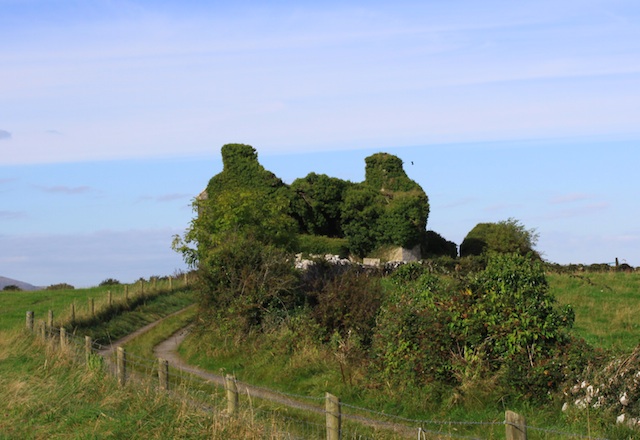
Foy’s Hill, Kinvara Photo: Norma ScheibeEpidemic Diseases of the Great Famine
Published in 18th–19th – Century
History, Features, Issue 1 (Spring 1996), The Famine, Volume 4 (abridged)
In December 1846, the board of health in Drumkeeran, County Leitrim, resolved to hire a house for use as a fever hospital, there being no such institution within a radius of eighteen miles. The proposal caused ‘inconceivable alarm’ in the town. Sixty-two of the residents, including merchants, shopkeepers, tradesmen, labourers, publicans, and householders, as well as Pat Gallaher, the schoolmaster, addressed a memorial to the Lord Lieutenant, objecting to the establishment of a fever hospital in the centre of the town. They stated that they were not so much opposed to the institution, as to its location.
A rather similar appeal was made by the residents of Kinvarra, County Galway, in July 1847. They claimed that the imminent opening of a fever hospital in the town placed their lives and those of their families in ‘the greatest peril’. They argued that the chosen site was too close to the town, that it either adjoined or was within eight feet of a range of houses occupied by some 300 individuals and was no more than sixty yards from the town centre.
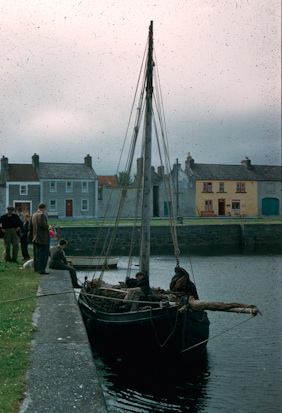
Kinvara Harbour c1950 Cresswell archivesOamaru Mail, Volume XXVIII, Issue 8273, 31 August 1903, Page 4
THE TWO IRELANDS
(By Filson Young, in the London Daily Mail.)
Donegal, August 17. (abridged)
There are two Irelands, one of smiling, one of miserable, aspect. The first is known to the many, the second to the few; the first greets the tourist at every turn, the second is discovered only by those who leave the beaten tracks, and, travelling far from the railways and even from the roads, come face to face with the naked life of mountain, bog, and shore. And the first is exploited and displayed, while the second is hidden.
There are some very simple facts about Ireland which at this moment cannot be too widely known. Before facing the dark side, let us dispose of the first, the prosperous Ireland, which, standing as it does in the foreground of the picture, obscures the view and interrupts the attention of those who think they have seen the country.
To say that it is a strip of Ireland’s eastern seaboard that is prosperous, is only one, and an imperfect way of stating the case. It would be nearer the mark to say that what we take for prosperity in Ireland is but the stir and bustle of market-places that exist only by virtue of their proximity to Europe. In the eastern seaports we find this stir and bustle. In the western, never.
Beyond earshot of bustling centres of artificial trade you are enfolded by the stillness and emptiness of rural Ireland. The green fields sleep in the sun. Empty cabins proclaim from their boarded-up windows – a thousand tragedies of failure and departure. It is a silent and vacant country.
Into the stately waterways of Cork, of Galway, of Limerick, the sea twice a day comes brimming up, filling with its inexhaustible flood the spaces between the imposing empty warehouses. The beautiful buildings, raised when Ireland had a population and a trade, are crumbling and deserted great chambers. These western ports, so nobly furnished by nature, and by man, so entirely unvisited, save by the punctual tides, are imposing monuments of a decay that is vast and complete.
Never a tide rises but it carries away with it something priceless, vital, irreplaceable — the life of the country. And even away from the great ruinous ports along a coast unmatched in the world for its bays and inlets and roadsteads, you may note the blight of desolation and mark the sea’s revenges.
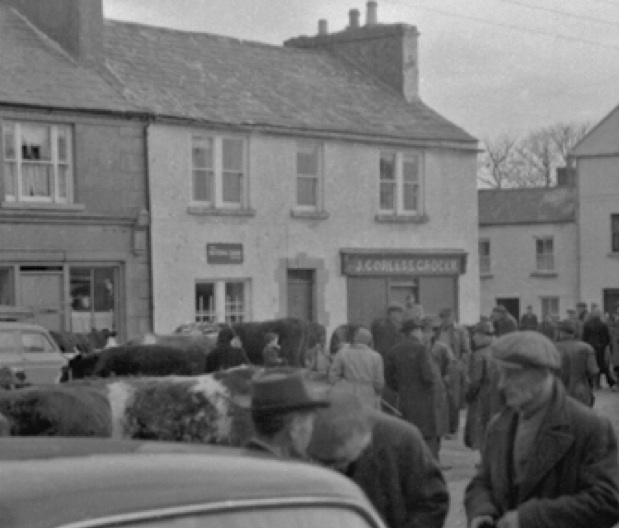
Corless, Grocers Kinvara Photo: Creswell ArchivesConnaught Tribune 1911
On friday fortnight Mr Thomas P. Corless D.C. President of Kinvara United Irish League, was evicted out of his holding at Crehaun, Kinvara, in pursuance of an order made by Judge Gibson at the recent Spring Assizes setting aside a deed purchasing the tenants’ interest and goodwill as far back as October. Suffice it to say the eviction was part of a huge conspiracy to ruin a man for openly identifying himself with the National cause.
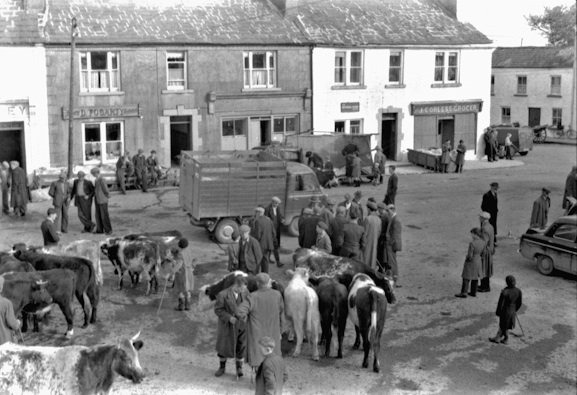
The Square, Kinvara c. 1950 Cresswell ArchivesThe Moreton Bay Courier 3rd March 1849 p4 (abridged)
An encounter took place on Monday between a detachent of the 4th Light Dragoons, forty in number, and a body of people from Kinvarra.
The soldiers, assisted by fifty-six policemen, were out collecting poor-rates, or rather seizing corn in default of payment. They went on until they came to the district they were to distrain on, when a barricade, partly formed, met their view, protected by about 300 men and women. They refused to let the armed force pass and said they would rather sacrifice their lives. The Riot Act was read three times, and still they would not give way.
The police and soldiers were ordered to charge with bayonets. Stones were thrown and some of the men severely hurt. The police drove the people a quarter of a mile into the fields, but they were quickly back again to the scene of the action. Mr Davys, the magistrate, did not wish to shed blood by ordering the military to fire, and, it being late in the day, he directed them to turn round and proceed home.
Much praise is due to this forbearance of the authorities, as there is no doubt but much blood would have been shed. Of course there will be a greater force brought down there in some few days.



 The Burren and Beyond