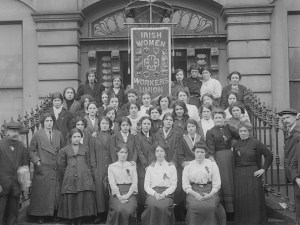
Members of the Irish Women Worker’s Union on the steps of Liberty Hall c. 1914 National Library of Ireland.
During the next three weeks the nation will be called upon to exercise the most momentous duty which can fall to the lot of citizens, viz., the choice of Parliamentary representatives who shall guide the destinies of the men and women of the country.
Vital interests are involved in the coming struggle, but the question of greatest importance which concerns all sections and all parties (for it deals with special needs of the larger portion of the nation) is the demand for the removal of the political disabilities of women. We trust this is the last General Election at which women will have to stand outside the pale of citizenship.
The Women’s Franchise League most strongly and earnestly appeals to all lovers of justice and freedom to use every effort during this election for the removal of the disabilities which press so heavily on the women of this nation.
Ursula M. Bright, Hon, Sec.
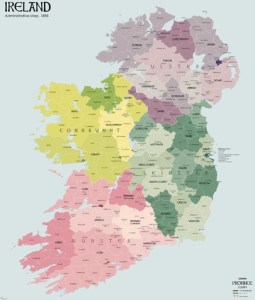
Administrative map of Ireland following the Local Government (Ireland) Act, 1898. Wikimedia Commons: XrysD
The forthcoming municipal elections in Galway promise to be unusually interesting, the Labour Party, as well as the Women’s Franchise League, have entered the lists, and some interesting developments are looked forward to.
A meeting was held on Sunday, Mr. M. Tannian presiding.
Present:
Messrs J.J. Daly
Thos. Higgins
F. Kilcooly
P. Casey
J. Harte
P. Callanan
J. Doyle
P. Lambert.
The following were appointed to attend the Home Rule meeting in Galway;
Messrs P. Lambert; P. Casey; P. Callinan; J. Daly.
The following resolution was proposed by Mr. J. J. Daly, seconded by Mr. J. Harte; That we condemn the action of any person who will put cattle on any obnoxious land in the parish until all concerned get fair play, as well as the other people of the parish.
The resolution, after a long and heated discussion, was passed, some being of opinion that no one in the parish is violating the rules of the branch, while others thought differently. Next meeting as usual.
The Rev. J.B., formerly a clergyman of the Catholic church, stationed at Kinvarra, County Galway, and now a professing Protestant, was placed in the dock and given in charge to the jury, indicted for having administered an illegal oath to one M.H., that she would not tell any person to whom a certain child belonged until he gave her leave; and on a second count for having tendered another oath to one P.T., an apothecary, to the effect that he would not divulge the situation which his wife was in.
The prisoner, a rather young countenanced person, pleaded not guilty. This case appeared to excite intense interest, particularly among the Protestant clergymen, a large concourse of whom swarmed about the clock, and were in frequent communication with the prisoner’s counsel.
Messrs. French, Q.C., Ellis, Baker, and Mathew Atkinson, prosecuted on the part of the crown; and the prisoner was defended by Messrs Walter Burke and Charles Granby Burke.
Mr W. Bourke applied to the court that the prisoner should be allowed to sit at the side bar with his counsel.
Baron Lefroy: As the charge is one of felony, no distinction can be made. The prisoner must take his place in the dock.
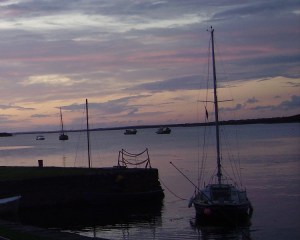
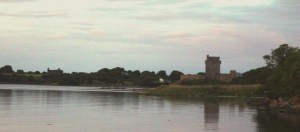
Kinvara Sunset Photo: EO’D
The prisoner was then put into the dock, and walked up to the front bar, apparently very much excited and embarrassed. M.H. was the first witness produced. She deposed on her examination by Mr. French, Q.C. to the following effect; I know the prisoner, whom I saw in the month of May last, at his own house in Kinvarra; I am a nurse tender and for the last twelve years I practiced midwifery; the Rev. M.B. employed me to attend his wife who was pregnant; I did attend her, and she was delivered of a boy; that child is now dead; I saw the prisoner after his wife was delivered, and also subsequent to the death of his child; he desired me not to tell whose was the child until he gave me permission; that is all he told me.
Mr. French Q.C: Did he require you to make any asseveration?
Mr. W. Bourke objected to this question, and directed the witness not to attempt answering it.
Baron Lefroy: In strictness, Mr. French, that is a leading question. In what manner did the prisoner direct you not to tell about the child?
Witness: that is all the manner.
Kinvara Sunset Photo: EO’D
Mr. C.G.Bourke submitted, as witness had already repeatedly answered the question, the counsel for the crown had no right to press her further.
Mr. French, Q.C: Pray, madam, when the prisoner required you to keep this secret about this child did he produce a book?
Witness: What if he did; I see a great many books about me here.
Mr. French, Q.C: It is quite clear that that wretched woman has been bought over. In the information taken before Charles Wallace, R. Gregory, Francis Butler, James Daly and J.B. Kilmain Esqrs, this witness swore that on Saturday, the 11th day of May last, the Rev.J.B, at Castlelodge Kinvara,did feloniously and unlawfully administer to her a certain oath or engagement upon a book, importing to bind her to secrecy and “not to communicate to any person the birth of his child, who was born on the midday of Saturday, the 11th of May last, in the dwelling house of the said Rev. J.B. of Castlelodge, but to conceal the birth thereof, against the form of the statute in that case made and provided.”
Patrick Taaffe examined by Mr. Ellis: I know the prisoner, he resides within a quarter of a mile of Kinvarra, County Galway; I recollect that on the 8th May he called on me to attend his wife; I did so and bled her; nothing more occurred on that day, but on the following morning I found her unwell with inflammation of the stomach; she was pregnant; before I went into her room Mr. B. brought me into an adjoining room, and said that as an old acquaintance he would rely on anything I would promise, but that Mrs B would not be satisfied unless I swore to conceal the situation in which she then was; I told him that as a medical man I would, of course, keep professional secrets, but that I would take no oath; he then put his hand in his pocket, and taking out a bible he laid it on the table and said, “there is the book, and take your oath.” I was of course displeased, and I tole him that if he had not confidence in my keeping a professional secret without taking an oath, he should get some other person to attend his wife; I then left him, he first apologising; he did not ask me more than once to take my oath at that time; when I saw his wife on Saturday she was in labour; I know M. H; I did not see her there then.
Kinvara Sunset Photo: EO’D
After a very severe and searching cross-examination by Mr.W.Bourke, Baron Lefroy asked the witness, if at the time the prisoner asked him to swear to the keeping of the condition of his wife’s secret, he had produced the bible? The witness replied that the prisoner first spoke about the matter, and afterwards produced the book from under his coat, saying, there take your oath, and said nothing more.
Mr. W. Bourke; Now, my lord, that being the case, I respectfully call upon your lordship to direct the acquittal. There has been no oath, much less evidence, of its having been tendered.
Baron Lefroy: As the prisoner did not actually tender the oath, after producing the book, the offence, in law, cannot be sustained, and I must direct a verdict of acquittal.
The jury then filled up the issue paper, returning a verdict of not guilty, according to his lordship’s directions.
On leaving the dock the prisoner was warmly greeted by a number of Protestant clergymen who took him under their protection. He shook hands with the first witness most heartily and said he thanked her sincerely. The crowd who thronged the court-house was very much excited at the result.
Tuam, August, 27, 1847 Dear Sir, When your kind invitation to the Galway dinner,in honour of the triumphant candidates for Repeal, reached me, I could not either attend or send my apology. This I regretted much, sympathising most cordially with the object of the festivity. You will not, then, I am sure, put my silence to the account of indifference to the respected invitation with which I have been honoured by the patriotic men of Galway. Had I been at home, I should have made an effort to be present on the interesting occasion, both to show my respect for the individuals returned, and my zeal for the cause which they personified. The town has made some atonement for the shameful apathy with which the enemies of Ireland’s only chance of prosperity, were permitted to walk over the course in the county of Galway. They may thank the more sacred duties that entirely absorb the attention of those who would not have been indifferent to the calls of their country for the protection of a native legislature. However, before the recurrence of a similar period, it is well that candidates should be impressed with the conviction that they can entertain no hope of representing Galway, unless they associate themselves with the noble national phalanx, who have proved that Repeal, far from being a chimera, is one of those lofty, enduring, and growing aspirations, which cannot be appeased except by the enjoyment of that legitimate freedom for which it is panting. Believe me, my dear Sir, your very faithful servant,
John Archbishop of Tuam.
Martin Geoghegan, Esq., & c., High Street, Galway.
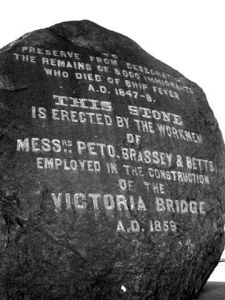
It will be in the recollection of many of our readers that during the famine years of 1847 and 1848 there was an unusual emigration from Ireland to Canada and the United States. Numbers of those who thus left their native land expired from ship fever, caused by utter exhaustion, before they reached the American continent; others only arrived there to die of that fatal disease. The Canadian government made very extensive efforts to save the lives of the poor emigrants. A large proportion were spared, but at Montreal, where the government erected temporary hospitals on a gigantic scale, upwards of 6,000 of these poor emigrant people expired. Their remains were interred close to the hospitals, at a spot that is now mainly covered with railway buildings, and in close proximity to the point whence the Victoria bridge projects into the St. Lawrence. All traces of the sad events of that disastrous period would have been obliterated but for the warm and reverential impulse of Mr. James Hodges, the engineer and representative of Messrs. Peto, Brassey and Betts, in Canada. Through his instrumentality and by his encouragement the workmen at the bridge came to the determination, infinitely to their honour, of erecting a monument on the spot where the poor Irish emigrants were interned. An enormous granite boulder, or a rough conical shape, weighing 30 tons, was dug up in the vicinity, and on the 1st instant it was placed on a base of cut stone masonry twelve feet square by six feet high. The stone bears the following inscription:
To preserve from desecration the remains of 6,000 emigrants who died from ship fever in 1847 and 1848, this monument is erected by workmen in the employment of Messrs Peto, Brassey, and Betts, engaged in the construction of the Victoria Bridge, 1859.
Several addresses were delivered on the occasion, and in the course of that made by the Bishop of Montreal he alluded in feeling terms to the many good deeds for which the name of his friend, Mr. James Hodges, will be gratefully remembered in Canada, the last of which was the event they were then commemorating. Thanks to him, the plot of ground on which the memorial is raised is set apart forever; so that the remains of the poor emigrants lying interred there will henceforward be preserved from all or any irreverent usage.
Supplement to the Cork Examiner, 18th November, 1899
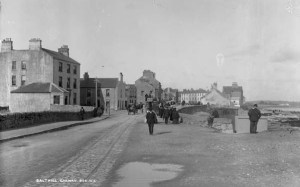
Kinvara c.1950 Photo: Cresswell archives
The finest scenery in Ireland is on the northwest coasts of Connemara, Mayo and Donegal. There are no grander headlands in Europe than these broken, precipitous highland masses towering above the Atlantic.
Galway is the gateway leading into this picturesque region with its invigorating climate. A magnificent seawall leads to it from Loop Head, at the mouth of the Shannon, with the glorious cliffs of Moher midway. Galway Bay is the outlet for a chain of lakes with which the highlands of Connemara are riddled; and the coast is mountainous, with a succession of many-coloured precipices and countless islands all the way from Clifden to Achill Head, where the Croaghaun cliffs are nearly 2,200 feet above the sea and thence along Mayo to Slieve League and the rock-bound highlands of Donegal. In picturesque colouring, grandeur, primeval wildness and elemental power there are few coasts that bear comparison with the north-western outstretch of Ireland.
Kinvara c.1950 Photo: Cresswell archives
Galway town is quaint and beautiful, and its charm of local colour comes from a strain of Spanish blood. For centuries it was a port commanding a large trade with Spain, and its merchants and sailors were constantly visiting and there were frequent marriages. While it was not Spanish in origin and attracted few settlers from the South, its architecture, gardens, manners and life were coloured by its associations with the more tropical country. The course of modern improvement has not been so rapid as to obliterate these traces of Spanish taste. While the town is not laid out with the regularity of a chess board, there is a central square or garden where the women are on parade on Sunday afternoon, and many of them have olive skins and coal black eyes and hair. They have the same love of colour which fascinate Spanish women, and are brighter and gayer in dress than the Irish girls of Limerick, Dublin or Cork.
The houses are also painted or kalsomined in pink, blue, yellow and white, so that there is a garish display of colour even in a quiet street like Prospect Hill leading into green meadows. Neglected as the old houses with their central courts and wide entries and stairways have been, Galway still contains many of the distinctive features of a Spanish town.
Kinvara c.1950 Photo: Cresswell archives
The Lynch mansion even in its present state of dilapidation goes far to support the composite reputation of this Irish Spanish port. This stronghold of a powerful family has degenerated into a chandler’s shop, but the medallions on the side, the decorated doorways and windows, and the grotesque heads near the cornice attest its foreigh character; and the Lynch stone on the crumbling wall behind St. Nicholas’s Church perpetuates the grim sense of justice of its most famous tenant. James Lynch Fitzstephen, wine merchant and Mayor, was in Spain about the time America was discovered and invited the son of one of his friends to return with him to Galway for a visit. The guest flirted with the Irish girls, and was finally stabbed one night in the streets by a jealous rival. The murderer was the Mayor’s only son, who confessed his crime in an agony of remorse. The father, encouraged by this violation of hospitality, condemned his guilty son to death, and with his own hand conducted the execution, either from his own castle or opposite the church. The Lynch stone commemorates this act of stern, unbending justice, and with skull and bones rudely sculptured enforces the quaint inscription;
“Remember Deathe Vaniti and al is but Vaniti.”
He will not come, and still I wait.
He whistles at another gate
Where angels listen. Ah I know
He will not come, yet if I go
How shall I know he did not pass
barefooted in the flowery grass?
The moon leans on one silver horn
Above the silhouettes of morn,
And from their nest-sills finches whistle
Or stooping pluck the downy thistle.
How is the morn so gay and fair
Without his whistling in its air?
The world is calling, I must go.
How shall I know he did not pass
Barefooted in the shining grass? A Little Boy In The Morning – Francis Ledwidge
Latest details of the important mineral discovery in Clare disclose that phosphate was first found in lead by Mr.Comyn about 8 years ago, in the old silver mine at Ailwee, Burren. After extensive prospecting work the phosphate bed was located between two layers of shale on the same ridge of hills which contained the Ailwee mine. The bed extended originally as far as the line near the Galway border but half of it has been scraped away by glacial action.
Mr. Comyn has acquired the mining rights and has opened the mines. Pending the arrival of machinery to crush the rock, the powdered phosphate on the margin is worked. At the invitation of Mr. Comyn the Department sent an eminent geologist, Mr. Farrington, to examine the deposit. The Department points out that the report of the interview with reference to the discovery in Saturday’s “Irish Independent” is inaccurate as far as the allusion to mining rights is concerned, as no reference to this subject was made.
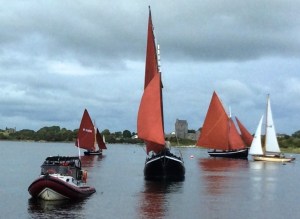
BBC (Bristol) have been in touch with the committee of Kinvara’s Cruinniú na mBád concerning the making of another film of that colourful traditional boat festival. Last autumn the BBC showed a half-hour long film made during the 1986 Cruinniú and their audience research revealed a very positive reaction.
The tenth Cruinniú to be held in August 1988 will not, as in previous years, be held early in the month. The reason for that is that the times for high-tide at the weekends in early August are particularly inconvenient for the traditional format of the three day event. Therefore, the committee had no option but to put it back to the last weekend of the month.

 The Burren and Beyond