An Irish magistrate, referring to a report that the crew of a sailing ship lived for a month on beans cooked in sea water and were only prevented by rain from perishng of thirst, tells of an earlier incident which, he thinks, may be useful, as it shows the value of oatmeal under similar circumstances.
About 20 years ago a small vessel, manned by four men, was carried north almost as far as Iceland while trying to reach Galway. It was some weeks before they finally made Lough Swilly, where they drifted ashore. The captain had to account for the loss of his vessel before a magistrate. He said he believed the crew would have perished but for a bag of oatmeal among the provisions. Oatmeal requires salt, and they made porridge with salt water, a wholesome and palatable food that served both as food and drink.
Messrs Dillon, O’Brien, Harris and Sheehy, all Irish members of Parliament, were arrested by the police yesterday at Loughrea near Galway, while presiding over a committee for collection of rents, under the plan of campaign promulgated by the United Ireland newspaper.
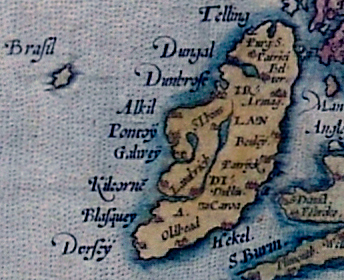
Ireland as depicted on the 1572 map of Europe by Abraham Ortelius. Interesting are the prominent featuring of St. Patrick’s Purgatory and the curious island of Brasil. Wikimedia CommonsNew Zealand Tablet, Volume VII, Issue 327, 25 July 1879, Page 17
At a recent meeting of the Royal Dublin Society Dr. W. Frazer exhibited a copy of Tassin’s maps of the fortified towns of France, which was additionally interesting by its containing several original plans drawn by Tassin and bird’s-eye views of Casal and Evreux. It also contained a manuscript map of the opposite coasts of France and Britain, apparantly of the most scrupulous accuracy, and a Chart ot the Islands and Maritime Coasts of Europe, in which is to be seen the route and navigation of the Hollanders by the north of Ireland and Scotland during the wars with the English for the German Ocean.
The course is laid down from Holland along the Norwegian coasts then passes between Fair Island and Foula. It then continues along the western coast of Ireland passing Brazil, which is laid down much in the position now ascertamed to be occupied by the Porcupine Bank and hence the course continues direct to Rochelle.
This map is evidently no fanciful sketch. Every sailing point and headland has been skilfully laid down, either by one who has passed over the track itself, or by one who compiled it from most competent authority, and this at a time when no British ships appear to have sailed over these western seas, though we know that the Dutch and French sailors almost daily did.
The probable date of the unpublished and apparently unique work is 1640. This copy appears to be in the very handwriting of Tassin himself, who was geographer to the King, and it would, indeed, appear most probable that Brazil did, as an island, at this or about this time, hold its head over the waters of the North Atlantic Ocean, though over its site, and after a lapse of more than two centuries, those very waters, to the depth of from 80 to 100 fathoms, now roll.
The evidence, then, would be in favour of Brazil having existed as an island off the entrance to Galway Bay in A.D. 1640, or thereabout, and of its having gradually subsided into the bosom of the ocean.
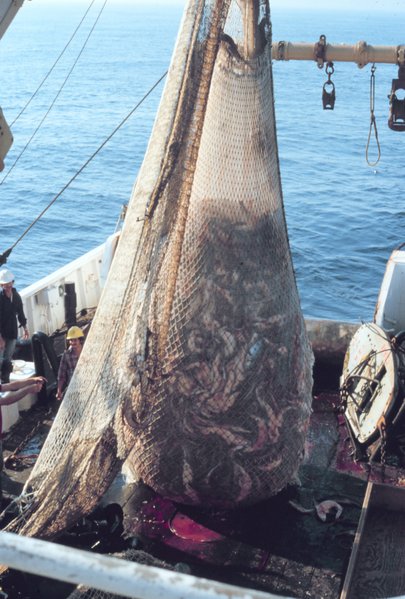
Trawl Net U.S. National Oceanic and Atmospheric Administration, Wikimedia Commons
New Zealand Tablet, Volume XXIV, Issue 4, 22 May 1896, Page 4
Special court was held in Galway for the purpose of trying the charges of illegal fishing preferred against the masters of two steam trawlers seized by a gunboat in Galway Bayfor illegal fishing etc.
The presiding magistrates were Messrs J O. Gardiner, P. M. and M. A. Lynch JP. The prosecution was carried on by Mr Underdown, head of the Customs, and the Inspectors of Fisheries, on whose behalf Messrs Blake and Kenny, solicitors, appeared. The defendants, J. T. Wales, of the trawler Traiton, and John Pettit, of the trawler General Roberts, were represented by Mr Gerald Clonerty, solicitor.
It appears that in the absence of Mr Pinkerton, Mr John Dillon put a question in Parliament which brought about the sending of a gunboat to watch illegal fishing in Galway Bay. Many complaints had been made by Claddaghmen of their boats being nearly run down by steam trawlers fishing the bay in the night time contrary to the fishery regulations.
The very first night the gunboat arrived in the bay the defendants’ vessels were seized. They were each fined £5 and costs for fishing within the prohibited limits, and £25 and costs for steaming about and trawling without having their lights on as prescribed by the bye-laws. Both vessels were from Milford Haven.
Freemans Journal 28th December 1859 p3 (abridged) As an evidence of the confidence entertained by the people in the Galway Steam Packet Company, a child about four or five years of age was sent here from Limerick by the coach, labelled and directed “Passenger to America, care of William H. Butler, Esq”. This child was at once taken up by Mr Butler, well cared for and, as the vessel was about to proceed to sea, delivered up to a respectable family who will take care of this young emigrant until the arrival of the vessel in America, where friends will be met to claim it.
Shortly before the sailing of the ship, Captain Thompson, the superintendent, and Mr Butler went on board to inquire of the passengers whether they had any complaints to make or fault to find, but all expressed themselves highly pleased with their position. The mails taken out by the Circassian were heavier than on any previous occasion.
The Galway Freemen Disfranchisement Bill is likely to prove an exceedingly inconvenient and unpleasant measure to its originators and backers. There can be no doubt whatever that glaring and scandalous corruption existed in Galway, especially amongst the freemen, many of whom were accustomed on every occasion of an election to let themselves openly to the highest bidder.
The ostensible object of the Bill is to punish this corrupt abuse of political privileges. It is supposed that its supporters, (amongst whom are the very parties who practised and profited by bribery and corruption in Galway), have other motives for their exertions besides a new-born zeal for public morality. The House of Commons accepts their zeal for what it may be worth, and puts to them a very simple but effective test.
As it is equally a crime to buy as to sell votes, the House has determined that, while the ignorant and needy freeman is visited with just punishment, the wealthy and educated briber shall not come off scot-free. They shall not be rewarded for success in debauching a constituency to gain their party triumph.
Geraldton Guardian 15th April, 1924
The Bishop of Galway in a speech advised the parents of wayward girls to ‘lay the lash across their backs.’ Referring to the shameful lack of chastity among youngsters he said; ‘I blame the girls themselves. They are not innocent and are not misled. Some of our Irish girls are becoming regular devils and a disgrace to the countywide. If it were not for the boys’ purity, there would be more scandals than now.’
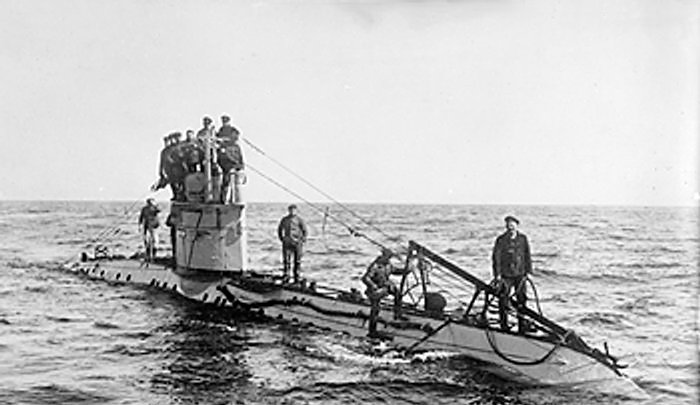
The crew of a German UC-1 class submarine on deck. wikimedia commons
The Advertiser 30th May, 1918
LATEST CABLE NEWS
MAROONED (abridged)
The Cork correspondent of the “Daily Chronicle” gives details of the arrest of a man who was put ashore from a German submarine and who is now in the Tower of London awaiting a court martial.
On April 13 near the cliffs of Moher, County Clare two fishermen noticed a man on a barren islet waving a handkerchief violently. When rowed ashore he said his name was O’Brien, and he was the survivor of a torpedoed ship. After he had been provided with food and clothing the authorities became suspicious. O’Brien was arrested and the police soon found that the torpedoing story was untrue. He had a good deal of English silver in his pockets. Moreover, a collapsible boat was found wrecked near the cliffs at Moher. Evidently the spy had landed on the islet at night, mistaking it for the mainland. He endeavored to destroy the boat and only discovered at daylight that he had marooned himself.
The Daily Express thus describes the Floating Hospital for Dublin which has been built by Messrs. Walpole, Webb, and Bewley, and which was launched on Saturday, November 8:
‘ The vessel, which has been, built in about the space of six weeks, is of rectangular shape, fifty- seven feet in length overall and twenty-eight feet broad. It is simple in appearance, very substantially built, and well suited to its purpose. A broad ladder is fastened to one end of the deck, which can be let down when required for the admission of patients. Another broad staircase leads from the deck, or, so to speak, the roof of the hospital, to the wards below, of which there are three, the vessel being divided into three compartments, which, by means of sliding doors, can be completely shut off from each other, if necessary. Each ward hold six beds, and might be made to hold more. There is at one end a kitchen and a nurses’ room. At the other is the surgery. The sides are devoted to stores and to various other minor details of construction. The height from the floor of the wards to the skylight, which runs along the centre of the upper deck or roof, is ten feet six inches. The general look of the floating hospital is cheerful and lightsome.
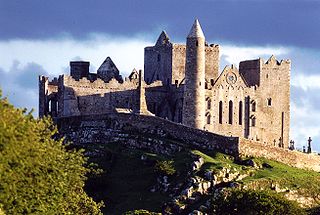
Sydney Chronicle 29th July 1848 p8 The Rock of Cashel
It is with much concern that we have received the intelligence of the fall of a portion of this time honored structure. On Wednesday last, at one o’clock, p. m., the tower, through which was the principal entrance, burst asunder, from top to bottom, and fell with a tremendous crash. Large masses of the building were precipitated down the hill to the very bottom. A crack had been perceived for many years in the tower, but no danger was apprehended. We regret to learn that much more of the noble fabric is in imminent danger and that its fall is certain unless active means be employed for its security. It would surely be a national disgrace if funds be not forthcoming to avert such a catstrophe of which not only antiquarians, but every Irishman, must deprecate the idea. The building fortunately still belongs to the See of Cashel, so that any works undertaken must be sanctioned by ecclesiastical authority.
There is said to be an old prophecy in Ireland. that when the Rock of Cashel falls, there will be a revolution in England.



 The Burren and Beyond