Posted in Posts and podcasts

Kinvara Handcraft Co-op – 1968

Connacht Tribune 20th September, 1968 p.7
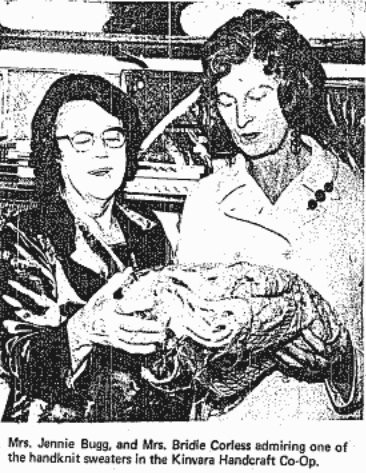
 Photo: Connacht Tribune 24th September, 1971 p.5

Photo: Connacht Tribune 24th September, 1971 p.5

The first meeting of the shareholders of the Kinvara Handcraft Co-op was held in Kinvara recently. There are 139 shareholders who hold twenty shares at £1 each.
The steering committee outlined the steps taken to date and surveyed the possibilities which lay ahead. Mr. John Tobin, I.A.O.S. addressed the meeting and spoke highly of the great response to a worthwhile idea. He went on to say that he had no doubt but that with continued local co-operation and shrewd management this venture would be an asset not alone to Kinvara but to a broad hinterland in South Galway and North Clare. By encouraging the growth of the handcraft industry and by taking viable steps to promote agriculture and tourism, this Co-operative could very well be a boon to the economy of the area.
Rev. Fr. C. O’Connor, C.C., presiding chairman, thanked Mr. Tobin and all who had contributed to the initial development.
The following management committee was elected who at their first subsequent meeting elected the officers:
Very Rev. B. Mulkerrins, P.P. (Patron);
Rev. C. O’Connor, C.C. (Chairman);
Mr. Sean McMahon, N.T. (Vice-chairman);
Mr. Toddie Byrne, N.T. (Secretary);
Mr. Kieran Moylan, N.T. (Treasurer);
Messrs. Patrick Bermingham, Gerry Ryan, Thomas Donlon, N.T., Paddy Kavanagh and B. Connors.
The ‘Aran’ knitting has been the theme of a number of meetings held in the parish and the response to date from within and outside the parish, augurs well for the success of the Co-op. The rate of 2/2 per ounce offered, plus participation in a bonus scheme, compares more than favourably with other such concerns.
Mrs. J. T. Bugg will control this aspect as distributor, finisher, quality controller, and pattern designer.
A meeting of the ladies of the parish is scheduled to discuss other aspects of handcraft, such as rushwork, crochet work, and souvenir making.
The securing of a site or premises to be used as a display centre is also receiving attention. Negotiations are in progress with Córas Tráchtála and other concerns with a view to marketing the finished products. Co-operation with other Co-ops such as Cloonfad and Strokestown is taking place. Continued guidance and support is promised from the I.D.A., Bord Failte and the County Galway Development Team.
Posted in Posts and podcasts

Galway – 1903

Irish Examiner September, 26th, 1903

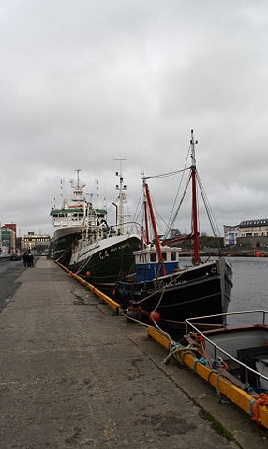
Galway Harbour Photo: Patrick-Emil Zorner Wikimedia Commons
Galway Harbour
Photo: Patrick-Emil Zorner
Wikimedia Commons

The rumour regarding Galway Bay to be selected by the Admiralty as a naval base has created much interest locally, but the official confirmation is still wanting. The rumour, however, is not taken for over much here, as it is believed its origin has sprung from a discussion which took place at Galway Urban Council meeting last week. It is stated that the Admiralty were anxious to acquire the foreshore called Fairhill, which is at present used as a fair green for the training of the Naval Reserve, it being eminently suitable. The Council, although ready to meet the admiralty, would not give their sanction, in the absence of any official reference to the matter. Galway Bay is well suited for either a naval base or a transatlantic station, there being not less than six fathoms of water in any part of the bay, and the depth in the fair way is greater, so that vessels of the heaviest tonnage might ride safely afloat. Years ago Galway Bay was a steam packet station for America.

Posted in Posts and podcasts

Winter show – 1910

Freemans Journal 8th December, 1910 p.5 (abridged)

Ball's Bridge over the River Dodder at Ballsbridge, County Dublin, Ireland Photo: Doug Lee Creative Commons
Ball’s Bridge over the River Dodder at Ballsbridge, County Dublin, Ireland
Photo: Doug Lee
Creative Commons

The Winter Show of the Royal Dublin Society was opened yesterday under weather conditions which were on the whole favourable, there being a reasonable amount of daylight and relatively little fog.
The total number of entries was 2,300. Last year it was 2,169.
Malting Barley
1st prize – winner also of champion prize
Peter Kilkelly, Munnia, Burrin, County Clare.
Seed used – Webb’s Kinver Chevalier.

2nd prize – also reserved for champion prize
Patrick Quinn, Geeha, Kinvara, Co. Galway
Seed used, Chevalier

3rd prize
Patrick Mahon, Geeha, Duras, Kinvara, Co. Galway
Seed used – Webb’s Kinver chevalier

Very highly commended
Thomas Keane, Geeha, Duras, Kinvara, Co. Galway
Seed used – Archer

Reserved
Joseph Diveney, Bellharbour, Co. Clare
Seed used, Chevalier

Posted in Posts and podcasts

Kinvara – 1899

Tuam Herald 14th October, 1899 p.2

Photo: EO'D
Photo: EO’D

Letters to the Editor
Sir,
Arising out of your recent interesting articles on the awful condition of our Co. Galway Roads, it is to be hoped that Mr. Perry will not certify for payment of Roads from the town of Kinvara without first coming to inspect them or else to send his deputy.
The state of these roads is indeed very bad. I don’t wish to name any road in particular as being worse than another, if I tried to I could hardly, as they are one and all as bad as each other.
I often travel these roads and therefore have reason to know the way in which they have been kept. Hoping you will publish these few lines and oblige.
A. TRAVELLER

Posted in Posts and podcasts

By Galway Bay – 1894

Irish Examiner 31st March, 1894 p.12

Galway Bay Photo: Tony Hisgett Creative Commons
Galway Bay
Photo: Tony Hisgett
Creative Commons

By Galway Bay
When Spring with blossoms wild and sweet, made all the meadows smile,
And wreathed her roses ’round the brow of God’s Eternal Isle,
I dreamed the bright dreams of a boy, and left my books and play,
To watch the white sails gleaming – the sails on Galway Bay.

At morn my bare feet brushed the dew, to see the great sun rise,
(Ah! never was a sun like that in all God’s splendid skies!)
A sun that gave the loveliest light – a light that lives today.
As when it kissed the sails that gleamed – the sails on Galway Bay!

How bright the suns – how sweet the winds – how blue the skies that bent
Above the waves that mirrored them and murmured as they went!
And the shouting of the captains and the sailors far away,
In the boats that rocked near Galway – the boats on Galway Bay!

I would today I were a boy – a little barefoot boy,
Where once I watched the bending sails – the boats that danced for joy!
For though my ship has crossed the sea and anchored far away,
Still blow the gales and gleam the sails – the sails on Galway Bay!

Atlanta Constitution.

Posted in Posts and podcasts

Muintir na Tíre – Kinvara – 1957

Connacht Tribune 10th November, 1967 p.10

St. Colman's Church, Kinvara. Cresswell archives
St. Colman’s Church, Kinvara.
Cresswell archives

At the A.G.M. of Kinvara Guild Muintir na Tíre last week in Ryan’s Hall, Kinvara, the Secretary, Mr. Toddie Byrne, stated that the financial success of the carnival run by the guild had now brought the Parish Development Fund to £1,267/10/6. The local guild had fulfilled its role in promoting the social and cultural life of the parish and all members showed interest in the activities. The highlight of the year was the unveiling of the plaque to the poet Francis A. Fahy.  On a Saturday in July the less fortunate members of society members of the Wheelchair Association were entertained and catered for in a spirit that reflected the proper Christian outlook.
During the year the newly formed Youth Club were represented in the guild and showed that these young people are anxious for social outlet. The success of local G.A.A. team has been the cause of pride and admiration in the guild.
Two lectures were given during the year, one by Sergeant J. McLoughlin on “Road Safety” and the other by Mr. McKiernan on “Piped Water”. Mr. T. Donlon, outgoing Chairman, said that there was great social involvement on the part of the parishioners through the one medium where personal and political affiliations blended i.e. Muintir na Tíre.

It was decided that a carnival would be held under the auspices of the guild next year; £250 will be allocated to the G.A.A. and the balance of the profits will be allocated to the Parish Development Fund, whence top priority will be given to the development of the entrance to St. Colman’s church.

Posted in Posts and podcasts

Kinvara – 2015

Connacht Tribune 6th November, 2015 (abridged)

Photo: TO'D
Photo: TO’D

Kinvara will have a world-class sewerage treatment plant when construction on the new facility is completed in early 2017.
That’s according to Irish Water, who have today signed a contract for the long-awaited facility at the Merriman Hotel, Kinvara. It concludes decades of campaigning for a new plant to tackle raw sewerage in Kinvara Bay.
The utility is investing 5 million euro to construct the new plant and upgrade the towns sewer network. The new plant will be located at Ballybranagan and Irish Water says its design, now entering its final stages, will allow for future population growth and tourist numbers.
Over the next two weeks, Irish Water will host meetings and community groups to address local concerns over the 14 month project.
Speaking to Galway Bay fm news at this morning’s contract signing, Environment Minister Alan Kelly says he looks forward to people swimming in Kinvara Bay once more.

Posted in Posts and podcasts

Kinvara Dramatic Society – 1957

Connacht Tribune 14th December, 1957 p.7

Kinvara 1956 Cresswell Archives
Kinvara 1956
Cresswell Archives

On Sunday night next Kinvara Dramatic Society will stage “The Troubled Bachelors” in the local hall. The production is by Mr. Kieran Moylan, star of many pantomimes, who will himself fill the leading role of “Peter Carmody.”
The play is in aid of the local G.A.A. and the artistes who will take part are Messrs K. Moylan, N.T; T. Byrne, N.T; P. Geraghty, M. Glynn and J. Mitchell, and the Misses F. Ryan, B. Quinn N.T; M. Connolly and S. Regan. A concert by local artistes will support the play.

Posted in Posts and podcasts

Galway Banquet – 1843

The Cork Examiner, June 30th, 1843 (abridged)

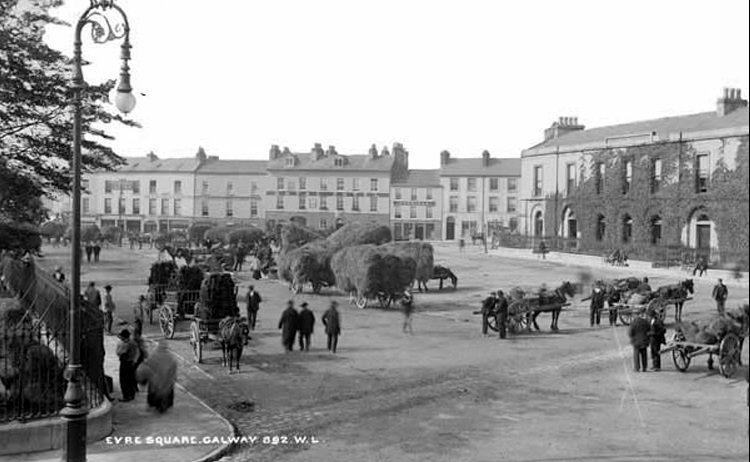
Eyre Square, Galway c.1897 National Library of Ireland Wikimedia Commons.
Eyre Square, Galway c.1897
National Library of Ireland
Wikimedia Commons.

The great public banquet to Mr. O’Connell took place this evening at the magnificent and extensive pavilion, erected for the purpose in Eyre Square, and served as a fitting conclusion to the grand and imposing scene of yesterday. The preparations were all on the most extensive scale, and no trouble or cost was spared to render the banquet worthy of the great importance of the occasion. The pavilion was large enough to contain upwards of 1,000 persons, and was fitted up with great taste and effect. Over the two principal entrances the word “Repeal” appeared in gas lights, and behind the head table several beautiful devices were also formed in the same brilliant material. The tickets collected by the stewards at the dinner amounted to 560 in number, and when the occupants of the principal table and the stewards were enumerated, the entire of the gentlemen present somewhat exceeded 600 in number.

Posted in Posts and podcasts

The Liberator – Galway – 1843

The Cork Examiner 30th June, 1843 p.1

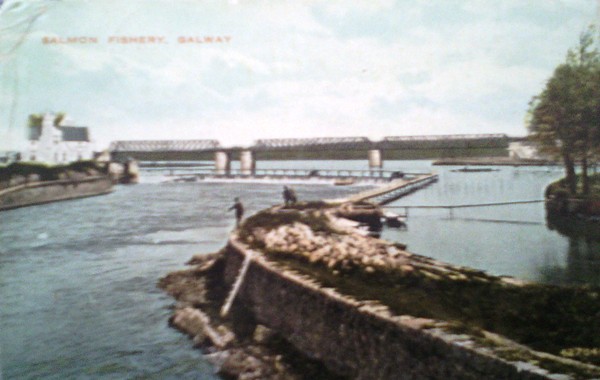
Salmon Weir Bridge Galway
Salmon Weir Bridge
Galway

Daniel O’Connell in Galway (abridged)
From an early hour the streets were densely thronged by the country people, who continued to pour into the town in countless thousands, exhibiting in their persons all the wild and picturesque costumes of the west. The women’s short dark-red flannel petticoats were surmounted by the deep blue or brilliant scarlet cloaks. The majority of the younger portion were barefooted, and had their heads uncovered, their hair hanging loosely over their shoulders.  Nearby were the dark frieze coats and corduroy breeches of the men from the interior of the country and the light sky blue dress of the Connemara men, who had prepared themselves to come in thousands in boats.  Owing to the lightness of the wind, only a comparatively small portion were able to enter the harbour in sufficient time for the meeting.
The dark blue of the Claddagh fishermen, the Aran Islanders in their hairy shoes of untanned calf-skin, and the Iar Connaughtmen, mounted on their untrained and unshod mountain ponies – all mingled together in the old streets, talking Irish in loud accents as they went along.
When twelve o’clock, the hour at which the procession was to set forth, approached, the throng in the neighbourhood of the Square and Market-place became extremely dense, while the excitement was increased by the arrival of the tradesmen, all ornamented with sashes and bands and carrying long white rods surmounted with ribbons, to take their places in the procession, and by the merry strains of the temperance bands, that were each carried in boats placed in carts, and profusely ornamented with flags and green boughs.
At length the loud shouts of that peculiar and most interesting body of men – the Claddagh fishermen – was heard as they approached to take their ascribed place at the head of the procession. They mustered nearly a thousand strong, and a large portion of them wore large white flannel jackets, ornamented with ribbons and pieces of various coloured silk, while their hats were quite concealed with ribbons, flower-knots, and ostrich feathers.
The tailors were allowed to take their position second in the procession, and the remainder of the trades, twenty-four in number, were placed by lot, as arranged at a preliminary meeting held on the preceding day, in the following order;
Millers, Wheelwrights, Hatters, Tobacconists, Bakers, Stonecutters, Ropemakers, Broguemakers, Printers (having a printing press mounted on a richly decorated chariot), Butchers, Plasterers, Shoemakers, Coachmakers, Shipcarpenters, Coopers, Chandlers, Cabinetmakers, Nailers, Sawers, Housecarpenters, Stonemasons, Painters, Smiths, and Slaters.