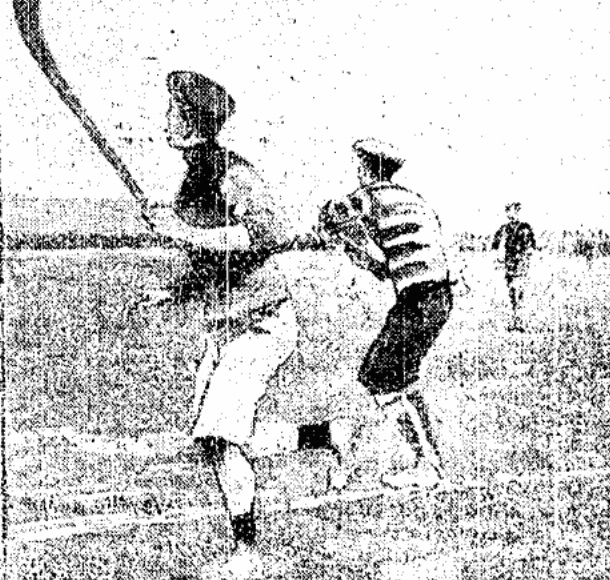
Long puck Wexford v Limerick Irish Independent 20th November, 1910
The Co. Clare Board G.A.A., were obliged to play off a tie between Tubber and Killinana on the Galway side on Sunday. Rumour had it that the hurling was to be prohibited, and for that reason an invitation to Gort to meet a selection from Clare was readily accepted, despite other engagements at home. A couple of platoons of military with full war equipment, assisted by several armoured motor cars, sported themselves on the roadside bordering the playing pitch. Shortly after the game started the “Iron Duke” and his other formidably named companions crossed the Clare border and disappeared amongst the hills unnoticed, except for a few derisive cheers as they motored past.
No hint, no touch of grim utility,
Earth’s busy functions sleep abandoned here;
Corn-grower, root-grower, nourisher of grain,
All are forgotten, nakedly austere.
Nought but herself, her inmost core, survives,
Stripped to the elements; enskyed and pure,
Remote, and stern, and coldly sanctified;
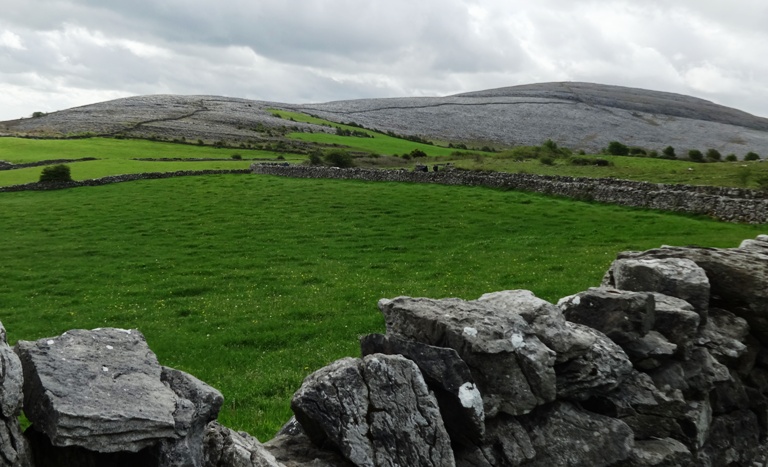
And therefore, Burren hills, to me you seem
Shrines meet for that which is, and which is not;
Approach beloved ones! Hasten! All is clear,
No bidding need you – you the unforgot!
The door stands open; only come; ah, come;
Come from your far-off realms, with noiseless tread,
Come as you were, no dearer could you be
The Loved, the Lost, the Sundered and the Dead!
Wide glistening pavements fit for ghostly feet,
Where never thought of mart or street intrude,
Only from ledge to ledge spent rain-drops drip,
And half-heard tinklings stir the solitude.
Imponderable wanderers! Shadowy all!
Ghost after ghost; half-veiled; grey muffled; while
With spirit-looks, visions seen in sleep,
Eyes seem to glimmer, lips austerely smile.
Again at dusk-time, or when moonbeams lie
Far on the sheeted silence, fold on fold;
Then with a swifter sequence, soft as light,
Life’s semblances enwrap this shadowy cold
Like autumn leaves, like high-borne clouds, they come
Strange shapes; and others, others, ah, not strange!
Not strange, God knows, but intimately dear
Untouched by time, defiant of all change.
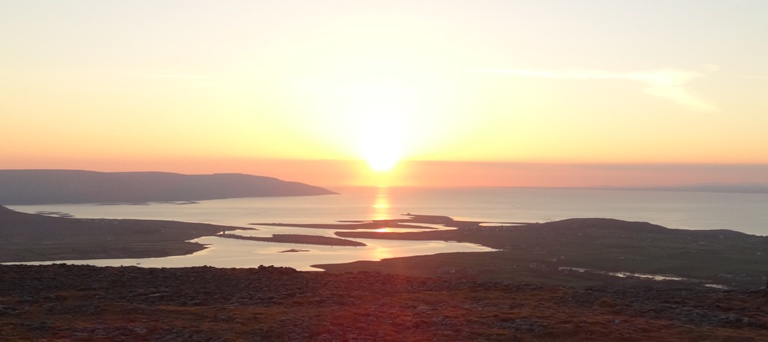
And therefore, Burren hills, grey Burren hills,
Soul of fierce Clare, wild West of all our West,
No mindless tract of earth or strand thou seem’st,
Such as dull maps and solemn charts attest.
Here mid your solitudes, as mid the crowds,
Alike for me thou shinest, realm apart;
Open to all we pine for, pray for, hope;
Sanctified Home-land of th’ unchanging heart.
On Monday night, in consequence of intelligence received by Col. Bourke, the Castle Connel Rangers, notwithstanding the severity of the weather, made an incursion into the county of Clare mountains, which were covered with snow, took two of the houghers against whom there are informations, and lodged them safely in our gaol on Tuesday last.
Letter from Mr. Briscoe to the editor of the Freeman’s Journal. (abridged)
Town Tenants’ League,
Executive Offices,
4 Upper O’Connell Street, Dublin
14th August, 1910.
Dear Sir,
As your readers may be aware, much disturbance and unrest has prevailed at Kinvara for some time past in consequence of the refusal of the trustees of the Sharpe Estate to reduce the rents in the town to the figure they were under O’Donnellan Blake Forster, and sanctioned by the late Judge Monroe when the estate was in his Court. Some time since decrees were obtained against the tenant, and these have been lodged with the Sheriff for execution. Yesterday Mr. Corless of Kinvara wired me asking to have execution of decrees delayed, and I immediately wired the agents asking them to have this done. This morning I received the following courteous reply to my wire from the agents:
Tuam, 13th August, 1910. Kinvara Estate. Dear Sir, We have received your telegram of this date, and, as requested, we have asked the solicitor for the estate to communicate with the Sheriff and ask him to hold over the execution of the decrees for a few days. We wrote to the tenants before lodging the decrees with the Sheriff, and gave them every opportunity of paying. If the rents and costs to date are now paid, we shall give the Congested Districts Board every facility to enable them to make an offer for the estate. The execution of the decrees can only be stayed to the 20th inst. Yours truly, D.J. Kirwan and Sons.
It was in connection with this estate Mr. Wm. Field, M.P; Mr Wm. Duffy, M.P; and myself recently interviewed the Chief Secretary in London, and I had strong hopes that interview would have laid the foundation of a settlement in the interest of the people of Kinvara. I may add I do not hold the Messrs. Kirwan in any way responsible for harsh proceedings, but evidently the trustees will have their pound of flesh.
Yours faithfully,
Coghlan Briscoe.
Connacht Tribune 31st January, 1925 p.8
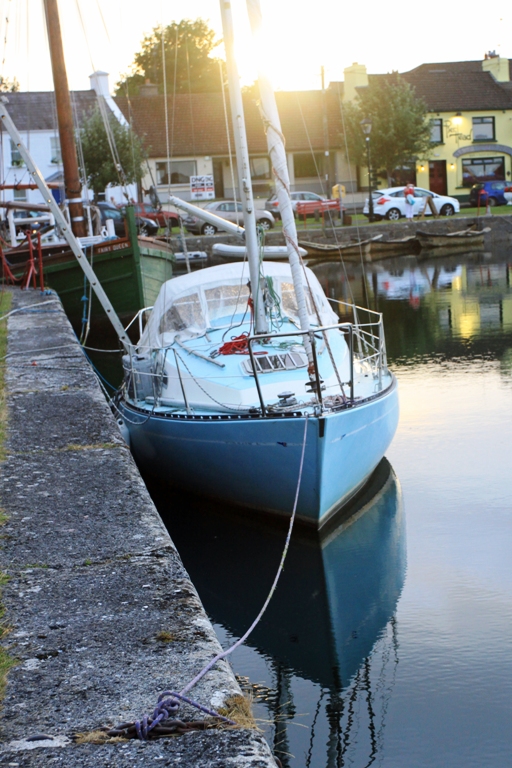
The following ships arrived in Galway harbour this week;
ss Mungret, from Liverpool on Monday, to load a cargo of timber for Garston;
ss Turquoise from Ayr, with cargo of coal for Mr. B. Hynes;
Cymrich, auxiliary motor vessel, bound from Dublin to Kinvara with cargo of manure in bags for Mr. O’Dea.
Strange Robbery of Arms
(Central News Telegram) Galway, Monday.
On Saturday evening the Naval Reserve Armoury, just outside this town, was broken into and its contents, consisting of twenty-three Martini-Henri rifles and seventeen cutlasses, were stolen. For many years these arms were stored in the police barracks, but recently they were removed to the armoury. No guard was kept at this place, and the door was fastened by an ordinary padlock, which could be picked with little difficulty. The police have been scouring the countryside since the robbery was discovered, but the thieves have not yet been traced. One of the cutlasses, however, and a ramrod, have been found on a road leading to the shore of the bay. It is conjectured that the robbers crossed in a boat from the County Clare, and made their escape with their booty the same way. Today her Majesty’s cutter Fly conveyed a party of police across the bay to County Clare to join in the search.
Connacht Tribune 6th December, 1958 p.7
Kinvara Dramatic Society, which last year drew the greatest attendances ever seen at any amateur or professional dramatic society in this district, is staging “A Damsel From Dublin” at the Kinvara Hall on December 14th, 15th and 16th and will later produce the same play in Clarenbridge on Sunday, December, 21st. Kieran Moylan takes the principal.
Official I.R.A. Galway, issued the following on Monday evening;
Having received information at Galway that post offices were being raided at Kinvara and Ardrahan, five men under Captain Farrelly O’Rourke were dispatched to Kinvara by Motor. Upon arrival they were told that the raiders had left in the direction of Gort. The official party pursued them hotly, and on reaching Gort, were told that the men had gone into the barracks. These men wore uniforms and carried arms, and their names were given to the Official I.R.A. party at Kinvara. Subsequently a man left the barracks, was pursued, and escaped. A sum of one pound ten shillings was taken from Kinvara Post Office.
On Monday morning last at about 8 o’clock, Newtownlynch farm at Duras was the scene of a large cattle drive. Men, women and children, all tenants on the estate of Major Lynch, assembled to the number of over one hundred, and went to the farm, which was guarded by police. When the police saw the people coming towards the farm they advanced and called on the crowd not to enter the lands, but they were met with defiant shouts of “No surrender!” While the police were engaged with the people on the road, a number of men managed to get on the lands, and drove a large number of horses, cattle and sheep off the farm. The police in another portion of the farm who were guarding the stock during the night, apparently were asleep, and were only awakened by the noise of the cattle. The farm was cleared with the exception of three horses.
The police called on them to stop and drew their revolvers. The men replied with shouts of “Faugh-a-ballagh,” and “We will drive them to h___.” Some of the police then started for Kinvara for reinforcements. The “drive” continued in the direction of Kinvara en route for Clarenbridge, where the owner of the stock resides. Large numbers joined the “drive” on the road. Sergeant Mulligan, in charge of a cordon of police, attempted to stop the stock within one and a half miles of Kinvara, but failed.
In the Dáil last week Mr. R. Lahiffe asked the Minister for Industry and Commerce what were the reasons for the delay in bringing rural electrification to Kinvara. The Minister stated that a canvass of the area had not met with sufficient response to make the scheme financially sound. He understood, he stated, that a local committee was endeavouring the increase the number of potential consumers and he could give no assurance as to when electricity would be brought to that area.