Letters to the Editor
Sir,
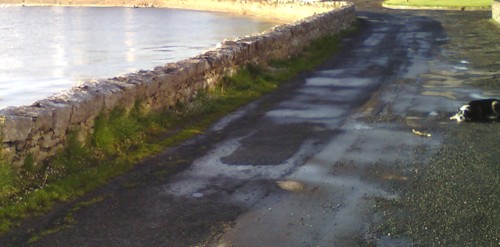
Arising out of your recent interesting articles on the awful condition of our Co. Galway Roads, it is to be hoped that Mr. Perry will not certify for payment of Roads from the town of Kinvara without first coming to inspect them or else to send his deputy.
The state of these roads is indeed very bad. I don’t wish to name any road in particular as being worse than another, if I tried to I could hardly, as they are one and all as bad as each other.
I often travel these roads and therefore have reason to know the way in which they have been kept. Hoping you will publish these few lines and oblige. A. TRAVELLER
By Galway Bay
When Spring with blossoms wild and sweet, made all the meadows smile,
And wreathed her roses ’round the brow of God’s Eternal Isle,
I dreamed the bright dreams of a boy, and left my books and play,
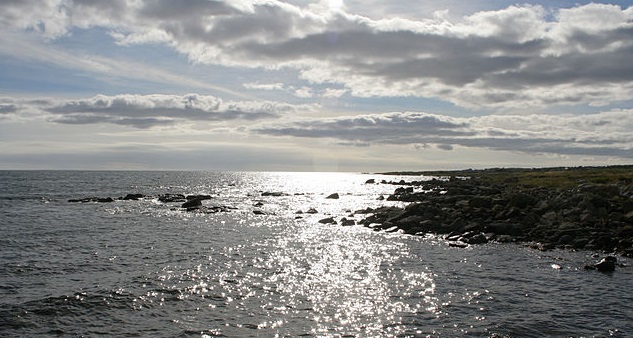
To watch the white sails gleaming – the sails on Galway Bay.
At morn my bare feet brushed the dew, to see the great sun rise,
(Ah! never was a sun like that in all God’s splendid skies!)
A sun that gave the loveliest light – a light that lives today.
As when it kissed the sails that gleamed – the sails on Galway Bay!
How bright the suns – how sweet the winds – how blue the skies that bent
Above the waves that mirrored them and murmured as they went!
And the shouting of the captains and the sailors far away,
In the boats that rocked near Galway – the boats on Galway Bay!
I would today I were a boy – a little barefoot boy,
Where once I watched the bending sails – the boats that danced for joy!
For though my ship has crossed the sea and anchored far away,
Still blow the gales and gleam the sails – the sails on Galway Bay!
At the A.G.M. of Kinvara Guild Muintir na Tíre last week in Ryan’s Hall, Kinvara, the Secretary, Mr. Toddie Byrne, stated that the financial success of the carnival run by the guild had now brought the Parish Development Fund to £1,267/10/6. The local guild had fulfilled its role in promoting the social and cultural life of the parish and all members showed interest in the activities. The highlight of the year was the unveiling of the plaque to the poet Francis A. Fahy. On a Saturday in July the less fortunate members of society members of the Wheelchair Association were entertained and catered for in a spirit that reflected the proper Christian outlook.
During the year the newly formed Youth Club were represented in the guild and showed that these young people are anxious for social outlet. The success of local G.A.A. team has been the cause of pride and admiration in the guild.
Two lectures were given during the year, one by Sergeant J. McLoughlin on “Road Safety” and the other by Mr. McKiernan on “Piped Water”. Mr. T. Donlon, outgoing Chairman, said that there was great social involvement on the part of the parishioners through the one medium where personal and political affiliations blended i.e. Muintir na Tíre.
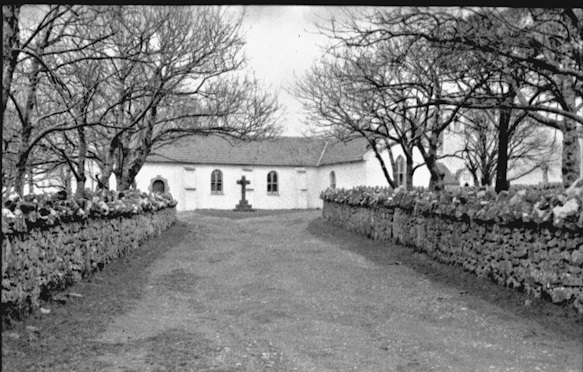
It was decided that a carnival would be held under the auspices of the guild next year; £250 will be allocated to the G.A.A. and the balance of the profits will be allocated to the Parish Development Fund, whence top priority will be given to the development of the entrance to St. Colman’s church.
Kinvara will have a world-class sewerage treatment plant when construction on the new facility is completed in early 2017.
That’s according to Irish Water, who have today signed a contract for the long-awaited facility at the Merriman Hotel, Kinvara. It concludes decades of campaigning for a new plant to tackle raw sewerage in Kinvara Bay.
The utility is investing 5 million euro to construct the new plant and upgrade the towns sewer network. The new plant will be located at Ballybranagan and Irish Water says its design, now entering its final stages, will allow for future population growth and tourist numbers.
Over the next two weeks, Irish Water will host meetings and community groups to address local concerns over the 14 month project.
Speaking to Galway Bay fm news at this morning’s contract signing, Environment Minister Alan Kelly says he looks forward to people swimming in Kinvara Bay once more.
On Sunday night next Kinvara Dramatic Society will stage “The Troubled Bachelors” in the local hall. The production is by Mr. Kieran Moylan, star of many pantomimes, who will himself fill the leading role of “Peter Carmody.”
The play is in aid of the local G.A.A. and the artistes who will take part are Messrs K. Moylan, N.T; T. Byrne, N.T; P. Geraghty, M. Glynn and J. Mitchell, and the Misses F. Ryan, B. Quinn N.T; M. Connolly and S. Regan. A concert by local artistes will support the play.
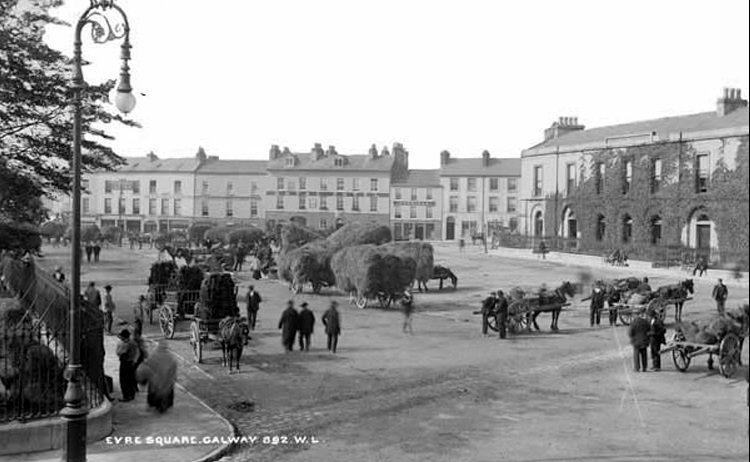
Eyre Square, Galway c.1897 National Library of Ireland Wikimedia Commons.
The great public banquet to Mr. O’Connell took place this evening at the magnificent and extensive pavilion, erected for the purpose in Eyre Square, and served as a fitting conclusion to the grand and imposing scene of yesterday. The preparations were all on the most extensive scale, and no trouble or cost was spared to render the banquet worthy of the great importance of the occasion. The pavilion was large enough to contain upwards of 1,000 persons, and was fitted up with great taste and effect. Over the two principal entrances the word “Repeal” appeared in gas lights, and behind the head table several beautiful devices were also formed in the same brilliant material. The tickets collected by the stewards at the dinner amounted to 560 in number, and when the occupants of the principal table and the stewards were enumerated, the entire of the gentlemen present somewhat exceeded 600 in number.
Daniel O’Connell in Galway (abridged)
From an early hour the streets were densely thronged by the country people, who continued to pour into the town in countless thousands, exhibiting in their persons all the wild and picturesque costumes of the west. The women’s short dark-red flannel petticoats were surmounted by the deep blue or brilliant scarlet cloaks. The majority of the younger portion were barefooted, and had their heads uncovered, their hair hanging loosely over their shoulders. Nearby were the dark frieze coats and corduroy breeches of the men from the interior of the country and the light sky blue dress of the Connemara men, who had prepared themselves to come in thousands in boats. Owing to the lightness of the wind, only a comparatively small portion were able to enter the harbour in sufficient time for the meeting.
The dark blue of the Claddagh fishermen, the Aran Islanders in their hairy shoes of untanned calf-skin, and the Iar Connaughtmen, mounted on their untrained and unshod mountain ponies – all mingled together in the old streets, talking Irish in loud accents as they went along.
When twelve o’clock, the hour at which the procession was to set forth, approached, the throng in the neighbourhood of the Square and Market-place became extremely dense, while the excitement was increased by the arrival of the tradesmen, all ornamented with sashes and bands and carrying long white rods surmounted with ribbons, to take their places in the procession, and by the merry strains of the temperance bands, that were each carried in boats placed in carts, and profusely ornamented with flags and green boughs.
At length the loud shouts of that peculiar and most interesting body of men – the Claddagh fishermen – was heard as they approached to take their ascribed place at the head of the procession. They mustered nearly a thousand strong, and a large portion of them wore large white flannel jackets, ornamented with ribbons and pieces of various coloured silk, while their hats were quite concealed with ribbons, flower-knots, and ostrich feathers.
The tailors were allowed to take their position second in the procession, and the remainder of the trades, twenty-four in number, were placed by lot, as arranged at a preliminary meeting held on the preceding day, in the following order;
Millers, Wheelwrights, Hatters, Tobacconists, Bakers, Stonecutters, Ropemakers, Broguemakers, Printers (having a printing press mounted on a richly decorated chariot), Butchers, Plasterers, Shoemakers, Coachmakers, Shipcarpenters, Coopers, Chandlers, Cabinetmakers, Nailers, Sawers, Housecarpenters, Stonemasons, Painters, Smiths, and Slaters.
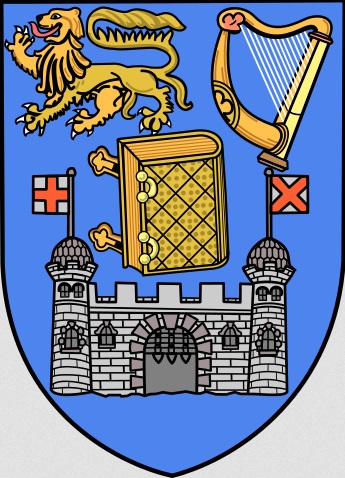
Line drawing of the arms of Trinity College, Dublin, as illustrated in “College Histories: Trinity College Dublin” by W Macneile Dixon. Creative Commons.
All Saint’s Day irresistibly revives the recollection of the fact that Trinity College Dublin occupies the site of the dissolved Monastery of All Hallows, or All Saints, and is thus not only in receipt of the revenues of plundered abbeys, like the Abbeys of Kilmacrenan and Asseroe in Donegal but actually is built on the ground once occupied by an “essentially Catholic” institution.
All Hallows Monastery was literally razed to the ground. In Trinity College at the present day there is only one relic from the time of the existence of All Hallows – a mulberry tree in the Provost’s garden is shown to the visitor as the sole survivor in that institution of the “pre-Reformation” period. In St. Werburg’s Protestant Church, in whose vaults Lord Edward Fitzgerald is buried, there are two antique monumental slabs with effigies. They are supposed to have formed portions of the tombs of the Abbots of All Hallows, which were preserved by pious hand from absolute destruction of the “suppression” of that home of religion and useful learning.
‘Tis Hallow E’en, ‘Tis Hallow E’en,
What memories the night revives
Of many a face and many a scene,
Bright oases throughout our lives.
A father’s stern, though mild rebuke,
Should youthful ardour run too high;
A gentle mother’s smiling look
Surveying our fun with loving eye.
The grass above their graves is green,
God rest their souls this Hallow E’en.
And whilst the whirling apple flew,
In spite of our vain endeavour,
And whilst the candle far more true,
Successful was in kissing over,
And whilst the pinioned diver plunged
For smallest coin with miser’s eye.
And grate with roasting nuts was fringed,
For lover swain and cailín coy
We ne’er forgot when fun was o’er
The prayer for those who’d gone before.
And Hallow E’En may come, may go,
And Time, the soother of all sorrow,
May even change our locks to snow,
E’er comes for us the “no tomorrow.”
But be it late, or be it soon,
At home, abroad, no matter where
Kind heaven, I pray thee, grant the boon
That I may have some friend still there
To say when Hallow comes again,
“God rest his soul this Hallow E’en.
Connacht Tribune 9th November, 1990 p.15
Kinvara was thronged with 600 adult spectators and several hundred children for the Halloween Ghost Parade through the streets last Wednesday night (8 p.m. to 11 p.m.). The full moon shone in all its lunar splendor throughout the spectacle.
A large number of costumed adults took part in the colourful parade which commenced outside the national school, proceeded down Main Street (Sráid na Phooka), and Locoal-Mendon Street and arrived at the quay.
Five mysterious people suitably disguised (Toddie Byrne, Paddy Geraghty, Paddy Ward, Pam Fleming and Stan MacEoin) accompanied the parade. At Locoal-Mendon corner there was a fire eating demonstration by Padraig Breathnach, assisted by Little John Nee of Macnas.
The fantastic scenario at the Quay featured three witches, three leprechauns, a horse led by a headless man, four Fir Bolgs twelve feet tall, a caterpillar and mermaid. The Macnas five piece band provided delightful drum rolls for the antics and acts of the characters.
Sweets (1,650 penny sweets in all), nuts (countless) and fruit by the score were distributed free to the children. The Town Crier, Jeff O’Connell, gave out the commands and comments.
For the visitors to Kinvara on the night the whole show was memorable. It was a credit to the local Community Arts Officer, Pam Fleming.