Posted in Posts and podcasts

The Ballad Singers – 1866

Freeman’s Journal 14th April, 1866 p.229 (abridged)
N
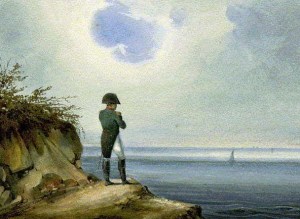
Napoleon at Saint-Helene, by Francois-Joseph Sandmann. Wikimedia Commons

In Ireland in ’48 a good many editors of newspapers were arrested, but not one ballad singer. In ’65 only one disloyal editor, Mr. Clark Luby, has been arrested; but the arrests of ballad singers in Cork, Dublin, Tralee, Limerick, and the country towns of the south has now given constant employment to the police. Not a fair is held in Ireland now at which the authorities do not take precautions for seizing upon the ballad singers, and confiscating their seditious wares – street literature reprinted by the Fenians and purchased extensively by the people. The Young Irelanders never would have re-published such lines as these;

The forward stepped young Boney,
And took me by the hand,
Saying, “How is old Ireland,
And how does she stand?”
“It’s as poor distressed a nation
As ever you have seen,
They are hanging men and women
For the wearing of the Green!”

One ballad has attained extensive popularity. As a ballad slip it appears anonymously, but Mr. McGlashan’s publication gives authorship to a Fenian, Mr. Charles Kickham of Mullinahone – the same Mr. Charles J. Kickham, we presume, who was arrested with the famous head centre and prison breaker, Stephens. It is “Patrick Sheehan” (The Glen of Aherlow).

Posted in Posts and podcasts

August 1916

The Catholic Press 31st August, 1916 p.16

Photo: EO'D
Photo: EO’D

In reply to an inquiry from Dublin, a letter has been received from the joint secretary to the advisory committee dealing with the cases of Irish prisoners in England to hear representations showing why certain prisoners at Frongoch should be released. No counsel or solicitors would be heard as advocates.
The London correspondent of the “Manchester Guardian” regards as serious the announcement that 1,600 Irishmen are being interned for the period of the war, and says that English solicitors are busy with regard to a number of the cases. He adds that the Government would be well advised to announce the steps that interned persons or their friends can take to secure an adequate hearing before the advisory committee.

In reply to Mr. Ginnel yesterday, Mr. Tennant said that, according to the latest information in the possessions of the Home Office, 125 persons were now undergoing penal servitude in connection with the recent rebellion. The Government had not considered the advisability of treating them as prisoners of war.

Posted in Posts and podcasts

Seamount – Kinvara – 1916

The Catholic Press 31st August, 1916 p.9

April in Kinvara Photo: EO'D
April in Kinvara
Photo: EO’D

“We, the priests of the Diocese of Kilmacduagh, have heard with amazement of an outrage perpetrated against the Convent of Mercy and community, Kinvara on Sunday, June 4, by the police, who said they came to search the convent for rebels. We enter our solemn protest against their search of the convent, and we say that the search, and the manner in which that search was made, was a gross outrage on religion and an uncalled for indignity and insult to the Sisters.
Catholics well know that religious Sisters never harbour strangers or externs in their convent, and that the sisters’ cells are privileged, no strangers being allowed to enter them. This immunity was violated by the police and the manner in which the cells were searched was equally offensive to manliness and common decency.”

Posted in Posts and podcasts

G.P.O. – 1916

The Catholic Press August, 31st, 1916 p.14
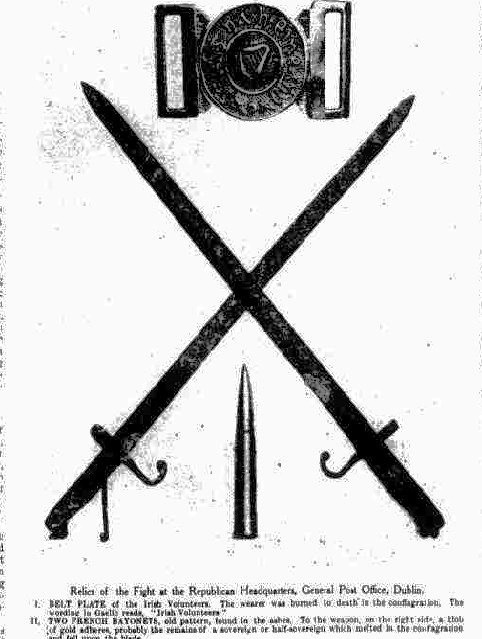
Relics of the Fight at the Republican Headquarters, General Post Office, Dublin
1. Belt Plate of the Irish Volunteers. The wearer was burned to death in the conflagration. The wording   in  Gaelic reads, “Irish Volunteers.”
2. Two French Bayonets, old pattern found in the ashes. To the weapon on the right side, a blob of gold adheres, probably the remains of a sovereign or half-sovereign which melted in the conflagration and fell upon the blade.
3. Three inch High velocity cartridge, with conical nickeled bullet, used by the riflemen of the Irish Volunteers, found in one of the “Forts” after its evacuation.

Bladeandbullet

Posted in Posts and podcasts

Kinvara – 1909

Connacht Tribune 13th November, 1909 p7

The Green Road, Kinvara Photo: EO'D
The Green Road, Kinvara
Photo: EO’D

A large and enthusiastic meeting of the people of Kinvara was held on Sunday last under the presidency of Rev. Thomas Burke P.P, for the purpose of forming a branch of the Town Tenants League. The following were amongst those present;
Messrs Arthur O’Dea
Thomas O’Halloran
Patrick J Flatley
Bartley Bermingham
William R Flatley
Thomas Green (hotel)
Fred. J. Johnston
Michael Corless
Augustus Johnston
Thomas Leetch
James Davenport
John McMahon
Patrick Winkle
Edward Holland
John Fahy
Patrick Whelan
ThomasMoran
Michael Howard
Thos P. Corless

Correspondence was submitted from J Coghlan Briscoe Esq. T.C. Secretary Town Tenants Exec., Dublin after which a working committee and officers were elected as follows;
President; Rev. Thomas Burke P.P.
Chairman;Thomas P Corless D.C.
Hon Treas; Thomas O’Halloran
Hon Sec; Arthur O’Dea
Committee;
Augustus Johnston
Michael Corless
Michael Connolly
Patrick Flatley
Thomas Green
William R Flatley
Fred J Johnston
Edward Holland
Bartley Bermingham

Representative on Central Executive – Thos P. Corless D.C.
Representative on County Committee Thomas Green and Thomas P. Corless

A sum of £3 was forwarded to the Town Tenants Executive as affiliation fee. The next meeting of the branch will be held on Sunday November 14th and the first Sunday in each month afterwards. Rev Father Burke P.P has written to Messrs Kirwan, Tuam, agents on the Sharpe estate demanding a reduction of 50 per cent on all rents now due. The tenants are determined to pay no rent until their just demand is conceded. The Kinvara town tenants are the most rack-rented in the west and have not been allowed any abatement in their rent since the present owners purchased the property, notwithstanding the way the trade of the town has fallen and the wretched condition of the houses.

Posted in Posts and podcasts

1824

Hobart Town Gazette and Van Diemen’s Land Advertiser 3rd September, 1824 p.2

Fado
Photo: EO’D

The attention of the English capitalists has at length been drawn to Ireland. A company has been for some time forming under the auspices of the leading Irish houses, for working collieries and mines in that country, which has been ascertained to abound in coal and minerals. The undertaking is warmly seconded by the most distinguished of the nobility and gentry connected with Ireland, as also by the principal London companies holding large landed property in the island. From the progress already made, there is every prospect of a favourable result. The bill for incorporating the company is to be read a second time in the house this evening. (March 12).