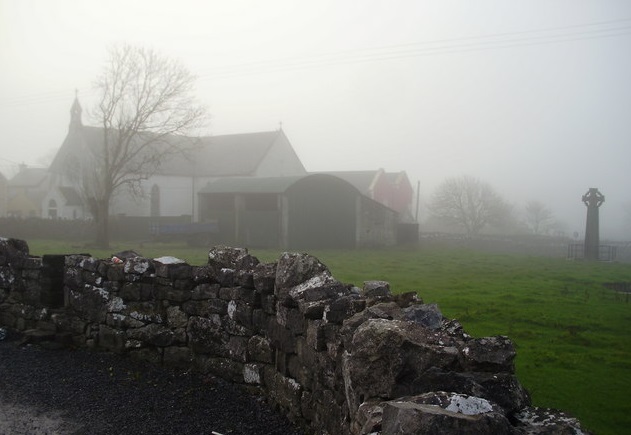
Church of St.Fachta and one of the Kilfenora High Crosses Photo: Eirian Evans Wikimedia Commons
To the editor of the Nation
Lisdoonvarna, County Clare, 13th July, 1864
Dear Sir,
Within the last ten days, in the vicinity of this far-famed watering-place, near the ancient town of Kilfenora, a statue of the Virgin and Child was discovered by a poor man who had been employed in cutting turf in an adjacent bog. The statue is of carved oak. The face of the Virgin is in perfect preservation, the folds of the dress most accurately delineated, and although the face of the infant in her arms is somewhat disfigured, it is wonderful how perfect the statue is after the lapse of perhaps several centuries. The statue is about two feet six inches in height, and was found some eight feet beneath the surface of the bog. Several persons, not only from this locality, but from the adjoining districts, have felt particular pleasure in observing this memorial of the past, which is now to be seen in the sacristy of the Catholic Church of Kilfenora, County Clare.
I am, dear sir, your obedient servant.
A. Visitor
No progressive or prideful village, however small it may seem to those who do not live in it, likes to be isolated from the main stream of traffic. Yet this is what will happen to the village of New Quay if the present scheme of steamrolling the road between the bridge at Currenroo on the Clare border and Ballyvaughan is persisted in. For the purpose of saving six hundred yards, it is proposed to make what would be virtually a new road through the Ballaghdhine boreen, once made by Barton Bindon for the purpose of watering his horses. Thus the level road to New Quay would be altogether ignored and traffic would be diverted from a village which is a fishing and seaside resort. It is obvious that little saving could be effected by the alternative road, for, inasmuch as the New Quay highway would still have to be maintained at the public expense, an additional stretch would be added to maintenance costs. Moreover, there are a number of ratepayers interested on the New Quay road, whereas there are one on the proposed new thoroughfare. In all the circumstances, it would seem that the wisest, if not the only, course would be to follow the line of the old road which possesses the added convenience of a post office and public telephone service – often a matter of importance on a lonely highway.
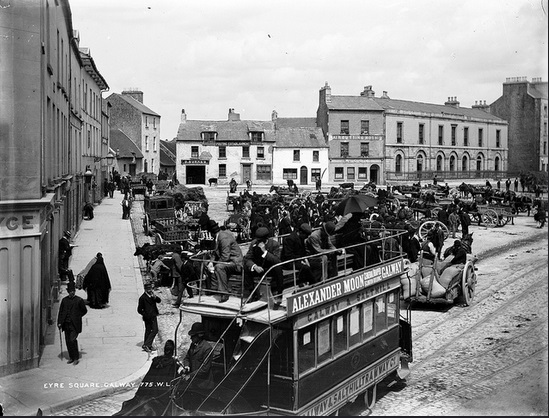
Eyre Square, Galway c.1885 National Library of Ireland
On Saturday night some soldiers of the Connaught Rangers, a detachment of which was under orders to proceed to Malta, on the 14th, attacked the police in Eyre Square with stones. Were it not for the timely arrival of assistance, Sergeant Redington would have been badly injured. Tuesday night the disturbance was renewed, and all the available police were brought out. Sergeant Boylan had his skull fractured from a stroke of a belt by one of the soldiers whose conduct was very violent. The police used their batons, and ultimately the soldiers were got to the barracks.
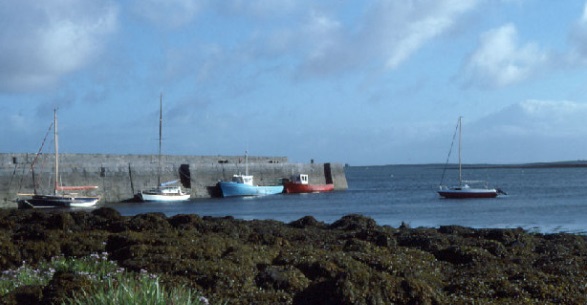
Ballyvaghan Harbour and Pier Photo: Dr Charles Nelson Wikimedia commons.
After a lapse of three years the popular Ballyvaughan races are being revived again. Owing to the scarcity of flappers (horses) for the past few years, the committee thought it advisable not to hold any meetings, but they are assured of good patronage this year, and on September 7, all roads will lead to this little next ‘mid the Burren mountains.
We have just received the account of one of the Terry Alt party being shot at Curranrue. The particulars, as have been related to us, are as follows;
A party of the 28th regiment were out on patrol on Saturday night, the Officer behind his party. A country man, who was behind a wall, presented a musket at him and endeavoured to fire, but burned priming. Two of the party, who formed the rear guard, immediately fired, and this daring ruffian was shot on the spot. He had an elegant musket with him.
The Terry Alts were one of a number of secret societies operating during the 18th Century. They were involved in agrarian agitation in pre-Famine Ireland. The heartland of the Terry Alts was County Clare. The “Whiteboys”, “Oakboys”, “Rockites”, and “Ribbonmen” were other such societies.
To the Editor of the Freeman’s Journal.
Lisdoonvarna, July 16th 1899
Sir,
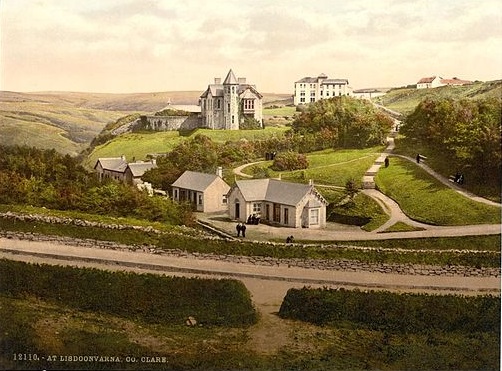
As one who has spent most enjoyable holidays in Lisdoonvarna, permit me to give my views to the public with regard to this most picturesque spot as a health resort. Situated, as Lisdoonvarna is, in the centre of wild mountain scenery, and possessing, as it does, the most salubrious air, and the best mineral waters in the world, it is not surprising that it has been called “The Cheltenham of Ireland.” The air blowing from the Atlantic is genial and bracing, and in my experience of health resorts nowhere have I found the air so invigorating as in Lisdoonvarna and its vicinity. With regard to the medicinal qualities of the waters, Dr. Mapother, a distinguished medical man, in one of his able works says; “It is not proposed to discuss at any great length the actions of sulphuretted waters or the respective advantage of the various sources in the treatment of cutaneous affections, but merely to call attention to one within twenty hours journey from London.”
Dr. Westropp and Dr. Forster, the resident physicians have given these mineral waters their careful studies for many years, and their experience of its effects on the human system will make their advice valuable for those who follow it. Most enjoyable excursions can be taken from Lisdoonvarna to the cliffs of Moher, to Lahinch Spanish Point, to Kilkee, to Ballyvaughan, either by the sea-coast or more directly by the famous cork-screw hill, to Corcomroe Abbey, interesting ruins in the centre of the romantic Burren hills, and the Lakes of Inchiquin, rich in scenery, are certainly well worth a visit.
For the information of intending visitors I am glad to be able to state that the dispute which existed between the local landowners and the inhabitants has been brought to a final and satisfactory settlement. The whole matter has been peaceably and amicably arranged. A local improvement committee has taken charge of all the wells and baths, and under their management considerable improvements have been already made. The plot of land around the sulphur wells has been neatly planted; the house over the springs has been completely renovated; competent and experienced hands have been employed to distribute the waters; the bath rooms have been put in order so that hot and cold sulphur and spring water baths are available daily from 6a.m to 9 p.m. In conclusion permit me to remind those who have sought in vain to regain health and strengths in English and Continental spas that they will do well to visit Lisdoonvarna, where the waters, baths and pure air are sure to prove more effectual than those already tried.
The Burren (county Clare) mountains blazed from one extremity to the other a few nights ago, in consequence of a rumour having reached the people’s ears that Mr. O’Connell M.P. had taken his seat. On the bonfires being discerned by the county of Galway peasantry, they immediately followed the example in almost every village, and along the roads. Nothing can equal the intense interest, the laudable anxiety of every class of persons. Two persons cannot speak together for five minutes without alluding in one way or another to Mr. Connell, the Catholics, Wellington, Anglesey, Peel or the Brunswickers. The latter infatuated miscreants are breaking the peace for spite, and God knows we do not think that if they all broke their necks into the bargain, the country would be anything the worse of the accident.
A thunder-storm of very peculiar character broke over this town yesterday morning about half past ten o’clock. The sky all round the horizon was clear, and there were no clouds anywhere to indicate what was about to take place, when we were startled by a loud peal, almost directly over us. On looking up, a dark gathering was now perceived about the zenith, but the general brightness of the atmosphere, so unlike anything that we had ever before observed during a thunder-storm, reminded us of the phenomenon considered by the ancients as a proof of the existence of Jupiter, when thunder claps were heard in a cloudless sky. The darkness above, however, quickly increased, and clouds – coming no one knew whence, but seeming to grow suddenly out of the disturbed air – began to settle over the town in dense masses interlaced with continual streams of vivid lightning.
A grey veil of rain soon appeared to hang down along the entire of the bay, dimming the brightness of the Burren hills, which were evidently at the time in full sunshine. The thunder roll was now almost incessant, and the display of lightning was, perhaps, the finest we ever witnessed. The immense length of the jagged shafts from the zenith to the horizon, and from the horizon back again to the zenith, crossing the sky several other directions, was among the most striking features of the display. The height of the storm was from four to five miles, and it continued stationary for almost an hour, when it slowly moved towards the north-east, leaving us again in bright sunlight.
But all was not yet over, for about two o’clock the sky began to darken toward the south-west, and the thunder recommenced. At half past two a white stream of lightning, accompanied by an explosion of a most terrific character, with a metallic ring in the sound, seemed to fall in the neighbourhood of the square, and we were soon after informed that the Bank of Ireland had, in fact, been struck by the electric fluid. After this the electric discharges continued with little intermission on every side, and shortly before three o’clock there was a shower of immense hailstones, accompanied by rain of such character as might almost suggest the outpouring of a celestial lake, and the streets became flooded almost instantaneously. This shower, fortunately for the hay and other crops about Galway, continued only for a few minutes, while it probably embraced but a narrow tract of country on its route; and it is to be hoped that but little harm was done anywhere by the storm in proportion to its apparently formidable character.
Distant thunder was heard for the remainder of the day. On inquiry at the bank we were kindly shown over the place by the manager, Mr. McDowell, when we found that the lightning first struck one of the chimneys, displacing several stones at the top and throwing one large one bodily into the yard at a distance of several feet from the house. Descending the chimney it penetrated the ceiling of one of the rooms making a very small hole and scattering the plaster in various directions. It then ran along a bell-wire under the ceiling on which it left several deposits that suggested a metallic character by their various iridescent colors of pink, yellow, blue &c. Reaching another apartment, strange to say, it forsook the wire and entered between the stucco plastering and the wall by rather a large breach, and there all further trace of its course was lost.
Several of the inmates of the house were severely affected by the concussion, either violently shaken or thrown down, and one of the servants was rendered insensible for some moments. One of the gentlemen in the bank office saw the lightning, as it appeared to him, playing among the iron railing outside which may, possibly have acted partially as a conductor, attracting a great portion of the electric fluid, and thus saving a great catastrophe.
Happily we enjoy a comparative immunity from thunder storms in Galway. Anything approaching the phenomenon of yesterday has not occurred with the memory of the oldest inhabitant. Galway Vindicator.
‘Twas when the troops of Guaire
Had Suffered sore defeat,
And he a lowly prisoner,
Was brought to Dhiarmuid’s feet.
Unto him came a Druid,
All at the King’s behest,
To sound the sea of charity
That dwelt in Guaire’s breast.
The Druid knelt beside him,
And thus to Guaire cried,
“A gift, a gift, great Chieftain,
Thy fame spreads far and wide;
For that thy hand is open,
And thou art wont to give
A gift, a gift, great Chieftain,
And long, long may’st thou live.”
“I have no gift,” said Guaire,
“And had I one to give,
Methinks for thee it should not be,
For I can now perceive
That thou are well supported
All at the King’s expense
Then, quick, I pray that thou away;
Good Druid, take thee hence.”
Now, when the Druid left him,
a wretched leper came
Unto the Chief; in tones of grief,
Assistance did he claim.
“For God and His dear Mother’s sake,
Give something unto me,
It is a wretched leper
That claims thy charity.”
When Guaire saw the leper,
And heard his tale of woe,
His soul was moved within him,
His heart felt many a throe.
“Alas, afflicted leper,
That I am poor like thee,
But take this silver bodkin,
For blessed charity.”
PENTAX Image
He plucked the silver bodkin,
While thus to him he spake,
That pinned the vest upon his breast,
And bade the leper take.
His fallaing now all loosely
Around the Chief did flow,
As from his sight, with bosom light,
The leprous man did go.
With doleful look of anguish,
Came back that leper swift
“Good Chief, good Chief, I’m wretched,
They’ve ta’en from me my gift.”
The golden girdle from his waist
The generous Guaire took,
And gave it to the mendicant
With kindly, pitying look.
Then gratefully the leper
Unto the Lord did pray
For Guaire’s weal – nor harm, nor ill,
Might ever near him stay.
He went away rejoicing,
But soon returned again
“Good Chief, good chief, I’m wretched,
Thy gift from me they’ve ta’en.
Now, when that Guaire heard him,
He was afflicted sore,
The tears adown his visage brown
In streams began to pour.
King Dhiarmuid there beheld him
Afflicted thus at heart,
“And weepest thou O’Guaire now,
That thou a pris’ner art?”
“I mourn me not my own hard lot,
King Dhiarmuid,” Guaire said,
‘Tis hard, I wot, but tears may not
For such as me be shed;
But I do weep in anguish deep,
That I have nothing more
To give unto that man of woe,
That leper sad and poor.”
“Oh, Guaire,” then replied the King,
“I clearly now can see,
All free from stain of motive vain
Is thy great charity.
And, for that I esteem thee
No longer as a foe,
I humble pray that from this day
All strife we do forego.”
“‘Twas I that sent the Druid
To ask a gift of thee,
“‘Twas I that bade implore thine aid,
This man of misery,
I know thy wondrous valour,
I seek thy friendship dear,
And in my stead, when I am dead,
Thou shalt be Monarch here.”
T.C.
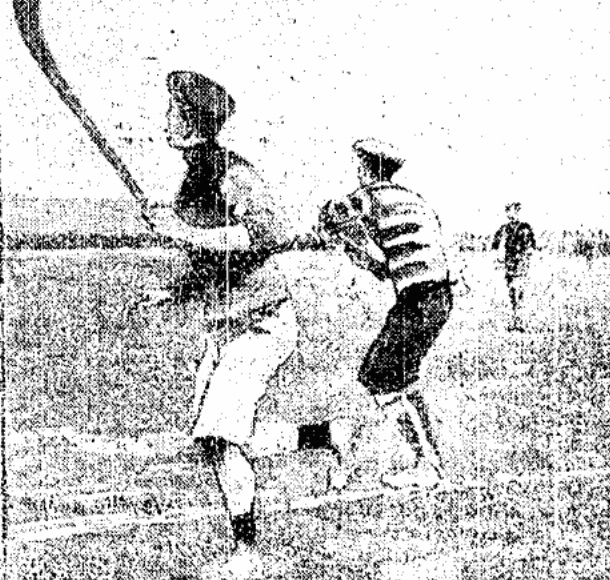
Long puck Wexford v Limerick Irish Independent 20th November, 1910
The Co. Clare Board G.A.A., were obliged to play off a tie between Tubber and Killinana on the Galway side on Sunday. Rumour had it that the hurling was to be prohibited, and for that reason an invitation to Gort to meet a selection from Clare was readily accepted, despite other engagements at home. A couple of platoons of military with full war equipment, assisted by several armoured motor cars, sported themselves on the roadside bordering the playing pitch. Shortly after the game started the “Iron Duke” and his other formidably named companions crossed the Clare border and disappeared amongst the hills unnoticed, except for a few derisive cheers as they motored past.

 The Burren and Beyond