Galway, Feb 4.
Last Wednesday and Thursday were so prodigious a storm that the spring tides on those days swelled so high as to overflow the Quay and parts adjacent. In several houses in the neighbourhood, the water was above three feet high; but on Thursday a circumstance happened which much surprised all that observed it, as the like was never perceived here before. Whilst it was flowing, the tide, as if by some violent emotion, was twice within the space of an hour, suddenly raised above its usual height, and as suddenly subsided, which made many think there had been an earthquake.
A sloop, said to be from Limerick, bound for Rotterdam with butter, has been for some days past in the Bay of Kinvarra, opposite this coast, her name or the master’s name not intimated; but it is said she has lost her rudder and is otherwise damaged by the tempestuous weather.
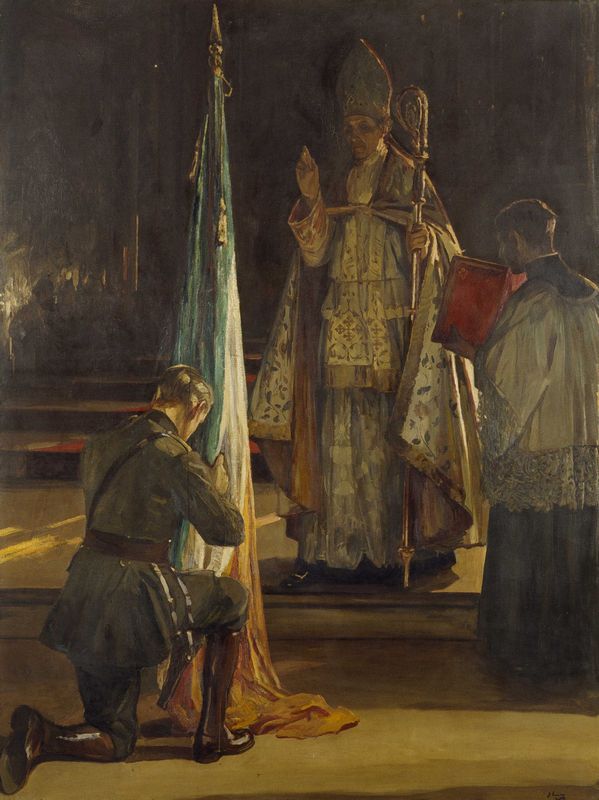
Blessing of the Colours John Lavery, 1922. Wikimedia Commons
At a full meeting of the Grand Jury, Gentlemen, Clergy and Freeholders of the County of Galway assembled pursuant to public notice from the High Sheriff at the County Hall in Galway on the 31st of March, 1782. The following resolutions were unanimously entered into; Resolved;
That a seat in Parliament was never intended by our constitution as an instrument of emolument to individuals and that the representative who perverts it to such a purpose (particularly at so momentous a period as the present), is guilty of betraying the trust reposed in him by the people for their, not HIS benefit. Resolved;
That the people who could tamely behold their suffrages made the tool of private avarice or ambition are still more criminal than the venal representative as they become the panders without even the wages of prostitution. Resolved;
That we do hereby solemnly pledge ourselves to each other and to our country by every tie of honour and religion which can be binding on man, that as our sacred duty which we owe to the community supercedes all ties and obligations to individuals.
It is time for the people to look to themselves and in great national questions to assert their right to control those who owe their political existence to their breath and may be annihilated by their displeasure.
Everyone in Galway is aware of the immense quantities of herrings that are at present in the bay but the Claddagh men will only go out every second night to capture them.
On Tuesday night Captain Oliver, one of the pilots, went out in his boat. This being a prohibited night, he soon found that he was being chased by two large hookers – watch boats, as they are termed – each filled with men. Seeing that he could not fight them he ran into Oranmore Bay and thus escaped.
On Friday night the “watchmen” succeeded in committing an outrage. Several boats from Kinvara were fishing when three or four Claddagh hookers, with about twelve men in each, bore down and cut away some of the nets. The boats that escaped came into market with immense quantities of herrings.
Very few of the Claddagh boats are marked, according to law, so that identification in such cases is almost impossible.
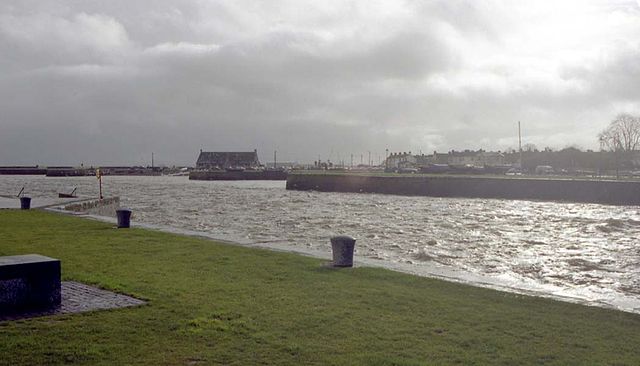
Pontypridd Chronicle and Workman’s NewsGalway Harbour Photo: Art Wikimedia Commons
2nd January 1891
The Dublin Express says that on Christmas night a disturbance took place between about 20 navy stokers, who are home in Galway on furlough from Plymouth, and about 20 men of the Connaught Rangers. A police patrol (three in number) interposed, and succeeded in inducing the military to desist; but when they advised the stokers to follow this example the latter turned on the patrol and beat them, whereupon the police drew their batons and dealt about them with a vigour that soon caused the stokers to beat a retreat through Mainguard-street. Here they were met by the soldiers, who attacked them with their belts, soldiers, wounding several of them, and obliging them to visit the doctors’ establishments to get their injuries dressed. One of the police patrol was also very much injured.
The Connaught Rangers acting under the impression that their assailants were men belonging to H.M.S. Banterer, being ignorant of the Christmas visit of the stokers, determined to have satisfaction, and with this object in view, a party of about 50 of them went to the dock on Friday night, and getting alongside H.M.S. Seahorse, which was also lying in the dock, and which they mistook for the Banterer, they asked the blue jackets to come forward and meet them in fair fight. They were informed by a man on board that the vessel was not the Banterer; and in the meantime word was conveyed to the latter vessel of the hostile intentions of the soldiers, whereupon, it is stated, the officer then in charge of the ship desired all hands to get on deck, and, opening the war-chest, had every man armed.
He then gave orders that should the Rangers make an attack they were to defend themselves, but not to kill, and to endeavour if possible to make prisoners of the entire force, and have them placed in irons.
When the would be attackers did arrive, however, and witnessed, the preparations made for their reception they held a council of war on the wharf at a safe distance from the defenders of the warship, and while this was in progress intelligence was conveyed to the military barracks of what was going on at the dock. A strong picket was at once sent out, on the arrival of which the besiegers beat a hasty retreat; but not before some of the leaders were captured. It is but fair to say for the credit of this gallant regiment that any disturbances which have brought the name of the Rangers into disrepute have on all occasions been brought about by recruits.
In 1830 a lady came to reside in Galway bringing with her a very interesting daughter about eight years of age. The husband of the lady had deserted her, and no tidings of him could be had. Whilst in Galway she married again, and died in childbed of her first child by the second marriage.
Upon coming to Galway she was engaged by a most respectable lady in town to give lessons to her children, and the lady was so struck with the child of the visiting governess that she took it into her house and generously afforded her a home. All this time the poor child knew nothing of her father; she supposed him to be dead, and the second husband of the mother had left the town.
Suddenly and quite unexpectedly, a great change came across the views of the doubly orphaned object of the benevolent lady’s care. A few days ago the first husband of the visiting governess – the child’s father – who was considered dead, arrived in Galway from India, with a considerable sum of money, the fruit of his industry. He inquired for his wife and found that she had been the wife of another, and had gone to the grave.
He then inquired for his child. He discovered her abode and claimed her as his own. The lady, beneath whose roof she had been nurtured, was most anxious to retain her, but the returned parent could not be prevailed upon, and after pouring out his grateful acknowledgments to the humane lady who had been a mother to the reputed orphan, he left with his young charge for the county of Cavan.
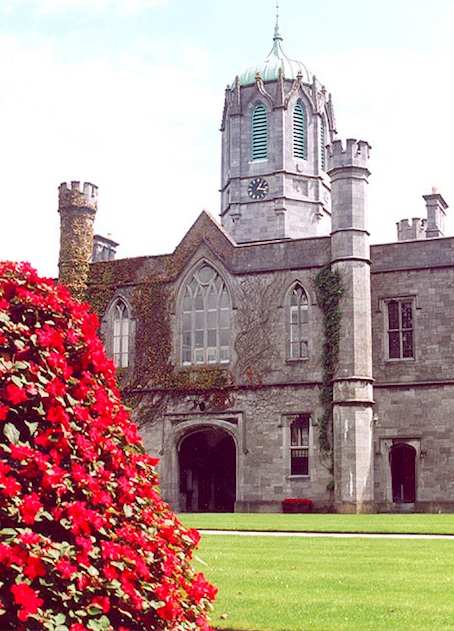
New Zealand Tablet 8th April, 1898 p9National University of Ireland, Galway Photo: Rob Smyth. Wikimedia Commons
A great meeting was held in Galway to consider the Catholic University question, and as might be expected, the Galway people spoke with no uncertain sound on the just claims of Catholics to educational equality. Professor Pye, MD., J. P., proposed the first resolution which ran as follows :—
“That we adopt the claim put forward by the Catholic laity of Ireland in their recent declaration, and reaffirmed by the national meeting held in Dublin, on the 11th inst., for perfect equality with our non-Catholic fellow-countrymen in all that regards endowment and privileges of University institutions, and express our determination to enforce that claim by every constitutional means in our power.”
The resolution was supported by Professor Steinberger, M.A., F.R.U.I., in a speech so fitting and to the point that we cannot refrain from quoting. He said he had travelled or lived in most of the countries of Europe, and when he first come to Ireland to learn the Irish language he met with many surprises. Nothing surprised him more than to find Ireland — which taught the greater part of the countries of Europe, and but for which he might now be a barbarian on the Alps or on the Danubem is without a University of its own.
He was astonished to find that the Catholic people of Ireland had no University. If they looked to India they could find the people provided for in this respect. If they looked to Austria, which was pretty much like the British Empire, in having under its dominion many different races and people speaking various languages, they would find the higher educational wants of these people well provided. Ireland is the only place in Europe where the majority of the people have no University.”
The following resolution was also carried;
“That we call on the members of Parliament for the town and county to press the Catholic claim for perfect educational equality on the House of Commons on every suitable occasion, and to expose the urgency of the grievance, and the injustice which a delay in dealing with it inflicts on the Catholic community.”
MODERN IMPROVEMENTS (abridged)
It has been thought expedient to place upon the levey book a good round sum
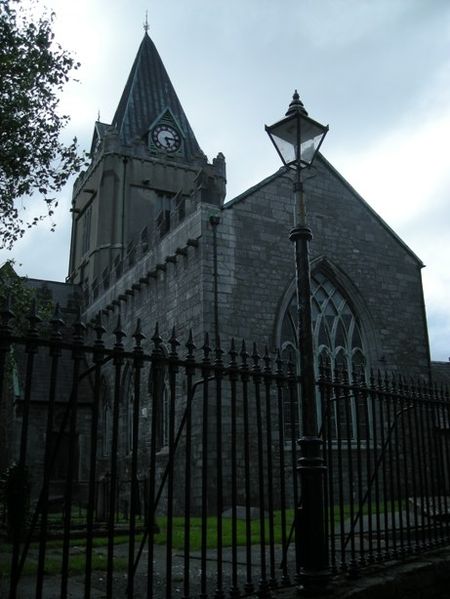
for the erection of two Galleries in the Church of St. Nicholas. One Gallery
is finished, at least the heavy work has been gone through, and has cost the
inhabitants of this miserable place some – (we do not know how many)
hundreds. The other Gallery will, we hear, be as expensive, if not more so-
and will be erected in the identical spot in which the former Gallery stood,
which was taken down a few years back.
Thus it was with us in Galway. We have, as the proverb says, “a time to gather and a time to scatter- a time to build up and a time to pull down.” If a Gallery was considered at all necessary in this beautiful building why was the old one taken down?
It certainly was not removed through any apprehension of its falling, for the
work and materials were found to be excellent; no – this was not the reason
of its disappearing. The Parish saw, that instead of its being at all
useful or necessary, it was calculated for very bad purposes, being nothing
less than a perfect nuisance, and a lurking place for abomination of every
description – a mere profanation of the House of God. In this assertion we
are borne out by every person with whom we have communicated; and, while all
see that it is an unnecessary expence to the Parish, none have had the
firmness to come forward and oppose the impost. Our astonishment at this is
very great; but we must confess that it is wonderfully increased at hearing
that it is intended to remove, or take down, the handsomest ornament in the
Church, for the purpose of making way for this Gallery.
We here allude to Lynch’s Altar. The new Gallery cannot be built so as to avoid disturbing this venerable remnant of antiquity, as the old one was, but Lynchs’ Altar – the finest specimen of mechanism in the entire building. Lynch’s Altar, which has stood the test of so many centuries, and even commanded the protection of a Gothic infuriated Soldiery in the general destruction of Church property and ornaments, must be now set aside, removed or taken down- and by whom? By men who ought to be enlightened – who pretend to taste and judgment, but who do not seem possessed of any strong claims on either. The large tomb will be (we hear) also removed. We shall merely ask – will the
descendants of the LYNCH family suffer this to pass without an observation?
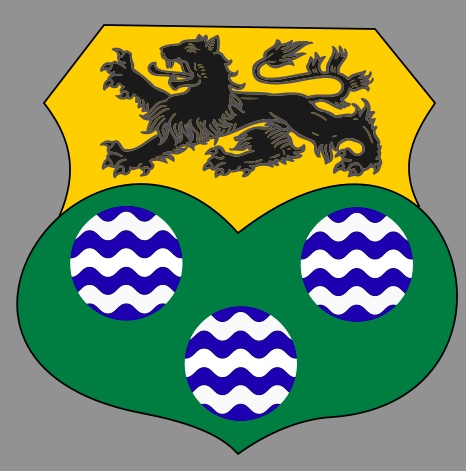
Leitrim Coat of Arms Kanchelskis Wikimedia Commons
On the evening of the landing of the immigrants by the Kapunda at Townsville, a grand scrimmage took place. Some unprincipled vagabonds broke into the single girls’ department about bedtime. The cries of the girls brought the gallant Galway and Leitrim boys to the rescue. They tackled the intruders and a regular fight was started. The police, who are far to few in number on an occasion of this kind, interfered. One got a black eye and another a torn jacket, and the result was that the depot was cleared and four delinquents marched to the lock-up. The most serious charge was against a man who bit off half the ear of one of the new chums. This cannibal is to be sentenced today.
Yesterday at Galway, as some musicians were returning from serenading the bishop at his house, the police seized their instruments and arrested the musicians. There is intense excitement over this matter.
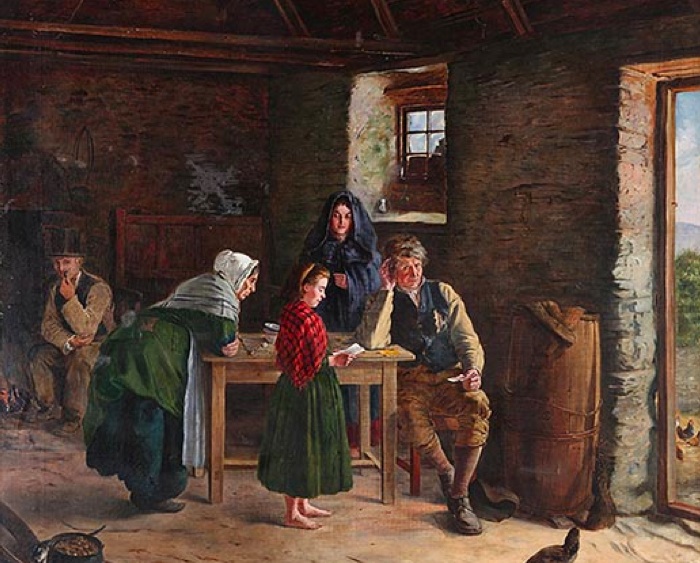
Freeman’s Journal 28th March, 1868 p11 (abridged)News from America 1875 James Brenan (1837-1907) Crawford Art Gallery, Cork
Lough Cooter is the largest lake in the south of county Galway, with many wooded islands lying in its bosom, and lovely views between them. The ‘Castle,’ belonging to the Gough family is a modern erection, in the castellated style, standing on the west bank of the lake, and commanding a most exquisite view, while the lawn slopes down to the water’s edge. Beautiful grounds, richly supplied with trees, surround the house, part of them planted and laid out, part left for the deer to wander about. A gateway and lodge stand at each end of the grounds ; and after passing through the whole length, we returned by another route to Gort in time for the quiet benediction in the little convent chapel.
Travellers from Galway and its neighbourhood proceed by coach via Gort to Ennis, and as there are many emigrants, the coach is often full. This was the case on the morning on which I left Gort, and accordingly two ‘long cars’ were furnished from the coach office, which were rapidly filled with emigrants from Gort. The whole cortege, started from the office in the main street and it was a strange and sorrowful sight to see the partings. A crowd of people collected round the passengers: mothers and brothers and sisters were saying good-bye, weeping, wailing and sometimes howling; kisses were given, last greetings exchanged; promises to write soon, to send money over, and ‘bring the others out’ were uttered and, at last, away they went.
I noticed that the best were going — the young, strong, and vigorous — the old, the feeble, and children were left behind.
By my side sat two young girls, strong, healthy, and active. They were going into the world, and had discarded the blue cloak and stuck on their heads showy bonnets much too small for them, profusely decorated with tulle and artificial flowers and with broad strings of white ribbon. When we were fairly out of town, passing through the solitary monotonous country and admiring friends were left behind, out came the large shawls, in which head, bonnet, and all were fully enveloped.
They became confidential and told me they were going to America to get places. On my suggesting that they could find such at home, they shook their heads and said not with such wages as in America. When they were tired of talking they took out their books and began to read, and, peeping over the shoulder of the one next me, perceived the volume carried with her was a prayer-book.

 The Burren and Beyond