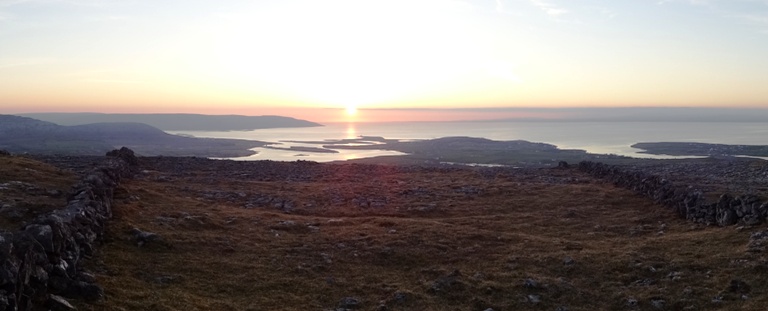
Mrs Skerrett, of Pembroke road, Dublin and Finavarra House, Kinvarra, Co. Clare, has let the latter place for the summer months to Mr. J. Harris Stone, B.L. of Oxford and Cambridge Mansions, London. The change to the solitude of the Burren district will be pleasing to the tired London man, and the air is deliciously fresh. There is a fine music room at Finavarra, and a series of theatrical performances was given there a couple of years ago by Mrs Skerrett and her sister, Mrs Sampson – both widows and full of quite unique talent in a musical and histrionic way.
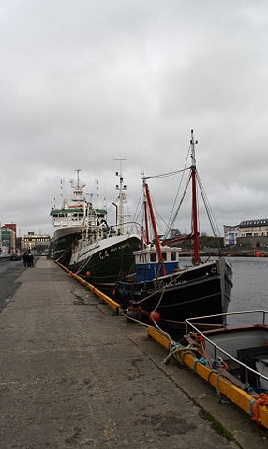
The rumour regarding Galway Bay to be selected by the Admiralty as a naval base has created much interest locally, but the official confirmation is still wanting. The rumour, however, is not taken for over much here, as it is believed its origin has sprung from a discussion which took place at Galway Urban Council meeting last week. It is stated that the Admiralty were anxious to acquire the foreshore called Fairhill, which is at present used as a fair green for the training of the Naval Reserve, it being eminently suitable. The Council, although ready to meet the admiralty, would not give their sanction, in the absence of any official reference to the matter. Galway Bay is well suited for either a naval base or a transatlantic station, there being not less than six fathoms of water in any part of the bay, and the depth in the fair way is greater, so that vessels of the heaviest tonnage might ride safely afloat. Years ago Galway Bay was a steam packet station for America.
Supplement to the Cork Examiner 4th April, 1903 (abridged)
Photo: Norma Scheibe
On the death of his father, Fiachra, Dathi became King of Connaught (c. 5th Century A.D.) On the death of his uncle, Niall of the Nine Hostages, he became Monarch of Ireland. He not only invaded the coasts of Gaul, but forced his way to the foot of the Alps where he was killed by a flash of lightening, leaving the Throne of Ireland to be filled by a line of Christian Kings.
Darkly their glibs o’erhang
Sharp is their wolf-dog’s fang.
Bronze spear and falchion clang
Brave men might shun them!
Heavy the spoil they bear
Jewels and gold are there
Hostage and maiden fair.
How have they won them!
From the soft sons of Gaul,
Photo: Norma Scheibe
Roman, and Frank and thrall,
Borough, and hut, and hall
These have been torn.
Over Britannia wide
Over fair Gaul they hied
Often in battle tried,
Enemies mourn!
Fiercely their harpers sing
Led by their gallant king,
They will to Eire bring
Beauty and Treasure.
Britain shall bend the knee
Rich shall their households be
When their long ships the sea
Homeward shall measure.
Barrow and Rath shall rise,
Towers too, of wondrous size,
Tailtin, they’ll solmenise,
Feis-Teamhrach assemble.
Samhain and Beal shall smile
On the rich holy isle
Nay! in a little while
Oetius shall tremble!
Up on the glacier’s snow
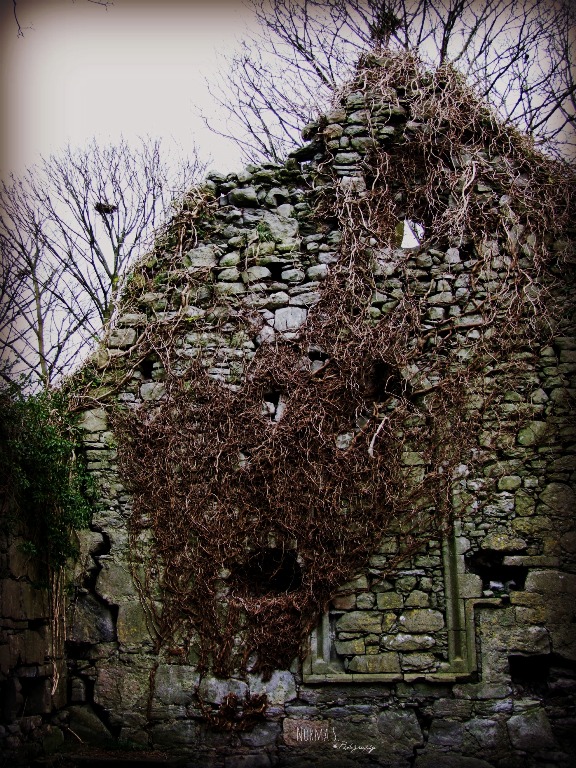
St Coman’s Church, Kinvara Photo: Norma Scheibe
Down on the vales below
Monarch and clansmen go
Bright is the morning.
Never their march they slack,
Jura is at their back
When falls the evening black
Hideous and warning!
Eagles scream loud on high;
Far off the chamois fly,
Hoarse comes the torrent’s cry,
On the rocks whitening.
Strong are the storm’s wings;
Down the tall pine it flings;
Hailstone and sleet it brings
Thunder and lightening.
Thundering, hail or wind;
Little these veterans mind
Closer their ranks they bind
Matching the storm.
While, a spear cast of more,
On the front ranks before,
Dathi the sunburst bore,
Haughty his form!
Forth from the thunder cloud
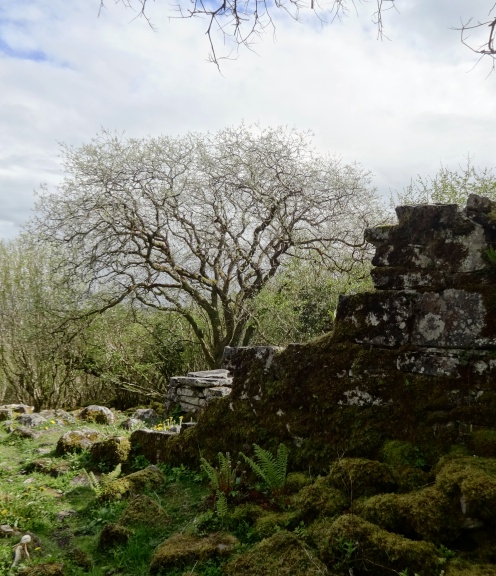
Photo: EO’D
Leans out a foe as proud
Sudden the monarch bowed,
On rush the vanguard;
Wildly the King they raise
Struck by the lightning’s blaze
Ghastly his dying gaze,
Clutching his standard!
Mild is the morning beam,
Gently the rivers stream,
Happy the valleys seem;
But the lone islanders –
Hark to the wail they sing!
Hark to the wail they sing!
Dark is their counseling
Hervetia’s highlanders.
Gather, like ravens near,
Shall Daithi’s soldiers fear!
Soon their home path they clear
Rapid and daring
On through the pass and plain,
Until the shore they gain,
And, with their spoil again,
Landed in Eirinn!
Little does Eire care
For gold or maiden fair
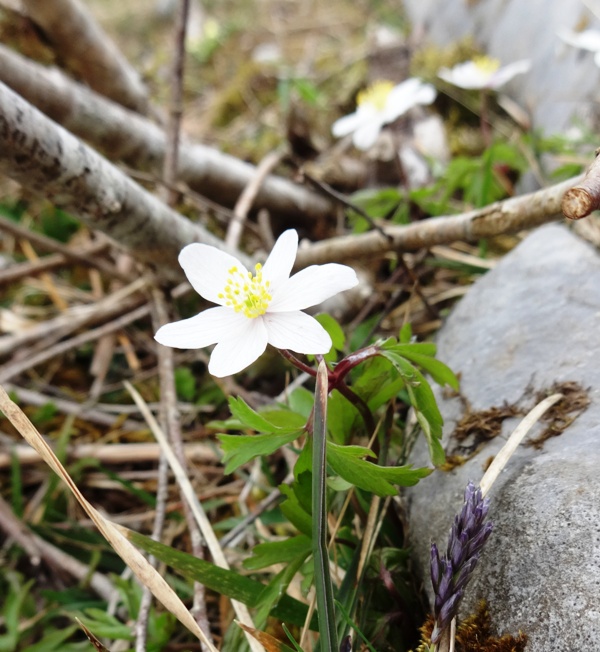
Photo: EO’D
“Where is King Daithi – where
Where is my bravest?”
On the rich deck he lies
O’er him his sunburst flies
Solemn the obsequies
Eire! thou gavest.
See ye that countless train
Crossing Roscommon’s plain
Crying, like hurricane,
Uile liu ai!
Broad is his cairn’s base
Night the “King’s burial place”
Last of the Pagan race,
Lieth King Daithi!
Notes:
Glib – a hairstyle with long fringe.
The consul Oetius, the shield of Italy and terror of ‘the barbarian’ was a contemporary of King Daithi.
Feis Teamhrach is the Parliament of Tara.
The Tailtin gaves were held at Tailte, County Meath.
Samhain and Beal, the moon and sun, were worshipped in pagan Ireland.
Eire was the ancient name of Ireland
A Sunburst was the national standard of Ireland
Hibernice, Reilig na Riogh was a famous burial place near Cruachan, in Connaught were the kings were usually interred before the establishment of the Christian religion in Ireland
Tribes and customs of the Ui-Fiachrach – Irish Archaeological Society publication.
Ireland is smaller than it was, only to an inappreciable extent, it is true, and apart from any action of the waves or weather which may have a tendency to affect its size by natural means. The truth is that some Ireland has been shipped to America in barrels.
Turf from Connaught and Clare, soil from Limerick and Mayo, heather from Croagh Patrick, shamrocks from Donegal, peats from the bogs of Ulster, turf from every county in Ireland, have been sent to Chicago to be used in building a miniature Ireland in the Coliseum. The soil will carpet the floor of the big building during an Irish fair which is to be held in that city. There were thirty-two casks of the soil, and it will be arranged in the shape of the counties from which it waa dug. There were eight great crates of peat, which will supply fuel for the miniature shops, stores, and houses that will be erected in each county.
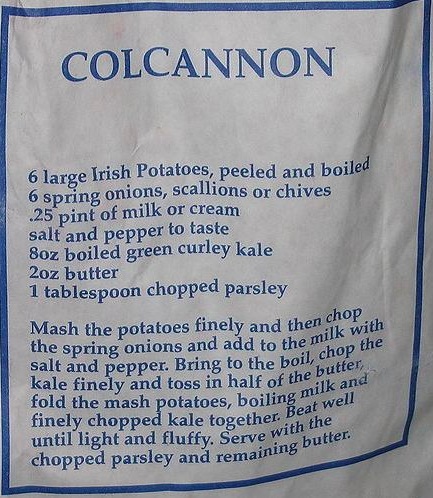
Colcannon recipe on bag of potatoes Photo: Sarah777 Wikimedia Commons
Colcannon
Six cups of boiled cabbage, three cups mashed potatoes, three heaped tablespoons butter, one cup of milk, seasonings.
Mix cabbage, potatoes, butter, milk and seasonings. Place in buttered baking dish. Dot with more butter and bake 40 minutes in hot oven. Serve with meat.
The Salt Lake Herald 14th June, 1903
Irish Colcannon
Peel and cut a large parsnip into small pieces, cook for fifteen minutes in boiling water; then add peeled potatoes and an onion. When the vegetables are very tender drain the mash, adding milk or cream until you have a smooth mess. Season to taste with salt and pepper.
The News and Herald 13th January, 1883 p4
Wash a head of white cabbage and put it over the fire to boil in plenty of salted boiling water Peel twelve large potatoes and put them to boil with the cabbage. When the cabbage and potatoes are done, drain of the water in which they were cooked, add to them four tablespoonfuls of butter, a cupful of good milk, or cream if it is plentiful, a level teaspoonful of pepper; chop all these ingredients together; then heat them and server the colcannon hot as a vegetable dish.
Philadelphia Colcannon
The Intermountain Catholic 28th February, 1903 p6 (abridged)
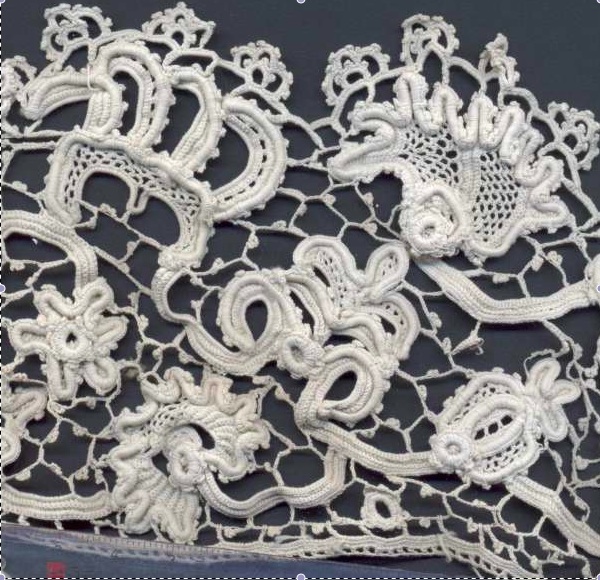
Irish crochet Creative Commons .
The industrial school of the Convent of Mercy, Gort, County Galway, Ireland will supply anything in lace.
It is gratifying to me to read from time to time extracts from subscriptions and business letters that come to this office, thanking for suggestions offered in this department. One just to hand is profuse in thanks for receiving laces ordered from Ireland, taken from the advertisement in our columns.
One reader asks: “Why do we not see this beautiful lace in our big stores?”
The answer is easy; Because you do not inquire for it, or, when you do, you exercise no judgment and permit yourself to be persuaded into purchasing an inferior article. Make it a point in shopping to ask for what you want, and do your own thinking as to whether or not you will purchase.
If you are a judge of lace then you know that some of the most exquisite laces in the world are made in Ireland, and you can even have a design worked out for you if you desire. The Irish laces were awarded prizes for designs and prizes for workmanship at the World’s fair at Chicago, which exposition was the greatest ever held in this country.
Edith Rayner in New York Freeman’s Journal
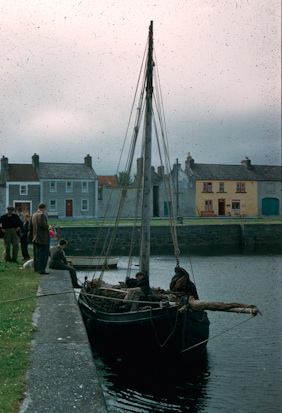
Kinvara Harbour c1950 Cresswell archivesOamaru Mail, Volume XXVIII, Issue 8273, 31 August 1903, Page 4
THE TWO IRELANDS
(By Filson Young, in the London Daily Mail.)
Donegal, August 17. (abridged)
There are two Irelands, one of smiling, one of miserable, aspect. The first is known to the many, the second to the few; the first greets the tourist at every turn, the second is discovered only by those who leave the beaten tracks, and, travelling far from the railways and even from the roads, come face to face with the naked life of mountain, bog, and shore. And the first is exploited and displayed, while the second is hidden.
There are some very simple facts about Ireland which at this moment cannot be too widely known. Before facing the dark side, let us dispose of the first, the prosperous Ireland, which, standing as it does in the foreground of the picture, obscures the view and interrupts the attention of those who think they have seen the country.
To say that it is a strip of Ireland’s eastern seaboard that is prosperous, is only one, and an imperfect way of stating the case. It would be nearer the mark to say that what we take for prosperity in Ireland is but the stir and bustle of market-places that exist only by virtue of their proximity to Europe. In the eastern seaports we find this stir and bustle. In the western, never.
Beyond earshot of bustling centres of artificial trade you are enfolded by the stillness and emptiness of rural Ireland. The green fields sleep in the sun. Empty cabins proclaim from their boarded-up windows – a thousand tragedies of failure and departure. It is a silent and vacant country.
Into the stately waterways of Cork, of Galway, of Limerick, the sea twice a day comes brimming up, filling with its inexhaustible flood the spaces between the imposing empty warehouses. The beautiful buildings, raised when Ireland had a population and a trade, are crumbling and deserted great chambers. These western ports, so nobly furnished by nature, and by man, so entirely unvisited, save by the punctual tides, are imposing monuments of a decay that is vast and complete.
Never a tide rises but it carries away with it something priceless, vital, irreplaceable — the life of the country. And even away from the great ruinous ports along a coast unmatched in the world for its bays and inlets and roadsteads, you may note the blight of desolation and mark the sea’s revenges.
The Sea-Divided Gael
(abridged)
From the Galway ‘Express’ of May 16th we extract the following :
Mr. M. J. O’Loughlin, Collector of Inland Revenue, Head Distributor of Stamps, and Receiver of Crown Quit Rents for the Counties of Galway, Clare, Mayo, Roscommon. etc., has been appointed to the important Collectorship of Inland Revenue at Manchester.
Mr. O’Loughlin will enter on his new duties on the 26th inst. The many friends of Mr O’Loughlin, while they will be glad to learn of his promotion, will be sorry that it means his removal from Galway. Mr O’Loughlin has been collector here for over three years, and has made himself very popular with all classes of the community. To all public movements of a deserving character he has always been willing to lend a helping hand and to cite only one instance his services in connection with the Claddagh Disaster Fund will not soon be forgotten.
Mr. O’Loughlin is a native of Kinvara . He was educated at Mungret College Limerick, has been 20 years in the Inland Revenue and, during that time, has served in many places in the three Kingdoms. He is one of the best known science men in the service. He is an honorary member of Lord Armstrong’s Ordnance Works at Newcastle-on-Tyne, and in the Royal School of Mines, London, won a scholarship, coming out first of 300 students. In addition to that Mr. O’Loughlin is a recognized authority on taxation, revenue and kindred subjects, having on several occasions taken the first prize offered by the ‘Civilian’ for the best essay on subjects connected with taxation. The best wishes of Mr. O’Loughlin’s many friends and acquaintances in Galway will follow him to Manchester, and his future career will be watched with interest in the City of the Tribes. (Mr. P. O’Loughlin. a brother, is the present District-Secretary of the Hibernian, A. C. B. Society, Sydney.)

 The Burren and Beyond