Posted in Posts and podcasts

A True Statement – 1828

The Australian 16th April, 1828 p.4
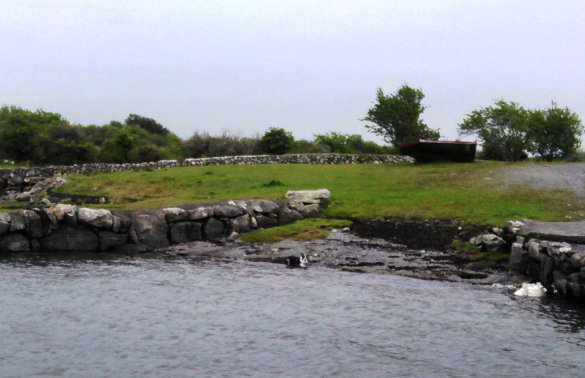
Photo: EO'D
Photo: EO’D

On the morning of the 4th Aug. two carriages, were seen driving with great rapidity towards the beach of Kingstown Bay, Dublin, where there lies moored a convict ship. The first was an open carriage, and from the elegance of its appointments, belonged to a person of rank. The travellers in this carriage were an elderly gentlemen and a lady, who, from her age and other circumstances, appeared to be his wife, and both seemed to lavish the most assiduous attentions on a young and lovely female, who sat beside them, holding an infant to her breast her head reclining on the bosom of the lady, and one of her hands clasped fondly by the old man, all apparently buried in profound grief.

The second carriage, which contained two persons, was surrounded by a military party. One of these persons was a young and handsome man, attired in the convict dress, and the other was presumed to be a prison officer. The former appeared to be of the better order of the peasantry, and exhibited in his manner a mind extremely agitated, while his eyes were strained towards the foremost carriage, and his looks appeared to rest entirely on the young female who sat fronting him within it.

As the carriages approached the beach, a boat put off from the convict ship; and reached the shore as they arrived. The travellers in the carriages were conveyed to the ship, from whence, some time after, the old gentleman and his supposed wife returned, much oppressed with grief, and ever and anon looking back to the ship to catch a last glimpse of their young companion, who remained on board with her infant. They almost immediately drove off in their carriage, leaving all the elderly tabbies of the good town of Kingstown quite in a quandary as to the extraordinary scene they had witnessed.

Subsequent inquiries, however, have discovered a solution to the affair by no means improbable to be the truth. It appears that the lady is Miss -—— . from the south of Ireland that she yielded to the secret impulses of her heart, and without the father’s knowledge, married a young tenant on his estate. Her husband, in the mean time, had become involved in the treasonable conspiracies which have kept the southern province of Ireland in a state of disturbance and was visited with the sentence of the law. The extent of his criminality precluded the possibility of pardon, and the affection of his wife would not permit her to remain behind, when the partner of her heart was doomed to perpetual banishment from his country. The elderly couple were of course the parents of the lady, and they had good cause for grief at parting for ever with their only child, whom they loved with all imaginable fondness, and whose loss they may be supposed to deplore with a grief proportionately severe.

Posted in Posts and podcasts

The Bridge of Sighs – Galway – 1828

Freeman’s Journal, 10th September, 1828 p.2 (abridged)

The bridge of sighs
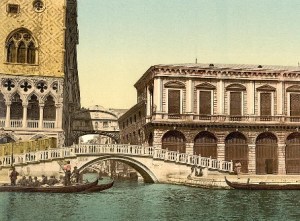
The Bridge of Sighs, Venice Wikimedia Commons

The boats of Lough Corrib, not too well constructed in the first instance, are greatly injured by the yearly practice of dragging them through the town from the lake to the bog at the time of the herring fishery. This extraordinary and most dangerous exertion of these poor people would be rendered unnecessary by a short Canal, which would be of incalculable benefit to the town and county of Galway; but will it be believed that the proprietors of the town fear it would be of too great service to their country neighbours. They neglect this splendid improvement, whilst they have laid out an enormous sum on a bridge so low as to obstruct the water passage, but which has in face of it a most beautiful gaol, with gallows resembling the portcullis of a fortification, and somewhat reminding us of the bridge of sighs at Venice.

Posted in Posts and podcasts

The Long Black Hand – Richard Cronnolly, Ballinderreen – 1864

Connacht Tribune – 25th February, 1972

Photo: EO'D
Photo: EO’D

Richard Cronnolly was born in Ballinderreen Co Galway in 1828. He joined the Dublin Metropolitan Police and spent his spare time in the Record Office where he studied old documents. Without any assistance, financial or otherwise, he found a publisher willing to give the result of his researches to the world. He was working against time, and died in the moment of success at the age of thirty five.

He left behind him a work that is remarkable. The Long Black Hand, a recitative poem, which tells of the slaying of malicious spirit who made life miserable for the people of Ballinderreen a few hundred years ago.
The Long Black hand may be read on Fadó Fadó at theburrenandbeyond.com

Posted in Posts and podcasts

The Knight of County Clare – 1828

Freemans Journal 14th July, 1828 p.3   (abridged)

Daniel O'Connell   George Hayter National Portrait Gallery
Daniel O’Connell
George Hayter National Portrait Gallery
Wikimedia Commons

The return to the writ for the Election of a Knight to serve in Parliament for the County of Clare was received at the Crown office, London, on Thursday. The following is a copy of the return and the Indenture accompanying it;

By virtue of this writ, to me directed, I did within two days after the receipt of the same, (that is to say), on the 19th of June, 1828, cause proclamation to be duly made for holding an election, to be held at the County Court house of the County of Clare, at Ennis, on the 30th of June, 1828, of a Knight to serve in Parliament for said county.
Sir Edward O’Brien and Sir Augustine Fitzgerald, Bart., two of the said electors of Knights, did then nominate and propose the Right Hon William Vesey Fitzgerald, being a Protestant, as the most fit and discreet person to be elected. James Patrick O’Gorman Mahon and Thomas Steele, Esqrs, two other said electors, did nominate and propose Daniel O’Connell Esq., as the most fit and discreet person to be elected a Knight.  Daniel O’Connell did, at said Court, publicly declare and profess that he was a Roman Catholic, and that he intended always to continue a Roman Catholic.

The poll commenced on the 1st day of July, 1828 and continued until the 5th day of July, when same finally closed.
During the said poll electors did publicly protest against the election of said Daniel O’Connell insomuch as he was, and declared that he intended to continue, as Roman Catholic.
At the final close of said poll 982 electors voted for William Fitzgerald Vesey Fitzgerald, as a fit and proper person o be elected and 2,057 voted for said Daniel O’Connell as a fit a proper person to be elected a Knight to serve for said county.