Collected by Peggy Moran, Ballinderreen N.S. from Mrs Mannin (aged 67) 1938 The Schools’ Collection, Volume 0033B, Page 04_031 National Folklore Collection, UCD. There was once a stone in Clare, and every night, there used be a candle lighting on it. If anybody saw that candle lighting after sunset they would be dead next morning. It happened when St Patrick came to Ireland that he heard of the stone. One night He went and took lodging at the house nearst the stone. When he saw the man of the house locking the doors and bolting the windows he asked him what was the idea of doing that. Then he told St Patrick about the stone. The Saint said open thye windows and doors and come with me, to see the stone. The man was afraid, because if he looked at the candle he would be dead next evening St Patrick said not to fear while he was with him. Then the Saint put on his Stole and said prayers near the stone. He struck it with his Stole and broke it in two halves. A black bird flew out. He struck the blackbird with the Stole and it fell dead. It fell into the water which was near the stone. Saint Patrick turned it into wine because it was turned into blood at first when the bird fell into it. The man said if he left the water in wine people would be coming from all parts of Ireland and get drunk. At that moment it was changed into water. Ever since it is called Lough Ruadh or the Red Lake.
Collected by Patrick Nolan, Kiltartan N.S. The Schools’ Collection, Volume 0047, Page 0090 National Folklore Collection, UCD.
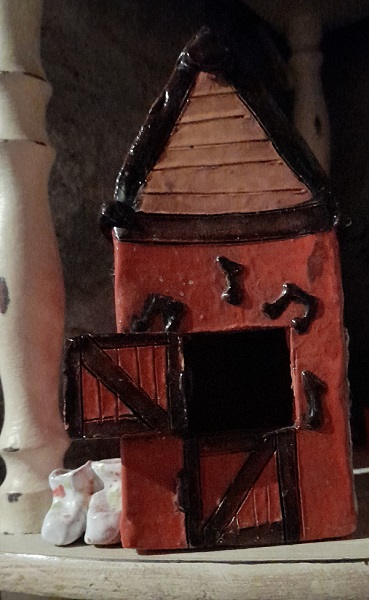
Clare’s Doll House Photo: EO’D
A Fob Gun
Nowadays toy guns, made in Germany or Japan can be bought for a penny. Long ago boys made their own guns. This is how they did it. First they got a piece of an elder tree. Then they would redden a piece of an iron and bore a hole through it. Then a piece of wet paper was got to act as a bullet. This was stuffed into one end of the gun. Next a stick was got to fit the hold. Another ‘bullet’ was inserted into the other end of the gun, and everything was ready. The stick was then pushed through the bore of the gun. The force of the air through the gun would make a shot.
Spinning Tops These were made by the boys themselves long ago. An empty thread spool was pared and shaped like a top. The hole through the centre of the spool was then filled with a piece of timber, and a nail (from which the head was removed) was then driven into the pointed end of the top. The top could be made spin by twisting several coils of twine around it.
This was composed by a local poet who’s name is unknown. It is about the Loughnane brothers, natives of Shanaglish beyond Gort. They were members of the I.R.A. and they were brutally burned by the English. They were dragged behind two carriers for three miles and they died near Kinvara. Their bodies were then thrown into a pond and were not discovered till ten days afterwards. The Tans that committed this outrage in Nov. 1920 (abridged)
As the winter’s wind blew wild on a cold November’s night, The sad news reached Kinvara of a mournful tragic sight,
It was the finding of two brothers pale corpses lay side by side, Far from their loving mother these true hearted brothers died, They were taken by our enemies while threshing their mother’s corn, And came back cold corpses to the place where they were born, They were taken in a lorry by a military escort, From their native home Shanaglish Three miles south-west of Gort. II They were dragged behind two carries for three miles and more, Till the blood gushed from their faces and their bodes bruised and sore, They were taken to Drimharsin on a clear November’s day, While the blood gushed from their faces and their roars were head for miles away. “What they suffered God only knows.” III Their bodies were brutally burned as they lay upon the ground, Then left into a pond to prevent them from being found, For ten long days in this desolate grave unblessed by any priest Those martyred brothers Loughnanes by God’s aid was released, To an old house near Kinvara the funeral marched next day, Under a body guard of I.R.A. who took the remains away. IV That day was a sorrowful day for their mother, To see the fresh blood oozing from a wound in Harry’s side, Poor Padraigh’s flesh was torn, o’er his eyes were boiled within, There was nothing left to recognize but a nose and half a chin, His brothers bones lay visible as cold corpses they did lie, Their bodies they were coffined and wrapped in brown and white, And left into the Church of God where they rested that night. V The following day was a mournful sight for the mother of the brave, To see her darling boys going to the bosom of the clay, Those brother nursed with tender care are now beneath the sod, Their spirits are despite their foes today before their God, In the church yard of Shanaglish those two young heroes lie, They gave their blood for Ireland and died for you I, (sic) And gave up all they had on earth and suffered all these pains, To strike for you anther blow and smash the Saxon chains. VI Is there any rebel here amongst you still to repeat those words again, To thread the path of dauntless men who have suffered without fear or disdain, But if you be true to England by obeying her Saxon laws, They you’ll soon forget our men shot down by the cold blooded murderers, the servants of the Crown, Let this ring throughout land and echo over the main, That our gallant Loughnane brothers were not sacrificed in vain.
The Schools’ Collection, Volume 0620, Page 062 National Folklore Collection, UCD. Collected by: Séamus Ó Sealbhaigh, Kilfenora N.S. 10/12/1937 The feast of St. Martin falls on the eleventh of November. In parts of Ireland fowl are killed and the blood spilt in different houses, the stable for the horse, in the cowhouse for the cow’s and in the dwelling house. As the belief was that the Saint protects the animals and people. Another belief was that if the blood was soaked in cotton wool and the wool kept safely and applied to affected parts when people got pains. It was supposed to cure them.
Some people also believe that it was not right to roll any sort of wheel’s on that day.
National Folklore Collection, UCD. The Schools’ Collection, Volume 0615, Page 073
Collected by May Burke, Turlough, Co. Clare from her mother 21st April, 1938 My mother tells me the only poet she know personally, was an old man, names Matthew Mahon. He lived near Kinvara in a village called Durras. When she first saw him, he was a very old man, and he was lame from his birth. He was very poor. He used to travel around the country on foot, taking notes of rivers and lakes, or any thing of note. He would then go home and shut himself in for weeks, composing verses in thanks and praise of those who would be good to him or give him lodging’s. A few of these verses are the only ones she remembers of the poems -:
Just in winter before the spring I went to Turlough there for to sing, To take down notes of each place I pass, I arrived in Turlough just after Mass. My mind at first was in great grief Knowing they might repose it would give relief, My feet were panting, for alas I’m lame and to ask for lodging’s I felt great shame.
Collected by Margaret McGann, Turlough N.S, from her father Thomas McGann, Aughavinane, Bellharbour, Co. Clare April 21st 1938 The only poet that they knew of around here was Matt Mahon. He lived in Duras in the parish of Kinvara. He was fairly well educated. He used to come around here with an ass and car. One of his hands and one of his legs were disabled. When he would come into a house if he was not well received he would make up a bad song about the people of the house and if he was well received he would make up a good song. He was travelling one Sunday and he went into a lot of houses and he got nothing until he came to Peter McGann’s.
He was highly received there and he composed the following verse:- I been from Connaught and in in (sic) Clare And by my conscience I must declare That the likes of Peter and his family are not living now in this country. They are kind, they’re mild, they’re good and grand, they’re likes I find are not in this land. For their hearts are wide, I really swear, surpassing all I know in Clare.
He used used to have these songs written in ballads and he used to sell them for 1d each.
Collected by Brigid Hynes Ballymanagh N.S., from Stephen Donohoe, Ballymanagh – 24th June 1938 National Folklore Collection, UCD. The Schools’ Collection, Volume 0036, Page 0161
There were no poets in this district formerly, but there was a wandering poet from Dooras, Kinnara (sic), Co Galway. His name was McMahon. He made a poem relating to anyplace he was ill treated in. He made a poem about Michael Cunniffe, Cahergal Craughwell, because he wasn’t entertained in it. The poem is as follows.
In Ballymana there are nice people, Kind and decent, when strangers pass, Especially those who are old and feeble, And poets are often of the class, But when a poet has walked the parish, To where Mick Cunniffe has got his home, The latter he did not him cherish, So now I will begin my poem. I Mick so bold, proud, and haughty, Thinks all others are a botch, If people speaks they are faulty, Because he carries a curious watch. II He is old enough to marry now, I think he is fifty nine, He wants a son to drive his cos, who yet will have his coin;
McMahon died in the year 1924. He was sixty two years of age. He is buried in Doorus, Kinvara, Co. Galway. One day he was talking to children on their way to school and he asked a slate of them. They gave it to him, and he wrote on it this verse;
The world is round, and it goes on wheels And death is a thing that everyone feels, But if death was a thing that money could buy, The rich would live, and the poor would die. But God is so merciful, it would not be so, The rich and the poor on their turn must go.
Long ago a man from Garryland, Kilmacduagh, Co. Galway went to Scotland.
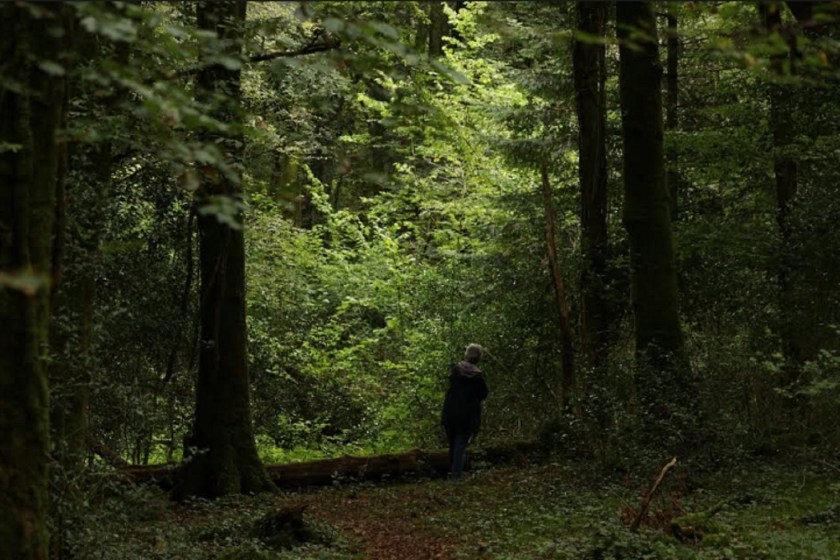
Garryland woods Photo: EO’D
Before he went he cut a stick in Garryland wood brought it with him. One day as he roaming about a big wood in Scotland he saw a little bothán and he went into it. Sitting at the fire he saw an old man smoking an old clay pipe. When he saw him he said I know where you got that stick, you cut it in Garryland wood and how I know is that my two sons are there minding a pot of gold that is hiden (sic) at the cathair and here is the key of the door and while the people are gone to Mass go to the cathair and you will find the door and you can open it with this key. There my sons are and they are tied to the pot of gold with chains and they are in the shape of two hounds. When they will see you they will jump with joy but do not get afraid. The man went home and found the door and went in. There were the hounds and when they saw him they began jumping about him and he got frightned and ran out without the key. He came back again but could not find the key and the gold is said to be there yet.
Collected by John Burke from his grandfather, Peter Burke, Cahermore.
From The Schools’ Collection, Volume 0036, Page 0257
National Folklore Collection, UCD.
Collected by Kitty Moran, Ballinderreen N.S from Mrs Thomas Moran
Photo: EO’D
BACKGROUND On Mr De Valeras first visit to Galway in the year 1913 the Sinn Féiners engaged all the sidecars in the parishes to go to the meeting. The meeting was held on New Year Day and the Sinn Féiners painted Pat Smyth’s horse because he did not go to Galway like the others. This song was composed by James O Connor Ballinderreen
Thomas dear and did you hear your horse was painted green
And taken from his stable and drove through Ballinderreen
We thought it was a circus horse with colours bright and gay
But it was a piece of good advice to remember New Years Day.
II
Pat Smyth arrived upon the seen and standing five foot two
He said he would revenge his gallant steed the pride of Caheradoo
He pursued the noble animal but his efforts were in vain
For the horse he boldly started off and snorted up Sinn Féin
III
Friends gathered round from Mulrook
and from Cillín Aran too.
To try to solve the mystery of the horse from Caheradoo.
But the perpetrators they were gone and behind them left no trail
They tied a flag upon his name and one hung from his tail
IV
And sure it was an ugly thing to treat the horse like that
For we all had veneration for Tom and little Pat
The Sinn Feiners they are gone to hell and that’s plain to be seen
They’d paint the very devil in that place called Ballinderreen
V
So now to conclude and finish and I think its nearly time
I hope you will excuse me I’m a little out of rhyme
But they say the Smyths have sworn and promised without delay
To send their horse to Galway on the coming New Years day.
The Schools’ Collection, Volume 0033B, Page 03_042
National Folklore Collection, UCD
Sometimes she represents an owl, a cat and very often a bat
There is a special spot in New Quay. It has derived its name from the vast number of enormous rocks which are still to be seen near the shore. The following story is told about this special spot :-
Once upon a time the devil came into Clare. He had nearly all the people of Clare under his control, but the people of New Quay resolved he would never enter. The devil came along one morning holding his little son by the hand. The people of New Quay were well prepaired (sic) for him, so the fight started. They flung stones at one another, but luckily enough the devils little son wasn’t able to fire the stones far enough, and the stones and flags were all in the same spot. This special spot has the honour of being called Flaggy Shore.
Tradition tells us that once upon a time St Bridget was going to church. As she was near Bellharbour, the thunder rolled and the lightning flashed, and the rain poured. St Bridget prayed to God for some shelter and that very moment a huge tree sprang up by the power of God. Bridget prayed that any poor person who would go that way would have shelter. This bush is now called Sceach Brighid.
It is said the banshee is one of the fallen angels who died without being baptised, and is therefore sent to this world to get penance and forgiveness. It is said there is a special room in Skeretts house and the door was never opened, the banshee is supposed to live in this room. It is said the banshee makes it her headquarters and always lived there when she was not occupied screeching around other dwellings as her calling requires. She always sleeps in the room and no one ever dared to disturb her. The floor is supposed to be covered all over a foot high with the dried leaves which blow in from the tress (sic) through the little round openings which represent windows. Sometimes she represents an owl a cat and very often a bat flying through the window in the twilight. She always cries most dismally before the death of a Kerins, Skerrett, Traynor, Mac or O.
Collected by Caitlín Ní Fhathaigh, age 14, Ballyvaughan N.S. from Michael Wall, age 86
The Schools’ Collection, Volume 0615, Page 245//
National Folklore Collection, UCD
The Schools’ Collection, Volume 0033, Page 0362
National Folklore Collection, UCD.
There was a meeting held in Killeeneen commemorating Raftery’s death about 1900. It was held in a field named “Caol Beag ” near the Killeeneen dance hall. There were two meetings before that near Killeeneen graveyard but they were not as important as the last one. Some of the attendants were Dr. Doughlas Hyde, the President now. Lady Gregory of Coole Castle within a half a mile of Gort. W.B. Yeats the famous writer. Mr Martyn (?) of Tylera. Mrs Costello of Tuam. All Loughrea’s nobility. Terry Furey who held the candles at Raftery’s burial. Eamon Kent who was exececuted in 1916 played the bagpipes. The Late Dr. P Cawley and Mr H. Walsh. The Chairman was Fr. McDonough P.P. Clarinbridge. They had Irish speeches, dance, songs and Irish story telling. It was a very enjoyable day and lots of people were sorry they had not more meetings.
Told by John O’Loughnan, aged 71 to Mary Kate Kelly, Caherdine, Craughwell
Collected by Kathleen Fallon,Clochar na Trocaire, Kinvara from Patrick Fallon, Carpenter, aged 57
There is not a district in Ireland that has not certain days and dates for different things. On Friday people who wash clothes are supposed to be unlucky for the rest of the day. Friday is cross day round the district of Kinvara. To keep crosses away from them during the day the people when they rise, make the sign of the cross on the door three times.
The farmers say that Friday is a very lucky day to sow seed and if they have not time to sow them on Friday they throw a handful of seed on the ground. It is said that if a person cries on his birthday he will be crying for the year. People say that it is very unlucky for ships to leave the harbour on may day for the sea is rough on that day and storms usually occur on that day.
The farmers have a superstition that it they have not their potatoes sown on the first week of April they will rot, if they are sown after the first week (sic.). People say that Tuesday and Friday are very lucky days for changing to a new house. People say that it a person moves into a new house on Saturday that he will not remain there long.
People say it is very unlucky to go near water during Whit week. When rain occurs on a Friday is is noted that the following Sunday is always wet. It is said that a person suffering from sore feet can be cured on the eight of September and on the fifteenth of August. If fain falls on St. Swithen’s day is is said that the rain will fall for forty days and forty night.



 The Burren and Beyond