The Grenfell Record and Lachlan District Advertiser 9th April, 1934 p4
GOLD COLLAR FOUND.
MADE 2500 YEARS AGO. (abridged)
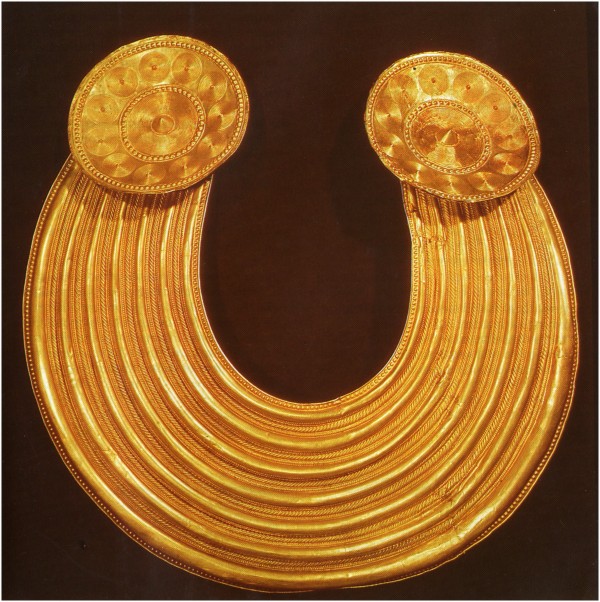
A collar of pure gold which is believed to have been made about 700 B.C., has been found at Burren, County Clare, says the ‘Manchester Guardian.’ The discoverer was a local farmer who noticed it glittering in a cleft of rock. The National Museum has claimed it as a treasure trove. Dr. Mahr, Keeper of Irish Antiquities in the National Museum, has confirmed the belief of its antiquity.
The type is well known, he said in an interview, and four similar ones are in the museum. Three were found in the area through which the Shannon flows. A fourth, like the one now discovered at Burren, has circular bosses and is believed to have been found in Armagh. Two collar’s containing bosses were found in the Rhine, near Worms, and these had probably been exported from Ireland in the middle of the last millennium B.C.
The Burren collar, or gorget, Dr. Mahr said, was the most beautiful find in Clare within the last thirty or forty years. Clare is famous for discovery. When the Limerick Ennis railway was being constructed in 1854 a large hoard was found near a stone fort at Megane, Ballykilty, Quin. Laborers removing a stone which was in their way uncovered a number of gold articles weighing about 160 ounces underneath. ‘Unfortunately, there was nobody to advise them,’ Dr. Mahr said, ‘as to how they should dispose of the articles, and they were mostly bought by local jewellers and melted down, to the great loss of Irish archaeology and kindred studies.’
Only thirteen of the articles reached the museum in Dublin, while about two dozen went to the British Museum.
The Catholic Press 6th January, 1921 p9
IRELAND’S SADDEST TRAGEDY.
Young Mother Shot by uniformed assassins. (abridged)
Mrs. Ellen Quinn, who was shot on November 1 while sitting on the lawn in front of her farmhouse at Kiltartan, Gort, bled to death the same night. She leaves three children, the eldest of whom is not yet four years old. Rev. Father Considine, C.C., Gort, wired Mr. Arthur Griffith, T.C., on November 2:
‘Woman within two months of childbirth,and holding a child in her arms was shot by Galway police here Monday evening. Died few hours afterwards. Have wired Greenwood.”
At the time of the shooting Mr. Quinn, who is a farmer, was away. A messenger, who went for the priest and doctor, broke the painful news to him. Another messenger going to Ardrahan for Dr. Foloy was, it is reported, wounded by a stray bullet. Uniformed men passed into Gort subsequently, firing shots. When the lorry passed the house where the dying woman lay the terror-stricken occupants fled by the back way.
Rev. Father Considine gave a Dublin ‘Freeman’s Journal’ correspondent who called on him a graphic description of Mrs. Quinn ‘s last moments.
“It is too awful, too inhuman, to contemplate.”
These were Father Considine’s opening remarks concerning the tragedy. Pressed to explain what occurred, Father Considine said:
“I have read of Turkish atrocities; I have read of the death of Jean of Arc; I have read of the sufferings of Nurse Cavell, and as I read those things I often felt my blood boil, and I often prayed that the good God might change the minds and the hearts of those cruel monsters. Little did I then dream that I should witness a tragedy, an atrocity more hideous, more revolting, more frightful, more brutal, more cruel than any of those things, and here in our own little peaceful parish of Gort. My God, it is awful!
“About 3 o’clock on Monday, November 1, Malachy Quinn, weeping bitterly, called for me. ‘Father said he, ‘I have just heard that my wife has been shot. Will you run down immediately.’
I procured a motor car, and hurried to the scene. At the gateway there we beheld a large pool of blood. In the yard another pool, and the porch leading to the kitchen was covered with blood.
I entered the room. Oh God! What a sight! There lay the poor woman, the blood oozing out through her clothes. She turned her eyes towards me and said:
‘Oh, Father John, I have been shot.’
‘Shot!’ I exclaimed.
‘Yes,’ she replied.
‘By whom?’ I asked.
‘Police,’ she answered.
‘By police?’ ‘Yes,’ she replied, emphatically.
‘Did you see them?’
‘Yes.’
‘Where?’
‘On a lorry.’
‘How many lorries?’
‘Two.’
‘From which lorry did the shot come?’
‘From the first.’
Photo: Juni Wikimedia Commons
She then became weaker, Father Considine explained, and on rallying exclaimed:
‘Father John, will you do something for me?’
‘I tried to console her,’ he explained, ‘ and administered the Last Sacrament. When I had finished she whispered to me’:
‘Bring me Malachy, bring him to me, I hear him crying. I have something to tell him.”
I did so. What a scene. Then she became weak and fainted off. Gradually she became worse.
I sent word immediately to the Head Constable at Gort. He arrived with police and military. All seemed shocked at the tragedy. I asked him to go in and see the woman. He and his men felt the trial too much, as he answered, ‘I cannot.’
No trace of the bullet could be found.’
Continuing, Father Considine said Mrs. Quiiin was sitting on the lawn with her child when the lorry passed from which the fatal shot was fired. The bullet pierced the stomach, and the child she was holding fell from her arms. She crawled over the wall into the yard, and then crawled to the porch to tell her servant that she was shot.
‘Take in the little children!’ she exclaimed. ‘I’m Done! I’m Done!’
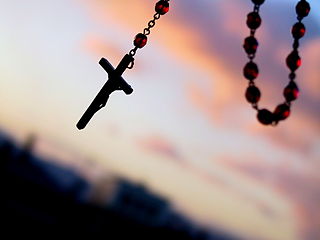
From 3 o’clock to 10.30 she lingered on in pain. Occasionally she would clasp my hand, pull me towards her, and say, ‘I’m done! I’m done!’ At 10.30 her condition became worse, and we knelt by her bedside to recite the Rosary and Prayers for the Dying, She tried to join, but was too weak. At 10.45 the little children began to cry, and with them the crowded house burst into tears. As I read the last prayer of the Ritual she looked around, then closed her eyes and died.
My God! what Turkish atrocity ever equalled this?
‘That morning,’ said Father Considine, ‘I had a note from her asking me to offer Mass for her deceased friends. Little did she dream tnat prayers for the repose of her soul would be asked for today from the altar?”
Foy’s Hill, Kinvara Photo: Norma ScheibeEpidemic Diseases of the Great Famine
Published in 18th–19th – Century
History, Features, Issue 1 (Spring 1996), The Famine, Volume 4 (abridged)
In December 1846, the board of health in Drumkeeran, County Leitrim, resolved to hire a house for use as a fever hospital, there being no such institution within a radius of eighteen miles. The proposal caused ‘inconceivable alarm’ in the town. Sixty-two of the residents, including merchants, shopkeepers, tradesmen, labourers, publicans, and householders, as well as Pat Gallaher, the schoolmaster, addressed a memorial to the Lord Lieutenant, objecting to the establishment of a fever hospital in the centre of the town. They stated that they were not so much opposed to the institution, as to its location.
A rather similar appeal was made by the residents of Kinvarra, County Galway, in July 1847. They claimed that the imminent opening of a fever hospital in the town placed their lives and those of their families in ‘the greatest peril’. They argued that the chosen site was too close to the town, that it either adjoined or was within eight feet of a range of houses occupied by some 300 individuals and was no more than sixty yards from the town centre.
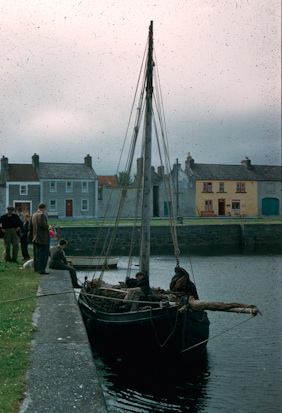
Kinvara Harbour c1950 Cresswell archivesOamaru Mail, Volume XXVIII, Issue 8273, 31 August 1903, Page 4
THE TWO IRELANDS
(By Filson Young, in the London Daily Mail.)
Donegal, August 17. (abridged)
There are two Irelands, one of smiling, one of miserable, aspect. The first is known to the many, the second to the few; the first greets the tourist at every turn, the second is discovered only by those who leave the beaten tracks, and, travelling far from the railways and even from the roads, come face to face with the naked life of mountain, bog, and shore. And the first is exploited and displayed, while the second is hidden.
There are some very simple facts about Ireland which at this moment cannot be too widely known. Before facing the dark side, let us dispose of the first, the prosperous Ireland, which, standing as it does in the foreground of the picture, obscures the view and interrupts the attention of those who think they have seen the country.
To say that it is a strip of Ireland’s eastern seaboard that is prosperous, is only one, and an imperfect way of stating the case. It would be nearer the mark to say that what we take for prosperity in Ireland is but the stir and bustle of market-places that exist only by virtue of their proximity to Europe. In the eastern seaports we find this stir and bustle. In the western, never.
Beyond earshot of bustling centres of artificial trade you are enfolded by the stillness and emptiness of rural Ireland. The green fields sleep in the sun. Empty cabins proclaim from their boarded-up windows – a thousand tragedies of failure and departure. It is a silent and vacant country.
Into the stately waterways of Cork, of Galway, of Limerick, the sea twice a day comes brimming up, filling with its inexhaustible flood the spaces between the imposing empty warehouses. The beautiful buildings, raised when Ireland had a population and a trade, are crumbling and deserted great chambers. These western ports, so nobly furnished by nature, and by man, so entirely unvisited, save by the punctual tides, are imposing monuments of a decay that is vast and complete.
Never a tide rises but it carries away with it something priceless, vital, irreplaceable — the life of the country. And even away from the great ruinous ports along a coast unmatched in the world for its bays and inlets and roadsteads, you may note the blight of desolation and mark the sea’s revenges.
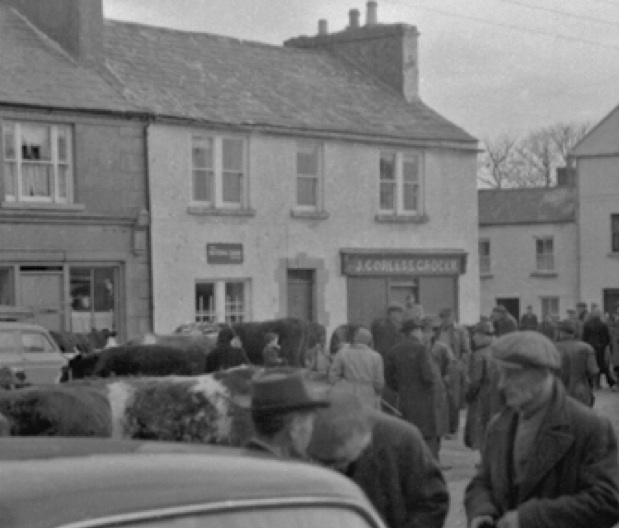
Corless, Grocers Kinvara Photo: Creswell ArchivesConnaught Tribune 1911
On friday fortnight Mr Thomas P. Corless D.C. President of Kinvara United Irish League, was evicted out of his holding at Crehaun, Kinvara, in pursuance of an order made by Judge Gibson at the recent Spring Assizes setting aside a deed purchasing the tenants’ interest and goodwill as far back as October. Suffice it to say the eviction was part of a huge conspiracy to ruin a man for openly identifying himself with the National cause.
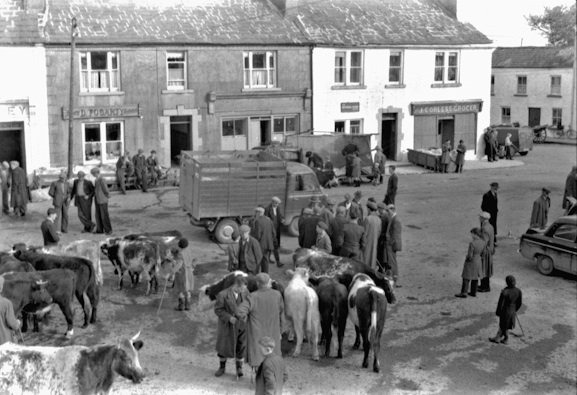
The Square, Kinvara c. 1950 Cresswell ArchivesThe Moreton Bay Courier 3rd March 1849 p4 (abridged)
An encounter took place on Monday between a detachent of the 4th Light Dragoons, forty in number, and a body of people from Kinvarra.
The soldiers, assisted by fifty-six policemen, were out collecting poor-rates, or rather seizing corn in default of payment. They went on until they came to the district they were to distrain on, when a barricade, partly formed, met their view, protected by about 300 men and women. They refused to let the armed force pass and said they would rather sacrifice their lives. The Riot Act was read three times, and still they would not give way.
The police and soldiers were ordered to charge with bayonets. Stones were thrown and some of the men severely hurt. The police drove the people a quarter of a mile into the fields, but they were quickly back again to the scene of the action. Mr Davys, the magistrate, did not wish to shed blood by ordering the military to fire, and, it being late in the day, he directed them to turn round and proceed home.
Much praise is due to this forbearance of the authorities, as there is no doubt but much blood would have been shed. Of course there will be a greater force brought down there in some few days.
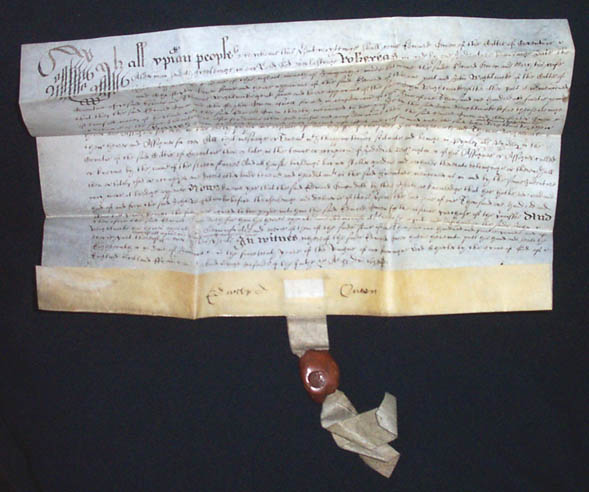
Vellum From the private collection of Randy Benzie Wikimedia CommonsFreeman’s Journal 23rd November, 1901 p 6 (abridged)
The ‘Anglo Celt’, viewing with alarm the appearance of desolation which the country is beginning to present, announces that to the person who succeeds in keeping the greatest number of would be emigrants from emigrating between September 28 and May 28 next will be presented with a gold medal for patriotism, together with a vellum certificate.
Twenty silver medals will also be given to the 20 who came next, they also securing vellum certificates. A certificate will also be presented to every man, woman, boy or girl who can prove that through their efforts one person was kept in the country.
That there is urgent need of something being done to stop the flow of citizens America-wards will be seen when it is stated that within the last ten years 250,000 have gone and whereas in 1840 Ireland had a population of 8,000,000 she has now only 4,400,000.
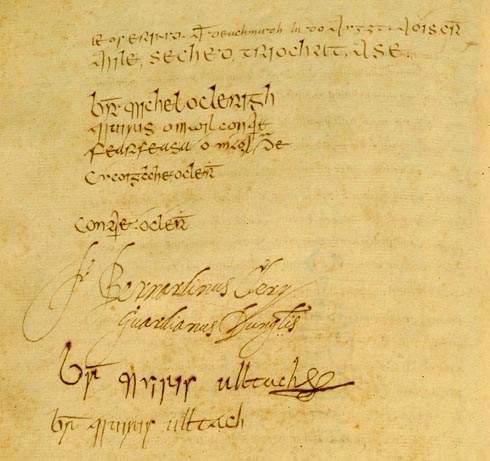
Signature page from Annals of the Four Masters University College Dublin Archives DepartmentFrom the Ordnance Survey Letters by John O’Donovan and Eugene Curry, 1839
Parish of Abbey
In this parish is also situated Corra an Rubha – Corranrue (i.e., the Causeway of Rue) in which stood a Castle belonging to the family of O’Heyne, formerly Chiefs of Hy-Fiachrach Aidhne. This Castle fell in the year 1755 at the very moment that the earthquake happened at Libson. The site of this Castle and a small part of its ruins (reduced to a formless heap) are still to be seen near the village of Corranrue, but I think it is on the Co. of Galway side of the boundary. It should be shown on the Ordnance Map. The present representative of the branch of the O’Heynes who lived in this Castle, as also on the Castle of Ballybranaghan at Kinvara, is John Heynes alias O’Heyne of the New Quay House, a very rich and sensible man, who is likely to purchase a considerable portion of Coill O’bFiachrach from De Bastro, the present proprietor, who is of French origin, and who, I am told wishes to sell out his estate in Connaught, with which he has, of course, little or no national sympathy. This gentleman descends from the last proprietor of Corranrue, thus :-
James, a man of Chieftan appearance and Herculean strength, aged 28.
|
John, now living at the New Quay, aged 55.
|
James,
|
John, lived at Poulanisce.
|
Brian,
|
Peter, the last who is said to have lived at Corranrue.
The senior branch of this once powerful family is Mr. Heynes of Ardrahan, who is well known in the country as Heynes the Process Server! This man is the senior representative of Guaire Aidhne, King of Connaught, so celebrated by the Irish bards as a Prince of unbounded hospitality. O’Heyne is senior to O’Shaughnessy. He was often chief of all the Territory of Hy-Fiachrach Aidhne, a Territory coextensive with the Diocese of Kilmacduagh, but O’Shaughnessy was never lord of more than Kinelea na h-Echtghe. O’Heyne built a beautiful little Monastery at Kilmacduagh but we do not find that O’Shaughnessy built any Church there and the reason is because he was never, until the reign of James I, but an Urriagh or sub-Chief to O’Heyne. O’Heyne is regarded to have been Chief of all the Hy-Fiachrach Aidhne at the following years :-
A.D. 1047. O’Heyne, Lord of Hy-Fiachrach Aidhne, died.
A.D. 1048. Maelfaal O’Heyne, Lord of Hy-Fiachrach, died.
A.D. 1055. Donnell Roe O’Brien was slain by O’Heyne, lord of Hy-Fiachrach Aidhne.
A.D. 1121. Torlogh O’Connor made a plundering excursion into Munster, and among other Chieftans, lost in a battle Hugh O’Heyne, Lord of the Hy-Fiachrach Aidhne.
A.D. 1180. Maurice O’Heyne, Lord of the Hy-Fiachrach Aidhne, was killed by the men of Munster.
A.D. 1225. Hugh O’Connor, presumptive King of Connaught, sent Felim his brother, and others of the Chiefs of his people and a great body of English soldiers to plunder Hy-Fiachrach Aidhne, the Country of Owen O’Heyne.
A.D. 1588. Owen Mantach, son of Edmond, son of Flann, son of Conor O’Heyne, Lord of Hy-Fiachrach Aidhne, died and his son, Hugh Boy, was elected to his place. Annals of the Four Masters.
The district of Rubha (Rue) in which the Castle of Corra an Rubha stood, is mentioned in the Annals of the Four Masters at the year 1599.
O’Donnell, after having plundered Thomond, proceeded on his way homewards across the chain of rough-headed mountains of Burren, and passing by Nua Chongbhail, Turlach, the Abbey of Corcumroe and Carcair na gCleireach, arrived at Rubha (Rue) in the west of Hy-Fiachrach Aidhne etc.
Photo; Cresswell ArchivesAmong the papers of the Chief Secretary’s Office Registered Papers National Archives Francis J. Crowley Bequest
NAI REFERENCE:
CSO/RP/1822/484
TITLE:
Tradesmen of Kinvarra, County Galway: for measure of relief
SCOPE & CONTENT:
Petition of tradesmen of Kinvarra, County Galway, to Richard Wellesley, 1st Marquis Wellesley, Lord Lieutenant, Dublin Castle, requesting relief as they have ‘no means left to support their families but pawning their Clothes and selling every little article they possessed for less than half Value’: proposes that aid be advanced to enable travel to colonies.
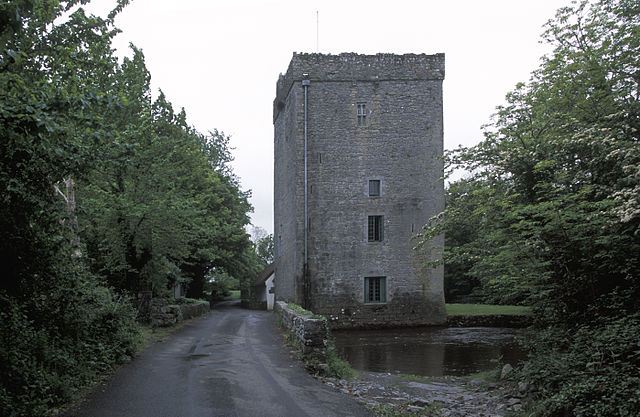
Thoor Ballylee Photo: Jerzy Strzelecki Wikimedia CommonsExcerpt from The Celtic Twilight – W.B. Yeats (1893) abridged
p232/3
LAST night I went to a wide place on the Kiltartan road to listen to some Irish songs. While I waited for the singers an old man sang about that country beauty who died so many years ago, and spoke of a singer he had known who sang so beautifully that no horse would pass him, but must turn its head and cock its ears to listen. Presently a score of men and boys and girls, with shawls over their heads, gathered under the trees to listen. Somebody sang a Muirnín Díles, and then somebody else Jimmy Mo Mílestór, mournful songs of separation, of death, and of exile. Then some of the men stood up and began to dance, while another lilted the measure they danced to, and then somebody sang Eiblín a Rúin, that glad song of meeting which has always moved me more than other songs, because the lover who made it sang it to his sweetheart under the shadow of a mountain I looked at every day through my childhood.
The voices melted into the twilight and were mixed into the trees, and when I thought of the words they too melted away, and were mixed with the generations of men. Now it was a phrase, now it was an attitude of mind, an emotional form, that had carried my memory to older verses, or even to forgotten mythologies. I was carried so far that it was as though I came to one of the four rivers, and followed it under the wall of Paradise to the roots of the trees of knowledge and of life. There is no song or story handed down among the cottages that has not words and thoughts to carry one as far, for though one can know but a little of their ascent, one knows that they ascend like medieval genealogies through unbroken dignities to the beginning of the world.
Folk art is, indeed, the oldest of the aristocracies of thought. Because it refuses what is passing and trivial, the merely clever and pretty, as certainly as the vulgar and insincere, and because it has gathered into itself the simplest and most unforgetable thoughts of the generations, it is the soil where all great art is rooted.


 The Burren and Beyond