The Times, LondonGuinea Wikimedia Commons
17th July, 1788 (abridged)
A short time ago some labourers were clearing the race ground of Loughmore, near Limerick. They found a small brass box, containing a piece of parchment five inches square, on which is written the admission of a fellow or scholar at Mungret University. Mungret University was at an early age famous. At the top is a picture of St. Patrick. It is signed Gulielmus Nophine, with the date A.D. 485. It was purchased for a guinea and sent as a present to a member of the Irish Academy.
Lancaster, April 15, 1766. (abridged)
WAS committed to my Custody, on suspicion of being a runaway servant, a Girl, who calls herself Isabel Beard.
She was born in Ireland, and came in the Snow Pitt above two Years ago. She is about 4 Feet 8 Inches high, had on a blue Stuff Gown, striped Linsey Petticoat and Bed Gown, old Shoes and Stockings. She says she belongs to a certain William Grimes, a Jobber, and late of York County, where she says she left him.
Her Master therefore is hereby desired to come, pay her Charges, and take her away, otherwise she will be sold for her Fees, by MATTHIAS BOOGH, Goaler.
———————————————–
October 12, 1769 The Pennsylvania Gazette
New Castle County, October 3, 1769.
WAS committed to the goal of this county, upon suspicion of being runaway servants;
JOHN MONEY, born in Ireland, about 5 feet 6 inches high, black hair, pale complexion, by trade a weaver. When committed he had on a light coloured homespun cloth coat, linsey waistcoat, and coarse tow trousers.
ELIZABETH MOORE, a native Irish woman, about 30 years of age, fair complexion, brown hair. When committed, she had on a stampt cotton gown of a purple colour, a linsey petticoat, shoes, and stockings.
Their masters (if any they have) are desired to come, pay their cost, and take them away, in 6 weeks from this date, or they will be sold for the same by THOMAS PUSEY, Goaler.
Native American Tobaccoo flower and buds Photographer: William Rafti of the William Rafti Institute Wikimedia Commons
London, Middlesex, England 23rd August, 1788
Last Saturday, Mr. Charles P. Bolton, surveyor of excise, assisted by Mr. Patrick Thally, guager, discovered in the town of Corrofin, an extensive tobacco manufactory, wherein they seized all the utensils used in that illicit trade; also a large quantity of loose leaf or four tobacco, in process of manufacture, which they lodged in his Majesty’s stores in that town.
Flax flowers Photo: D. Gordon E. Robertson Wikimedia Commons
Mr James Hill Dickson, for many years connected with the flax manufacture in the north of Ireland, has made a proposal to the chairman and directors of the Midland Great Western Railway, which they have favourably entertained – of erecting a mill on a platform, with wheels to run on the railway, to which will be attached a portable steam engine, of six horse power, with which to work the mill.
The mill, engine and workmen can be transported at the shortest notice to any given point along the line of railway from Dublin to Galway and into the country, to any farm or district along the line, at moderate distances, where flax may be grown, thus doing away with cumbrous and expensive fixed establishments hitherto so necessary to the successful cultivation of the flax plant and, in these depressed times, so difficult to erect and establish
Irish Cliff Fowlers (abridged)
I shall here outline the different methods I have witnessed on the coast of Ireland of descending steep rocks for birds or eggs. At the Gobbins, a climber has been going down the rocks occasionally in the season for above thirty years. He has a monopoly of the aerial exercise in consequence of being the only person in the vicinity supplied with a rope for the purpose. His preparation was the work of a moment; throwing his shoes off, and a noose of the rope over his head so as to embrace his body beneath the arms. Down he dropped from the summit, with much less concern than a lady steps from her carriage. Two or three men (generally his two brothers) ‘give out’ the rope, of which a coil is left back, some little distance from the summit of the cliff. They keep it tight until the egg-gatherer reaches the ledges containing the nests, when he gives a signal to slack it. The liberty thus afforded him to move to either side prevents the necessity of shifting the rope laterally at the summit of the cliff, where it is kept to the same place all the time.
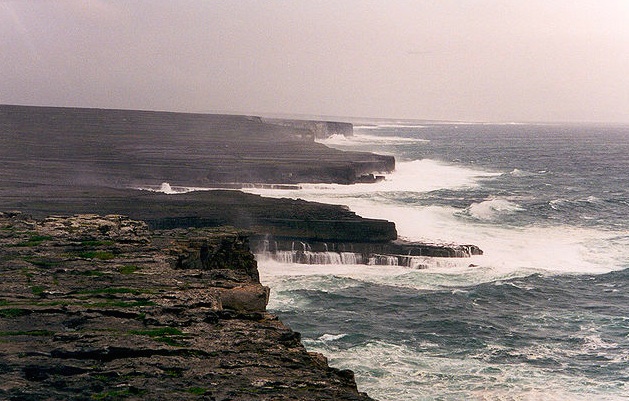
The method adopted at Arranmore, the largest of the islands of Arran off Galway Bay was different. When Mr R. Ball and I visited that island in July 1834 a rock climber – a tall athletic fellow – came up behind, unheard in his ‘pompootes’ . He was lowered over the loftiest limestone cliffs of the island, perhaps five hundred feet in height. His manner of descent was free and easy. He sat upon a stick, about a yard in length and two inches in thickness, to the middle of which one end of the rope was fastened, the other being held by men above.
When coming near his prey, he held the rope in one hand, and with the other threw a rope fastened to a rod around the birds. Several gulls so taken were brought up. When over the cliff he leapt as far into the air from the surface of the precipice as he could do without injury to himself from the rebound. He likewise performed various antics, and with the stick as a seat, looked quite comfortable and at his ease.
Thompson’s Natural History of Ireland.
Friday night a desperate gang of eight or ten fellows, well armed, and with their faces covered, entered the dwelling house of Colonel Blaquiere, near Gort, and after tying the family, plundered the house of what valuable articles they could get at.
They entered at the window of the Colonel’s bed-chamber, who, notwithstanding his being overpowered by numbers, made a most brave resistance, nor did he submit until totally surrounded and covered with wounds, when the inhuman villains tied him, with his head downward, in which pitiable situation he remained bleeding at every pore, until some of the family were enabled to extricate themselves, and go to his assistance; after which the neighbourhood was alarmed, and a spirited pursuit immediately commenced by the gentlemen. The villains to expedite their retreat, took two horses from the Colonel’s stable, but left behind them a blunderbuss, a pistol, an old riding-coat, and two bludgeons.
7th August, 1909
A gentleman, a resident of Loughrea living in England, thus writes about the changes time has wrought there: – “There was a Pawn Office – a Mont de Piete – established in my day in a house once occupied by Mr Smyth, in Main Street. Behind was a three storey range of wool stores once used by him. The manager of the Pawn Office was Mr John Cowen, but the enterprise came to grief, and Dr Lynch went to live there, but later on it was converted into a police barrack. In those days I speak of, the population was about 8,000. It is not half now. I knew Monahan’s Hotel, built where the new Cathedral now is. It was called ‘The Head Inn’ and is mentioned in Lever’s Novels where many a pleasant evening was held. Loughrea was then the centre of the county society, and its hunt ball the great social event. One of the Monahans was Anthony, but the other, James, became a chief Justice. By the way, Charles Lever was Consul in Trieste, where he died and was succeeded by a great Irishman, Sir Richard Burton, whose grandfather was the Rev Edward Burton, Rector of Tuam. His grave is in Mortlake Cemetery
New York Daily Tribune 17th July, 1851 p4 (abridged)
Photo: EO’D
We publish this morning the details of the Irish Census of 1851. Facts more startling were never contained in figures, and yet they are little more than we have expected. They are what the causes long in operation have tended to make them.
While other countries have been increasing in population, Ireland has at this day three hundred thousand people fewer than thirty years ago; above a million and a half fewer than ten years ago, and two millions less than it would have been at the usual rate of increase. The diminution has been caused by disease and emigration.
It is estimated that at least half a million of persons have died by famine within these ten years. There are even fewer houses now than there were then. Above a million have emigrated because at home despair and death alone awaited them in the future. Apologists for human wickedness and disorder blasphemously call this exterminating process the Visitation of God. We proclaim it to be the Crime of Man.
Ireland is a fair and pleasant country. Its climate is genial, its soil fertile, its position excellent. It might support in abundance a dense and happy population. The people are industrious and endowed by nature with talents and qualities that, if developed would make their green island a paradise on earth. But now it is a Hell.
It has been prevented from attaining any kind of independence, forbidden from engaging in foreign commerce, allowed no manufactures to spring up there.
We shall be told, no doubt, of the improvidence of Irishmen; but what made them improvident? Was the ever a provident nation that had become habituated to being plundered and dispossessed of everything which prompts to thrift and foresight? We shall be told too, of the tendency of the religion professed by the Irish to keep nations in the background; but this cannot account for a tithe of the facts in the case. It is still certain that landlordism, taxation and the monopoly of manufactures and commerce have been enough ten times to ruin the most powerful and energetic people that ever existed.
Let no man in these days dare to say that the loving and blessed Heaven sends war, pestilence and famine to devastate and destroy the nations. God gives man blessings, not curses and starvation. Disease and misery are the work of human wrong and human ignorance alone.
The very year of the famine there was shipped for sale food enough to have saved the death of the hundreds of thousands then perishing. Had the soil belonged to the people and had they no taxes to pay but those for the support of their own government they would have eaten this food and lived.
Looking around the circle of humanity, there appear so many established wrongs still perpetuated by self-interest and a blind obedience to authority, tradition and prejudice, that it is impossible to regard any social order or any nation as either wholly free from stain or wholly worthy of condemnation. It will be well for us and for the world if the lessons taught by those facts are taken to heart and acted on.
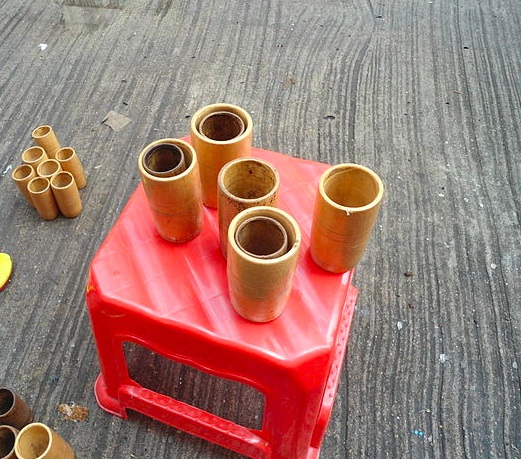
Fire cupping in Haikou Photo; Anna Frodesiak Wikimedia Commons
The Newspapers notice a discovery made by an Irish Physician in Paris, Dr. Barry. His doctrine is that the reflux of blood to the heart is occasioned by the pressure of the atmosphere. Consequently the cupping-glass is the remedy to be applied to a bite by a rapid or poisonous animal. The doctor tried a great many experiments with success and latterly with a viper provided for him by the French government with great difficulty. Cavillers impeach the originality of this momentous discovery by saying that the system of sucking poisonous wounds practised of old was a remedy on the same principle. In the common and unavoidable event of hydrophobia, this is a discovery of the greatest utility and importance. Dr Barry held a high surgical rank in the Portuguese service, and was lately honoured by the sovereign of that kingdom with the order of the Tower and Sword.




 The Burren and Beyond