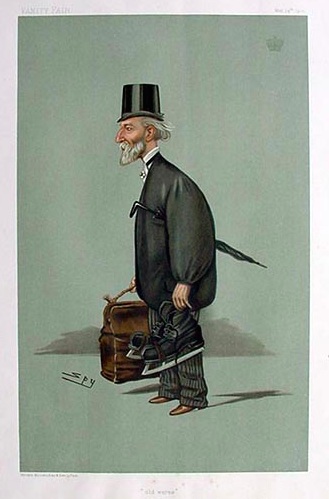
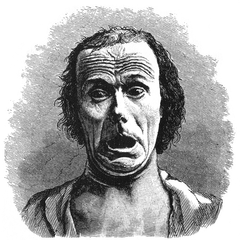
Marquess of Clanricarde 24 May 1900 by Leslie Ward – Published in Vanity Fair, 24 May 1900. Wikimedia Commons
21st August, 1915
Marquis of Clanricarde Compromises. (abridged)
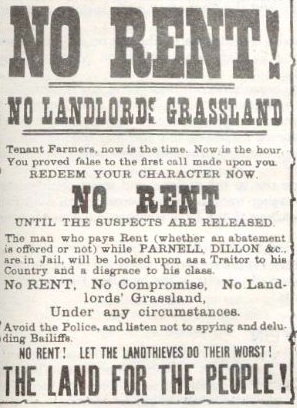
After litigation extending over some four or five years the legal proceedings in connection with the expropriation of the octogenarian Marquis of Clanricarde through compulsory sale from his estates in County Galway to his tenants, have been brought to a close by means of a compromise according to the terms of which he is to receive $1,200,000 for the property. This is not a large sum considering that the estates were formerly rated as yielding a rental of near $100,000 per annum.
But of course the fact that Lord Clanricarde is 84 years of age and has no direct heir will have been taken into consideration by him in consenting to accept this sum.
Few people know Lord Clarnricarde personally. He lives the life of a hermit in London in a dingy set of chambers in the Albany, off Piccadilly, and never goes out into society. Yet there is no member of the House of Lords whose name has been so frequently before the public. Half the agrarian crimes in Ireland during the past four decades have been due to his merciless and relentless cruelty toward the tenantry on his extensive estates on the Emerald Isle. Hundreds of thousands of dollars-probably millions- have been spent by the government in executing the decrees of eviction which he obtained from the courts against his tenants for the nonpayment of rent.
Freeman’s Journal 26th December 1885 p45 (abridged)
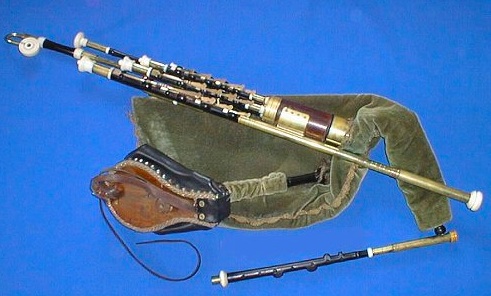
UilleannPipes photo: ‘Ganainm’ Wikimedia Commons
In every district of Ireland there is, or was a generation ago, always one musician who, by reasons of his superior skill, received a kind of patent of nobility and whose name was always spoken in association with that of his locality. In this way the subject of our sketch was known as the Piper of Galway.
Who that lived or travelled thirty odd years ago, in the city or the hills, in the fastnesses of Connemara, or by the shores of Lough Corrib and Lough Con, did not feel his bosom bound with gladness or melt in sorrow at the sweet strains of his matchless and inimitable pipes. His memory was wonderfully retentive and he could perform on his instrument thousands of airs, especially those of his native land. “Felim’s Death on the Field of Athrenee,” and “Red Hugh’s March to the Curlew Mountains,” he played with wonderful and enchanting power; from the Ros Catha of the warlike bard to the saddening symphonies of the “Coolun,” or the plaintive pleading tenderness of the “Molly Asthore,” he was equally and eminently famed. The music of Carolan and the melodies of Moore were all in the gift of this poor blind piper of Galway.
A more interesting character was seldom met with – a man deprived by fate of eyesight, yet by the light of his mind tracked his journey through life in one continued stream of sunshine, beloved by many and respected by all whose respect was worth possessing. Despite his humble condition and the loss of sight (which would be deemed by most persons as one of the greatest of human calamities) he was a happy man.
He was always singing, in sunny weather sprightly airs, and in gloomy weather pathetic ones; but he never looked sad, except when a tale of sorrow excited his pity or when he was about to separate from friends.
Perhaps the most eminent trait in his character (independent of his musical one) was his habitual, we might say, his constitutional benevolence. Many anecdotes of his goodness are told. He was always a temperate and prudent man and would never lower the dignity of his professional character by playing in a tap-room or any place where drunkenness was known. He had a great love of approbation, a high opinion of his musical talents, a strong feeling of decent pride and a great love of country. Green be the shamrocks on his grave.
A summary of the census in the counties of Clare, Cork and Kerry exhibits some startling results. The progress of depopulation in these Irish counties during the last ten years is without a parallel in history.
New Zealand Tablet, Vol. XXI issue 23, 5th October, 1894 p 21
Photo: EO’D
On Friday Major F. G. Cullman, Sub-Sheriff of Clare, carried out an eviction under the eviction clauses of the Land Act, on the estate of the Rev Hyacinth Skerrett,Old Quay, Burren. The tenant evicted was Bridget Fahy. Possession was handed over to Pat Gaynor, the landlord’s representative.
The proceedings were of the quietest character. A force of police was in attendance. An attempt was made to carry out an eviction in the same district on the estate of Lord Annally. The tenant was Denis Sweeny of Muckinish West against whom was an ejectment o the title for non-payment of rent. When the evicting party arrived at the house it transpired that a son of the tenants, also named Denis, was suffering from fever. A medical certificate was produced, signed by Dr E Heyns, Ballyvaughan Union, indicating that it would be dangerous to attempt the removal of the sick man. The Sheriff declined to proceed with the eviction.
AN COISTE BODHAR
Story: Script Emer O’Donnell
Script Consultants: James O’Malley
Michael Doheny
Donal C. Hanlon
Emer O’Donnell
Cast:
Barman: James O’Malley
Niall: Michael Doheny
Eamon: Ray McEnany
Man: Donal C. Hanlon
Woman: Emer O’Donnell
Production: Dawid Ciesielski
Recorded at Gort Media Centre Studios – thanks to Sinead, Peadar, Tom, Heather, Gerry and Kevin!
Maryborough Chronicle, Wide Bay and Burnett Advertiser 28th January, 1864 p 15
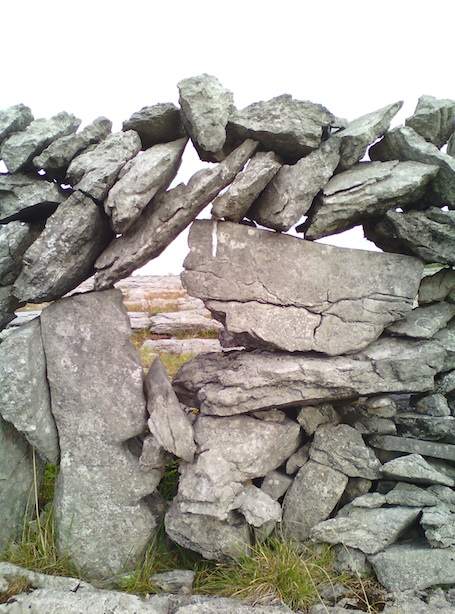
Photo: EO’D
At Dromelihy, County Clare, some men, in digging for potatoes, came on a massive boulder, which required their united exertions to remove. It had been artificially set over four other and formed an enclosure of about two feet square. But well repaid were they for their labours. Having displaced it, they found the contents to be a copper kettle filled with silver pieces, each being worth about tenpence, and some of which bear the date of 1510.
On digging further they perceived some stones set in mason work, which they upturned with renewed energy. They succeeded in entering a vault, which, to their surprise and disappointment, contained nothing but a leaden coffin about nine feet in length. On taking off the lid, (which, by the bye, was considered very daring of them) they beheld a human skeleton of massive proportions, the thigh alone measuring 2ft 11in and the cranium half an inch in thickness.
A curious and interesting scene was enacted over in Ireland yesterday. Loughrea was the place where the spectacle occurred. After the court adjourned a sitting in which a number of Clanricarde rental cases were under consideration, a hundred or more Nationalists headed by a band, paraded the streets. They were led by a convert from the enemy’s side. The convert was one of her Majesty’s policemen in full uniform.
During lulls in the music this enthusiastic proselyte would address the crowd, asserting that the police were heartily sick of the degrading work which they called upon to perform in Ireland. He said that there were many, who, like himself, would be only too glad to abandon the whole business.
After finishing one of these addresses, he called for three cheers for Dillon and O’Brien, but this juncture was an unlucky one in his new career. At that moment the head constable, with a body of police, swooped down upon the crowd capturing the rebellious constable and marched him off to the barracks under arrest.
During the stay of Sanger’s circus at Mallow on Thursday a large baboon escaped from its cage and caused consternation among the spectators, who ran off in all directions. The animal rushed down a street, and, seizing a dog, killed it. It then bolted into a china shop, where it caught a child by the neck and gave it a severe scratch, causing blood to flow. Again rushing into the street, it injured another child, cutting its cheek severely with its claws.
An excited crowd pursued the baboon armed with pitchforks and staves, but it ran from street to street, spreading consternation everywhere. Some policemen at length managed to shoot the animal. Mr. Sanger has, it is stated, threatened to bring an action against the police for £200, the alleged value of the animal and the persons whose children were injured have threatened proceedings against Mr. Sanger.
Castle on Inchiquin Island Photo: Bob Jones Wikimedia Commons
31st December, 1892
KILFENORA, Dec. 7, 1892
We have been witnesses, here, of a very extraordinary scene, indeed. Visitors to Lisdoonvarna who have made the usual excursion to the Lake of Inchiquin will remember the pretty park which skirts this village, and within which a finely built residence looks out from the shelter of the trees. The inquiring excursionist will have been told that this is the residence of Mr. O’Donnell Blake Foster. It is no longer. Yesterday Mr. Blake Foster was evicted with all due formality of law. The sub-sheriff, Mr. Cullinan, officiated, and the inevitable Mr. Emerson represented the claimants for rent. When the eviction was completed an Emergencyman was duly installed in the spacious house- the most imposing mansion in which an emergencyman has as yet established himself.
The circumstances which led to Mr .Blake Foster’s eviction were as follow:- When he came of age he found his property heavily encumbered, so heavily, indeed, that after a time he surrendered it to the courts, and himself became simply a tenant of Ballykeal, paying a smart rent for his “holding.” Like other farmers here about, Mr. Blake Foster found and insuperable difficulty in making land pay; and though he fought gallantly against the hard times, the battle was a losing one, and he fell into arrears. The creditors of the estate gave him short shrift, and the result has been the appearance at Ballykeal House of Mr. Cullinan, the sub-sheriff, and of Mr. Emerson, and the Emergencymen.
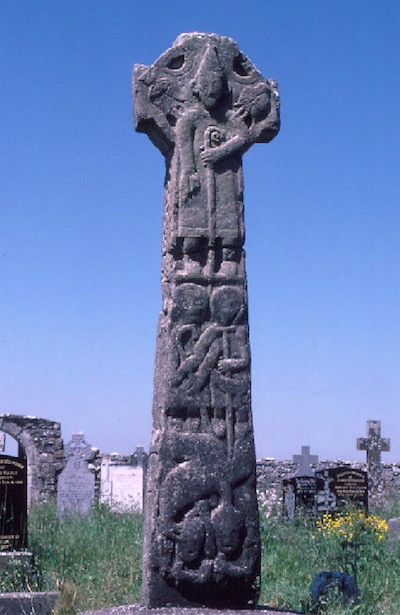
The Doorty Cross, Kilfenora Photo: Dr Charles Nelson Wikimedia Commons
The scene was a striking one in its way. About ten o’clock the sub-sheriff, unaccompanied by any protective force, walked up the avenue, between the rows of tall trees, leading to he house. On his arrival he found a large number of sympathising friends gathered round the tenant, who was waiting for eviction. The parish priest, Father Crowe, and the larger farmers of the neighborhood were gathered round Mr. Blake Foster, while a large crowd of people from the surrounding country were engaged removing the furniture and other property. I may mention that on the previous day 500 men with 300 carts, had gathered to remove the potatoes, hay, and other movable farm produce and that on Friday of last week 75 carts had been engaged removing the tenant’s turf ricks beyond Mr. Emerson’s reach.
The eviction was duly carried out, as far as the “big house” was concerned. But a difficulty still exercised the legal representative of the creditors’ claims. Near the gate of the demesne and within the boundary wall, a Land League hut had been erected, and here for many years Andy Lynch, who had been evicted off a neighboring property, had lived, in view of Mr. Blake Foster’s hall door. The evictors demanded that the hut should be pulled down and the demesne surrendered without this incumbrance. The sub-sheriff did not think this any part of his duty, and said so. Andy Lynch was summoned to make terms with the new occupants of Ballykeal. He appealed to Mr. Blake Foster, who told he that he would never advise any man to break up his home, and bade him do as he thought best for himself. Andy, left to his own choice, refused to enter into terms with the evictors, and his poor chattels were accordingly transferred to the roadside.
Perhaps the Property Defence Association will be satisfied with the day’s work. They have an old grudge against Mr. Blake Foster. Six or seven years ago he was removed from the Commission of the Peace because of his sympathy with his distressed neighbors. He built on his own land two huts for tenants who had been evicted and maintained them there in spite of denunciations of the class to which he belonged. Immediately after this the Tory Lord Chancellor discovered that Mr. Blake Foster was unworthy to hold “her Majesty’s Commission of the Peace;” and he was accordingly despoiled of that “dignity.” He had also, given grievous offence to the landlord class, as an ex-officio guardian of the Ballyvaughn Union by opposing Mr. William Lane Joynt at the Board. However, all this has been explained now; Mr. Blake Foster has shared the fate which he tried to mitigate for other tenants in distress It is needless to say that public sympathy is wholly on his side, and that it will support him in any struggle he may make to regain the home from which he has been expelled.