The following official report was issued yesterday (Thursday) afternoon;
Commandant S. O’Reilly, O.C., National troops, Portumna, surrounded Kinvara, Co. Galway this morning and arrested there Edward E. a qualified engineer, who had been sent from field general headquarters, Irregular forces, Fermoy, as an engineering officer for the west. Included in his instructions was a letter to Mr. Michael K. O.C. 4th Western Division, Irregulars, asking the latter to make him a suitable weekly allowance. Important papers, maps, plans, etc, together with a revolver and ammunition were found upon him. His capture is regarded as important.
Mr. C. F. Kinvara was an irregular who had been active in the district, was also arrested. Two motor cars, from which the numbers have been razed, were found.
Irish Examiner 17th July, 1914 p.5 (abridged)
By the Volunteers of North Tipperary it is persistently rumoured that on Sunday week a cargo of arms, supposed to be from the Tipperary Men’s Association in America, was landed at Finavarra Point, West Galway. In the days following, the arms, it is alleged, were brought by night by easy stages, by the various Volunteer corps in West Galway, through Gort, Woodford and Williamstown, reaching the latter village on Saturday night last. Here the arms were received by a number of volunteers from the Tipperary side of Lough Derg, and in the course of the night were transferred by boat to Terryglass. Next day (Sunday) while the Volunteers of North Tipperary were mobilised at Nenagh, and while the police of the district were on special duty in that town, the arms, it is alleged, were hidden in a bog. The strictest secrecy was observed while the arms were in transit and it was only when they were well under cover that the information leaked out.
In view of the above rumour it is interesting to note that the commander of the Nenagh corps last even when dismissing his men publicly informed them opposite the Literary Institute that they would be in possession of rifles next week.
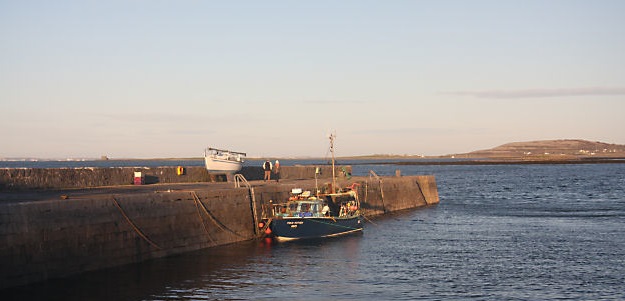
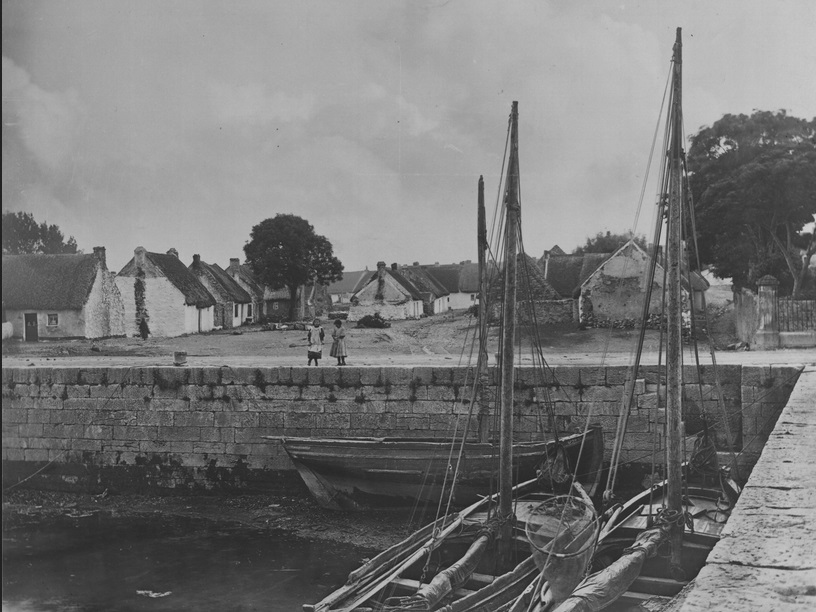
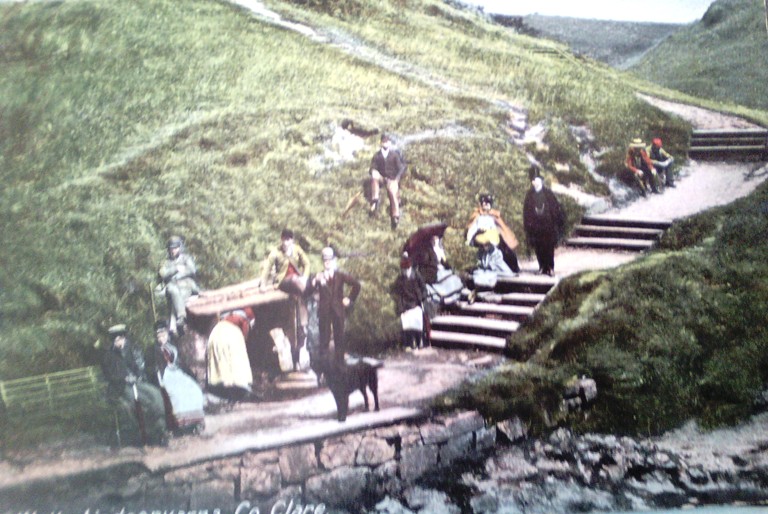
Ballyvaughan Harbour Photo: Bob Jones Wikimedia Commons
The Ballyvaughan Regatta came off on Wednesday, at the village of Ballyvaughan, situate in the county Clare, and about eight miles from Galway across the bay. It was conducted under the patronage of the members of Parliament for Clare and the local gentry. The weather was most propitious, the day being exceedingly fine, and, by the way, was complained of by the ladies as being oppressive.
The number of spectators was very large, and not alone were the lovers of aquatics in Clare afforded an opportunity of enjoying themselves, but so also were the people of Galway, as the splendid little vessel, the Citie of the Tribes, gave an excursion trip from Galway at eleven O’clock, by permission of the directors, thus affording as enjoyable a day’s amusement as could be wished for, and one of the best your correspondent has enjoyed for some time. The sports consisted of seven races and were exceedingly contested and most creditably conducted.
Freeman’s Journal 8th August, 1861 p4
Monday evening the poor Claddagh fishermen went out in great numbers, hoping to profit by the myriads of herrings that swarm our bay. It was blowing moderately at the time from the N.W., but a few hours later it blew a regular gale from the westward, scattering the hookers in all directions, obliging them to run, some for Kinvara, and others for Ballyvaughan and Newquay. With difficulty they reached those places of shelter, and we regret to learn that many of the poor people lost their nets and fishing gear in the storm. They mostly returned today and loud are the lamentations of many a poor family in the Claddagh for the loss of the instruments of their labours.
Supplement to the Cork Examiner 4th April, 1903 (abridged)
Photo: Norma Scheibe
On the death of his father, Fiachra, Dathi became King of Connaught (c. 5th Century A.D.) On the death of his uncle, Niall of the Nine Hostages, he became Monarch of Ireland. He not only invaded the coasts of Gaul, but forced his way to the foot of the Alps where he was killed by a flash of lightening, leaving the Throne of Ireland to be filled by a line of Christian Kings.
Darkly their glibs o’erhang
Sharp is their wolf-dog’s fang.
Bronze spear and falchion clang
Brave men might shun them!
Heavy the spoil they bear
Jewels and gold are there
Hostage and maiden fair.
How have they won them!
From the soft sons of Gaul,
Photo: Norma Scheibe
Roman, and Frank and thrall,
Borough, and hut, and hall
These have been torn.
Over Britannia wide
Over fair Gaul they hied
Often in battle tried,
Enemies mourn!
Fiercely their harpers sing
Led by their gallant king,
They will to Eire bring
Beauty and Treasure.
Britain shall bend the knee
Rich shall their households be
When their long ships the sea
Homeward shall measure.
Barrow and Rath shall rise,
Towers too, of wondrous size,
Tailtin, they’ll solmenise,
Feis-Teamhrach assemble.
Samhain and Beal shall smile
On the rich holy isle
Nay! in a little while
Oetius shall tremble!
Up on the glacier’s snow
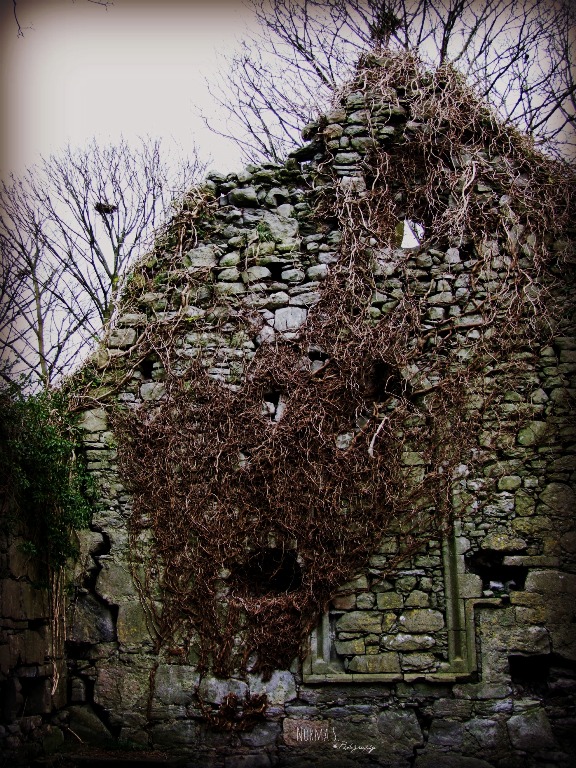
St Coman’s Church, Kinvara Photo: Norma Scheibe
Down on the vales below
Monarch and clansmen go
Bright is the morning.
Never their march they slack,
Jura is at their back
When falls the evening black
Hideous and warning!
Eagles scream loud on high;
Far off the chamois fly,
Hoarse comes the torrent’s cry,
On the rocks whitening.
Strong are the storm’s wings;
Down the tall pine it flings;
Hailstone and sleet it brings
Thunder and lightening.
Thundering, hail or wind;
Little these veterans mind
Closer their ranks they bind
Matching the storm.
While, a spear cast of more,
On the front ranks before,
Dathi the sunburst bore,
Haughty his form!
Forth from the thunder cloud
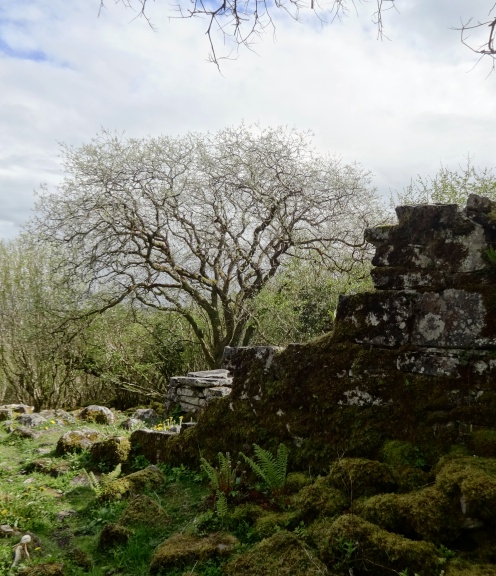
Photo: EO’D
Leans out a foe as proud
Sudden the monarch bowed,
On rush the vanguard;
Wildly the King they raise
Struck by the lightning’s blaze
Ghastly his dying gaze,
Clutching his standard!
Mild is the morning beam,
Gently the rivers stream,
Happy the valleys seem;
But the lone islanders –
Hark to the wail they sing!
Hark to the wail they sing!
Dark is their counseling
Hervetia’s highlanders.
Gather, like ravens near,
Shall Daithi’s soldiers fear!
Soon their home path they clear
Rapid and daring
On through the pass and plain,
Until the shore they gain,
And, with their spoil again,
Landed in Eirinn!
Little does Eire care
For gold or maiden fair
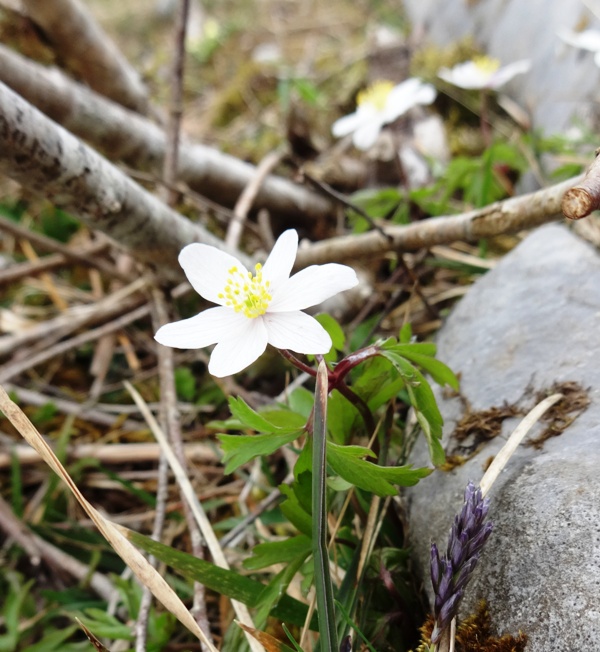
Photo: EO’D
“Where is King Daithi – where
Where is my bravest?”
On the rich deck he lies
O’er him his sunburst flies
Solemn the obsequies
Eire! thou gavest.
See ye that countless train
Crossing Roscommon’s plain
Crying, like hurricane,
Uile liu ai!
Broad is his cairn’s base
Night the “King’s burial place”
Last of the Pagan race,
Lieth King Daithi!
Notes:
Glib – a hairstyle with long fringe.
The consul Oetius, the shield of Italy and terror of ‘the barbarian’ was a contemporary of King Daithi.
Feis Teamhrach is the Parliament of Tara.
The Tailtin gaves were held at Tailte, County Meath.
Samhain and Beal, the moon and sun, were worshipped in pagan Ireland.
Eire was the ancient name of Ireland
A Sunburst was the national standard of Ireland
Hibernice, Reilig na Riogh was a famous burial place near Cruachan, in Connaught were the kings were usually interred before the establishment of the Christian religion in Ireland
Tribes and customs of the Ui-Fiachrach – Irish Archaeological Society publication.
Supplement to the Cork Examiner, 18th November, 1899
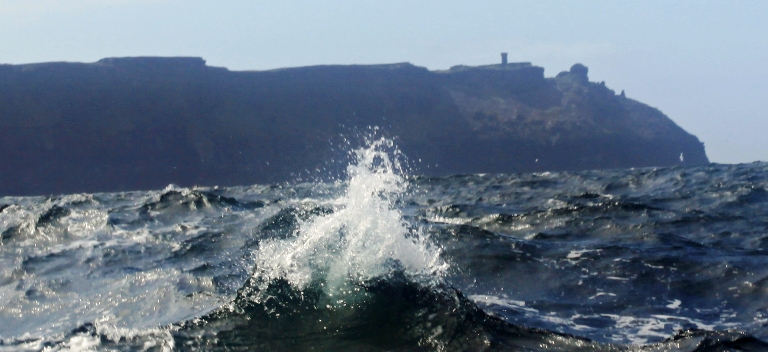
Photo: Norma Scheibe
The finest scenery in Ireland is on the northwest coasts of Connemara, Mayo and Donegal. There are no grander headlands in Europe than these broken, precipitous highland masses towering above the Atlantic.
Galway is the gateway leading into this picturesque region with its invigorating climate. A magnificent sea wall leads to it from Loop Head, at the mouth of the Shannon, with the glorious cliffs of Moher midway. Galway Bay is the outlet for a chain of lakes with which the highlands of Connemara are riddled. The coast is mountainous, with a succession of many coloured precipices and countless islands all the way from Clifden to Achill Head, where the Croaghaun cliffs are nearly 2,200 feet above the sea and thence along Mayo to Slieve League and the rock-bound highlands of Donegal. In picturesque colouring, grandeur, primeval wildness and elemental power there are few coasts that bear comparison with the north-western outstretch of Ireland.
Galway town is quaint and beautiful, and its charm of local colour comes from a strain of Spanish blood. For centuries it was a port commanding a large trade with Spain. Its merchants and sailors were constantly visiting and there were frequent marriages. While it was not Spanish in origin and attracted few settlers from the South, its architecture, gardens, manners and life were coloured by its associations with the more tropical country. The course of modern improvement has not been so rapid as to obliterate these traces of Spanish taste. While the town is not laid out with the regularity of a chess board, there is a central square or garden where the women are on parade on Sunday afternoon, and many of them have olive skins and coal-black eyes and hair. They have the same love of colour which fascinate Spanish women, and are brighter and gayer in dress than the Irish girls of Limerick, Dublin or Cork.
The Claddagh, Galway Photo: Robert John Welch (1859-1936) N.U.I.G. archives Creative Commons
The houses are also painted or kalsomined in pink, blue, yellow and white, so that there is a display of colour even in a quiet street like Prospect Hill – leading into green meadows. Neglected as the old houses with their central courts and wide entries and stairways have been, Galway still contains many of the distinctive features of a Spanish town.
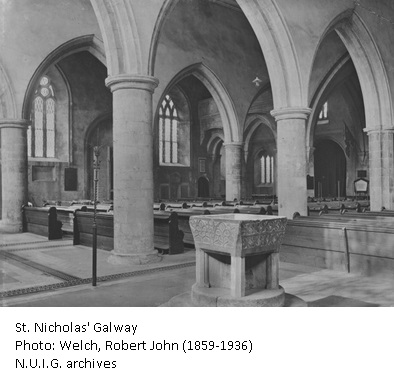
The Lynch mansion even in its present state of dilapidation goes far to support the composite reputation of this Irish Spanish port. This stronghold of a powerful family has degenerated into a chandler’s shop, but the medallions on the side, the decorated doorways and windows, and the grotesque heads near the cornice attest its foreign character; and the Lynch stone on the crumbling wall behind St. Nicholas’s Church perpetuates the grim sense of justice of its most famous tenant. James Lynch Fitzstephen, wine merchant and Mayor, was in Spain about the time America was discovered and invited the son of one of his friends to return with him to Galway for a visit. The guest flirted with the Irish girls, and was finally stabbed one night in the streets by a jealous rival. The murderer was the Mayor’s only son, who confessed his crime in an agony of remorse. The father, encouraged by this violation of hospitality, condemned his guilty son to death, and with his own hand conducted the execution, either from his own castle or opposite the church. The Lynch stone commemorates this act of stern, unbending justice, and with skull and bones rudely sculptured enforces the quaint inscription;
“Remember Deathe Vaniti and al is but Vaniti.”
Although the Castle and the mansions of the Burkes and the Joyces have fallen into ruin, there are Spanish patios, doorways, dripstones and archways, and even Saracenic windows, to be seen in the tangle of crooked streets, if one has the patience to look for them. More obvious than these peculiarities of ancient domestic architecture are the levels of colour and a gaiety of manner and spirits, which remain as unerring signs of Spanish infusion of blood. There are Spanish faces in the back streets, and Spanish voices are heard in the fish markets. Poverty is as real here as in other Irish towns, but its pathos is less moving because an instinctive effort is made either to hide it or take a cheerful view of it. There are flowers in doorways and windows; the cottages have touches of bright colours.
The Claddagh offers as interesting a study of the heredity as Spanish-Irish Galway. This is the strange suburb at the entrance to the harbour, where a tribe of coast fishermen has retained for generations many characteristic traits. These fishing folk disliked strangers, had little to do with Galway, lived by themselves and intermarried, kept out of ordinary courts of law, and allowed a chief, known as the Claddagh King, to settle all their disputes. Their King has been dethroned, and they have relaxed their discipline sufficiently to suffer fishermen not of the tribe to live among them and even to welcome tourists to their thatched cottages. The characteristic dress of the woman, a red gown and blue mantle with a handkerchief wound round their head, is still seen in this fishing colony, and every wife wears the Claddagh ring, with two hands holding a heart. The huddle of huts is one of the strangest and most fantastic spectacles on the Irish coast.
There was a time when a great commercial revival was predicted for Galway. A transatlantic packet line obtained a small contract and sought to take advantage of the shortest sea course between the United Kingdom and Newfoundland and Halifax; and extensive harbour improvements were planned in order to open the port to ships of the largest draught. The packet line lost two ships and abandoned the route and the breakwater has not been built; Galway, with its herring fleet and salmon fisheries has remained a fishing port.
The salmon fisheries have been improved by the construction of fish walks and ladders and by systematic measures for promoting breeding, and there are salmon leaps to be seen from every one of the picturesque bridges. Electric engineers have looked at the swift river pouring a torrent from Lough Corrib into Galway Bay, and suggested that power could be supplied at low-cost for creating a great manufacturing town. One small power house has been erected, and a few flouring mills are in operation.
With the opening of Connemara and Mayo to tourist travel on a large-scale by the construction of light railways, the establishment of coaching routes and the erection of new hotels, Galway’s fortunes are improving without commerce or manufacture. Curiosity shops have multiplied, and the Claddagh ring is prominent in every show-case. Wise men are suggesting that the town can be made more attractive to strangers by reproducing some of the bygone effects of domestic architecture and colour; and it is not unlikely that the paint-pots will be emptied upon the walls of the cottages before a new season sets in, and that garrulous guides will be in readiness to conduct tourists to every neglected ruin in ancient Galway. It is certain that full advantage has not been taken of the picturesque resources of this delightful fishing town, but it is also doubtful whether visitors can ever be detained very long on the edge of Connemara where there is a coast of unrivalled grandeur in reserve for them.
“New York Tribune”
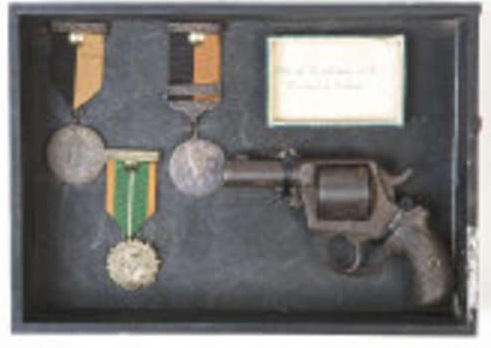
Kinvara 1916 and War of Independence Medals awarded to brother and sister, Joe and Annie Kilkelly, Kinvara, Co. Galway and revolver owned by Joe Kilkelly. Image: Adams.ie