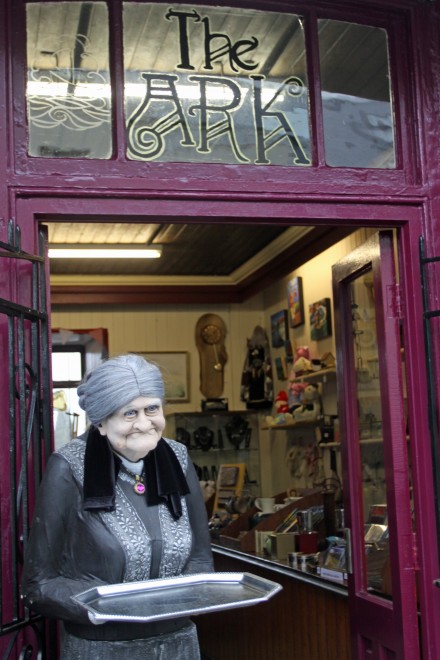
Agnes of the Ark has declined to be interviewed for widgetworld3. She is getting lessons in the ‘world wide web’ from her great grand niece (me) and has decided to set up her own page. In point of fact told me straight out
“That’s an awful stupid name for a webpage. What the name of heavens is a widgetworld? Hah? Sounds like something you need flyspray for. Would you have some sense and pick a name that doesn’t sound like an infestation.”
As every fact connected with the mysterious disease which steals away the food is of importance, we give the following singular statement which appears in the Galway Vindicator:
A woman named M— M——- ages thirty three, was brought a few days ago on a car to the work-house gate. She appeared to be suffering from acute pain; her hands and face presented the appearance of having been severely burned, as if they had been held over the flame of a strong fire.
In reply to the questions put to her, she made the following statement;
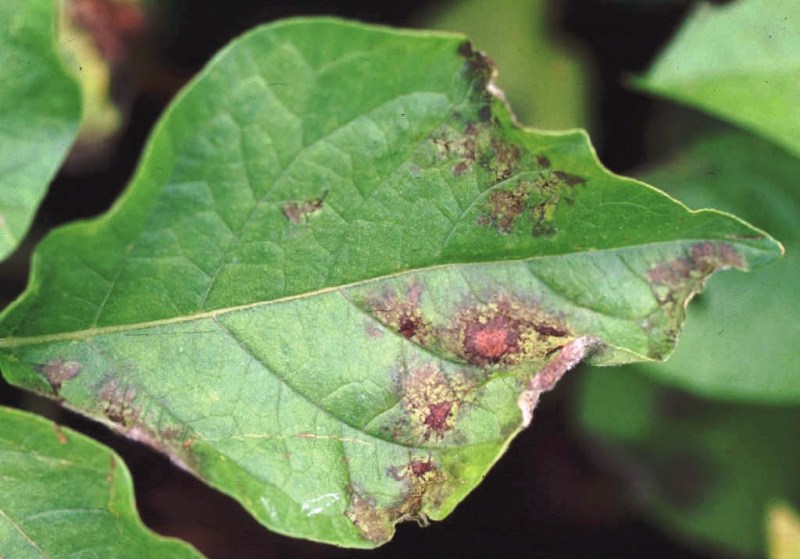
She was employed by a man to weed potatoes, and was at work on Friday, the 18th ultimo, in her perfect health, when a sudden blast of burning air came over her, and she was thrown back. She felt as if a quantity of pungent snuff had entered her nostrils. She also stated that the stalks of potatoes where she was at work were burned to a cinder, and the tubers made soft and black. It is thought the parts of the poor woman’s body which were affected will mortify.
The ancient festival of Tailteann was first inaugurated in honour of a pagan queen, Tailte, after whom the place was named, and around whose burial mound the athletic feats and various sports and games were performed. It lies about ten miles northwest of Tara. The date of the first Aonach held there is lost in the mists of antiquity but the Annals of the Four Masters record that “Lugha Lamh Fadha (Lugha of the Long Arm) established the games in the year 3333 of the Age of the World.”
The festival was a triennial one, ending each time on August 1st and was under the patronage of the King of Tara. For eighteen centuries – seven pagan and eleven Christian – Aonach Tailteann was held under royal edict, and, whatever its political significance, it was the great triennial social event during the period of Tara’s birlliancy. It had a very intimate and close connection with the “Feis Teamrach,” or “Festival of Tara,” which was the great national assembly held at Royal Tara. So important was it that, in the Annals, it is commemorated thus:
Three glories never to be forgotten:
Tailteann, Tara and Aodh MacAinmhireach
the latter being one of the Kings of ancient Ireland.
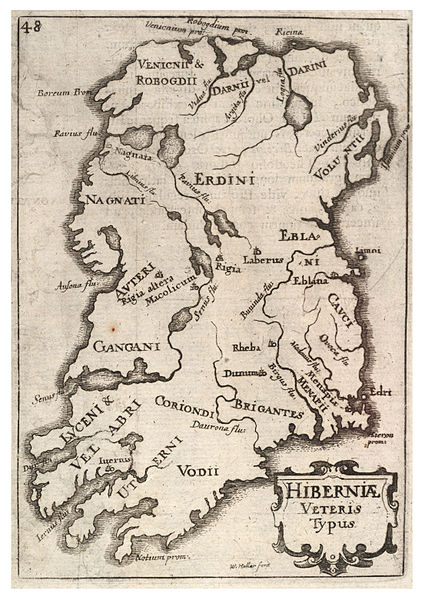
Ireland Wenceslaus Hollar (1607-1677) Scanned by University of Toronto Wikipedia.org
FEATS OF PROWESS
All the athletes of Erin cam to Tailteann to test their skill, and it is said that the Celts of Scotland, Wales, and Brittany sent representatives to enter the lists against their brother Celts. Feats of prowess, valor, dexterity and strength were the order of the day, while the evenings were given up to music and the gentler arts. The chieftains of the clans attended these functions with their immense retinues – charioteers, horsemen, runners, jumpers, spear and lance throwers, swimmers, wrestlers, harpists, singers and “shanachies.”
There, during an annual truce, lasting a week before and a week after the Aonach, the laws governing the relations between the clans and the high-king were drawn up or renewed, new pacts ratified, and a sort of general political and social Spring cleaning gone through. It was designed to build up the spirit of the race, to foster the ideal of mutual tolerationsand brotherhood, and to direct the nation along the road leading to the common weal.
The last official celebration of Aonach Tailteann was held in the year of Our Lord 1169, under the patronage of Rory O’Connor, High King of Ireland; but the festival was of such repute that tradition has it that a fair, or “pattern,” was held there annually up to a century ago.
Though Aonach Tailteann was the chief festival of its kind in Erin, each province, or petty clan, had its own Aonach;
Aonach Carmain was hosted by the Kings of Leinster – the last celebration of which took place in 1079
Aonach Cruachan, held at Rathorghan in the Barony of Roscommon hosted by the Kings of Connacht
Aonach Colman in the Barony of Ballycowan and afterwards transferred to the site of the present day town of Nenagh
Aonach Uisneach in the Hill of Usnagh in Westmeath
Aonach an Bhrogha at Brugh na Boinne – the pagan burial place of Irish Kings
As far back as the first historical records the harp has been accorded the place of honour, Irish folk lore places great stress on the harp as the national musical instrument. In all important events where music was admitted, at feasts and banquets, the harp was foremost as the instrument of romance, heroic qualities, and even love. Later it was also used by the clergy in their proselytising travels through the country. (Strangely enough the flute was relegated to the least important place!)
The Irish harp was called the cruit, and as far as can be ascertained the cruit dates back to the twelfth century B.C. records mention the fact of the cruit being endowed with some remarkable attributes. It could evoke real, physical responses in those who heard its sound, including, mirth to the point of hopeless and helpless laughter; joy to a level impossible to describe – and sorrow to the point of death. It was therefore not surprising to find that the players of this instrument commanded considerable attention and respect.
There is an old Irish legend taken from the notes of Oscar Rothschild that tells of the harper Uaithne, who possessed a cruit which formerly belonged to the god Dagda. Uaithne was married to Boinn, the goddess of the river Boyne. She in turn was queen of the fairies.
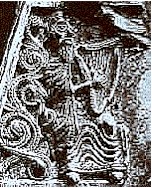
Maedoc book-cover, Ireland, circa 1000 AD
The couple had three sons called after the three strings of their father’s harp – Gentraiges, Goltraiges and Suantraiges. All three were gifted and remarkable harpists.
A Chieftain’s son named Freoch was related to Uaithne by marriage. His mother, Befind, also came of fairy train. The bond of marriage and, perhaps the bond of the supernatural led Freoch and Boinn to form and alliance that included her three sons. It was all for love.
At that time the reigning King of Connacht (Ailill) and his wife (Medb) had a beautiful daughter. The fame of her lovliness had gone far afield. Her name was Findabair. Freoch wanted to marry Findabar. To further his chances he enlisted the aid of his aunt, Boinn, and she did her utmost to ensure his success. She bestowed on him all the jewellery and equipment of a fashionable man of the highest rank – and – most valuable of all, she lent the aid of her three sons, trained in the use of their fathers cruit (harp).
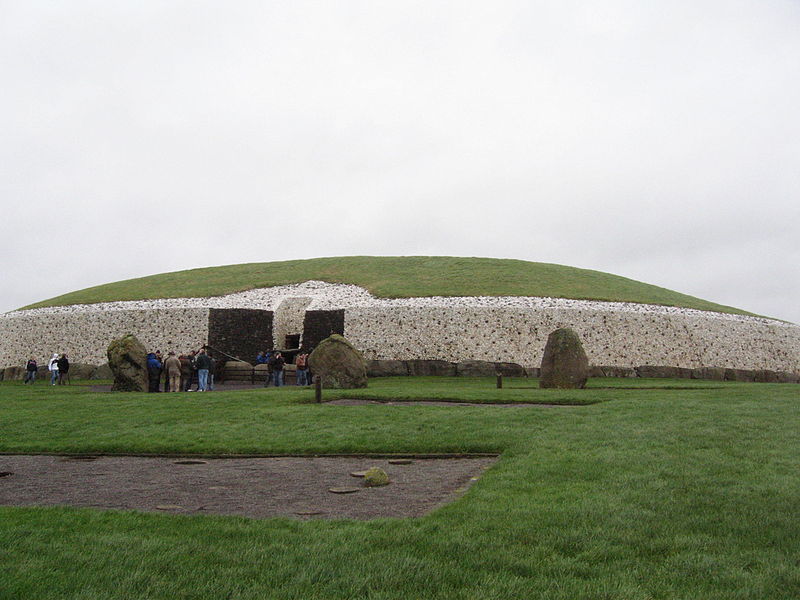
Brú na Bóinne, Newgrange Photo: Barbara y Eugenio
Freoch and his retinue visited the court of the King of Connacht and his daugher Findabar. They spent some time in feasting and other happy pastimes. One day at a game of chess the King wished to enliven his guests with music. This gave Freoch his great opportunity. He requested his three harpers to play the chants of Uaithne (Motherhood). They did. It was a mournful lament and while the harpers played, tragedy overtook twelve of the King’s people, who sorrowed unto death. The King was startled and upset and it was not long before he began to devise means of getting rid of Freoch. He set him trials to test his mettle.
But these trials were of no avail aginst the fairy protected hero. Freoch was triumphant in all and when he completed them his three harpers again played a plaintive tune, again with fatal effect. Thirty of the King’s most dearly loved retainers were smitten to death by the potent magic of the sorrow laden melody.
The King of Connaught had to grant Freoch’s wish. He was betrothed to Findabar and the harps, all three, heralded the joy of their union – their music spilling out and across the countryside, lifting the hearts of all who heard.
Note: Boinn’s husband has also been named as Nuada, Elcmar or Nechtan
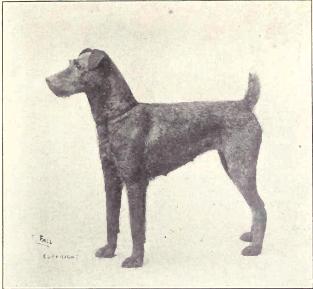
A rather curious story comes to me this week. An Irish terrier was sent all the way from Rome by its owner, a great lady of the Italian capital, to be buried in Ireland. The lady was passionately fond of the dog, and when it died recently she had it embalmed and encased in an elaborate and expensive coffin.
She immediately communicated with a firm of London lawyers, requesting them to find some place in Ireland where her pet could be buried and its remains rest undisturbed. As a result, she was put into communication with J….. L….., B……… L…., the famous race horse owner. He agreed to allow the dog to be buried on his estate, and the coffin from the Italian woman duly arrived from Rome. After the interment the bereaved owner of the Irish terrier paid Mr L…. a check for a substantial sum for the burial ground – probably two square feet – and also left the wherewithal to purchase a tombstone.
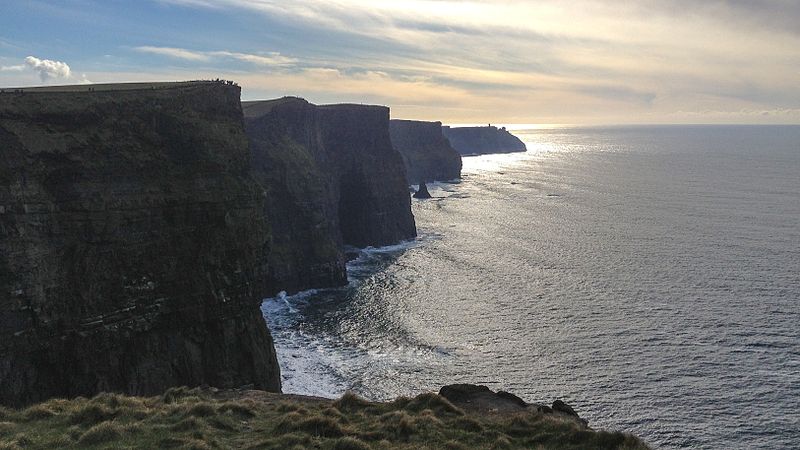
Fancy being brought face to face with the great ocean representing on the map an expanse of water between the Irish and the American shores of no less than five thousand miles. No intervening territory meets the eye the whole length of this prodigious waterway, no strip of land, no cliffs, not even a bare rock on which a sea bird might perch. As a Clare boatman once said to a party of tourists;
“Just throw a stone from where you are now and it will fall into another world, barring it didn’t sink in the water.”
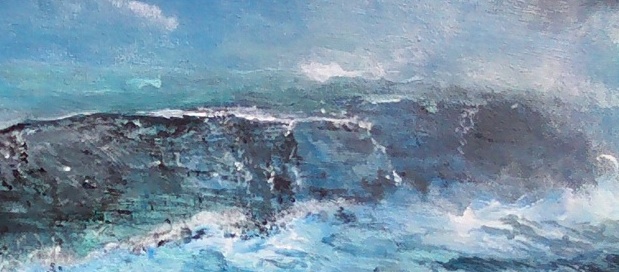
The surpassing grandeur of the great Atlantic ‘in breeze, or gale, or storm’ is in itself something to gaze upon. There behold the mighty sea, almost along the entire shore, rolled back ‘from dusk till dawn, and from dawn till dusk again,’ in masses of foam against huge frowning, raven-coloured rocks. The din of the conflict scarcely ever ceases, while day and night those sable cliffs valiantly repulse their fierce assailants.
The cliffs of Moher, lining the coast of Clare for five miles, are in themselves a simple marvel. Moher, an iron-bound barrier, erected by Nature to repel the lashing fury of the ocean, is pronounced on all bands to be the finest pile of rock that guards the margin of our sea girt land. Try and imagine a serried array of boulders rising abruptly at low water mark to an altitude ranging from 600 to, it is said, 1,000 feet, and this is Moher.
These towers of the sea are not so tall as others in Ireland – for instance, in Crohahawn in Achill, or Slieveneague in Donegal. It is to be remembered, however, that the precipitous cliffs on the Mayo coast repose in their sockets at an angle of about 45 degrees; but the Clare Peaks, sheer perpendicular elevations, stand rooted and immovable against the rage of the tempest, and are more than proof against almost perpetual winds from the west.
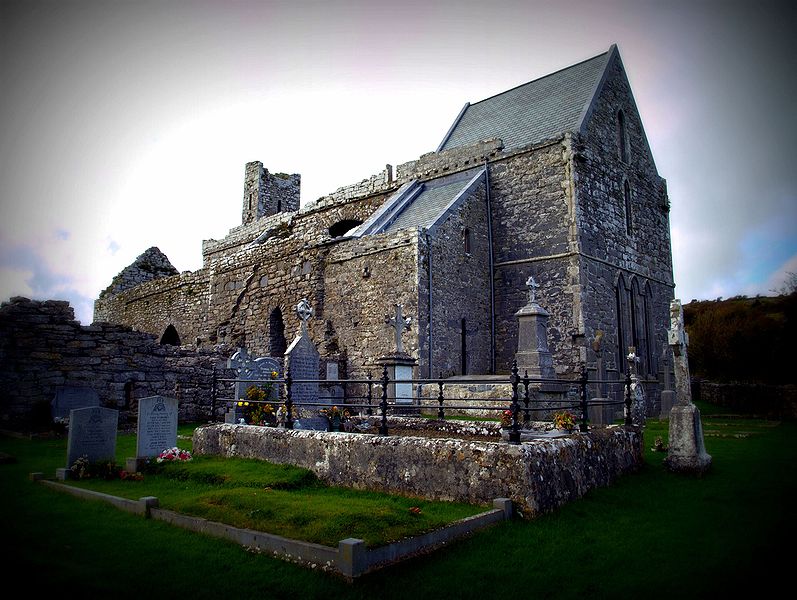
Corcomroe Abbey The Burren, Co Clare Photo: Shaun Dunphy Creative Commons
Some notion may be formed of the violence of western hurricanes on the coast of Clare by the fact that trees planted inwards fifty miles from the Cliffs of Moher acquire a bend towards the eastern horizon. The power of the blasts off sea is enhanced by the indented character of the shore in this portion of Ireland.
Huge recesses of the Atlantic are frequent, and add immensely to the fascinations of the Clare Coast. From Liscanor (sic) to Doonbeg the ocean forms a spacious bay at Corcomroe and other charming inlets of smaller size. The fresh invigoration breezes, surcharged with ozone, that play around on all sides of the coast of Clare acknowledges no compeer anywhere.
THE NEW GALWAY STEAMERS – STILL MORE RAPID COMMUNICATION WITH EUROPE
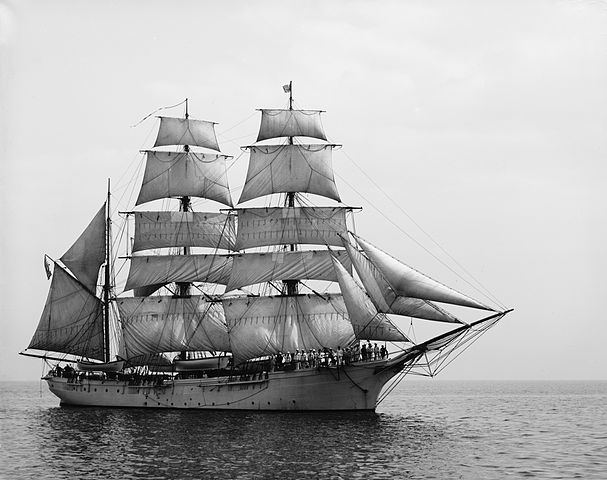
The steamship Connaught, the first of the four new Galway steamers to be called after the four provinces of Ireland, was to have been launched yesterday, and will probably be soon on her way to this continent. The company has entered into a contract with the government binding themselves to convey mails and telegraphic dispatches to and fro between Galway and St. Johns respectively, in six days by the steamers of this line.
This is certainly a bold stipulation. It is quite an American idea, and if carried out will bring the two continents into closer communication than they ever were before. The distance between the two ports is about 1,650 miles, and if it is made in 144 hours, these vessels must run at a uniform speed in all weathers of nearly twelve miles an house. it is said, however, that they will be able to run twenty miles an hour if required.
If they fulfill the terms of the contract, nothing can beat this rapidity of communication except Wise’s balloon or the Atlantic telegraph.
THE BELMONT CHRONICLE, AND FARMERS, MECHANICS AND MANUFACTURERS ADVOCATE. 2ND SEPTEMBER, 1853 P1
IRELAND
There is a religious movement in progress in Ireland that promises important results. Through the influence of emigration and proselytism the relative numerical strength of the Protestants and Roman Catholics is undergoing a rapid change, and the former are gradually gaining the ascendency. It has been predicted by the London Times that “in fifty years Ireland well be Protestant to a man.” A concealment of the fact is no longer attempted by the Roman Catholic press. The Dublin (R.C.) Nation says;
“There can be no longer any question that the systematized proselytism has met with immense success in Connaught and Kerry. It is true that the altars of the Catholic Church have been deserted by thousands, born and baptized in the ancient faith of Ireland. The West of Ireland is deserting the ancient fold.”
The Dublin Tablet says;
“We repeat, it is not Tuam, nor Cashel, nor Armagh, that are the chief seats of successful proselytism, but this very city in which we live.”
Slemish, mountain in County Antrim where St Patrick is reputed to have shepherded as a slave Photo: Man vyi Wikimedia commons
The Dubin Evening Post says:
“We learn from unquestionable authority that the success of the proselytisers in almost every part of the country, and, as we are told, in the metropolis, is beyond all the worst misgivings we could have dreamt of.”
This testimony is further corroborated by the report of the Irish Missionary Societies, which characterize the movement above spoken of as the “New Reformation.” Ireland can scarcely be regarded as a Roman Catholic country inasmuch as, out of a population of six millions and a half, nearly one-third is Protestant. To effect this result divers influences have contributed, prominent among which are the labors of “The Society for Irish Church Missions to the Roman Catholics,” organised in 1840, under the presidency of the Duke of Manchester. This society has now 142 agents. In the district of West Galway where in 1810 no 300 Protestants were to be found, there were, in May 1852 nearly 6,000 converts attending church services, while 3,500 children were taught in the bible schools. In Dublin and various other places mentioned the missions and schools are prosperous.