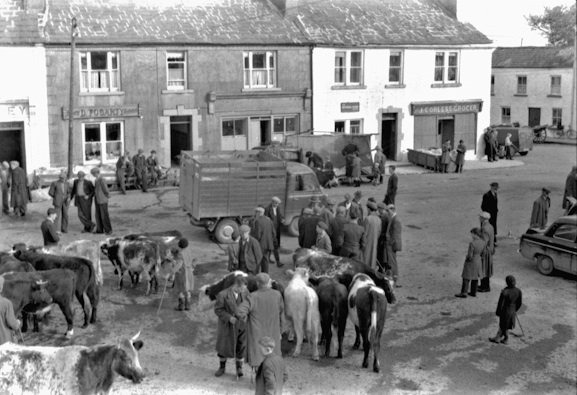
The Square, Kinvara c. 1950 Cresswell ArchivesThe Moreton Bay Courier 3rd March 1849 p4 (abridged)
An encounter took place on Monday between a detachent of the 4th Light Dragoons, forty in number, and a body of people from Kinvarra.
The soldiers, assisted by fifty-six policemen, were out collecting poor-rates, or rather seizing corn in default of payment. They went on until they came to the district they were to distrain on, when a barricade, partly formed, met their view, protected by about 300 men and women. They refused to let the armed force pass and said they would rather sacrifice their lives. The Riot Act was read three times, and still they would not give way.
The police and soldiers were ordered to charge with bayonets. Stones were thrown and some of the men severely hurt. The police drove the people a quarter of a mile into the fields, but they were quickly back again to the scene of the action. Mr Davys, the magistrate, did not wish to shed blood by ordering the military to fire, and, it being late in the day, he directed them to turn round and proceed home.
Much praise is due to this forbearance of the authorities, as there is no doubt but much blood would have been shed. Of course there will be a greater force brought down there in some few days.
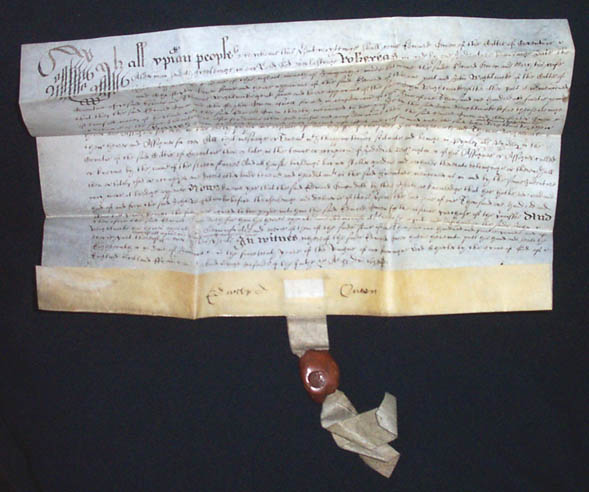
Vellum From the private collection of Randy Benzie Wikimedia CommonsFreeman’s Journal 23rd November, 1901 p 6 (abridged)
The ‘Anglo Celt’, viewing with alarm the appearance of desolation which the country is beginning to present, announces that to the person who succeeds in keeping the greatest number of would be emigrants from emigrating between September 28 and May 28 next will be presented with a gold medal for patriotism, together with a vellum certificate.
Twenty silver medals will also be given to the 20 who came next, they also securing vellum certificates. A certificate will also be presented to every man, woman, boy or girl who can prove that through their efforts one person was kept in the country.
That there is urgent need of something being done to stop the flow of citizens America-wards will be seen when it is stated that within the last ten years 250,000 have gone and whereas in 1840 Ireland had a population of 8,000,000 she has now only 4,400,000.
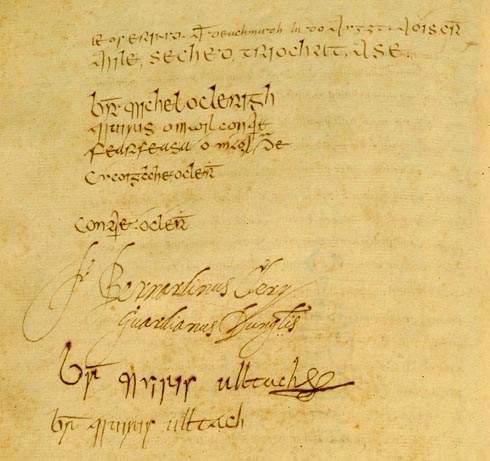
Signature page from Annals of the Four Masters University College Dublin Archives DepartmentFrom the Ordnance Survey Letters by John O’Donovan and Eugene Curry, 1839
Parish of Abbey
In this parish is also situated Corra an Rubha – Corranrue (i.e., the Causeway of Rue) in which stood a Castle belonging to the family of O’Heyne, formerly Chiefs of Hy-Fiachrach Aidhne. This Castle fell in the year 1755 at the very moment that the earthquake happened at Libson. The site of this Castle and a small part of its ruins (reduced to a formless heap) are still to be seen near the village of Corranrue, but I think it is on the Co. of Galway side of the boundary. It should be shown on the Ordnance Map. The present representative of the branch of the O’Heynes who lived in this Castle, as also on the Castle of Ballybranaghan at Kinvara, is John Heynes alias O’Heyne of the New Quay House, a very rich and sensible man, who is likely to purchase a considerable portion of Coill O’bFiachrach from De Bastro, the present proprietor, who is of French origin, and who, I am told wishes to sell out his estate in Connaught, with which he has, of course, little or no national sympathy. This gentleman descends from the last proprietor of Corranrue, thus :-
James, a man of Chieftan appearance and Herculean strength, aged 28.
|
John, now living at the New Quay, aged 55.
|
James,
|
John, lived at Poulanisce.
|
Brian,
|
Peter, the last who is said to have lived at Corranrue.
The senior branch of this once powerful family is Mr. Heynes of Ardrahan, who is well known in the country as Heynes the Process Server! This man is the senior representative of Guaire Aidhne, King of Connaught, so celebrated by the Irish bards as a Prince of unbounded hospitality. O’Heyne is senior to O’Shaughnessy. He was often chief of all the Territory of Hy-Fiachrach Aidhne, a Territory coextensive with the Diocese of Kilmacduagh, but O’Shaughnessy was never lord of more than Kinelea na h-Echtghe. O’Heyne built a beautiful little Monastery at Kilmacduagh but we do not find that O’Shaughnessy built any Church there and the reason is because he was never, until the reign of James I, but an Urriagh or sub-Chief to O’Heyne. O’Heyne is regarded to have been Chief of all the Hy-Fiachrach Aidhne at the following years :-
A.D. 1047. O’Heyne, Lord of Hy-Fiachrach Aidhne, died.
A.D. 1048. Maelfaal O’Heyne, Lord of Hy-Fiachrach, died.
A.D. 1055. Donnell Roe O’Brien was slain by O’Heyne, lord of Hy-Fiachrach Aidhne.
A.D. 1121. Torlogh O’Connor made a plundering excursion into Munster, and among other Chieftans, lost in a battle Hugh O’Heyne, Lord of the Hy-Fiachrach Aidhne.
A.D. 1180. Maurice O’Heyne, Lord of the Hy-Fiachrach Aidhne, was killed by the men of Munster.
A.D. 1225. Hugh O’Connor, presumptive King of Connaught, sent Felim his brother, and others of the Chiefs of his people and a great body of English soldiers to plunder Hy-Fiachrach Aidhne, the Country of Owen O’Heyne.
A.D. 1588. Owen Mantach, son of Edmond, son of Flann, son of Conor O’Heyne, Lord of Hy-Fiachrach Aidhne, died and his son, Hugh Boy, was elected to his place. Annals of the Four Masters.
The district of Rubha (Rue) in which the Castle of Corra an Rubha stood, is mentioned in the Annals of the Four Masters at the year 1599.
O’Donnell, after having plundered Thomond, proceeded on his way homewards across the chain of rough-headed mountains of Burren, and passing by Nua Chongbhail, Turlach, the Abbey of Corcumroe and Carcair na gCleireach, arrived at Rubha (Rue) in the west of Hy-Fiachrach Aidhne etc.
Photo; Cresswell ArchivesAmong the papers of the Chief Secretary’s Office Registered Papers National Archives Francis J. Crowley Bequest
NAI REFERENCE:
CSO/RP/1822/484
TITLE:
Tradesmen of Kinvarra, County Galway: for measure of relief
SCOPE & CONTENT:
Petition of tradesmen of Kinvarra, County Galway, to Richard Wellesley, 1st Marquis Wellesley, Lord Lieutenant, Dublin Castle, requesting relief as they have ‘no means left to support their families but pawning their Clothes and selling every little article they possessed for less than half Value’: proposes that aid be advanced to enable travel to colonies.
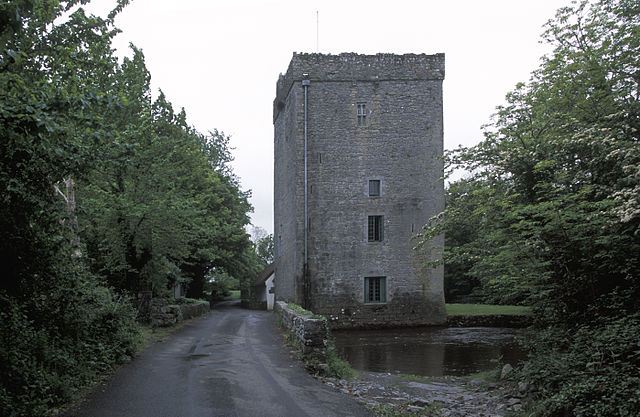
Thoor Ballylee Photo: Jerzy Strzelecki Wikimedia CommonsExcerpt from The Celtic Twilight – W.B. Yeats (1893) abridged
p232/3
LAST night I went to a wide place on the Kiltartan road to listen to some Irish songs. While I waited for the singers an old man sang about that country beauty who died so many years ago, and spoke of a singer he had known who sang so beautifully that no horse would pass him, but must turn its head and cock its ears to listen. Presently a score of men and boys and girls, with shawls over their heads, gathered under the trees to listen. Somebody sang a Muirnín Díles, and then somebody else Jimmy Mo Mílestór, mournful songs of separation, of death, and of exile. Then some of the men stood up and began to dance, while another lilted the measure they danced to, and then somebody sang Eiblín a Rúin, that glad song of meeting which has always moved me more than other songs, because the lover who made it sang it to his sweetheart under the shadow of a mountain I looked at every day through my childhood.
The voices melted into the twilight and were mixed into the trees, and when I thought of the words they too melted away, and were mixed with the generations of men. Now it was a phrase, now it was an attitude of mind, an emotional form, that had carried my memory to older verses, or even to forgotten mythologies. I was carried so far that it was as though I came to one of the four rivers, and followed it under the wall of Paradise to the roots of the trees of knowledge and of life. There is no song or story handed down among the cottages that has not words and thoughts to carry one as far, for though one can know but a little of their ascent, one knows that they ascend like medieval genealogies through unbroken dignities to the beginning of the world.
Folk art is, indeed, the oldest of the aristocracies of thought. Because it refuses what is passing and trivial, the merely clever and pretty, as certainly as the vulgar and insincere, and because it has gathered into itself the simplest and most unforgetable thoughts of the generations, it is the soil where all great art is rooted.
Photo: Bart Braun Wikimedia CommonsA Walking Tour Round Ireland in 1865 by an Englishman
London: Richard Bentley, New Burlington Street. 1867 p181/2 (abridged)
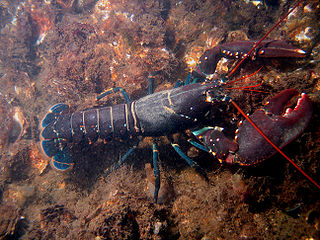
I left Kinvarra at half-past nine o’clock this morning. I pass to the right on leaving the town a round tower, and on the left you have the hills of Clare. Then to the right there is the Kinvarra National School, a neat looking building, erected in 1840. Shortly afterwards I meet an industrious boy who has been making good use of his time by catching a fine lobster. Though he knows a house further on where they generally buy the lobsters, on the principle of the bird in the hand being worth two in the bush, he offers it to me. I excuse myself from the purchase on the ground of travelling. I tell my young friend of the story of the lobster which seized a man’s hand and held it so fast he was drowned by the rising tide. The boy says he is aware of this propensity on the part of the lobster and takes due care.
I then pass through the village of Corranroo, where you have fairly passed out of the county of Galway into Clare. Then on to the foot of some hills from whence a fine view is obtained of the arm of the sea and surrounding country. There are three roads here; one to the left leading to the south, one to the right being a road longer by two miles, leading to Ballyvaghan, and a road in the centre over the hill being the shorter one to the same place.
Further up the hill you have a still better view of the bay, and an immense expanse of table-land with a round tower on an island to the left, and the town of Galway in the distance on the other side of the bay.
Dunguaire Castle, Kinvara Photo: Angella Streluk Creative CommonsA Walking Tour Round Ireland in 1865 by an Englishman
London: Richard Bentley, New Burlington Street. 1867 p181/2 excerpt – abridged
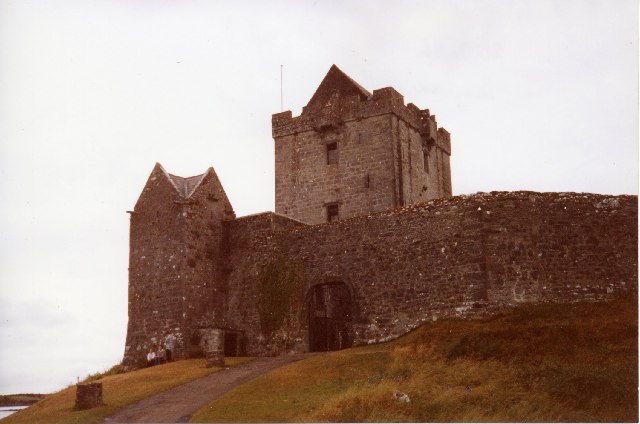
I (then) leave the main road, leading to Gort, Ennis and Limerick and take a road to the right, and pass through the village of Ballinderreen, and then for miles through a bleak and desolate country until I reach Kinvarra. This place is distance from Galway about seventeen miles. There is a castle here called Dungoury, (sic) which is in a very good state of preservation. I ascended to the top from which a fine view is obtained. Below is the village town of Kinvarra, prettily situated on a small bay and with some appearance of trade. Around is a stone covered country, wild and uncultivated.
On walking into the town a storm of rain fell and I offered a share of my umbrella to a gentleman in the road. He kindly showed me the inn and on learning that my mind was a blank as to my course of travel from this place, he wrote on a slip of paper a prescribed route as far as Kilkee. He kindly asked me to join his circle to tea in the evening at eight o’clock and then left me meanwhile to my own resources.
It was still early in the afternoon, so I walked to the end of the bay and bathed as well as the weeds (which were gathered thickly) would permit. On my way back an old woman told me a story of a girl of the village, some time since, who was accustomed to swim across the bay, put some wheat-ears between her teeth from the field on the other side, and then swim back again. The distance to and fro would be about a mile.
On my return to the inn I found a turf fire lighted without any direction of mine, a mode of welcome not at all acceptable this warm weather. The hostess is a stout well-meaning woman, though rather too fussy. She places before me some oysters and eggs, scanty fare enough. She tells me she is the mother of eighteen children. Oh fancy!
My hostess tells me a pretty story of one of her eighteen, a boy. He went to London en route for Australia, and wrote from the metropolis to say, that though he had seen all the sights there, he still thought no place equal to Kinvarra.
TITLE:
Arthur French St George, Oranmore, County Galway: on public works projects in region for alleviation of poor
SCOPE & CONTENT:
Letter from Arthur French St George, Tyrone, Oranmore, County Galway, to Henry Goulburn, Chief Secretary, Dublin Castle, indicating strong disappointment at failure to carry out repairs to road from Galway to Kinvarra, considered a worthwhile public works project.
In view of the triumphal progress of the Irish delegates in America, it may be interesting to give some figures showing what Irish-America really means:-
The city of New York contains more Irish than Dublin, Cork and Belfast combined.
The city of Brooklyn contains more Irish than Galway and Waterford put together.
There are more Irish in Boston than in Dublin, and more in Philadelphia than there are in Belfast – but it is in the Irish names in America that the greatest proof is evinced of the devotion of the Irish exile to the old land.
There is an Ireland in Alabama, another in West Virginia, another in Indiana and another in Minnesota.
The are three Hibernias situated in Florida, New Jersey, and New York.
There are five Erins scattered throughout the States of Georgia, New York, Tennessee, Texas, and Wisconsin.
There is an Irishburg in Virginia, an ‘Irish Ridge’ in Ohio, an ‘Irish Ripple in Pennsylvania, an ‘Erina’ in Nebraska, ‘Erin Shades’ in “Virginia, and ‘Erin Spring’s’ in Indian Territory.
The names of Irish provinces are illustrated by Munster in Illinois, and Munster and Ulster in Pennsylvania.
In New York there is an Ulster Park, an Ulsterville, and an Ulster County.
There are 17 Dublins in the States, 18 Waterfords, 9 Tyrones, 7 Limericks, 5 Clares, 4 Mayos, 4 Sligos, 3 Corks, 3 Wexfords, 6 Antrims, 9 Derrys (four of which are called Londonderry), a Roscommon. a King’s County, a Queen’s County, a Galway, a Wicklow, a Longford, Kilkenny, Kildare, Donegal, Carlow, Monaghan and Armagh.
There are 12 places called Avoca, and 6 places called Avondale in honor of Parnell. There are also several places called after Parnell himself. There is a Garryowen in lowa, a Tullamore in Illinois, a Rathdrum in Idaho, an Achill in Roscommon County, Michigan; a Ballina in California, a Doneraile in Kentucky, a Strabane in Dakota, an Ardee in New York and in Tennessee, a Kinsale in Virginia, a Kincora in New Jersey, a Tara in lowa, a Navan in lowa, and another in Michigan, a Queenstown in Maryland and Pennsylvania while there are twelve towns called Westport, four called Newry, thirty called Newport. There’s a Valencia in Kansas and Pennsylvania, four places called Ennis, a Kilmichael, a Kilmanagh, Lismore, Lisburn, and eleven Bangors.
There are ten places called Belfast, a Boyne in Michigan, a Bandon in Minnesota and in Oregon, a Clontarf in Minnesota, a Dungannon in Ohio and twenty-five, Milfords.
Almost every State in the Union has counties called after the famous Irish-Americans of revolutionary fame. There are two counties eight towns, and seven places called after Jack Barry, ‘the father of the American Navy’ who was a County Wexford man. It would be almost impossible to enumerate the towns and places named after ‘Old Ironsides,’ Parnell’s grandfather. The ‘Starktowns are also very numerous, some in honor of General Stark and some in honor of his wife, ‘Irish Molly Stark,’ as she was always lovingly described, who took her husband’s place when he was killed at his gun, and remained in command of the gun till the end of the war. She was created captain for bravery in action, but never lost the title to ‘Irish Molly.’
In honor of O’Brien, of Machias Bay fame, there ia an O’Brien County in lowa, and an O’Brien in Glynn County, Ga. In honor of Patrick Henry we have 10 counties and 18 towns. There are towns and counties ad libitum called M’Donough, Sullivan, M’Cracken, Calhoan, O’Brien, Emmet, Meagher, Dougherty, Murphy, etc. Phil Sheridan has no fewer than 3 counties and 17 towns named in his honor while there are several Colorans, Burkes Shields, Kearney, Clebarn, Mulligan, Moran, Lynch, Kelly Mai one, etc.
Photo: Jon Sullivan Wikimedia CommonsNew Zealand Tablet 24th April, 1891 p9
A conflict took place between two armed police and a number of people at Kilbeacanty. The police, who were protecting an emergency man, entered a public house on their way to Loughgraney, when the party inside, it is alleged, took their rifles and injured them. Assistance having come to the aid of the police, four arrests were made. The names of the prisoners have not yet transpired.



 The Burren and Beyond