Posted in Posts and podcasts

Aughnish Sea Wall – 1913

Connacht Tribune 11th January, 1913 p.6 (abridged)
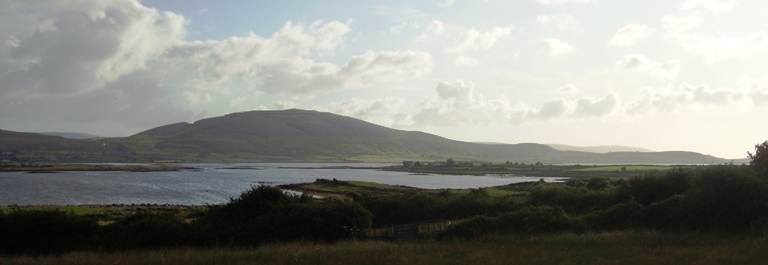
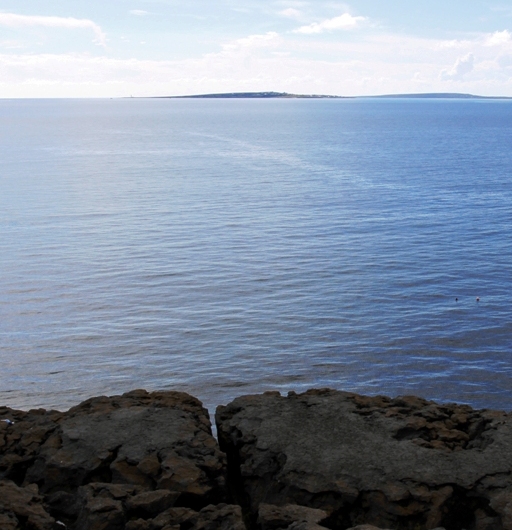
View from Duras, on the way to Aughnish Photo: BO'D
View from Duras, on the
way to Aughnish
Photo: BO'(abridged)

Dear Mr Moran,
In last week’s issue of the “Tribune”, I read an account of the serious damage done to the sea wall at Aughnish by the storm. This, I think, calls for a little plain speaking from someone in the locality. In the interests of the heavily-muleted ratepayers of the Gort Rural District, I am prompted to write and I hope to convince you that my remarks are more than necessary.
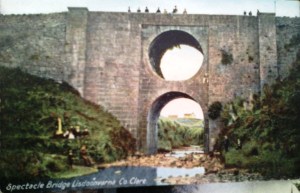
The sea wall, or “Coch,” at Aughnish, as you are aware, is a causeway connecting the densely populated village of Aughnish Co. Clare, with the mainland at Geeha – an appropriate name, for every wind that blows, run riot there. The road runs along by the Atlantic for about a thousand yards, two-thirds of it being in the Gort Rural District, and one-third being in the Ballyvaughan District, County Clare. For the past half century the causeway has been repaired times out of mind at considerable cost to the County Galway, but at a very trifling cost to the County Clare. More money has been spent by the Galway Grand Jury and the Gort Rural District Council on repairing breaches after every storm than would steamroll all the roads in Kinvara and Duras for the next ten years.
The people are heartily sick voting huge sums away year after year for repairs that, for all practical purposes might as well have been thrown into the sea.
Your predecessors applied for small sums varying from £50 to £100 for repairing the sea wall, and the work was always entrusted to a Gubaun Saor, whose only ambition was to draw his money and not care a straw if it fell the day after, as it did a number of years ago under the Grand Jury regime.
The Clare Grand Jury did things better, they expended a decent sum twenty golden years ago, and they never had to expend a penny on repairing it ever since. The Clare county surveyor insisted on a competent clerk of works superintending the contract from start to finish and he insisted on the proper materials being used, and on the specification being carried out to the letter. I am sure if you visit Aughnish and see for yourself what is required and insist on having it done (as I am sure you will),  in a proper manner and by competent mechanics under a resident engineer, such as you have amongst your assistants, it will be a long time again before the Aughnish sea wall comes up before the Gort District Council. Unless you take action at once, and put an end to botching and tinkering for ever, I fear the ratepayers of Kinvara and Duras will rise in rebellion against the District council at the next quarterly meeting.
Hoping that you take my advice to heart.
Your obedient servant.
SPEX
Posted in Posts and podcasts

Kinvara – 1916

Connacht Tribune 9th April, 1966 p. 29

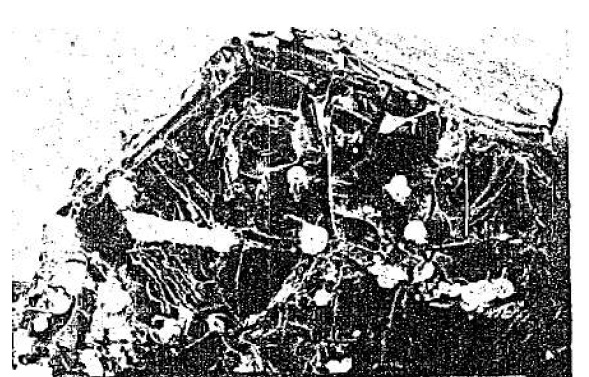
Fragment from G.P.O. Image: Connacht Tribune
Fragment from G.P.O.
Image: Connacht Tribune

This piece of stone is a portion of one of the walls of the G.P.O. which was burned during the 1916 Easter Rising and it is now on public display at the Bank of Ireland, Eyre Square, Galway.
It was given to the bank for display purposes by Mr G. Nally of Kinvara. His mother came into possession of the stone soon after the Rising and later Mr. Nally took it with him across the Atlantic where it was displayed in America. Some years ago it was returned to this country.
The peculiar colour of the stone is explained by the fact that there is a good deal of glass solidified on the surface. This occurred when glass bottles and jars holding food supplies for the Volunteers occupying the G.P.O. melted when the building burned. Peas can be clearly seen still imbedded in the glass and stone. The piece weighs about two stone and is about one foot long. There are a number of similar unique souvenirs of the Battle of the G.P.O. still in existence in parts of the country but this is believed to be the only piece in the west of Ireland.

Posted in Posts and podcasts

Galway to Kinvara – 1923

Connacht Tribune 29th December, 1923 p.5 (abridged)

Across the Bay Photo: EO'D
Across the Bay
Photo: EO’D

The Council of the Galway Chamber of Commerce had an interesting discussion at its meeting on Friday evening last on the question of linking up the towns around Galway Bay more closely with the city, and developing traffic on the Corrib. Prof. A. Eraut, M.A. occupied the chair; and the discussion was mitigated by Mr J.O’Kelly-Lynch, who said that Mr Winkle, Mr Feeney and other merchants in Kinvara had pointed out to him that much of the trade of that town was done with Ennis and Limerick, and that it could be diverted to Galway provided regular communication were established across the Bay. The pier at Kinvara was available even for a boat like the Dun Aengus. The gentlemen mentioned had sent him a telegram that day saying that they would offer their utmost support to any proposal to establish closer communication by sea.
Mr. M.J.Crowley, H.C., thought it would be well to discuss the whole matter with Captain Meskill of the Dun Aengus, who was an expert on these matters. The Galway Bay Co.’s boat had only nine feet of a draft, but he believed that at times she had to be in the mud at Kinvara.
Mr. Sp. P. Corbett said that Commander Hanan had a small boat at the docks, and he had made an effort to establish a commercial trade with Kinvara, but it had not been a success.
Mr C.C. Copeland, of the City of Galway Shipping Co., said he thought that Commander Hanan had some trouble with his engines at Kinvara, and the wages he was compelled to pay for repairs over there took away anything he could earn on the venture.
It was resolved that the secretary should communicate with the traders of Kinvara as to what traffic they could guarantee and consult Captain Meskill and the owner of the boat on the Corrib.

Posted in Posts and podcasts

The ‘lament’ of Padraic O’Conaire – 1943

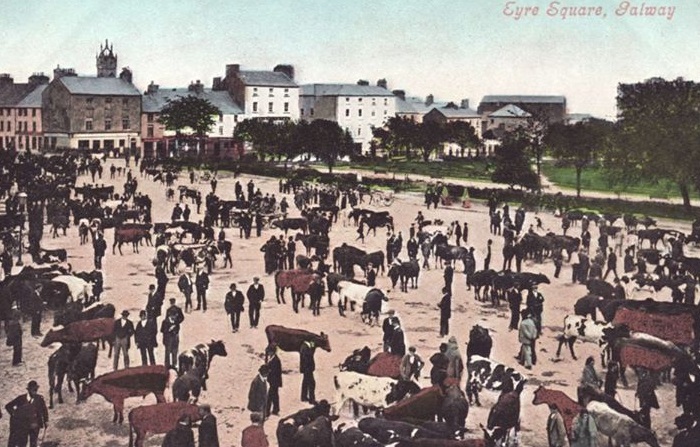
eyre sq
Cattle Fair, Eyre, Square, Galway

Connacht Sentinel 13th April, 1943 p.2
In 1935 Eamon de Valera veiled a statue of Padraic O’Conaire in Eyre Square, Galway. The Square was used for a variety of purposes including a turf dump during the Emergency. The storage of turf at Eyre Square ended in the late 1940s. Mr Kevin McDonagh marked its departure, from Padraic’s perspective, with the following poem.

O dreadful change! O piercing sight!
O prospect ugly, bleak and bare!
I’ve half a mind to stand upright
And part forever from the Square.

The crafty folk who jeer and scoff
At things that poets find most sweet.
Have tumbled down and carried off
Those noble piles of rich brown peat.

I’d fondly hope they had been stacked
To lend a rustic atmosphere
To my surroundings and distract
My brooding mind from every care.

‘Tis many a time they raised in me
A thrill as when (with eyes agog)
I’d notice floating lazily.
The Mist That Does Be On the Bog!

I’d e’en had hopes – a foolish batch
That soon a cottage might arise
Amid the peat with golden thatch
And blue smoke curling to the skies.

Exit now, my dreams are shattered quite,
And, like the peat, dissolved in air,
I’ve half a mind to stand upright,
And part forever from the Square.

Kevin McDonagh

Posted in Posts and podcasts

Duras Mills, Kinvara – 1898

Tuam Herald 24th December, 1898 p.4

Barley (Hordeum vulgare)  Photo: Cliff  Wikimedia Commons
Barley (Hordeum vulgare)
Photo: Cliff
Wikimedia Commons

John O’Dea, the proprietor of Duras Mills, Kinvara, was awarded second prize, Co. Galway Section by the Distillers Committee of the Royal Dublin Society’s Show, for the barley exhibited by him at the late show at Ballsbridge. The sample exhibited was taken out of a large quantity grown on Mr. O’Dea’s farm at Duras, and purchased at the Kinvara market by Messrs H.S. Persse, Ltd, Nuns Island Distillery, Galway. It speaks well for Mr O’Dea’s enterprise to be an exhibitor at the show and it is hoped his example will be followed by a good few of his neighbours entering for the Winter show, 1899. With a little more care and attention to the cultivation and saving of the crop there should be no difficulty in a Kinvara farm obtaining first prize, for the quality of the grain grown in the locality is second to none in Ireland.

Posted in Posts and podcasts

The races at Kinvara-Dooras – 1909

Connacht Tribune 31st July 1909 p.6

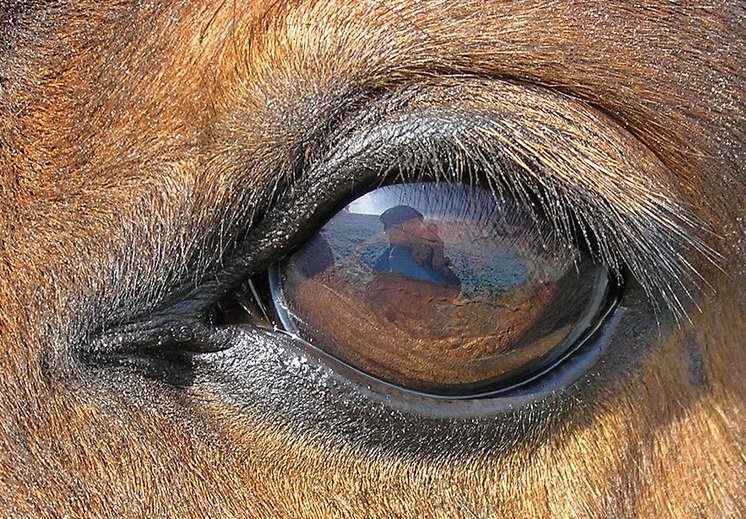
Pferdeauge  Photo: Waugsberg  Wikimedia Commons
Pferdeauge
Photo: Waugsberg
Wikimedia Commons

Garland Monday must be considered a red-letter day in the sporting annals of the town of the “Ould Plaid Shawl.” The Kinvara-Dooras Races were run on Monday, July 26th over the Newtown-Lynch course, and were a complete success. The entries were large and the racing good.  A large concourse of spectators were present, and all thoroughly enjoyed themselves.
Dublin bookmakers patronised the enclosure, and backers seemed to have got the better of the results. Some of the “bookies” complained bitterly of the knowledge of horse-flesh displayed by the patrons of the “sport of Kings,” and they appeared to have left under the impression that Kinvara men were keen sportsmen.  All races were started sharp to time, and all praise is due to Mr M. Donohue, Co. C., J.P. and his capable assistant stewards for their great efforts in having brought these races to such a successful conclusion.
The day was beautifully fine, which added to the enjoyment of the proceedings. Perhaps the best race of the day was the last, in which Mr W. Carr. D.C., figured as owner and rider of Salamanca, a horse, which he informed our sporting correspondent, “beat the train from Athenry to Ardrahan!” This achievement was speedily made known to the bookmakers, who seemed very slow to take any money on this famous racer, which was got by De Wet, out of Ladysmith. Salamanca carried 11st 4lb., a weight which seemed to have told with deadly effect on the animal.

Mr. W. Carr (Bill) made a most plucky effort to win the race, and when hazel seemed to have no effect on Salamanca, he had recourse to another expedient. Viewing the leading horses from across the course, he made a desperate effort to head them by riding right across.  Happily for the leaders, the marquees formed a rather formidable barrier and, instead of shortening his course, Bill lengthened it somewhat. To his credit, be it said, he was in no way despondent, and finished game.
Dr. Connolly’s Kinvara Boy was a most popular win, and when the jockey, John Killeen, dismounted, he was met by an enthusiastic crowed of sportsmen who carried him on their shoulders over the course.
Special mention should be made of the fine performance of Railway Boy.
The course was in perfect condition and Mr M. O’Donohue seemed to be ubiquitous – acting as a Clerk of Scales, Starter, Judge, and as a dispenser of hospitality. He will long be remembered by patrons of these races.

Posted in Posts and podcasts

Sporting Intelligence – 1875

Irish Examiner 12th August, 1875 p.3

 "Rock of Gibraltar" Photo: Avocado kebab Wikimedia Commons

“Rock of Gibraltar”
Photo: Avocado kebab
Wikimedia Commons

Galway Races
This meeting was begun, when weather of the most charming character favoured the proceedings. The attendance was extremely numerous and fashionable, and included all the well-known racing men. The course was in excellent order. There is every prospect of a splendid day’s sport.

The result of the principal races are as follows;
PROVINCIAL PLATE
The Kitten – 1
Mr Cockin – 2
The Nufght – 3
6 ran.

THE GALWAY PLATE
Liberator – 1
Mimulus – 2
Pride of Kildare – 3

Posted in Posts and podcasts

At Galway (Races) – 1909

Connacht Tribune 7th August, 1909 p.8

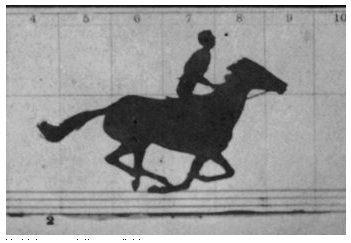
Still from Horse in Motion Eadweard Muybridge "Sallie Gardner" owned by Leland Stanford 1878 Library of Congress Prints and Photographs Division
Still from Horse in Motion
Eadweard Muybridge
“Sallie Gardner” owned by Leland Stanford
1878 Library of Congress Prints and Photographs Division

Galway, scarce two months ago.
Silent lay ‘neath Sol’s bright glow,
Save where horses lean and slow
Were tugging tramcars wearily.

But Galway sees another sight,
When crowds of visitors alight.
Fondly expecting beds at night,
Amidst the race-week revelry.

Boys of the Horsey Old Brigade.
Who ‘oft a mad career have stayed
Confident matron, timid maid,
Are there in all their finery.

They shake the hills with “Won by Heaven,”
As the nimble steed’s to victory driven.
Mid language (let us hope forgiven),
From bookies breathing hurriedly.

But reddest hues of paint shall glow
On Galway’s town, so quaint and slow
When training’s laws aside shall throw
Those jocks disporting playfully.

‘Tis morn – the shocked and startled sun
Looks down on fast and furious fun,
Where early “Peelers” try to run
In members of “Our ‘Varsity.”

The combat deepens. Never cave
in to the foe, Galwegians brave!
Wave, innkeepers, your long bills wave
And charge with wild effrontery.

Few, few shall part (for bread and meat,
And mild cigars, and whiskies neat),
With sums that fail to record beat,
For bold seaside chicanery.

Gladys H.LLawnroc.

Posted in Posts and podcasts

Stormy weather – Kinvara – 1911

Connacht Tribune 25th February, 1911 p.8

Stormy weather, Kinvara Photo: EO'D
Stormy weather, Kinvara
Photo: EO’D

Grave Situation in Kinvara (abridged)

Questions in Parliament.

Mr Duffy had the following questions down for Wednesday, but we have not yet received the replies:
To ask the chief Secretary to the Lord Lieutenant of Ireland whether he is aware of the disturbance that was imminent in the Kinvara district, Co. Galway, during the past 12 months owning to the attitude taken up by the trustees of the Sharpe estate in respect to the sale of the estate; does he know that an understanding was arrived at last October, as between the agent to the property and the tenants, to the effect that a request would be made immediately to the Congested Districts Board to acquire the entire estate, including the town.

Has such a request been made; and what is the cause of the delay in dealing with this estate?

Question 2:
To ask the Chief Secretary to the Lord Lieutenant of Ireland if he is aware that the district in and around Kinvara is one of the most congested in the west of Ireland; has it come to his knowledge that the people for years have been requesting the various public departments to purchase the available lands in the neighbourhood for allocation amongst them; can he say what time has now elapsed since the Blake-Foster estate, Kinvara district, was first offered for sale; is he aware that the agent, Mr W. E. Holmes, Roscommon, offered the estate to the Congested Districts Board last May; and having regard to the history of the estate and the conditions which prevail on this property, whether he will direct the attention of the Congested Districts Board to the estate and state the cause of their inaction:

Question 3;
To ask the Chief Secretary to the Lord Lieutenant of Ireland whether the estate of Colonel Lopdell, Athenry, situated at Cappamore, Kinvara, County Galway, is one of the estates to be dealt with by the Estates Commissioners; has the estate been inspected and purchase sanctioned by the Commissioners seeing that a considerable number of years have passed by since the tenants agreed to purchase their holdings; and having regard to the quantity of mountainous land on the estate which would become available for allotment, whether he will call the attention of the Estate commissioners to the delay in dealing with this property?

Question 5;
To ask the Chief Secretary to the Lord Lieutenant of Ireland whether any request to sell his estate in the districts of Duras, Funshin and New Town has been made to Mr Wilson Lynch Belvior, Sixmilebridge, Clare, by the Congested Districts Board and when and with what result?