YORK v the Galway Harbour Commissioners
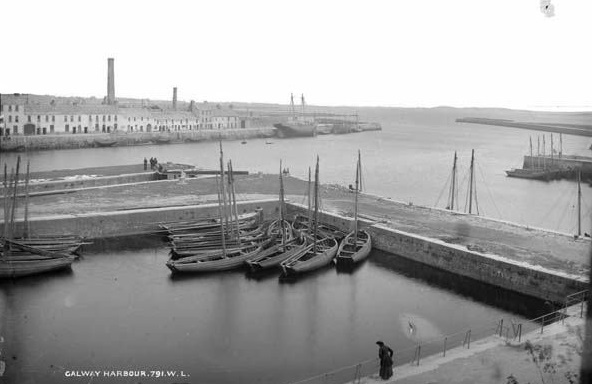
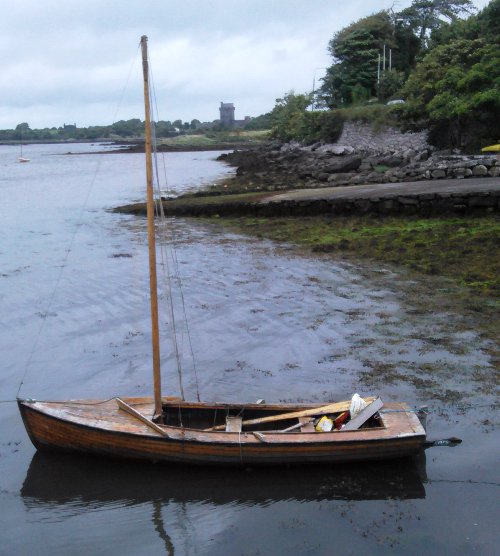
This was an action instituted by the plaintiff against the defendants in their corporate capacity, to recover compensation for the value of his sloop and boats, which he alleged were damaged during the night of the memorable storm in January 1839, by the falling portions of the old quay walls. The
plaintiff endeavoured to sustain the action on the ground that the injury arose from the dilapidated state of those walls and it was the duty of the Commissioners to keep same in proper repair. After the plaintiff’s case had closed the defendant’s counsel called for a non-suit that, on the ground that the action could not under the act incorporating the Commissioners be maintained against them, and secondly, admitting that it was otherwise maintainable, that it should have been proved that there was a sufficient fund in the hands of the commissioners to enable them to keep the old quays in a substantial state of repair.
After a lengthened argument on the subject, ably supported by Counsel on each side, the court ruled in favour of the defendants objections, and accordingly non-suited the Plaintiff.
Counsel for the Plaintiff, John Beatty WEST, Q.C., Gerald Fitzbibbon, and Murrin Burke, Esqrs.; Agent, John M. O’Hara, Esq.-Counsel for the Commissioners, Richard Keating, Q.C., James H. Blake, Q.C., James H. Monaghan, Q.C., and Allan Shoue, Esqrs.-Agents, Messrs. J and J. Blakeney.
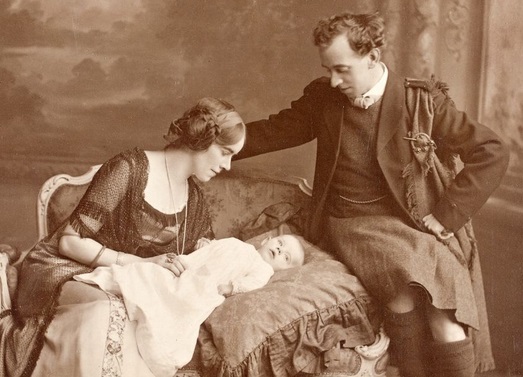
Muriel, Donagh and Thomas MacDonagh, 1913 National Library of Ireland
by Eileen Moore
One of the first three men executed on May 3rd by the English Government as leaders in the Irish Revolution was Thomas MacDonagh, M.A. His young widow is a sister of the prison bride of Joseph M. Plunkett, who was executed on May 4. Another of the same family, Miss Nellie Gifford, suffered six weeks’ imprisonment as a rebel.
Mrs MacDonagh presented a pathetic appearance in her deep mourning, with her three and a half-year old son, Donagh, clinging to her skirt. She is transparently pale, with copper coloured hair and blue eyes. Her eyes have an appealing look. Perhaps that is the reason why General Maxwell is said to have sent her a command to appear in public as little as possible, fearing that her appearance might excite public sentiment. This command was directed particularly to Requiem Masses which were being celebrated all over the city for the souls of the dead patriots.
Mrs MacDonagh is the mother of two children – the boy mentioned, little Donagh, and a baby girl called Barbara, 18 months old. There is a dazed look in her eyes as if she had not yet recovered the shock of her husband’s death. Her story was the most pathetic of any I had listened to from the women of the Revolution. She was the only one who had not the consolation of seeing her husband for even the brief 20 minutes allotted by the Government to the relatives and friends of the Revolutionists. Mrs Pearse did not see her sons, but Mrs MacDonagh was the only wife who did not see her husband. She did not know of his imprisonment or death until the news was flashed to her in an evening paper.
“It was cruel,” Mrs MacDonagh said, with tearless eyes, “that I should be denied the consolation of a last interview with my husband. I did not see him after he left the house on Easter Monday. News that the Proclamation of Independence had been read by James Connolly reached me. I had a copy and placed it over the mantelpiece. I brought my little son to look at it.”
“When the days passed and I heard no word from Thomas, I could stay in the house no longer. I went out. All the week I had been listening to the roar of the machine guns, and all the week I had been praying for my husband’s safety. I heard the “Stop Press” calling. I bought a paper – the first thing I saw in big headlines was the execution of my husband. I don’t remember how I got back to the house. The authorities never sent me any official notice of my husband’s death. I wish the whole world to know of this fact. It was cruelly unjust to me. Someone told my little son that the soldiers killed his father – that was very unwise. Now the child screams at the sight of a soldier and hides his face. He worshipped his daddy. I shall tell him the true story when he grows up. We have no home now.”
“Our lease of Cullingswood, our home, expired many months ago. Mrs Harvey O’Kelly, the owner, the first woman to be imprisoned in Ireland for suffrage, wouldn’t accept the extra rent due. She was very kind to the children and myself. Cullingswood was opposite the first St. Enda’s College. It was an historic old house with memories of ’98.”
“I was very ill,” continued Mrs MacDonagh, “from the shock of my husband’s death. I was with him in the work for the freedom of Ireland. Before Easter Week, when things were taking shape, he had to be away a great deal from home, but there was scarcely a night but he managed to spend a few minutes with us. He always like to kiss the children good night. I am proud that he died for Ireland. He was a good father, a good son, and a good husband. ”
“His two brothers stuck to him. His brother Jack was taken prisoner. The soldiers did not know that he was a brother of Thomas. When they found it out they abused him shamefully.
I am not strong like other women, but I am strong enough to feel proud of my husband. A humble neighbour came in to sympathise with me the other day. She burst into tears when she saw me in my black dress. I told her not to cry, for Thomas died a noble death in a great cause – the freedom of Ireland.”
“Did you visit the slums?” she asked suddenly. “If the machine guns had only managed to destroy them instead of some of the other buildings they ruined it would have been a blessing – they are a disgrace to civilisation.”
In my walk through the city I had noticed the run down looking tenements near Liberty Hall and had wondered how they had escaped the general devastation.
On Friday evening, at a place called Duras Demesne, near Kinvara, the patrol of police from Kinvara had a severe encounter with some civilians. They succeeded in arresting two men who were brought before Mr. Persse, J.P. and remanded without bail for three days, when there will be an inquiry into the matter.
“It is Government policy to encourage local initiative and enterprise, especially where there is a genuine local involvement,” said Mr. Robert Molloy T.D., Minister for Local Government at Kinvara on Friday when he officially opened the new Co-Operative Handcrafts Centre. “It was one of the reasons why the County Development Team system was introduced in the western counties in 1965,” he pointed out. The Handcrafts Centre is situated on the western corner of The Square, Kinvara, the most prominent position in the seaside town and as well as a sales and display area there is accommodation for handcrafts work and instruction. After a modest beginning three years ago the present annual turn-over target is £30,000. This injection of finance into the area is outstanding by any standards. It is the direct result of the dedication and foresight of the Chairman, Mr.Toddie Byrne, and his committee. The Co-Operative is the first big economic boost for the parish and district and augurs well for future undertakings in Kinvara.
“A grant of £4,000, representing two-thirds of the cost of your new premises, was made available from the Special Regional Development Fund operated by the Minister for Finance, on the recommendation of the Team,” Mr. Molly declared. “The record of your Co-Operative to date has been most encouraging. It is progressive and profit-making, and congratulations are due to your Management committee and staff for this happy achievement. It is imperative, however, for further development that the techniques of production, design and quality control be constantly reviewed, and that saleable articles be guaranteed by the Society to the sales outlets. Care must be taken to guard against overproduction of products that may have been profitable in the past and may now be losing market appeal.
“The possibility of achieving a significant income through handcrafts production can be realised only with the assistance of a well thought out marketing strategy, which must reduce to a minimum the overheads and the number of links in the chain between the producer and the eventual customer.
The co-ordination of handcrafts production throughout the West, with a view to maximising the amount of income generated by such activities, has engaged the attention of the Galway County Development Team during the past year. Your Chairman, Mr. Toddie Byrne, was active on a committee representative of the handcrafts industry in Galway and the adjoining counties, which was chaired by Mr. Sharkey, the County Manager and County Development Team Chairman.”
“Largely as a result of the Team’s work,” the Minister said, “the Irish National Productivity Committee will shortly commence a general survey of the industry in the West with a view to formulating proposals to improve and develop it. This survey is being financed by a grant from the Special Regional Development Fund. The new premises we are about to open here this afternoon,” Mr. Molloy continued, “begins a new phase in the development of Kinvara Handcrafts Co Co-Operative. the provision of a showroom, offices and storeroom will greatly assist the society in promoting further the skills in handcrafts and handcrafts in order to supplement the incomes of the many families on small farms in the locality.
“The idea of the co-operative was born just over three years ago, through the initiative of a small group here in Kinvara, who were instrumental in bringing together your local guild of Muintir na Tire, the County Development Team and the Irish Agriculture Organisation Society. It was based on a genuine spirit of co-operation, which is an essential ingredient in the building up of a healthy community. From the beginning, it was clearly evident that there was an enthusiasm in this locality for a community project of this kind and this enthusiasm was more than confirmed by the financial commitments undertaken by the 140 shareholders when the project was launched two years ago last month. Amongst co-operatives generally, this degree of financial involvement by shareholders is not always forthcoming and it is perhaps this wonderful response to a worthwhile local idea that made the enterprise profitable from the start. I would like, therefore, to congratulate the shareholders and the Kinvara Guild of Muintir na Tire who provide the initial finance to launch the society. I wish the enterprise every success in its future operations,” Mr. Molloy concluded.
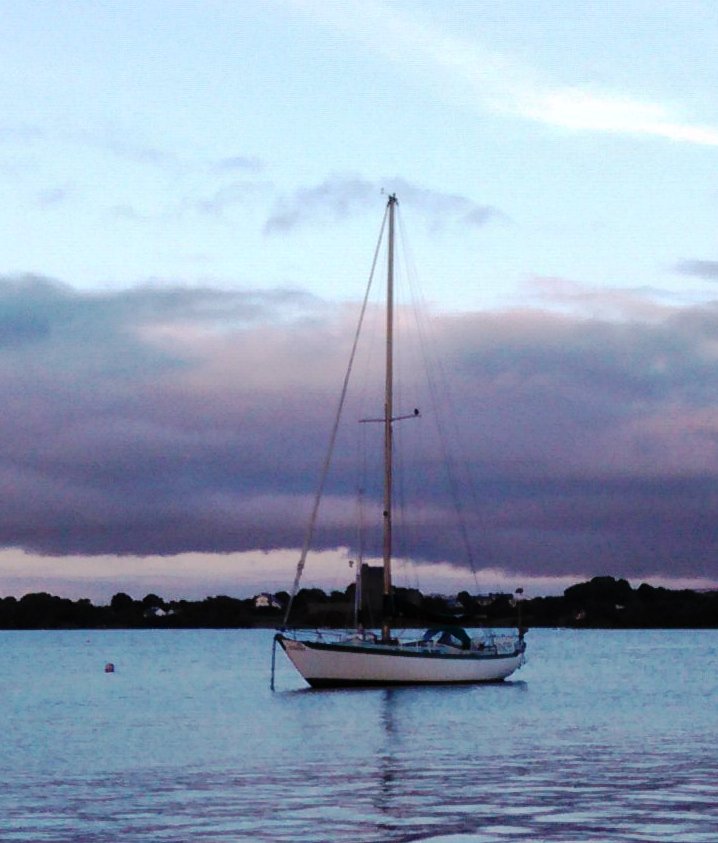
Kinvara Sunset Photo: EO’D
It was a big occasion in the life of the townsfolk and during the ceremony Francis Fahy’s “Ould Plaid Shawl”, the song which made the town famous, was sung by Miss Roisin Moylan, accompanied by her father Mr. Kieran Moylan, N.T. Rev. C. O’Connor, C.C., Galway Cathedral, formerly curate in Kinvara, emphasised to the crowd the factors which led to the realisation of an idea among a few people. Foresight of a few, dedication, co-operation of the people of the parish and the help from such outsiders as politicians, were the contributing factors. “Today was necessary for the people of the parish,” he said. “It gives them confidence to achieve this goal and it has also given them 100% confidence in the leaders in this parish. Kinvara can now go forward with confidence to the other projects which they have in mind,” he concluded.
CONTRIBUTION
Mr. Toddie Byrne, Co. C., Chairman of the Co-Operative Management Committee, welcomed the guests and attendance on this “special day in the history of the town.” He thanked all the people who had contributed to the success of the Co-Operative. “I thank Mr. Robert Molloy and through him the Government,” he said, “for their wonderful contribution to the Co-Operative. We could not have otherwise attained our goal and I want him to bring back to Dublin our thanks and appreciation.”
Mr. Byrne referred to the help and encouragement given by the late Seamus Duke, Mr. John Tobin, I.A.O.S., Mr. John O’Hara, National Bank of Ireland (Gort), Mrs. E. Bugg (Kinvara) and her brother Mr. Al O’Dea (Tuam), Miss V. O’Sullivan (Bord Failte), the two Dail Deputies, Mrs B. Hogan O’Higgins and Mr. Bill Loughnane, Mr. Tony Smith, County Development Team, Mr. Raymond Monahan (Kinvara), the architect; and Messrs Fahy and Morgan (Loughrea), the contractors. He expressed the apologies of inability to attend of Mr. A. Sharkey, County Manager, Mr. John Lynch, Co. Development team, Mr. Dan O’Neill, Ireland West and Mr. Oliver Hynes, C.E.O.
After the opening ceremony the building was blessed by Very Rev. B. Mulkern P.P. A reception for some fifty guests later took place at Winkles’ Hotel.
The government has again learned the necessity to increase the military force in Galway. A troop of the 13th Light Dragoons from Gort, arrived here on Tuesday, under the command of Captain Hamilton, for the purpose of repressing any outbreak among the people which may arise owing to the exportation of corn from this port.
Two companies of the 30th are likewise expected – one from Loughrea, the other from Oughterard – to aid the force in garrison, if necessary. This increase of troops is said to have been caused by the posting of a threatening notice at the Gashouse last week, to the effect that the merchant stores would be broken up by the people, if any further exportation of corn was attempted.
Supplement to the Cork Examiner 8th October, 1887 (abridged)
The Cottage Acrylic on Canvas EO’D
Cornelius and William K. Vanderbilt have decided to commence a rather curious business enterprise. They propose to build a large number of small houses in the suburbs of New York city, with every comfort and convenience, and sell them to working people at cost.
The houses will be sold on an installment plan, in monthly or yearly payments.
Payments will not amount to more than fair rental.
The life of the purchaser will be insured to the extent of the unpaid amount of the purchase price.
The policy will be held as mortgage. If the purchaser dies the policy pays off what is owing on the house.
The purchaser will be insured against the loss of property, if he meets with some misfortune before the whole amount is paid up.
A combined movement of various detachments from different parts of the county of Clare, and the county of Galway, was executed on the 22nd instant, for the purpose of surprising and surrounding the midnight legislators of county Galway.
The detachments from Clare consisted of those of the 74th Regiment. Those of Galway consisted of strong parties of the 28th, 56th and 59th Infantry and a squadron of 8th Hussars.
All these parties met at a given point at 6 o’clock on the morning of Monday and secured 261 Terry Alts. The combined parties of the 74th Regiment succeeded, after a long chase, in securing Michael Conolly, a chief leader of the Terry Alts, charged with having directed the late attack on Sir John Burke’s house at Marble Hill. All of the above prisoners were sent under strong escort to Loughrea. Of the above prisoners, several have been identified as being concerned in recent outrages. The investigation commenced on Wednesday and is still going on. Many most respectable witnesses have been summoned.
The Terry Alts were a secret society in County Clare who agitated for land rights, fair rent and against payment of tithes to the established church. The movement began in 1828.
On Monday night last, the country in this neighbourhood presented a most extraordinary appearance. About 9 o’clock an immense light suddenly appeared at a great distance to the southwest of Cork. In a few seconds after, another appeared in an opposite direction. The signal was rapidly answered, and in less than four minutes after the first appeared, we could, within that short period, count no less than 154 lights in the direction of the King’s County alone.
The signal was taken up and no less rapidly answered through the Counties of Westmeath, Longford, Roscommon, Galway and even in the distant hills of the Queen’s County, all of which were distinctly visible from Anchor’s Bower, a hill which overlooks the town. Although groups were assembled at several places through the town, gazing at the spectacle and giving their opinion on the subject, no one could say what the meaning of it was.