
Irish Independent 4th December, 1934 p.12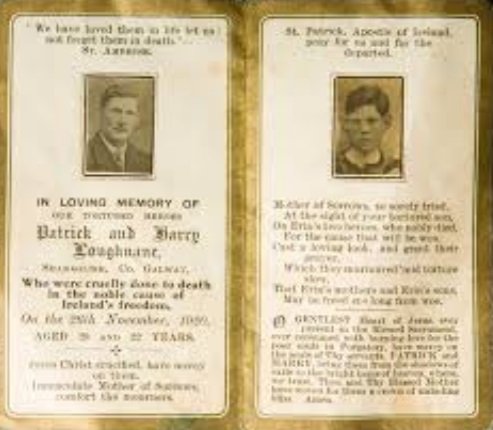
Mr. Sean Russell, I.R.A. unveiled a memorial cross, and delivered an oration, near the spot where the mutilated bodies of Patrick and Harry Loughnane (brothers) were found in November, 1920 at Carragaroe, Kinvara.
The brothers were members of the Volunteers, and were taken from home by the Black and Tans; their bodies being discovered in a pond some weeks later. Members of the I.R.A. from many districts, including many old comrades in the Volunteers, paraded to the spot, where they formed a guard of honour, and recited a decade of the Rosary in Irish.
Author: The Burren and Beyond
B.A., M.A.(Archaeology); Regional Tour Guide; Dip. Radio Media Tech; H.Dip. Computer Science.
Kinvara railway – 1879
Freemans Journal 13th December, 1879 p. 7
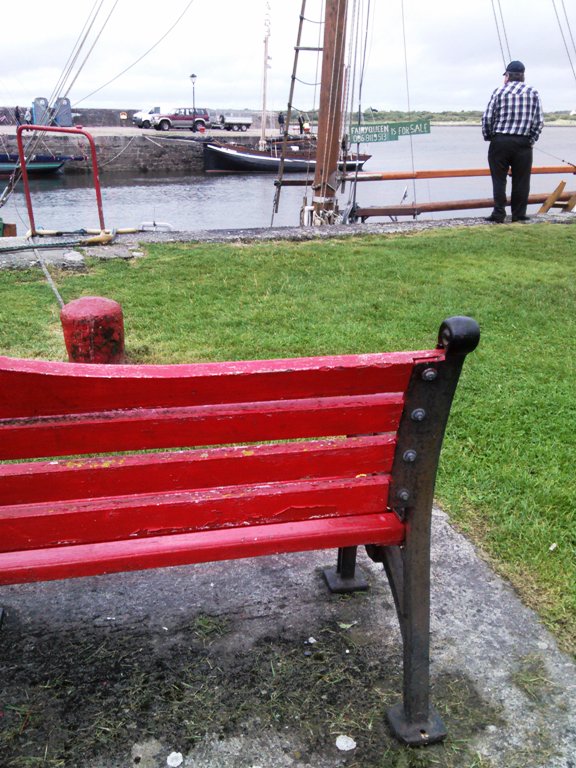
Photo; EO’D
To the Editor of the Freeman
Kinvara, December 11th
Dear Sir,
I regret very much that the distress in the west, on which you so seasonably commented in your leader in Wednesday’s Freeman, is not confined to Clifden nor to Connemara, but is to be met with as severely elsewhere.
We have in Kinvara, with its population of over 350 families, want at present bordering on starvation, while the people in the rural districts all round are not much, if anything, better off, and unless our paternal Government open up public works in some form, actual starvation, with its usual sad and sickening train, will be the result before the 1st February.
Our rulers may shut their eyes to and pretend to ignore the present crisis, but there can be no question as to the existence of deep and general destitution among the labouring classes. This distress seems to be more keenly felt by a certain class of small farmers than it is by those who have nothing to fall back on but their daily pay, for the latter are more or less familiar with want, though not to anything like the present extend; while the former were before now comparatively comfortable, but this year an accumulation of misfortunes, for which they were unprepared, came upon them, and crushed them to the very earth. Rot among the sheep, consequent on the severe autumn and winter of last year; losses in the sale of stock, the partial destruction of their crops this year by blight, storms, and a wet summer and autumn – these were the casualties that crowded in rapid succession on the small farmers, and reduced them to a state worse, if possible, than that of the purely labouring class.
How miserable the condition of many among the small landholders is at present no person knows better than the priest who goes among them with all the freedom of a father, and is made their confidant in their weal and woe. It requires no prophet to tell how those poor people are to eke out an existence during the next six months, for starvation and pestilence will victimise many of them unless something is done to give employment to the many hands among them who are able and willing to work.
If, as we are assured, the solas pupuli be the suprema lex, surely the Government of the country is bound to save the people, and when this can be done without any loss to itself, as in the present emergency by opening up reproductive works. The obligation becomes so grave and solemn that no Government can overlook or disregard it without laying itself open to the charge of being anxious to get rid of its subjects “with a vengeance.”
In Kinvara a great deal might be done in the way of giving employment to the labouring classes. We have a beautiful bay, but no trade, except in turf; a good harbour, which we require badly, would do much to encourage and promote trade with Galway; opening a communication between Kinvara and Gort, a distance of seven miles, by means of a railroad, which could be laid down at present, would not only serve the poor by giving them employment, but would also materially benefit both towns. Then again, though it might sound paradoxical to assert it in the depth of winter, still it is perfectly correct to say that we are at the present time suffering from a dearth of fresh water, as the only one spring which supplied the whole town, and neighbourhood, has ceased (not an unusual occurrence) to yield its usual refreshing beverage, and in consequence we are compelled to put up with a substitute of a very muddy description, while never-failing wells of the most crystal like water are to be found on the burren hills about three miles off. But as far as we are practically concerned at present they may as well be thirty miles; for, like the lakes that “shone in mockery nigh” they are untouched and untasted by us. However, it would be very easy and by no means expensive to convey the water from those hills by pipes to Kinvara, and as employment is required for the poor, the present would be a very favourable opportunity for doing a very useful, if not a necessary work.
I am, dear Mr. Editor, faithfully yours,
J. Molony P.P.
Mr. J.B.Murray – 1911
Freeman’s Journal 11th May, 1911 p.33

Photo: EO’D
By royal warrant, dated the 21st of March, 1911, Mr. James William Brady Murray, B.A., B.L., J.P., of Moyvore, Kinvara, Co. Galway, has been appointed a member of the first governing body of University College Galway, in the room of Mr. William Daly, J.P., D.L., deceased.
Kinvara – 1909
Southern Cross 19th November, 1909 p.3
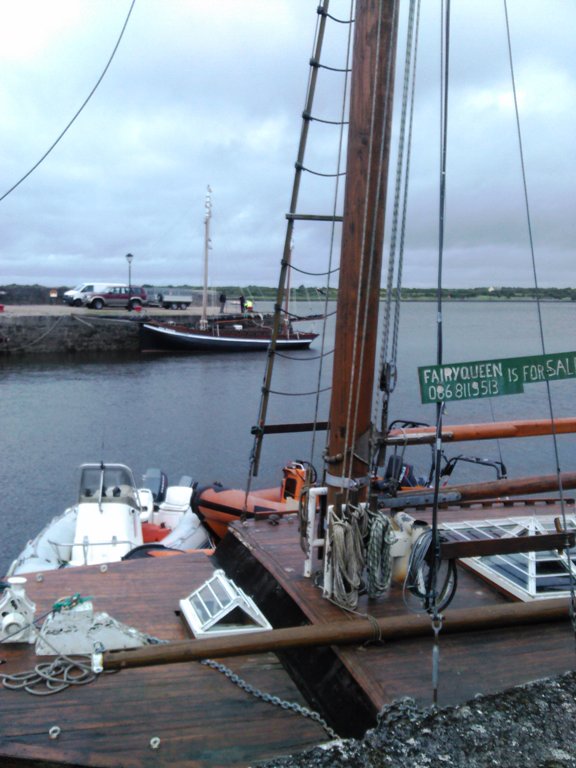
Photo: EO’D
The town of Kinvara was brilliantly illuminated in honor of the first visit of the Most Rev. Dr. O’Dea to his episcopal parish since his translation to Galway. His Lordship attended for the purpose of opening the mission conducted by the Capuchin Fathers in connection with the founding of the St. Patrick’s Temperance League of the West, as well as for the purpose of administering the Sacrament of Confirmation to hundreds of children throughout the parish.
Tawnagh – 2016

Galway Harbour reef – 1938
Catholic Press, 13 January 1938, page 25
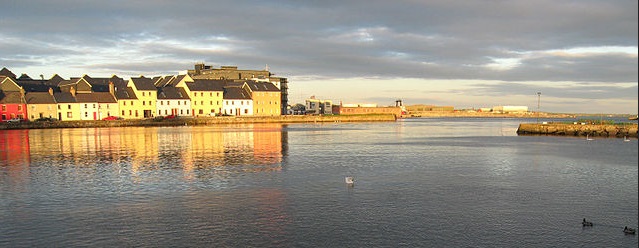
Wikimedia Commons
It is well-known that Galway Harbour would be one of the finest in the world but for a reef that prevented large ships from entering. Several catastrophes have been connected with this barrier. The historic rock is now being smashed to smithereens by an 18 ton torpedo-type battering ram, which has a point made of the hardest steel known to scientists. The removal of this obstacle just outside Dun Aengus Harbour forms part of the, gigantic plan to modernise facilities for handling increased traffic at all stages of the tide, and for bringing in much larger ships.
Australians will recall a similar work at Fremantle by the famous Irish engineer, C. Y. O’Connor. The submerged rock barrier rendered navigation not only difficult but at times dangerous, and, more than once, ships have been laid up in the harbour for days, and others have had to stand by in the bay during inclement weather. Out in the harbour men are working to put an end to all that. Day and night, during October and November, the harbour was the scene of intense activity. The improvement scheme is estimated to cost £200,000, and within two years it is hoped to bring Galway into line with the other leading harbours, capable of accommodating seagoing vessels up to 8000 or 9000 tons.
French and Dutch experts, aided by local workmen, are well advanced with the job of removing the reef. A huge dredger first carries away the mud and sand from the reef 3 surface, preparing the ground for the rock breaker.Worked from a specially constructed barge, this battering-ram is dropped through a steel tube on the rock, smashing its way through it like a pneumatic drill breaking concrete. By the middle of this year it is expected that it will have completed its work, and the construction work proper, with an average of 200 men in employment, can begin on the harbour.
It is proposed to deepen and widen the approach channel to the dock to such an extent as to allow vessels to turn before entering or leaving the docks. The Dun Aengus Dock will be replaced by a concrete pier, 450 feet in length, on the south-west side and 320 feet on the north-east side. Passengers alighting from or embarking on the Atlantic tenders, especially during the winter months, must have carried away unfavourable impressions of the pier, bleak and without shelter from the Atlantic gales. It is to facilitate them, the travellers from the Aran Islands, and the Customs officers and other officials, that a concrete shed, 250 feet long, will be built along the pier. It will be equipped with offices and waiting-rooms. On both sides of the new pier it is intended to provide a railway line connected to the main line of the G.S.R. These branch lines will be equipped with travelling cranes capable of dealing with cars, baggage and merchandise. Adequate quays, roads, a car park, and additional space for storage will be made by filling in the disused dock to the east of the Dun Aengus Dock. This portion of the work is also in hand, and two caterpillar excavators are preparing the site. Till now the use of the harbour has been restricted to vessels with a draught of about 12 feet, entering or leaving one hour before or after high water, but when the scheme has been completed it will be possible for vessels up to 350 feet m length, and with a draught of more than 21 feet, to clear the passage with ease. Galway people see in the harbour scheme a new era of prosperity. Its completion, they say, will lead to many more ships making use of the harbour, with a consequent increase in exports and imports, and much-needed employment both at the docks and in the city.
A startling development – 1932
Advocate, Melbourne 8 December 1932, page 6
A startling development of the Drumm battery is expected—it is to be put on ‘buses and lorries! This is the latest report. Early in the new year, the first Drumm battery driven vehicles are expected on the Dublin street’s. An expert mad.e the following statement:— “They will change the present transport system in the city in such a short time that everyone will be astonished. It is true that the Dramm-driven motor vehicles cannot go more than thirty miles an hour, but that will be quite enough. I know that there will he no difficulty about charging the batteries. .That was the big trouble in the past, but Dr. – Drumm has changed all that.
“I estimate that the cost of equipping the first Drumm motor vehicles, will be fairly high—nearly £200. But it will be a bargain at that. “There will be no intricate parts, and the saving in that direction alone will be enormous. There will be no oil consumption. One charge of the batteries will drive them about seventy miles. ‘ You might say that once the batteries are installed, the only cost to the owners of the vehicles will be that of tyres and of charging the batteries. The charging will be cheap and easy, and tyre costs will not be so high as at present because the petrol driven vehicles are pushed; the Drumm vehicles will be pulled, and there wilt be less strain. Incidentally there will be less wear and tear upon the roads.” If these promises are fulfilled, Dr. Drumm’s invention will perform the evolution in transport which I made bold to predict two years ago.
The Countess – 1918
The Argus, 30th December, 1918 p.5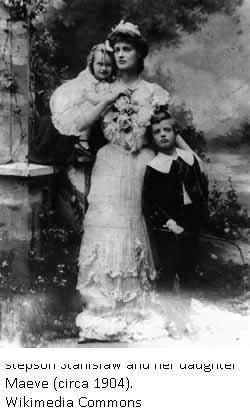
Amongst the Sinn Feiners elected in Ireland is the Countess Markievitch, who took a leading part in the Dublin rebellion at Easter, 1916.
In spite of her name, the Countess Markievitch is an Irishwoman, being the eldest daughter of the late Sir Henry Gore-Booth, Bart., of Sligo. A sister is Miss Eva Gore-Booth, the poetess. In 1900 she married the Polish count Casimir Dunin de Markievich. The two, the wife being the leader, were in the forefront of the most “advanced” party in the intellectual circles of Dublin. But it was when authority had to be defied that the Countess surpassed herself. Then what denunciations of England came from this gaunt, excited figure! What belabourings of Man! For she was a Suffragette as well as a Sinn-Feiner and was a leader in the suffrage disorders in Dublin. One of her chief swoops into notoriety was in the great strike of 1918, when she was one of the most active supporters of Larkin. For her share in the Easter Rising at Dublin in 1916 she was sentenced to death, but the sentence was commuted, and she was subsequently amnestied. Similar treatment was meted out to Professor John MacNeill, the nominal head, or “Chief of staff,” as he styled himself, of the Sinn Fein volunteers, who has also been returned to Parliament, having defeated the Nationalist candidate for the National University of Ireland.
To, General Sir J.G.Maxwell – 1916
The Catholic Press, 4th January, 1917 p.22
Ashford, Charleville, May 17, 1916.
Sir,
I beg to acknowledge the receipt of your letter of 12th inst., which has been forwarded to me here. I have read carefully your allegations against Rev….. .and Rev……., but do not see in them any justification for disciplinary action on my part. They are both excellent priests who hold strong national views; but I do not know that they have violated any law, civil or ecclesiastical. In your letter of 6th inst you appealed to me to help you in the furtherance of your work as military dictator of Ireland. Even if action of that kind was not outside my province, the events of the past few weeks would make it impossible for me to have any part in proceedings which I regard as wantonly cruel and oppressive.
You remember the Jameson Raid, when a number of buccaneers invaded a friendly State, and fought the forces of the lawful Government. If ever men deserved the supreme punishment it was they. But officially and unofficially, the influence of the British Government was used to save them, and it succeeded. You took care that no plea for mercy should interpose on behalf of the poor young fellows who surrendered to you in Dublin. The first information which we got of their fate was the announcement that they had been shot in cold blood.
Personally, I regard your action with horror, and I believe that it has outraged the conscience of the country. Then, the deporting in hundreds, and even thousands, of poor fellows without a trial of any kind seems to me an abuse of power, as fatuous as it is arbitrary; and altogether your regime has been one of the worst and blackest chapters in the history of the misgovernment of the country.
I have the honour to be, sir, your obedient servant.
Edward Thomas,
Bishop of Limerick.
To General Sir. J.G. Maxwell, Commander in Chief, the Forces in Ireland.
Rising – 1917
Watchman 1st November, 1917 p.7
Wikimedia Commons
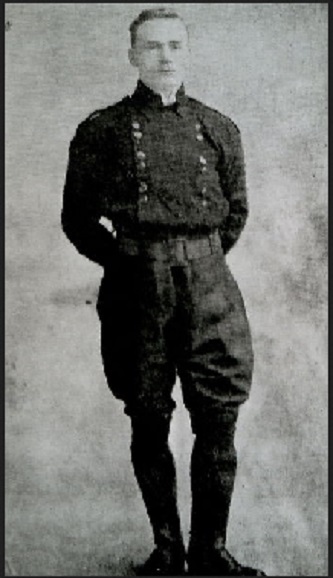
A cable from New York, dated Sunday last, states that the Secret Service has frustrated a second Sinn Fein rebellion which was planned to occur next Easter, on the anniversary of last year’s bloody Dublin riots. German gold was scheduled to play a part. The preliminaries were mapped out, and ready to be put in operation, when the Secret Service men stepped in and arrested “General” Liam Merlewes (sic.) one of the leaders of the 1916 outbreak. Baron von Reculinghausen (sic.) was apparently Count von Bernstorff’s designee to watch Germany’s interests in Ireland after Bernstorff was ousted from the United States.
The Canadian authorities, acting upon the information received from the Secret Service, arrested Dr. Patrick McCarton, upon his arrival at Halifax. He was travelling on a fraudulent seaman’s passport. McCarton enjoyed the title “Ambassador of the Irish Republic to the United States.” It is commonly reported that German agents are busy in Ireland, attempting to stir up a second outbreak. A German cargo, which submarines carried, comprising machine guns and ammunition, was landed in lonely inlets in the Irish Sea.
It is understood that the United States possesses the official Sinn Fein report of the 1916 riots and other valuable data in connection therewith. Merlewes (Mellows), prior to the Easter Monday rebellion, spent three months in an English prison. Later he proceeded to Galway, and organised 700 volunteers for the United States, following the failure of the revolt.
McCarton arrived in the United States early in 1917, a fugitive from justice. Both decided to return to Ireland. McCarton sailed on October 17.

