Gardai carrying out searches following the robbery of the Galway – Ballyvaughan mail car found in a house at Cahermore, Gort, two Mills Bombs, a large quantity of gelignite, a shotgune, sword, pike, and 40 rounds of rifle ammunition.
In raids in Kinvara district revolvers, gelignite and revolver ammunition were discovered. Two men were arrested in connection with the find.
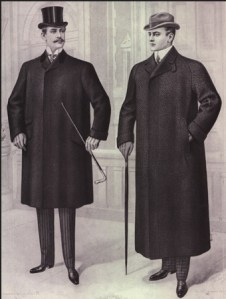
Image: Sartorial Art Journal, December 1900 Wikimedia Commons
To the Editor, Connacht Tribune
Sir,
I would suggest to the police doing protection duty on the Tyrone estate to watch the sky; they may catch Jack Dunne’s air-ship, the “Hope of Europe,” and they might find the hope of the tenants on the Tyrone estate. The R.I.C. are very good to the people of Ballinderreen. Lately, some person found a coat, and gave it up at the barracks at Kinvara, and the Kinvara police are making a house-to-house visit to find out if any of the inmates lost it.
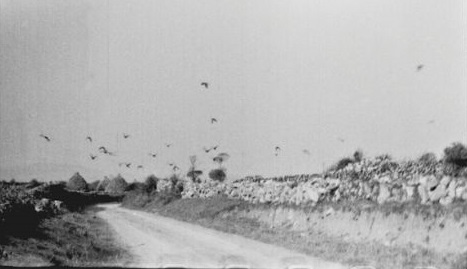
H.G. St. Birds.
(abridged)
Time flows on and in its swift passing links with a storied past drift and sometimes disappear. Galway, a city with an unusual blend of ancient and modern, in its tall-housed winding streets – reminders of the day when it was a port for the gallant ships of the Spanish Main – and in its seaside suburb, Salthill, signs of progress and modern development – has many treasures of the past.
The historic sword and mace of Galway will shortly be disposed of in Sotheby’s Auction Rooms, London. Priceless memoirs of the city’s past, those old relics were given to Edmond Blake, a member of one of the twelve tribes. In 1841, Mr. Blake had been Mayor of Galway for ten years, but although he was entitled to an annual salary of £800 he was never paid a penny of it, so when the Corporation was dissolved on that date, Mr. Blake agreed to accept the civic sword and great mace, which then passed into his keeping. In 1908 he died at the age of 92, bequeathing the historic relic of the city’s greatness to his family. Some time ago, it seems the sword and mace were offered to the National Museum, which refused to purchase them, so they are now up for auction in London. Mr. Louis Wine, of Dublin, made several offers of the sword and mace to the Galway Urban Council but they could not buy them. It seems sad that they should be taken away from their original home, particularly now when there is every reason to hope that Galway will again have a Mayor and Corporation.
Galway enjoyed the privilege of incorporation from the fourteenth century until the passing of the Municipal Corporations (Ireland) Act, 1840. Under the new Bill the city’s status will be raised to that of a Municipal Corporation. Galway will become a local authority under the meaning of the Air Navigation Act and the status of the city will then be about that of Wexford. The city will have a right then to a seal and to assume the armorial bearings previously borne; the new borough will have the power to extend its boundaries, and the liabilities of the Urban Council.
Note: The sword and mace were sold in 1938 to William Randolph Hearst for £5,000. He willed them to be returned back to Galway. On 27th October, 1960 Mrs William Randolph Hearst officially presented the mace and sword to the Minister for External Affairs Frank Aiken at a reception in New York’s City hall. Thanks to the Hearst family they have been returned to Galway.
Kinvara, December 1. My Dear Dr. Gray, I shall feel obliged by your inserting in your next publication the following: The Rev. Francis Arthur, Kinvara, begs to acknowledge the sum of 35/ from his Grace the Archbishop of Tuam, through the Rev. James Waldron and the Rev. James Magee, for distribution among the priests in the distressed parishes of the diocese of Kilmacduagh, according to the directions of the bishop, the Most Rev. Dr. Fallon. I remain, my dear Dr. Gray, your much obliged, Francis Arthur P.P.
O, to have a little house!
To own the hearth and stool and all!
The heaped up sods upon the fire,
The pile of turf against the wall!
To have a clock with weights and chains
And pendulum swinging up and down!
A dresser filled with shining delph,
Speckled and white and blue and brown!
I could be busy all the day
Clearing and sweeping hearth and floor,
And fixing on their shelf again
My white and blue and speckled store!
I could be quiet there at night
Beside the fire and by myself,
Sure of a bed and loth to leave
The ticking clock and the shining delph!
Och! but I’m weary of mist and dark,
And roads where there’s never a house nor bush,
And tired I am of bog and road,
And the crying wind and the lonesome hush!
And I am praying to God on high,
And I am praying Him night and day,
For a little house – house of my own –
Out of the wind’s and the rain’s way.
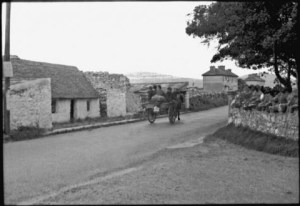
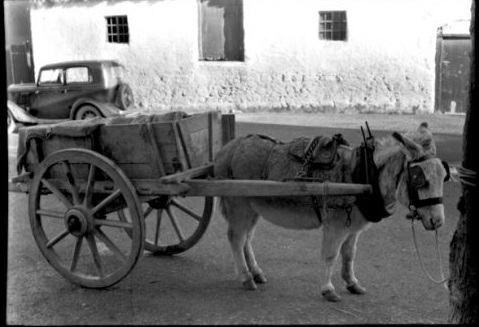
Donkey and Cart, Kinvara c.1950 Cresswell Archives
A large and representative meeting of the Gort District Council and Board of Guardians was held on Saturday at which the following resolution was proposed by Mr. Michael Mitchell D.C. and seconded by Mr. M O’Donohoe, D.C.;
Resolved; That we, the members of the Gort District Council, beg to congratulate Messrs J.W.Brady Murray, J.P. and J.W. French, J.P.(chairman of Galway District Council) for having the courage of their convictions in attending at great personal inconvenience the Kinvarra Petty Sessions and refusing to be a party to the successful attempt made to penalise the Irish language by the recent prosecution of Bartley Hynes for having his name in Irish characters on his cart, and we hope as a result of this prosecution, thousands will follow. That copies of this resolution be sent to J.W.Brady Murray J.P; J.W.French J.P; the Galway County Council, the Gaelic League, the “Irish Daily Independent and Nation,” and the “Freeman’s Journal.” The resolution was strongly supported by the Ven. Archdeacon Daly M.A. who said it was the greatest pity to let the Irish language die out; every country had its own language – the Welsh had their own language, and every Irishman should have his and not be ashamed of it.
T.P. Corless D.C. followed in support of the resolution, and expressed a hope that in future a preference of appointments in the Gort Union be given to those who would speak the Irish language and not be ashamed of it. The resolution was carried amid loud applause, some of which was expressed in Irish.
We agree with all our County contemporaries that there is a general, and to our mind, a justifiable complaint made of the want of a regular service between Galway and Kinvara across the bay. The present inland mode of communication cannot be regarded as calculated to foster or improve commercial relations between the two towns concerned. too much time would be occupied for transit purposes and no railway line touches nearer than seven miles to Kinvara. This adversely affects both Kinvara and Galway, for at the present time transit facilities very largely govern the volume of trade between any two centres of population. It is held by shrewd business men that if there was a regular three-day or two-day service between Galway and Kinvara the trade between the two ports would be very considerable, for Kinvara Harbour would be made the outlet for a very large tract of country that presently lies in a most undeveloped condition for want of such facilities as a regular service with Galway would offer.
There are now two boards to hand with practically plenary powers to deal with such matters, the Congested Districts Board and the Board of Agriculture, and if these were approached by a committee representing the interests of Galway and Kinvara respectively, there need hardly be a doubt that the project outlined would come off. Both these Boards undertook to contribute three-fifths of the cost of the ferry at Kilbeg, and it is but reasonable to expect that they would favourably entertain any feasible representation made to them in respect of the project under consideration. It would, at any rate, be an experiment well worth the while of the places that would be affected by such a transit service to take combined action and see what can be done.
On Sunday last a large and influential meeting of the people of Kinvarra and the surrounding districts was held in the chapel yard after last Mass. The meeting was convened to consider the present general depression, which is telling very severely on the tenant farmers in the neighbourhood. Kinvarra is essentially an agricultural district and the principal crops, being potatoes and barley, have been very seriously damaged by the constant wet and the late severe storms. The Rev. John Molony P.P., presided and Mr. James Curtin acted as secretary. The following resolutions were unanimously adopted:
Proposed by Mr. Henry Fanagan, Esq., and seconded by Mr. John Lynch; That this meeting is of opinion that the agricultural produce of this district, on which the people have almost entirely to depend for the payment of their rents and the support of their families, has been so much injured by the unprecedented wet summer and the late storms as to render it impossible for the tenant farmers to pay their present rents; and moreover to give just grounds for learning that the coming winter and spring will find many of them almost destitute.
Proposed by Mr. William Flatley and seconded by Mr. Stephen Leech; In the face of the great losses we have sustained, caused by three successive bad harvests and the depreciation of agricultural produce arising from foreign importation, we are compelled to make an earnest but respectful appeal to our landlords to make such a reduction in our rents as will enable us to pass through the present severe crisis and save us from utter ruin.
Proposed by Mr. Thomas Corless and seconded by Mr. Michael Kelly; That we feel we have good grounds to hope that our appeal will meet with a favourable response, as many of our landlords reside outside the parish, and consequently there is not so much employment given to the labouring classes in the district, nor that encouragement to local trade which might naturally be expected from resident proprietors.
Proposed by Mr. Peter Burke and seconded by Mr. John Burke; That copies of these resolutions, signed by their respective tenants, be forwarded to the landlords of the parish, and that another copy, signed by the chairman and secretary, be sent to the Freeman’s Journal, the ever-faithful friend and advocate of the rights of the tenant farmers in Ireland.
(signed)
J. Molony, P.P., Chairman
James Curtin, Hon. Sec.
Kerry Evening Post 31st January, 1877 p.2 (abridged)
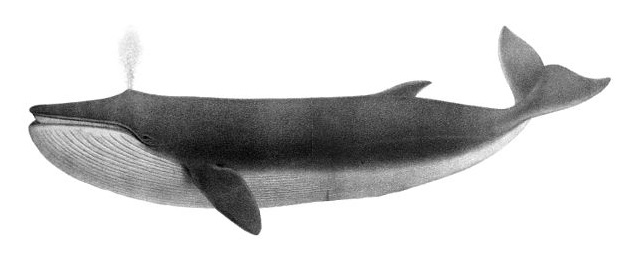
“The Finback” (Balaenoptera physalus) from Charles Melville Scammon’s Marine mammals of the western coast of North America (1874)
The Galway Express reports that a whale was got dead out at the sea on Friday night by a Claddagh man named John Donohoe; he gaffed and strung it to his boat, with the aid of another small boat’s crew. The night was extremely stormy and they got much knocking about, but succeeded in towing it in. It is a rather small fin-whale, about twenty-five feet long, and from three and a half to four tons weight. The blubber has been cut off, and is valued for about £40, a rather handsome booty.
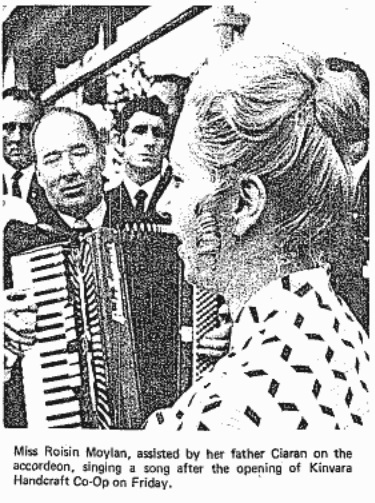
The Secretary of the Kinvara Handcrafts Society, Mr. Toddie Byrne, said last week that they now intend to launch out into crochet making. Mrs. Michael Corless of The Square, Kinvara, is busy designing wool crochet dresses and caps. Another product will be rush-work for which they’ve been inundated with offers from local women and women from neighbouring parishes. Up to now, he said, they had decided not to deal with rush-work because of involvement in the making of Aran jumpers and cardigans.
At present they have over two hundred of these garments in stock. Buyers from England have bought some of the local garments and a letter has been received by the Society from a housewife in England expressing appreciation of the workmanship, the pattern and potential market for these traditional garments. A small consignment has been dispatched to America. Negotiations are in progress for the purchase of a site for the construction of a display centre and offices in the town of Kinvara where a permanent staff will take charge of the daily affairs of the co-operative. A special display of the hand-made garments will take place in early February in the town for the benefit of buyers from Canada who are expected to make a great impression on the sales of the fine garments.


 The Burren and Beyond