Posted in Posts and podcasts

Great Meeting in Gort – 1869

Tuam Herald 13th November, 1869 p.1
The Land Question (abridged)


Gort, Sunday Night
This patriotic little town may well take credit to itself for the support which it has this day given to the cause of tenant right in this country. It afforded not only to the people on this side of the extensive county of Galway, but to thousands in the northern districts of the county Clare, an opportunity of expressing their opinions on the present unsatisfactory state of the land laws in Ireland, and of pointing out the mode in which the tenant farmers of the country desire that they should be altered. Some influential gentlemen residing in the town and neighbourhood were anxious that the people should, in the form of resolutions, express their grievances with a view to their redress by a Ministry and by a Parliament which have already manifested an anxious wish to remove those evils which have been a source of misery and discontent to the country.

The notice by which the meeting was called was given only a few days back, and yet the meeting of today was a great success, keeping in view the fact that it was not a county meeting, but was composed mostly of people within a circuit of ten miles of the town. The Athenry and Ennis Junction Railway, however, ran special trains, and brought large numbers of people from longer distances. The train which left Ennis at eleven o’clock arrived in Gort at twelve o’clock bringing people from Ennis, Crusheen and Tubber, and the train from Athenry, which arrived shortly after, carried large number of tenant farmers from that station, from Oranmore, Crughwell (sic.) and Ardrahan. The traffic arrangements were under the direction of Mr. Thomas O’Malley, the manager, and were admirably carried out by Mr William Lawlor, the efficient station master of Gort.

Many of the farmers came in on horseback heading bodies of 400 or 500 people. Ardrahan furnished a contingent of about 400, and the united parishes of Ballymena and Crughwell sent by rail about 300 persons, who were accompanied by the Rev. Francis Arthur, P.P. and the Rev. M O’Flanagan, C.C. This body on entering the unfurled their banner, which had inscribed on it the mottoes, “Fixity of Tenure” and “Tenant Right,” and the Rev. M. Nagle, P.P., Kilbeaconty, accompanied a body of his parishioners, numbering, perhaps, five hundred. The Rev. John Barry, P.P., Behagh, and the Rev. Michael Killeen, C.C., accompanied about 800 from their parish, with banners bearing the words, “Fixity of Tenure” and “Tenant Right.” Numbers also came from Corofin, Ballyvaughan, Kilkeely, New Quay, Feakle, Derrybrian, Loughrea, and Kinvara.


A very large body of tenantry came on horseback from Kinvara, accompanied by their landlord, Isaac B. Daly, and Mrs Daly, who drove in their carriage, and who were loudly cheered. By one o’clock there could not have been less than from 10,000 to 12,000 people in the town, all evidently interested in the cause which brought them together. Previous to the commencement of the proceedings a procession was formed, headed by a number of young girls, some of whom were entirely dressed in green, and these were followed by well-dressed young men carrying green banners, having inscribed on them the words, “God save Ireland,” “fixity of tenure,” “tenant right,” and “Cead mille failthe,” (sic.) and the harp in gold was on several of them. There was scarcely a person in the whole procession, which walked round the market-square, accompanied by music, who was not in some way ornamented with green.

They cheered on passing the houses which by some patriotic device attracted attention. An excellent cast of the face of O’Connell was placed in one of the windows of Forrest’s Hotel, and beneath was a saying of the Liberator’s, “He who commits a crime gives strength to the enemy.” At Glynn’s Hotel, there was a sign on a green ground, and the words “Prosperity to Ireland.” These received respectful attention on the part of the people who, as the hour approached for the commencement of the meeting, assembled in front and around the platform which was erected in the middle of the square, and was so spacious as to accommodate about one hundred and fifty persons. On the motion of Mr. L. S. Mangan, Gort, seconded by Mr. Thomas Boland, the chair was taken amidst loud applause by the Very Rev. T. Shannon, P.P., V.G.
Posted in Posts and podcasts

An unfortunate rencontre – New Quay – 1844

Irish Examiner 22nd July, 1844 p.1

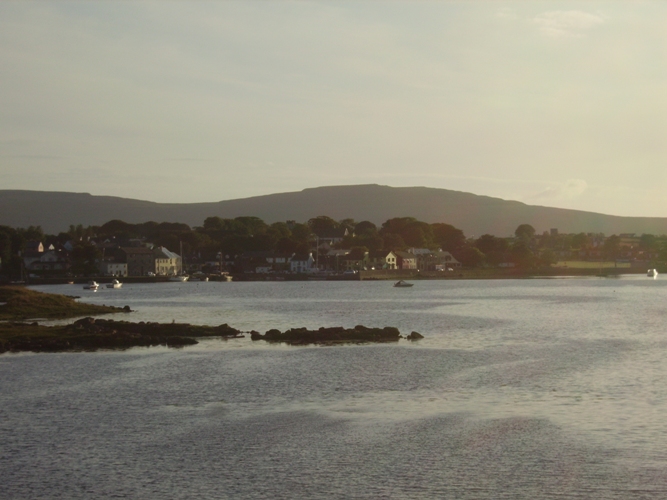
Photo: EO'D
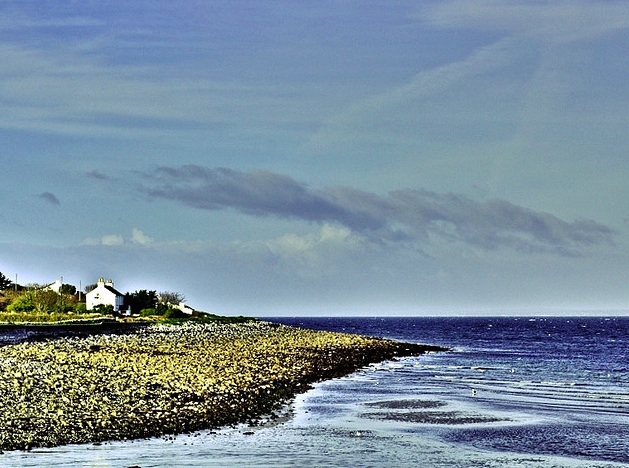
Photo: EO’D

A paragraph, extracted from the Clare Journal, has been making the round of Metropolitan papers, with reference to an alleged unprovoked assault of some Claddaghmen on a trawling party from New Quay. Upon the most unquestionable authority we have it that the Claddagh boats were quietly proceeding to their fishing destination when an individual belonging to the trawling party presented a loaded musket at some of the boats when passing and thus provoked the unfortunate rencontre, described in the Clare Journal.

Posted in Posts and podcasts

New Quay – 1933

Connacht Tribune 27th May, 1933 p.6 (abridged)

New Quay, County Clare Wikimedia Commons
New Quay, County Clare
Wikimedia Commons

No progressive or prideful village, however small it may seem to those who do not live in it, likes to be isolated from the main stream of traffic. Yet this is what will happen to the village of New Quay if the present scheme of steamrolling the road between the bridge at Currenroo on the Clare border and Ballyvaughan is persisted in. For the purpose of saving six hundred yards, it is proposed to make what would be virtually a new road through the Ballaghdhine boreen, once made by Barton Bindon for the purpose of watering his horses. Thus the level road to New Quay would be altogether ignored and traffic would be diverted from a village which is a fishing and seaside resort. It is obvious that little saving could be effected by the alternative road, for, inasmuch as the New Quay highway would still have to be maintained at the public expense, an additional stretch would be added to maintenance costs. Moreover, there are a number of ratepayers interested on the New Quay road, whereas there are one on the proposed new thoroughfare. In all the circumstances, it would seem that the wisest, if not the only, course would be to follow the line of the old road which possesses the added convenience of a post office and public telephone service – often a matter of importance on a lonely highway.

Posted in Posts and podcasts

Storm – 1861

Freeman’s Journal 8th August, 1861 p4kinvara oil
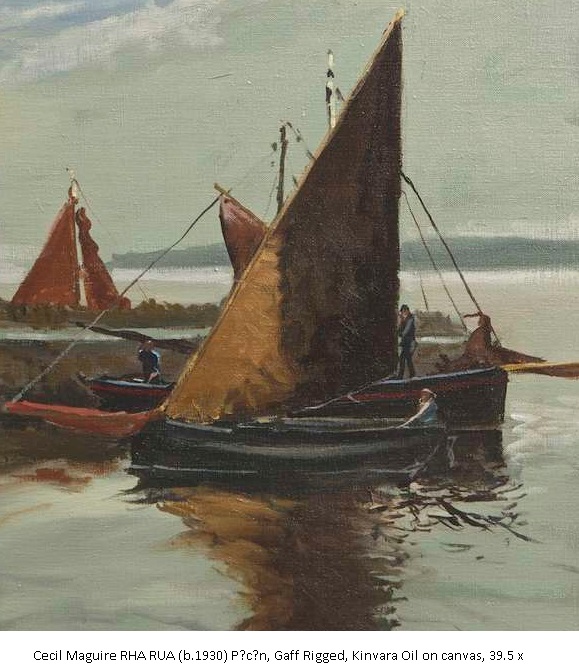
Monday evening the poor Claddagh fishermen went out in great numbers, hoping to profit by the myriads of herrings that swarm our bay. It was blowing moderately at the time from the N.W., but a few hours later it blew a regular gale from the westward, scattering the hookers in all directions, obliging them to run, some for Kinvara, and others for Ballyvaughan and Newquay. With difficulty they reached those places of shelter, and we regret to learn that many of the poor people lost their nets and fishing gear in the storm. They mostly returned today and loud are the lamentations of many a poor family in the Claddagh for the loss of the instruments of their labours.

Posted in Posts and podcasts

A sensational incident – 1911

Connacht Tribune 15th July, 1911 p.4 (abridged)

Photo: EO'D
Photo: EO’D

On Friday morning of last week, about 4.30 a.m., the mail car from Kinvara to Ballyvaughan was held up at Curranroo, Co. Clare, by an armed man, who sprang from behind a wall and, pointing a revolver at the driver, shouted, “Hands up,” and took possession of the horse and car.
The first intimation the driver got that anything was wrong was when he espied a wall built across the road a few hundred yards from Curranroo in the Newquay direction on top of a hill near the house of James McNerney. He was in the act of dismounting in order to remove the obstruction when a man, wearing a mask, with a slouch hat on one side of his head and a “speck” cap on the other, who had, evidently concealed himself in a sandpit for some time previously where he had an uninterrupted view of the Kinvara road and of the mail car approaching, sprang out on the road and presented a revolver heavily mounted, and obviously of an American type, and commanded the driver to walk towards Kinvara until the junction at Corker Hill – the boundary of Clare and Galway – was reached.  He drove off with the car and horse and made by the new line in the direction of Corofin.

The driver retraced his steps when he saw he was out of danger and reported the matter to the police at Newquay. The police immediately set out on bicycles and some of the letters were found scattered a few miles away at Funshin, and the other three bags were found near Cappamore, Kinvara.

Posted in Posts and podcasts

New Quay Bazaar – 1890

Freeman’s Journal 23rd August, 1890 p.12

Photo: Norma Scheibe

Freeman’s Journal 23rd August, 1890 p.12
Among the winning numbers of Bazaar held at New Quay, County Clare, on Thursday 21st August, 1890;

Epergne –  Annie Rourke, Corofin, County Clare.
Album  – Thomas Fahy, Rhine, Finavara
Two Mufflers –  Michael Curtin, Philadelphia
Pinafore –  Mr J O’Shea, New Quay.
Picture –  Michael Grady, Cahermore
Antimacassar –  Mrs Yonge, Bognor, Sussex
A Wax Doll  – Mrs Quinn, New Quay, County Clare
Antimacassar –  Bridget Connolly, Carnamadra
Glove Box and Handkerchief case – Mary Keane, Aughinish
Pair of socks  – Edward Smith, Newport R.I. American
Knitted quilt –  Lizzie Nilan, Murty Clough, New Quay
Reading lamp –  The Convent, Gort
Smoking Cap –  Mrs Tierney, Bridge Street, Gort
Our Lady of Lourdes Statue –  Mrs Quinn, Duras Cottage
Pinafore – Honor Glynn, Kinvara
Candlestick –  K Keane, Cregg, New Quay
Pin Cushion –  Mr D Curran, Dominick St., Galway
Fire Screen –  M Sweeney P.P. New Quay
A pair of boots –  Miss Mona Kelly, Westport
Fifty years of History –  Honor Jordan, New Quay
Holy Water Font –  Mrs Keane, Kinvara
Cheese cover and inkstand –  Father Usher, Ennistymon
Evening Service  – Maggie Foley, Middleton, America
Set of Vestments  – Mrs Kerin, Kinvara
Cushion –  Anne Shaughnessy, Aughnish
Chest of tea –  John Lynch, Gort
A Petticoat –  Thomas Gardner, Kilmoran, Gort
A Hearth Rug –  Michael McNerny, Bellharbour

Posted in Posts and podcasts

New Quay – 1907

Nenagh News 17th August, 1907p3 (abridged)

Across the way. Photo: BO'D
Across the way.
Photo: BO’D

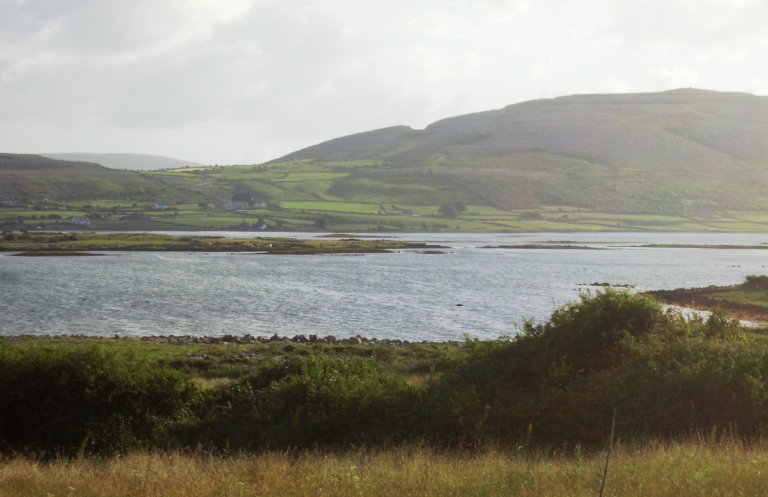
New Quay is encircled on the south side by the rugged range of the Burren Mountains showing the ancient ruins of Corcumroe Abbey, Aughmama Abbey, Mucknish castle, and other castellated ruins along Bellharbour Bay, with the villages of Curranroe, Kinvara, Bellharbour, Ballyvaughan and Finavara, in the immediate vicinity. The air at this district and its surrounds, filled with the ozone and saline of the salt sea of the Atlantic Ocean infuses new life and vigour into one accustomed to living in inland places where the air is entirely devoid of those health giving properties and less embracing.

There are two bathing centres in New Quay supplied with bathing boxes, and a splendid range of sanded strand, one at New Quay and the other at Old Quay, a short distance away towards the Flaggy Shore. The circle of sea surrounding New Quay extends from Curranroe, at the boundary of Clare and Galway, by Munna and Carton, along one of the northern peaks of the Burrin Mountains and continuing on by Old Quay, the Flaggy Shore, Finavarra, Martello Tower and Scanlan’s Island. At this point the entrance is to Bellharbour Bay by a narrow strait dividing Finavarra from Mucknish castle and Ballyvaughan and continuing inland by the southern slopes of Finavarra demesne, and Corcumroe Abbey to Bellharbour Quay and circling outward in the opposite direction by Muckinish Castle, Oughmama Abbey and Ballyvaughan, under the shade of the Burren Mountains.

In fine weather the open sea from the mountain heights and verdant plains of this district, presents one crystal sheet of sparkling surface, with ships, steamers, trawlers, and every style of sailing boat strewn here and there along the surface of the water, from the coast to the circle of the horizon, touching the Atlantic Ocean in the West where the top rigging of the largest barque afloat is seen as a speck above the curvature of the sea, until the full sails and hull of the vessel are exposed to view as it approaches nearer along the surface of the sea.

In stormy weather this open expanse of sea presents an entirely different appearance form what it is in fine weather. To residents of the district the disturbed and placid surfaces of the sea are as familiar as the rising and setting of the sun, but to the visitor or tourist unaccustomed to the fury of the tempest, a short sojourn at New Quay brings the extreme changes caused by the elements into view.

There are intermediate phases in the elements and surface of the sea which only add to the enjoyment of a sail in open boats, but woe betide the boats or even larger vessels, tossed about like shells on the surface of the mountain waves, rolling in silvery breakers from the Atlantic ocean against the cliffs and rock-bound coast.

Posted in Posts and podcasts

A fair point – 1907

Nenagh News 17th August, 1907 p3 (abridged)

Kinvara Photo: BO'D
Kinvara
Photo: BO’D

About one hundred thousand pounds of the estimated two and a half millions annual over-taxation of Ireland would build a small link of railway between Ardrahan and Ennistymon by Kinvara, New Quay, Ballyvaughan and Lisdoonvarna and throw open to the public the enjoyment of the open sea and means of transit for the famous Burren oysters, Redbank oysters and Pouldoody oysters, whose banks are along this particular section of the coast of Clare, particularly New Quay.

Posted in Posts and podcasts

Burren Barracks protest – 1929

Connacht Tribune 1909-current, 02.03.1929, page 7

New Quay, County Clare

Poteen running

Over one hundred and fifty signatures, headed by that of the parish priest, have been appended to a petition of protest against the proposed removal of the civic guards’ barracks from New Quay, County Clare. The petition has been forwarded to the Chief Commissioner and is as follows …

read more on In the news at theburrenandbeyond.com


Posted in Posts and podcasts

Cruinniú na mBád – New Quay – 1835

Freeman’s Journal 14th December, 1835 P4

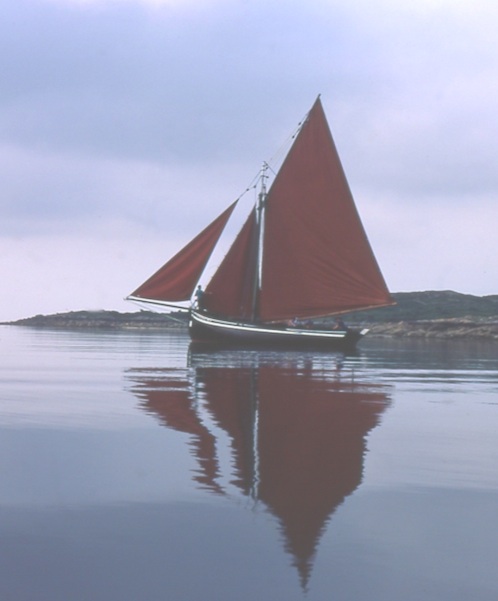
Galway Hooker  Photo: Anne Burgess.   Wikimedia Commons
Galway Hooker
Photo: Anne Burgess.
Wikimedia Commons

A few days ago a regatta took place at New Quay. Mr O’Connell Esq., M.P. acted as commodore, and he and John Scott, of Cahercon, Esq., both subscribed 10/s towards the amusements. The sailing and rowing matches were excellent.
The chief race for hookers was won by a Connemara boat, in consequence of Flaherty’s boat from the Claddagh having stranded. There was a private match between Mr Scott and Mr J. Hynes with their canoes, which was won by Mr Hynes. Mr O’Connell and Mr Scott remained a week and enjoyed the hospitality of Mr J. Hynes.