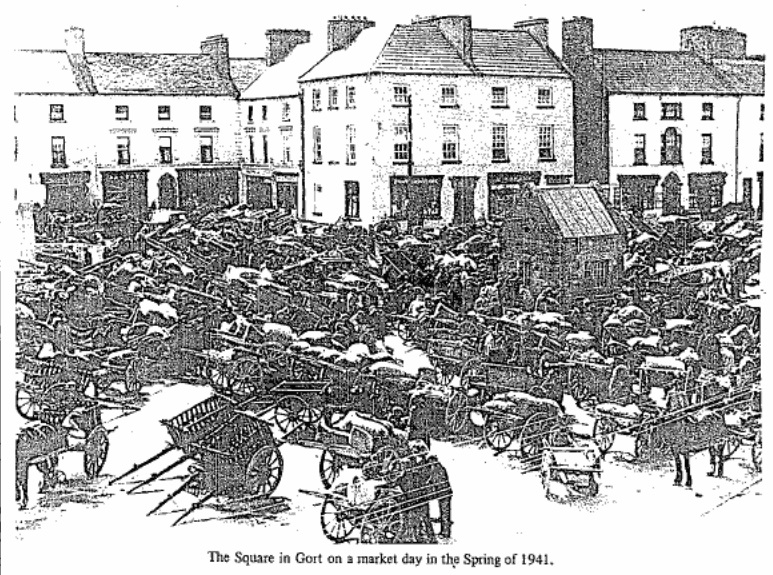
On Friday last week upwards of eighty tenants of the Gough estate held a meeting at Mr. Lally’s hotel, the Square, Gort. Dr. Comyn, solr., addressing the tenants said; Our purpose in assembling here today is to arrive at some conclusion by which we may be enabled to complete the purchase of the Gough estate. Six years ago we believed the only obstacle that stood in our way was the game rights; we sent a deputation to meet the representatives of Lord Gough to Dublin and the question of the game rights was satisfactorily settled. We then left the completion of the purchase to the Commissioners. They sent Mr. Bailey down to inspect the land, which he did, and if they produce his report, it will be found that there is no question of Ashfield not being included in the sale. Now, after six years anxiously waiting, the requirement of Ashfield for disposal pops up. Therefore, our business is with the Commissioners, not with Lord Gough. We have kept our part of the bargain; they have not. The estate as it is now offered, would only provide about two acres for each tenant. Hence, my object in coming here today is to get the full consent of the tenants to meet Lord Gough with a view to acquiring the lands of Ashfield for inclusion with estate.
Very Rev. Father Nestor, Shanaglish, Gort, called upon the tenants to answer affirmatively by saying in a loud voice “Yes”, or negatively “No”. On a general accordance being given, the meeting terminated.
The National Forces operating from Galway under Commandant-General Austin Brennan have now begun to clear the country of Irregulars in real earnest, writes our Galway correspondent. As a result of an operation just under the valley of Tullira Castle, on the Kinvara road at Coolfin, sixteen prisoners were captured on Monday afternoon and on Tuesday a total of 22 prisoners was brought to Galway and lodged in the local gaol.
Early on Monday afternoon eight motor vehicles containing over thirty riflemen and their officers left Galway for Gort. They were equipped with cross-cut saws and engineering tools, and quickly cleared the roads on their way. They passed through Ardrahan village without incident, and along the road to the west of Tullira Castle, under the shadow of the Skehanagh heights, which have been made famous by the dramas of Lady Gregory and other Irish play-wrights.
To the west of this road lies the Great Southern Railway line to Gort and Ennis, and at the inlet of the sea further west the village of Kinvara. As the lorries passed along they noticed men on the march through the fields about a mile distant. They were evidently coming from Kinvara and making for Tullira Castle. The lorries passed along the road towards a bend in the hope of getting a better view, but here they found that their range of vision was altogether obstructed by trees and undergrowth. The vehicles were thereupon put in charge of a small party, whilst the little company of riflemen was distributed amongst the three officers and a few efficient sergeants, who had seen considerable service in the recent war. A few of the cars moved slowly back along the road that they had come, whenceupon the men dismounted, and one officer proceeded along a boreen towards the north-west, accompanied by half a score of men in extended formation. The first shot was fired when a scout was seen rushing across the fields apparently to warn his comrades in the rearguard. He was called upon to halt, and shots were then discharged at him at a range of over 400 yards. Thereafter shooting became general at long distance range.
The Irregulars replied, firing about 100 shots in all. Lieut. McCarthy, who was in charge of the centre, crossed a wall with a sergeant whilst bullets whizzed past. As the sergeant fell on his knees to take aim in the fields a bullet grazed his knuckles.
The National troops operated in a “V”, seeking what cover they could find, and sniping at the Irregulars as the occasion offered. The latter had splendid positions and excellent cover and they retreated as they fired. The main body was at least 1,000 yards from their adversaries and it was at this range that most of the shooting took place. When the scout had got clear, there was considerable commotion in the rearguard of the Irregulars, whistles were blown loudly and shrilly and a general retreat took place.
Proceedings of the Royal Irish Academy (1836-1869), Vol. 10 (1866 – 1869), pp. 440-443
M. Brogan – 8th February, 1869 (abridged)
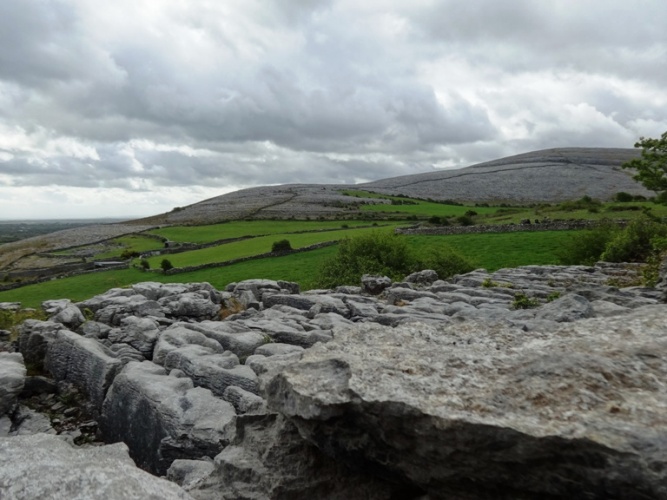
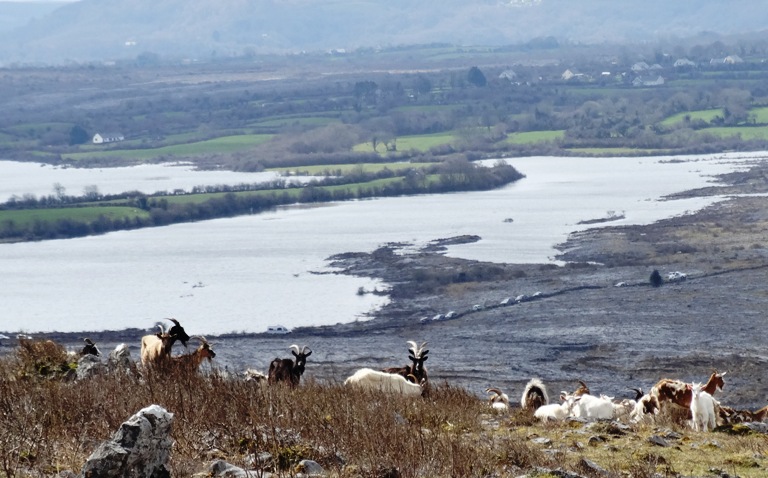
The Hills of Clare Photo: EO’D
When travelling through the country on official duty, I frequently meet with antiquarian remains, some of which may not have as yet been brought under the notice of the Academy. Being recently employed on inspection duty in the county of Clare, my attention was attracted by what I at first conceived to be immense cromleacs, or druidical alters; but which I concluded, on closer inspection, to be sepulchral monuments of some of those stalwart heroes of the olden times who had been “dead and turned to clay” long ere the Milesian adventurers left the sunny shores of Spain to seek and win new home in the green island of Innisfail.
The precise locality of these antiquarian remains is a little south of the public road leading from Gort to Feakle, and about midway between these two towns, in the townland of Druomandoora. The situation is very romantic, being on the northern declivity of the Clare hills, overlooking the deep valley which separates Clare from Galway and which embosoms two beautiful lakes – Lough Graney (Lake of the Sun), and Lough Cooter, with its wooded shores, and islets, and magnificent castle, whose lofty towers and battlements proudly rise over the stately woods by which they are surrounded, and fling their shadows o’er the pellucid lake, “whose tiny wavelets murmur at its base.”
They consist of two sepulchral monuments, distant about a furlong from each other, with two figures inscribed on the adjacent rocks, which in many places present tolerably smooth exposed surfaces. The monument at the greatest elevation on the slope of the hills, though not in the most perfect state of preservation, is the largest. It is called by the people of the locality “Leabadh Diarmaid” (Diarmud’s Bed), while the smaller and more perfect one is called “Leabadh Granu.” I may remark, en passant, that there is a very remarkable sepulchral monument at Coolmore, about three miles north of Ballyshannon, county of Donegal, to which local tradition has assigned the name of “Diarmud and Granu’s Bed.” The rock inscriptions are;
1st. An elaborately and artistically designed figure, somewhat resembling the caduceus of Mercury.
2nd. The impression or outline of the sole of a sandal. I suppose it to represent a sandal; as, if it were intended to represent the naked foot, there would certainly be some attempt, however, rude, to represent the formation of the toes. The foot must have been rather small, probably that of a youth or of a female, as the carving represented it as only ten inches in length, by four and a half inches at the widest part, and two and a half inches at the narrowest part..
My reasons for assuming that the two first mentioned remains are sepulchral, and not cromleacs erected for sacrificial purposes are;
1st. the name accorded to them by local tradition.
2nd. The covering slabs being placed almost horizontally, without the inclination of the covering slabs observable in structures intended for sacrificial purposes; and
3rd. The extreme roughness and irregularity of the upper surface of the covering slabs, formed of the coarse conglomerate rock of the locality. This is most observable in the smaller and more perfect monument, which is covered by a single slab, tolerably smooth on the inner side, but extremely uneven on the outer side, without the slightest mark to indicate that it was ever designed or used for any purpose but that of effectively securing the receptacle underneath. The larger one, of which I give a rude drawing, was covered by at least two large slabs, the end one of which still remains in its original position. The other has been broken into fragments, some of which have been removed; but one large one yet remains, leaning against and overtopping the supporting stones, several of which have also disappeared.
Irish Examiner 1st April, 1850 p.4 (abridged)
As we spare no pains to collect the fullest and most authentic information connected with the social progress of the country and the development of her industrial resources, we are now enabled to lay before our readers a detailed account of the Gort Silver Mines – collected by personal inquiry and personal observation on the spot.
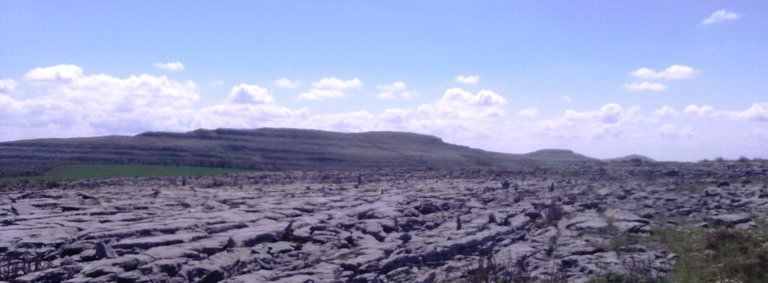
They are situated within a short ride of the thriving town of Gort, in the direction of Kinvarra, at a place called Caherglissance, upon the property of Mrs. Blair. The whole surface of the country appears to be covered with immense fragments of limestone; upon the removal of which very true soil is sometimes found; but more frequently great quarries of limestone will be discovered under the surface. The limestone is brittle and light coloured, and the soil unproductive and barren. In the distance the Kinvarra mountains rise, and give to the landscape a graceful termination. The mines are situated upon a flat surface of country which abounds with turloughs, formed by the subterranean river of Gort. This river flows out of the lake of Lough Cooter, and after proceeding for about a quarter of a mile, falls into a natural cavern of limestone rock at Rinditin where it disappears for about a mile, its course being clearly traced through several holes like wells, several of them of great depth, at the bottom of which water is clearly heard, by dropping a stone into the holes. The river again makes its appearance at Canahoun, where it flows out of a natural and picturesque arch of rock, and after passing through the town of Gort, turning in its progress several large mills, it alternately sinks and rises till it finally joins the sea at Kinvarra, a distance of seven miles, the water percolating through the sand before high water mark. Two of these turloughs are situated close to the mines, and afford an abundant supply of water.
Burren Turlough Photo: EO’D
These mines were accidentally discovered by a poor man about five years ago, but attracted no attention at the time. It was not until they were taken under the management of Mr. W. Rickford, Collett, late M.P. for Lincoln, that their real value was discovered. This gentleman is also chairman of the Killaloe Slate Company; he is described by Mr. Montgomery Martin as a man “of energy, decision, business habits, liberality and benevolent conduct.”
The mines are situated close to the surface in some places – so close that we may be naturally surprised at the length of time during which all this wealth lay concealed and useless in the bowels of the earth. Four or five openings have been made in different portions of the rock, and two or three shafts have been sunk, more for the sake of enlarging the field for labour and tracing the direction of the veins of ore with a view to more extended operations, than for the sake of collecting the ore at present. On entering one of the galleries, which are reached by flights of steps cut in the rock, the visitor will, after proceeding a few yards through a narrow passage dimly lighted with candles, arrive at a large chamber, the walls of which resemble a solid mass of crystalized lead, or silver. Here he will find several miners at work, opening new galleries, and tracing the direction of the ore. The large lumps of ore are carried out in wheelbarrows, and the portions of limestone or talc attached to them are separated with a heavy hammer, after which the ore is broken on a stone slab, by women with large hammers resembling a common smoothing iron fastened to a short stick. This gravel is sifted in copper sieves, and all the larger portions broken again until the whole is reduced to the consistency of coarse sand. This sand is afterwards placed in a copper sieve, which is immersed in a cistern of water, and by a curious rotatory motion given by the miner to the sieve, the heaviest portions, containing all the valuable metal, fall to the bottom, and the lighter portions are skimmed off with an iron scoop from the top and thrown away. The finer portion is again subjected to several washings, after which it is packed in casks for exportation to England.
Specimens of the ore of this mine have obtained 55 pounds 2s.6d per ton when brought to this state, and the ton of ore sometimes contains two hundred and forty ounces of silver. We saw nearly 600 pounds worth of ore ready or almost ready for exportation. Some of the specimens of the ore were beautiful. Sometimes it resembles bright masses of lead freshly broken, sometimes its hue is orange or dark brown, and sometimes it assumes the most beautiful blue or green imaginable. One specimen, which we took from a great mass of clear white spar twelve or fourteen feet in thickness and height, was beautifully tinted with light green and resembled a piece of coloured crystal. Some other specimens were of the richest deep blue, and sometimes the blue and the green will be found united in the same specimen. The silver is generally found in connection with the lead, but a few pieces of copper ore have been found, generally of a deep brown colour, spangled with bright gold-coloured marks.
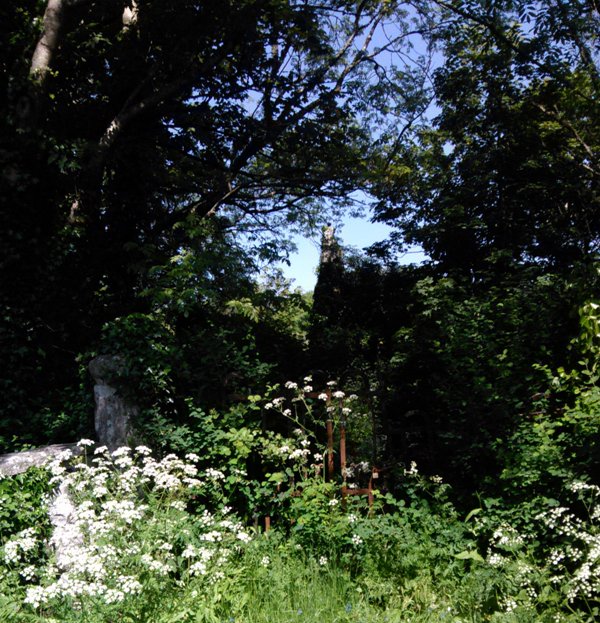
A quiet place Photo: EO’D
There are at present 150 men employed at the mines, but as soon as the works are opened a little further a large number of persons will be employed. The difficulty of procuring anything not usually required in the neighbourhood is a serious inconvenience and cause of delay. It was, for instance, found impossible to procure a leaden pipe of particular dimensions in Gort, a few days since, for a portion of the works, in consequence of which much time was lost, until it could be obtained from Limerick a distance of thirty miles; but these difficulties are incidental to all new undertakings, and can be remedied only by time. Mr Collett, with a wise liberality, instead of engaging at the ordinary wages of the country (6d to 8d a day), pays the labourers at the rate of 1s and the boys 8d per day. He is, consequently, very popular, and has every reason to approve of the conduct of the men under his charge. He has engaged some Cornish workmen from England, who show a good example of industry to their Irish fellow labourers, and the best feelings exist between them.
In “Dutton’s Statistical Survey of the County of Galway,” he enumerates many minerals found in the neighbourhood of Gort; amongst others, manganese from Gortecarnane, the estate of Lord Gort, and from Chevy Chase the property of Dudley Persse, Esq; ironstone from the same place on the estate of Lord Gort, and soft ironstone, yellow ochre, heavy red earth with small shining particles, fine potter’s clay; purple coloured concretion of limestone, coalsmute, coalslate or coal, fine red fire earth etc from various places in the neighbourhood.
Under the active superindendence of Mr Collett, we may shortly expect to see several, if not all of these mines in active work, and Gort may yet become the centre of the most extensive mining operations yet known in Ireland.
The Advocate
Long puck Wexford v Limerick Irish Independent 20th November, 1910
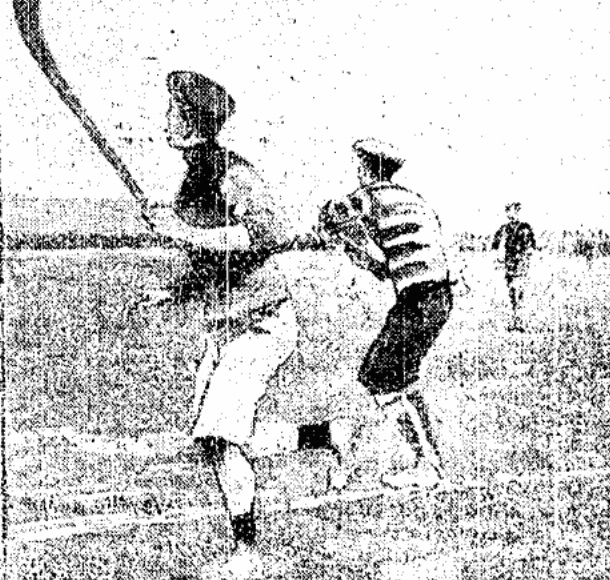
The Co. Clare Board G.A.A., were obliged to play off a tie between Tubber and Killinana on the Galway side on Sunday. Rumour had it that the hurling was to be prohibited, and for that reason an invitation to Gort to meet a selection from Clare was readily accepted, despite other engagements at home. A couple of platoons of military with full war equipment, assisted by several armoured motor cars, sported themselves on the roadside bordering the playing pitch. Shortly after the game started the “Iron Duke” and his other formidably named companions crossed the Clare border and disappeared amongst the hills unnoticed, except for a few derisive cheers as they motored past.
NOTICE TO CONTRACTORS
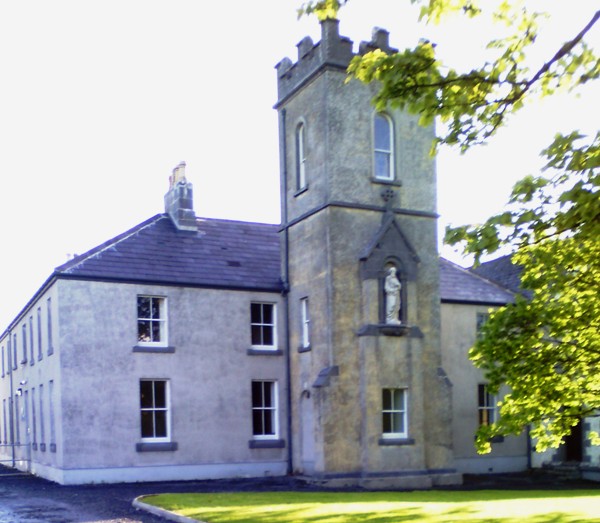
This Sisters of Mercy at Gort will receive tenders on or before 29th April, for the Erection of Convent, Chapel, and School Buildings at Kinvarra, county Galway, in accordance with plans and specifications prepared by M.A. Hennessy, Esq. Architect, M. Inst., C.E.I., A.R.I.A.I.
Copies of plans &x, may be seen at the Convent, Gort, and at the office of the Architect, 10 Glentworth Street, Limerick.
The lowest or any Tender need not be accepted, and contractors are to tender at their cost.
Foy’s hill Fever Hospital Kinvara, Photo: Norma Scheibe
It is today our melancholy duty to record the deaths of four of our medical friends, who, within a few days, have been sacrificed to fever, with which they were afflicted during the discharge of their professional duties:-
On the 23rd inst. Doctor George Seymour, Surgeon to the Kilconnell Dispensary;
On the 24th inst. Doctor Charles Donnellan, of Winterfield, Medical Attendant to the Annadown Dispensary;
On the 25th inst. Francis Bodkin Esq., for many years Apothecary to the Clifden Poor House;
On the 26th inst. Doctor Edward Lambert, of Oranmore, a gentleman much beloved, leaving a widow, with a young and interesting family, to deplore his loss.
Independent of the above, we are sorry to add that serious apprehensions are entertained for the recovery of Dr. Mulville of Gort, and Dr. Hynes, of Kinvarra. Galway Vindicator
Irish Examiner 17th July, 1914 p.5 (abridged)
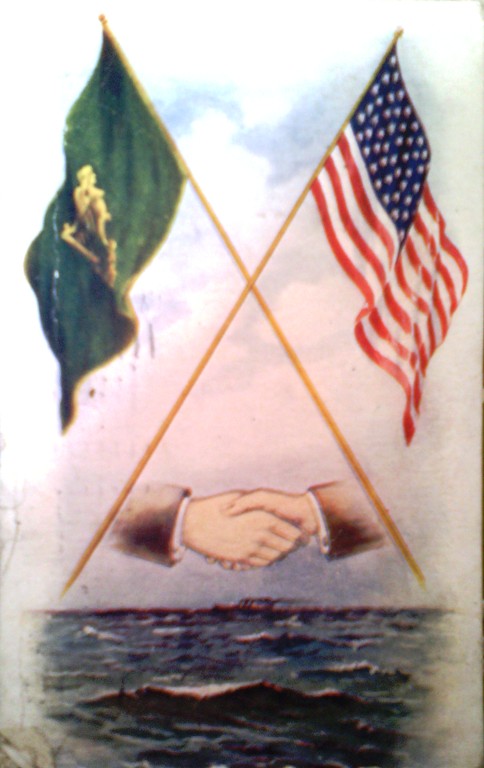
By the Volunteers of North Tipperary it is persistently rumoured that on Sunday week a cargo of arms, supposed to be from the Tipperary Men’s Association in America, was landed at Finavarra Point, West Galway. In the days following, the arms, it is alleged, were brought by night by easy stages, by the various Volunteer corps in West Galway, through Gort, Woodford and Williamstown, reaching the latter village on Saturday night last. Here the arms were received by a number of volunteers from the Tipperary side of Lough Derg, and in the course of the night were transferred by boat to Terryglass. Next day (Sunday) while the Volunteers of North Tipperary were mobilised at Nenagh, and while the police of the district were on special duty in that town, the arms, it is alleged, were hidden in a bog. The strictest secrecy was observed while the arms were in transit and it was only when they were well under cover that the information leaked out.
In view of the above rumour it is interesting to note that the commander of the Nenagh corps last even when dismissing his men publicly informed them opposite the Literary Institute that they would be in possession of rifles next week.


 The Burren and Beyond