Posted in Posts and podcasts

Prevalent maladies – 1824

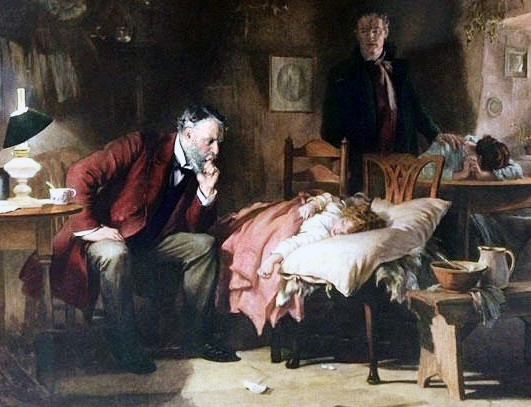
The Doctor - 1891 Luke Fildes (1843–1927)  Wikimedia Commons
The Doctor – 1891
Luke Fildes (1843–1927)
Wikimedia Commons
THE CONNAUGHT JOURNAL 2ND DECEMBER, 1824
The most prevalent maladies in this town (Galway) and neighbourhood for the last year, are stated from the following Report of Dr. O’MALEY, whose practical intercourse with them through the medium of the Dispensary, affords him an unlimited facility of offering the most correct observations:
Fever has been on the decline; however, many cases have occurred sporadicaly, of the intermediate type, termed Synochus; the remainder mild Typhus, with a few instances of the malignant variety. Pneumonia, (inflammation of the lungs and its coverings,) has occasionally existed; Cattarh, with Pleuralgia, (pain of breast, &c.) being exceedingly frequent. A few cases of Pneumonia Typhoides (inflamed lungs with Typhus fever) have also taken place during the autumn.
Inflammatory sore throat often presents itself, owing to the vicissitudes of our atmosphere; and Hepatitis (liver complaint) is a frequent assailant from the same cause, aerial inclemency, and another powerful agent, immoderate spirituous potation.
That Morbid Proteus Rheumatism, acute or chronic, doth constantly uphold a relentless sway, and concentrates, in many individuals, the keenest pangs of enfeebled humanity. Dispepsia (indigestion) and Corrdialgia (spasmodic pain of stomach) in its different varieties, have been, and must be, incessantly frequent in occurrence, until the scanty food of our squalid poor be succeeded by a more generous and abundant measure. Of all diseases which engage the attention of Nosologists, Dysentery & Diarhoea have for the last months stalked with relentless gripe through these wretched domiciles of incomprehensible misery, the hovels of the poor.
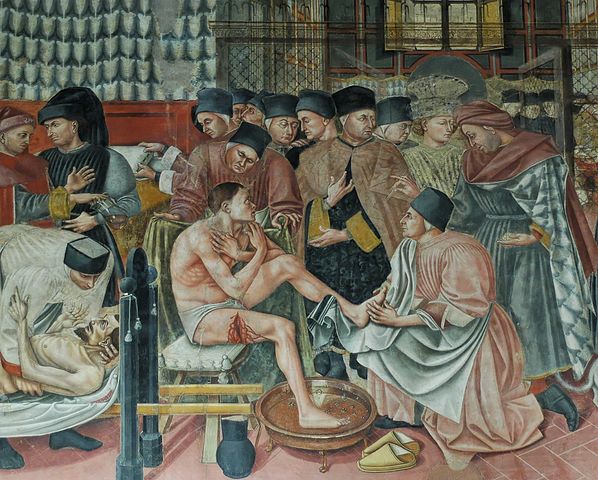
Healing the sick, fresco by Domenico di Bartolo. (1400-1447) Sala del Pellegrinaio (hall of the pilgrim), Hospital Santa Maria della Scala,Siena Wikimedia Commons
Healing the sick, fresco by Domenico di Bartolo. (1400-1447) Sala del Pellegrinaio (hall of the pilgrim), Hospital Santa Maria della Scala,Siena
Wikimedia Commons
These diseases, so different in their nature, have been principally excited by the same causes, namely, no wholesome diet, and deficiency of warm vesture; dysentery indubitably becoming contagious among them, from the limited extent and offensive uncleanliness of their dwellings. This circumstance is worthy of remark, as the Dysentery of these latitudes is seldom contagious, unless under the conditions already mentioned, or when concomitant with epidemic Typhoid affections.- Colic is a malady that next in order rears is stand and among the indigent; frequent cold and wet and indigestible esculents act as its occasional causes. In many instances it has yielded its grasp in the last mentioned genus Dysentery, and in a few has been the precursor of a more certain harbinger of death, Enteritis (inflammation of the bowels.)

The Cholera of our climate, though comparatively imbecile to that of the southern part of the Asiatic region, is a formidable malady, that has occasionally occurred during the estival and autumnal seasons, but in an immediate and decisive practice has invariably yielded.

Hoemophilis (spitting blood) often appears here, but when unconnected with any other affection, is seldom fatal. It, or inflamed lungs, sometimes is a variety of consumption named Inposthumutous, Phthisis, which, with another variety (Tubercular) have occurred here within the last year much less frequently than could be expected from the vicissitudes of atmospheric temperature. It has been computed that in England this disease carries off one-fourth of the population, in Paris, one-fifth, in Vienna, one-sixth, while in Russia it is by no means common, and in tropical climates still less so, from the greater uniformity of their atmosphere, either frigid or torrid. Asthma also constantly presents itself, and unless when produced from malformation, is generally a senile disease, sometimes closing its career with the induction of others.
Dropsy is one of frequent occurrence among the lower class, because it is for the most part a disease of debility. We usually find that it has been preceded by some species of fever, and in other instances it is nurtured by an abuse of ardent spirits, inanition, hard labour and a long exposure to wet and cold. These sap the body and induce affections of the stomach, particularly the liver, weakening the digestive organs becoming frail and instituting in various ways the complaint in question.

Another opportunity shall be taken to illustrate the most prevalent diseases of females and children.
Posted in Posts and podcasts

Fortitude – 1823

Galway Wikipedia
Galway
Wikipedia
Connaught Journal
Galway, Ireland
Thursday, June 12, 1823

On Wednesday, rather an interesting looking woman was observed standing on the verge of the quay, opposite where the brig Fortitude, freighted with passengers for America, was lying; when, on hearing a shot fired, she thought it was the signal for sailing, on which she plunged into the river with a view of reaching the vessel, or abiding the consequences.

She was fortunately taken up, and on being recovered, she said in explanation, that her husband was on board the vessel, having deserted her and her family.

There was an order immediately for his being re-landed. In furture he should atone for having taken a step that was near ending so fatal to a wife that loved him better than he deserved.

Posted in Posts and podcasts

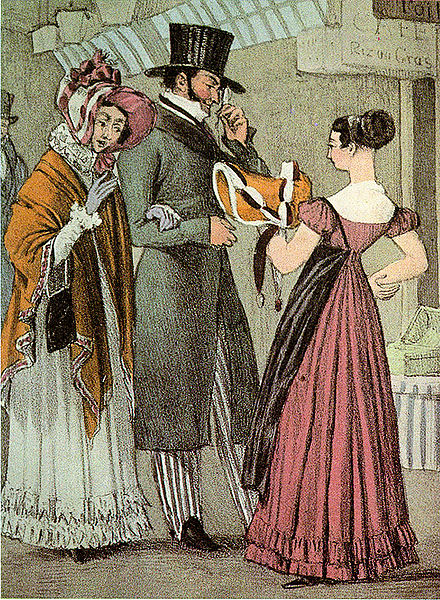
Galway Girls – fashion – 1823

Millinery Shop Paris, 1822 John James Chalon (1778-1854) Wikipedia
Millinery Shop Paris, 1822
John James Chalon (1778-1854)
Wikipedia
Connaught Journal

Thursday, April 10, 1823
FEMALE FASHIONS FOR APRIL
Morning Visiting Dress
Pelisse robe of mignionette, leaf green, of Gros de Naples, trimmed down
each side in front, and round the border with puffings of same, confined by
straps of satin; the bust ornamented by satin Brandenburgs, each terminated
by a silk tassel. Frill a la Henriette, of Urling’s lace. Small equestrian
hat of fine beaver or satin, of a lavender gray, placed very backward and
crowned with a plume of curled feathers of the same colour.–Sautoir of pale
silk. Green satin half boots, and Limerick gloves.

Connaught Journal 3rd March – Fashionable Millinery
Miss E ROBINSON
Begs to announce to her Friends and the Public her having received, from the
first Houses in Dublin, a select and fashionable assortment of Millinery;
Laces, of a superior quality; and a variety of Satins and Lutestrings, of
different shades for Bonnets, for which she has received the Newest
Patterns.
The above Articles having been purchased for Ready Money, they will be
disposed of on the most moderate terms, at her Shop, next door to the
American Society-room, Shop-street.
Bonnets made in the most fashionable manner, and on the shortest notice.

Posted in Posts and podcasts

Sabotage at sea – 1858

Allan Line Royal Mail Steamers c 1890 Heritage Centre Cove Wikimedia Commons
Allan Line Royal Mail Steamers c 1890
Heritage Centre Cove
Wikimedia Commons
The Star 13th september 1858
IRELAND. (abridged)
(From the Times Correspondent.)
Dublin, Saturday, 22nd June.
The fine steamer Indian Empire, which was to leave Galway on the 18th June, with the first mails from Ireland to the United States, was run hard ashore near St. Margaret’s Rocks by the pilot who had charge of her from Southampton. Fortunately, however, the spot where she struck was not dangerous, and the ship eventually floated off and proceeded to Galway, having sustained but trifling damage. The damage will not impair or otherwise prevent her from sailing on her appointed date.
The authorities in Galway, on learning the particulars of the vessel’s going ashore, caused the pilot to be arrested, and after undergoing a preliminary investigation, he was committed to prison on a charge of having wilfully and knowingly run the Indian Empire on a hidden rock.
The somewhat sinister accident which befell the steamship on her first entrance into Galway Bay has created quite a sensation here, and the result of the trial of the two pilots is looked for with no ordinary anxiety. A Dublin journal (The Express) thus refers to the disaster : ” It remains for a jury to decide whether they were guilty or not of the crime of intending to destroy the steamer. It seems to be the general opinion in Galway that the facts cannot be accounted for except on the presumption of their guilt.”
This, however, should be left to the decision of a jury of their countrymen. If they should be found guilty, the crime is one of the foulest on record. But if they are guilty, others are guilty too. If they did run the steamer on the’ rock intentionally, they were the agents of a diabolical conspiracy, which should be traced out. If the chief criminals can be detected, no punishment would be too severe for them. Suspicion points to Liverpool as the seat of the conspiracy. The motives assigned are commercial jealousy.

Posted in Posts and podcasts

Dreadful sufferings in the Polar sea – 15th December 1860

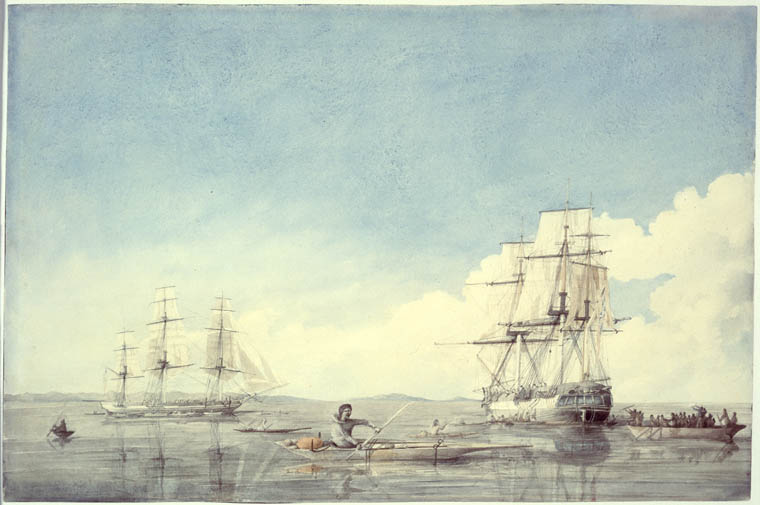
The Hudson's Bay Company ships Prince of Wales and Eddystone bartering with  Inuit off the Upper Savage Islands, Hudson Strait;  Robert Hood (1819)
The Hudson’s Bay Company ships Prince of Wales and Eddystone bartering with Inuit off the Upper Savage Islands, Hudson Strait; Robert Hood (1819)
South Australian Advertiser p3
DREADFUL SUFFERINGS IN THE POLAR SEA.(abridged)

The only survivor of the crew and passengers of the barque Kitty, a sailor named William Armstrong, arrived at Galway by the Prince Albert last August. Armstrong, on the 29th of June, 1859, shipped as mate of the barque Kitty, from Newcastle-on Tyne, which sailed with a cargo consigned to the Hudson’s Bay Company. She was commanded by Alexander Ellis, and besides her crew of able-bodied seamen she took a few passengers, who intended to settle in the locality.
The voyage from the outset was rather boisterous and protracted, for the vessel did not get off the American shore till the beginning of August. On the 11th of that month she was enveloped in a fog off Cape Resolution, and she was suddenly surrounded by huge mountains of ice, so as to render escape almost hopeless. The bergs could be seen through the fog, gradually drawing nearer and nearer, until at last the vessel was touched by them.

Icebergs, Cape York, Greenland Wikipedia.org
Icebergs, Cape York,
Greenland
Wikipedia.org

The crew and passengers wore naturally panic-stricken, but they soon recovered, and commenced efforts to save their lives. Two boats were got out, and as much provisions as could be put into them in a hurry were stowed away. One was under the command of the captain. The other under Armstrong, the mate, left, the ship’s side, just as the bergs closed upon the ill-fated vessel, and crushed her into pieces. She then went down. The remaining boats managed to get through an opening, but only to find themselves in a field of ice, its pieces threatening destruction at every moment.
For days the two boats beat about making attempts to reach the open sea, with no success. The cold began to take effect, and the fearful symptoms of frost-bite became painfully apparent. Remedies such as were within their power were applied, but they were useless. The poor creatures gradually became worse, and dropped off one after another.
Finally the botls separated in a fog. The captain’s boat was never heard of again. Armstrong, with the few persons in his boat still surviving, pursued his course, the little crew in his boat getting fewer in number, while the survivors were becoming weak and sickly. Those who were sinking under the privations, as their hour approached, became maniacs. Two or three besides Armstrong only remained when the welcome cry of ” Land” was raised, and the men strained their eyes and asked one another could it be real. It was at length reached, but too late for some of them. The ecstacy of such a discovery, after being 62 days in an open boat and suffering such privations in a polar region, was too much for them, and all, with the exception of Armstrong, sank to the ground and died. It it is no wonder Armstrong dropped upon his knees, and returned thanks to his God that he had been spared.
Having obtained a little rest, he wandered along the shore, and was fortunate to fall in with some Esquimaux on a hunting expedition. They conducted him to their huts, and there kept him for a considerable time, until he had recruited his strength. They then brought him to a place where some Moravian missionaries were residing, who forwarded him to St John’s in the early part of August. Up to the present no tidings could be got of the vessel, and it was long since supposed that every soul had gone to the bottom.
Haslem Counties Herald.

Close

Posted in Posts and podcasts

Snail Cures – 1867

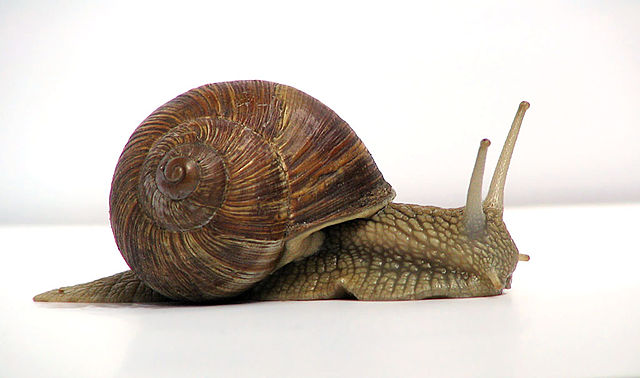
Photo: Wikimedia Commons
https://widgetworld3.wordpress.com/podcasts/
THE BRISBANE COURIER 22ND JUNE 1867 P7
A CURE FOR CONSUMPTION (abridged)

In Ireland some have great faith in the efficacy of snails as a cure for persons in decline, or consumption, but they do not in all places use them in the same way. A lady in Tipperary, who has as large a practice as the regular doctor, tells me that the way to administer snails is to “boil them in veal broth.” She herself knew a lady, who was taking cod liver oil with no result, grew strong with this remedy.

A daughter of a clergyman in Galway writes;
“The snails used for the broth, as you designate my very fine syrup, are the common large things that creep about the garden with their houses on their back. They are collected and placed on a large dish, and plentifully sprinkled with dark sugar, then another dish is turned over to prevent them running away, and the next morning the syrup which has been made in the night is to be drained off, and a tablespoon taken three times a day. A little lemon peel may be added to flavour the broth. The same snails should not be sugared twice. It is a really good thing, but of course will not cure in a day; but I know a lady who attributed her own cure to it.

Posted in Posts and podcasts

Another extraordinary fish story – 1851

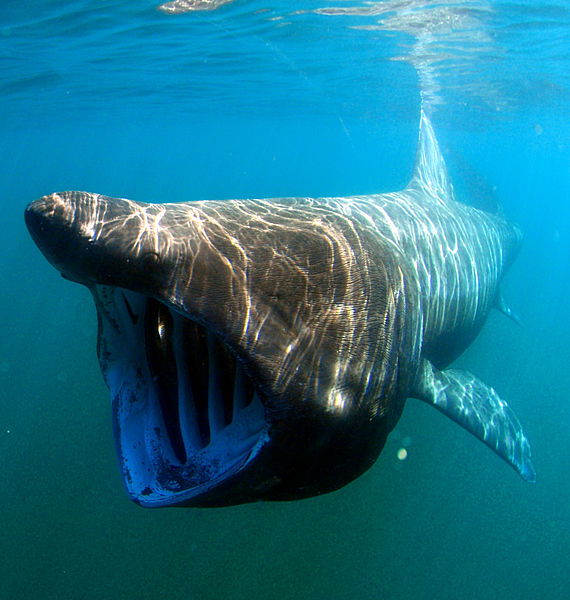
Photo: Greg Skomal/NOAA Fisheries Service Wikipedia.org
Photo: Greg Skomal/NOAA Fisheries Service
Wikipedia.org
https://widgetworld3.wordpress.com/podcasts/
The Argus 11th March, 1851 p4
ANOTHER EXTRAORDINARY FISH STORY
(abridged)
A short time since, no small excitement was produced in Londonderry by a report that the Fenella iron steamer, on its way down the lough, had been piratically attacked off Ennishowen Head by some indescribable animal. It seized the vessel by the bow with its jaws and dragged it all the way into Portrush harbour – the very port to which the vessel was bound. The terror of the passengers and crew was greatly augmented by beholding the creature preparing to board. They were saved from the cruellest of all imaginable deaths by the prompt interposition of a party of the constabulary. With repeated volleys they compelled the monster to a hasty retreat.

It seems that when the Fenella was at the tail of the Tons, nearly opposite to Downhill, those on board felt as if she had grazed upon something, which they supposed might be a sunken wreck, though from the depth of the water, that was scarcely possible. Some observed an agitation about the bow as if caused by a huge animal. When the Fenella reached Portrush harbour (about seven miles further) it was observed by those on shore, as well as some on board, that an enormous fish had hold of the vessel by the bow with its jaws. It turned out that the marks of its teeth were distinctly imprinted in the paint of the bow (which, like the rest of the vessel is of iron).

It was then twilight, so that its shape could not be well observed; but it was judged to be fourteen teet in length, and of a very dark colour. We think that it may have been one of the basking sharks which are common off the coast of Galway.
Londonderry journal.

Posted in Posts and podcasts

Duelling in Ireland – 1843

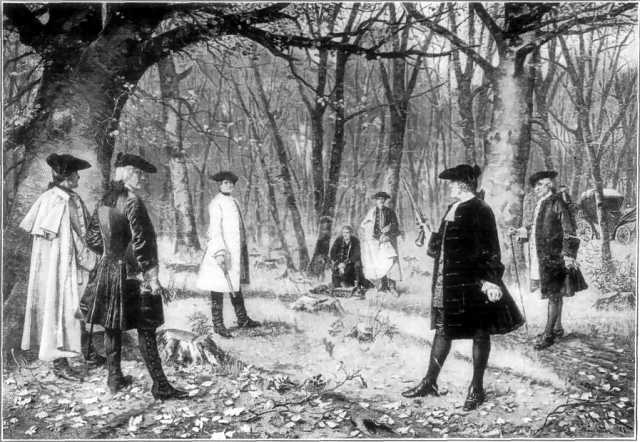
Alexander Hamilton- Aaron Burr Duel Gutenberg File of 1902 Book Wikipedia.org
Alexander Hamilton- Aaron Burr Duel
Gutenberg File of 1902 Book
Wikipedia.org
https://widgetworld3.wordpress.com/podcasts/
Launceston Advertiser 2nd November 1843
IRISH DUELLING (abridged)

No gentleman had taken his proper station in life till he had “smelt powder,” as it was called; and no barrister could go circuit till he had obtained a reputation in this way; no election, and scarcely an assizes, passed without a number of duels; and many men of the bar, practising half a century ago owed their eminence, not to powers of eloquence or to legal ability, but to a daring spirit, and the number of duels they had fought.

It was no unusual thing for the opposite counsel to fall out in court in discussing a legal point, retire to a neighbouring field, settle it with pistols, and then return to court to resume the argument in a more peaceable manner.

The public mind was in such a state of irritation from the period of 1780 to the time of the union, that it was supposed that three hundred remarkable duels were fought in Ireland during that interval. Counties or districts became distinguished for their dexterity at the weapons used – Galway for the sword; Tipperary, Roscommon and Sligo for the pistol; Mayo for equal skill in both.

Weapons of offence were generally kept at the inns for the accommodation of those who might come on an emergency unprovided. In such cases, ‘pistols were ordered for two, and breakfast for one,’ as it might and did, sometimes happen, that the other did not return to partake of it, being left dead in the field.

The laws by which duelling is punishable were then as severe as now, but such was the spirit of the times, that they remained a dead letter. No prosecution ensued, or if it even did, no conviction would follow. Every man on the jury was himself probably a duellist, and would not find his brother guilty.

Posted in Posts and podcasts

Haunted – 1914

https://widgetworld3.wordpress.com/podcasts/

TRUE IRISH GHOST STORIES (excerpts)

COMPILED BY St. John D. Seymour B.D & Harry L. Neligan D.I.R.I.C.  1914

Courtesy: Project Gutenberg


The Spirit of the Dead watches - 1892 Paul Gauguin (1848-1903) Albright Knox Art Gallery, Buffalo, New York Wikimedia Commons
The Spirit of the Dead watches – 1892
Paul Gauguin (1848-1903)
Albright Knox Art Gallery, Buffalo, New York
Wikimedia Commons
A lady, who requests that her name be suppressed, relates a strange sight seen by her sister in Galway. The latter’s husband was stationed in that town about seventeen years ago. One afternoon he was out, and she was lying on a sofa in the drawing-room, when suddenly from behind a screen (where there was no door) came a little old woman, with a small shawl over her head and shoulders, such as the country women used to wear. She had a most diabolical expression on her face. She seized the lady by the hand, and said: “I will drag you down to Hell, where I am!” The lady sprang up in terror and shook her off, when the horrible creature again disappeared behind the screen. The house was an old one, and many stories were rife amongst the people about it, the one most to the point being that the apparition of an old woman, who was supposed to have poisoned someone, used to be seen therein. Needless to say, the lady in question never again sat by herself in the drawing-room.


Another house in Co. Clare, nearer the estuary of the Shannon, which was formerly the residence of the D—— family, but is now pulled down, had some extraordinary tales told about it in which facts (if we may use the word) were well supplemented by legend. To commence with the former. A lady writes: “My father and old Mr. D—— were first cousins. Richard D—— asked my father would he come and sit up with him one night, in order to see what might be seen. Both were particularly sober men. The annoyances in the house were becoming unbearable. Mrs. D——’s work-box used to be thrown down, the table-cloth would be whisked off the table, the fender and fireirons would be hurled about the room, and other similar things would happen. Mr. D—— and my father went up to one of the bedrooms, where a big fire was made up. They searched every part of the room carefully, but nothing uncanny was to be seen or found. They then placed two candles and a brace of pistols on a small table between them, and waited. Nothing happened for some time, till all of a sudden a large black dog walked out from under the bed. Both men fired, and the dog disappeared. That is all! The family had to leave the house.”

Now to the blending of fact with fiction, of which we have already spoken: the intelligent reader can decide in his own mind which is which. It was said that black magic had been practised in this house at one time, and that in consequence terrible and weird occurrences were quite the order of the day there. When being cooked, the hens used to scream and the mutton used to bleat in the pot. Black dogs were seen frequently. The beds used to be lifted up, and the occupants thereof used to be beaten black and blue, by invisible hands. One particularly ghoulish tale was told. It was said that a monk (!) was in love with one of the daughters of the house, who was an exceedingly fat girl. She died unmarried, and was buried in the family vault. Some time later the vault was again opened for an interment, and those who entered it found that Miss D——’s coffin had been disturbed, and the lid loosened. They then saw that all the fat around her heart had been scooped away.

Posted in Posts and podcasts

The new Galway Steamers – 1860

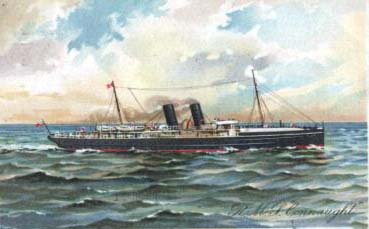
The Connaught 1900 Postcard
The Connaught 1900
Postcard

https://widgetworld3.wordpress.com/podcasts/

THE GRAND HAVEN NEWS 16TH MAY 1860 P1

THE NEW GALWAY STEAMERS – STILL MORE RAPID COMMUNICATION WITH EUROPE

The steamship Connaught, the first of the four new Galway steamers to be called after the four provinces of Ireland, was to have been launched yesterday, and will probably be soon on her way to this continent.  The company has entered into a contract with the government binding themselves to convey mails and telegraphic dispatches to and fro between Galway and St. Johns respectively, in six days by the steamers of this line.


This is certainly a bold stipulation.  It is quite an American idea, and if carried out will bring the two continents into closer communication than they ever were before.  The distance between the two ports is about 1,650 miles, and if it is made in 144 hours, these vessels must run at a uniform speed in all weathers of nearly twelve miles an house.  it is said, however, that they will be able to run twenty miles an hour if required.


If they fulfill the terms of the contract, nothing can beat this rapidity of communication except Wise’s balloon or the Atlantic telegraph.

(N.Y. Herald, May 23)