Posted in Posts and podcasts

Kinvara 1910

Connacht Tribune 24th December 1910 p5
On Monday morning the Kinvara cattle drivers, Ml. Donohue, Gortnaclogh, T. Gorman, John Hynes, P. Healy, Bartly Quinn, Moy, and John Smith, Kinvara were released from Galway Jail after undergoing a term of six months’ imprisonment. They were tried at the Summer Assizes and sentenced by Judge Kenny for driving the cattle of Patrick J. Flatley off the lands of Funshinbeg. The severity of the sentence and the respectability of the prisoners evoked the greatest sympathy at the time, and the Nationalists of the district vied with one another in doing the farm work and harvesting for their families ever since.
They were met at the door of the prison as they emerged, by Mr Ml O’Donohue J.P., Co. C. and seven cars, laden with members of the Kinvara hurling club. They were sumptuously entertained by Mr. O’Donohoe, and started from Eyre square after “doing” Salthill, about 3 p.m. for Kinvara.
They were loudly cheered passing through Oranmore and Clarenbridge, and on reaching Kilcolgan they were greeted with illuminations. They were met outside Kilcolgan by a big contingent with cars and horses, from the Kinvara and Duras branches U.I.L., consisting of Messrs. T.P.Corless, D.D., president; Ml Curtin, B. Quinn, M. Melia, Pat Hanlon, Bryan Kilkelly, T. Keane, Joe Forde, Pat Halvey, P. Callanan, P. Whelan, Ml Carty (Secretary), Michael Huban, A. Conners, C. O’Loughlin, P. Noone, J. Moylan, John Glynn etc., who cheered them loudly. As Ballindereen was approached it was seen that every house was illuminated, bonfires were ablaze on every hill, and lighted torches lit up the horizon.
A noticeable feature in Ballindereen was a big force of police under arms on the outskirts of the crowd. A hurriedly convened meeting was held under the chairmanship of Mr. Michael O’Donohoe, Co. C. J.P., who thanked the sterling Gaels and fearless Nationalists of Ballinderreen for the great reception they had given the prisoners(cheers). He would never forget it to them (sic.) He reminded them of the early days of the Land League Movement and of the proclaimed meeting in 1879, and said he was glad to see the same spirit animating them today.
Mr. T.P.Corless, D.C., also addressed the meeting.
Amidst a scene of great enthusiasm the procession, which had now assumed enormous dimensions, started for Kinvara. The houses along the route were illuminated and bonfires and torches blazed at Pollough and Toreen. At Ballyclera the whole village turned out and the procession passed with great difficulty through a virtual sea of fire. Dungora Castle presented a grand appearand with its many and various coloured lights. Overlooking the town and harbour, the lights could be seen for miles. The turrets on the top were beautifully lighted and arranged in such a way as to resemble a huge harp. A bonfire was ablaze in frong of the Castle as the prisoners were passing.
Kinvara was brilliantly illuminated and an immense bonfire was lighted in a field opposite the Convent of Mercy.
In Moy and Gortnaclogh, the homes of the prisoners, bonfires and illuminations were kept up until morning.
Mr. Cruise, D.I., and a number of extra police were drafted into Kinvara, but notwithstanding the greatest excitement, everything passed off quietly.
Posted in Posts and podcasts

Farewell from Kinvarra, Duras and Killinna – 1867

Freeman’s Journal 16th December, 1867 p3 (abridged)

Dun Guaire, Kinvara Photo: Norma Scheibe
Dun Guaire, Kinvara
Photo: Norma Scheibe

Address of the parishioners of Kinvarra, Duras and Killinna to the Rev. Francis  P.P. Croughwell and Ballimana.
Rev. Dear Sir,
We have been deputed by our fellow parishioners of the united parishes of Kinvarra, Duras and Killinna, to offer you in the first instance their sincere and heartfelt congratulations on your recovery from your late severe and dangerous illness, and in the next to convey to you their, and our own, deep regret at your having been so soon after removed from amongst us.
For four and twenty years have you discharged the onerous duties of Pastor to these parishes with a pious zeal truly edifying, and the benefits conferred on religion and morality by your counsel and teaching during that eventful period it is not in our power to convey an adequate idea of, but we fondly cherish the hope that they will be appreciated by Him whose faithful servant you have ever been and who is sure to reward those who faithfully do His work.
It would be difficult, Rev. Sir, to enumerate all the advantages which your late Parishioners have derived, both spiritually and temporally, from the interest you have ever evinced in their welfare.
Need we refer to your exertions in their cause when famine and all its sad consequences, fever, cholera, &c, &c, stalked abroad, and like and avenging angel was devastating the land.  Then, indeed, it was that the good and zealous Priest of Kinvarra proved the interest he felt in his flock, in not only being found day and night in the midst of contagion and approaching dissolution, ministering to their spiritual wants, but also in relieving by his purse, and frequent appeals in their behalf to the charitable throughout the kingdom, their distressed condition.
We would be ungrateful and unworthy of the benefits conferred on the parish by him did we omit the name of your respected and beloved Curate in this address, of him  who, which on the mission amongst us, has won for himself not only our esteem and affection, but the respect and regard of all those who had the happiness of hearing his exposition of the Word of God during his mission in the parish.  We felt much, and were truly sorry to learn, that your respected Bishop had resolved on removing you, Rev. Sir, to another parish, but which removal we, however, sincerely hope will prove to you a well-merited reward for your past invaluable services in this.
We cannot give expression to the feelings of regret entertained by all when it was ascertained that his Lordship felt it necessary to remove the Rev. Mr McDonogh also from amongst us.
In conclusion, we beg to observe that, although the scene of your labours is now elsewhere and amongst other people, we are convinced that your prayers will still be offered to the Throne of Mercy for those who have commissioned us to present you with this Purse and its contents as a trifling token of the love and esteem in which you have ever been and will be held by them, as well as by your sincere and ever faithful friends.
Signed on behalf of the Committee.
Isacc B. Daly, Chairman
D.J. Hynes, M.D.(Vice Treasurer)
Martin Kerin (Vice Treasurer)

Posted in Posts and podcasts

Newtownlynch, Duras – 1910

Connacht Tribune 7th May, 1910 p.5  (abridged)

Photo: Pikaluk Wikimedia Commons
Photo: Pikaluk
Wikimedia Commons

On Monday morning last at about 8 o’clock, Newtownlynch farm at Duras was the scene of a large cattle drive. Men, women and children, all tenants on the estate of Major Lynch, assembled to the number of over one hundred, and went to the farm, which was guarded by police. When the police saw the people coming towards the farm they advanced and called on the crowd not to enter the lands, but they were met with defiant shouts of “No surrender!” While the police were engaged with the people on the road, a number of men managed to get on the lands, and drove a large number of horses, cattle and sheep off the farm. The police in another portion of the farm who were guarding the stock during the night, apparently were asleep, and were only awakened by the noise of the cattle. The farm was cleared with the exception of three horses.

The police called on them to stop and drew their revolvers. The men replied with shouts of “Faugh-a-ballagh,” and “We will drive them to h___.” Some of the police then started for Kinvara for reinforcements. The “drive” continued in the direction of Kinvara en route for Clarenbridge, where the owner of the stock resides. Large numbers joined the “drive” on the road. Sergeant Mulligan, in charge of a cordon of police, attempted to stop the stock within one and a half miles of Kinvara, but failed.

Posted in Posts and podcasts

Kinvara, Duras – O’Heyne – 1674

Connacht Tribune 3rd March 1978 p.4

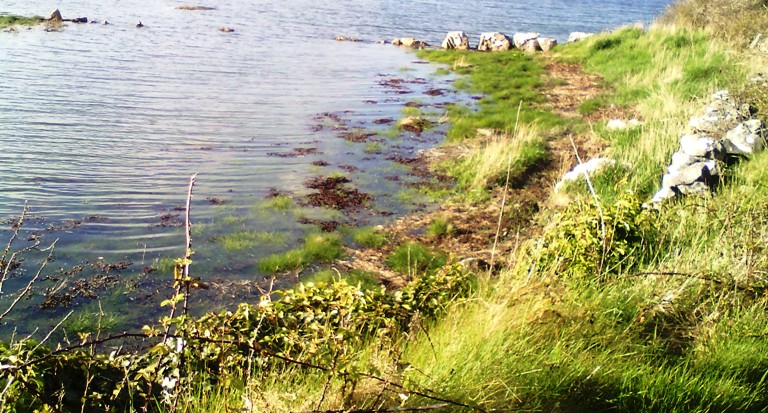
Duras Shore Photo: EO'D
Duras Shore
Photo: EO’D

Turlough Hynes was parish priest of Kinvara and lived at Poulnegan. Archbishop James Lynch of Tuam ordained him priest in Cong in 1674. It seems likely that he was of the same family of Frs. Edward and Terence Hynes. A chalice in Kinvara bears this inscription:
The gift of Pa French Esq., to the Rev. Fa. Ther. O’Heyne and his successors in the Parishes of Kinvarra and Duras.
The chalice was stolen, broken and repaired. A second inscription on the base records that the cup was replaced by Vicomte de Basterot in 1886.
Rev. Fr. Martin Coen

Posted in Posts and podcasts

Kinvara, Killina, Duras – 1847

Freemans Journal 16th May 1847 p.2

Photo: EO'D
Photo: EO’D

Kinvara, Killina and Duras, Galway – Reverend F. Arthur (abridged)
Deaths by famine, 148, in addition to 98 occasioned by a melancholy subsistence on sea weed, nettles, “Bliskane,” & c. Last year the mortality was 52, so that the increase amounted to within a fraction of 400 per cent. Over 1,100 persons were cast out to perish by the order of reduction. There is the parade of relief under the act, but the committee are fastidiously select. Out of a population of 10,000 “there is not 100 who would not be ranked under the first class paupers.”
The reverend gentleman regrets the absence of a Protestant rector “to assist in the great work of charity,” a regret inspired with the most sublime Christianity. And yet the Mail not long since made merry, with that divine desire which proved how well the Rev. Mr Arthur could share the brotherhood of benevolence with one of a difference creed. We seek to introduce no unworthy bickering into the neutral ground of charity, or to interrupt the “truce of God,” with reflections derogatory to any class embarked in the sacred cause of humanity; but if stones have been cast, the Catholic clergy did not originate or perpetuate the quarrel. They calmly bore the faint ebullitions of the old intolerance – which even the fate of thousands of perishing fellow Christians could not altogether repress.

Posted in Posts and podcasts

Aughnish Sea Wall – 1913

Connacht Tribune 11th January, 1913 p.6 (abridged)

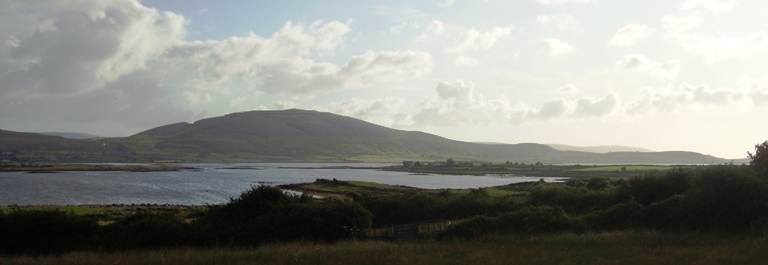
View from Duras, on the way to Aughnish Photo: BO'D
View from Duras, on the
way to Aughnish
Photo: BO'(abridged)

Dear Mr Moran,
In last week’s issue of the “Tribune”, I read an account of the serious damage done to the sea wall at Aughnish by the storm. This, I think, calls for a little plain speaking from someone in the locality. In the interests of the heavily-muleted ratepayers of the Gort Rural District, I am prompted to write and I hope to convince you that my remarks are more than necessary.
The sea wall, or “Coch,” at Aughnish, as you are aware, is a causeway connecting the densely populated village of Aughnish Co. Clare, with the mainland at Geeha – an appropriate name, for every wind that blows, run riot there. The road runs along by the Atlantic for about a thousand yards, two-thirds of it being in the Gort Rural District, and one-third being in the Ballyvaughan District, County Clare. For the past half century the causeway has been repaired times out of mind at considerable cost to the County Galway, but at a very trifling cost to the County Clare. More money has been spent by the Galway Grand Jury and the Gort Rural District Council on repairing breaches after every storm than would steamroll all the roads in Kinvara and Duras for the next ten years.
The people are heartily sick voting huge sums away year after year for repairs that, for all practical purposes might as well have been thrown into the sea.
Your predecessors applied for small sums varying from £50 to £100 for repairing the sea wall, and the work was always entrusted to a Gubaun Saor, whose only ambition was to draw his money and not care a straw if it fell the day after, as it did a number of years ago under the Grand Jury regime.
The Clare Grand Jury did things better, they expended a decent sum twenty golden years ago, and they never had to expend a penny on repairing it ever since. The Clare county surveyor insisted on a competent clerk of works superintending the contract from start to finish and he insisted on the proper materials being used, and on the specification being carried out to the letter. I am sure if you visit Aughnish and see for yourself what is required and insist on having it done (as I am sure you will),  in a proper manner and by competent mechanics under a resident engineer, such as you have amongst your assistants, it will be a long time again before the Aughnish sea wall comes up before the Gort District Council. Unless you take action at once, and put an end to botching and tinkering for ever, I fear the ratepayers of Kinvara and Duras will rise in rebellion against the District council at the next quarterly meeting.
Hoping that you take my advice to heart.
Your obedient servant.
SPEX

Posted in Posts and podcasts

Stormy weather – Kinvara – 1911

Connacht Tribune 25th February, 1911 p.8

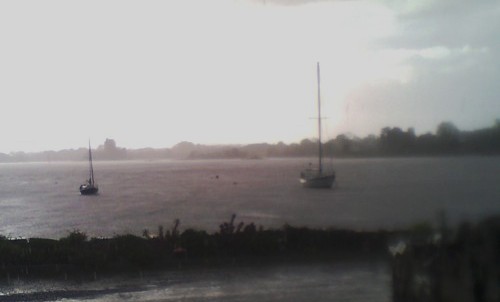
Stormy weather, Kinvara Photo: EO'D
Stormy weather, Kinvara
Photo: EO’D

Grave Situation in Kinvara (abridged)

Questions in Parliament.

Mr Duffy had the following questions down for Wednesday, but we have not yet received the replies:
To ask the chief Secretary to the Lord Lieutenant of Ireland whether he is aware of the disturbance that was imminent in the Kinvara district, Co. Galway, during the past 12 months owning to the attitude taken up by the trustees of the Sharpe estate in respect to the sale of the estate; does he know that an understanding was arrived at last October, as between the agent to the property and the tenants, to the effect that a request would be made immediately to the Congested Districts Board to acquire the entire estate, including the town.

Has such a request been made; and what is the cause of the delay in dealing with this estate?

Question 2:
To ask the Chief Secretary to the Lord Lieutenant of Ireland if he is aware that the district in and around Kinvara is one of the most congested in the west of Ireland; has it come to his knowledge that the people for years have been requesting the various public departments to purchase the available lands in the neighbourhood for allocation amongst them; can he say what time has now elapsed since the Blake-Foster estate, Kinvara district, was first offered for sale; is he aware that the agent, Mr W. E. Holmes, Roscommon, offered the estate to the Congested Districts Board last May; and having regard to the history of the estate and the conditions which prevail on this property, whether he will direct the attention of the Congested Districts Board to the estate and state the cause of their inaction:

Question 3;
To ask the Chief Secretary to the Lord Lieutenant of Ireland whether the estate of Colonel Lopdell, Athenry, situated at Cappamore, Kinvara, County Galway, is one of the estates to be dealt with by the Estates Commissioners; has the estate been inspected and purchase sanctioned by the Commissioners seeing that a considerable number of years have passed by since the tenants agreed to purchase their holdings; and having regard to the quantity of mountainous land on the estate which would become available for allotment, whether he will call the attention of the Estate commissioners to the delay in dealing with this property?

Question 5;
To ask the Chief Secretary to the Lord Lieutenant of Ireland whether any request to sell his estate in the districts of Duras, Funshin and New Town has been made to Mr Wilson Lynch Belvior, Sixmilebridge, Clare, by the Congested Districts Board and when and with what result?

Posted in Posts and podcasts

Threshing – 1910

Connacht Tribune 15th October, 1910 p4

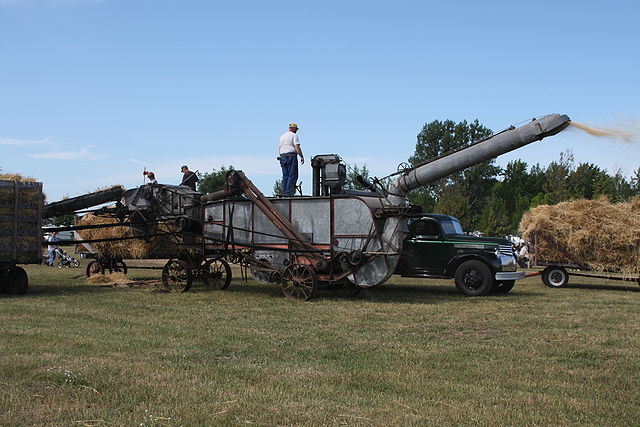
Threshing Machine In Action Photo: Ben Franske Wikimedia Commons
Threshing Machine In Action
Photo: Ben Franske
Wikimedia Commons

The topic of the hour in Duras is the Loughrea Threshing machine that did such wonderful work for a local farmer and a Caherglissane grazier. Some say it belonged to Tener, was commissioned by Ludlow, and worked by Bartly Naughton. Fahy was written in letters as red as blood on the car, and Mr Skehill was in command.

Posted in Posts and podcasts

Kinvara, Duras, Kiloveragh – 1932

Connacht Tribune 25th June, 1932 p22 (abridged)

Ballybranigan Photo: Norma Scheibe
Ballybranigan
Photo: Norma Scheibe

Interesting Lecture at Gort by P. J. Murray, N.T.

Patrick French, son of Roebuck, waa a Catholic. He was a very generous donor to the Kinvara church, his gifts including a beautiful chalice.

James, French, brother-in-law of Oliver Martyn, Tullyra, spent much of his iife in France, owing to the delicate health of his children. His daughter Frances, married Bartholomew De Basterot, who thus became heir to the Durus property. The establishment of his claim, however, involved him in a legal suit extending over thiee years. The enormous expense thus entailed so impoverished him that he was forced to sell some of the property.

It was purchased by Robert Gregory, Coole Park, and Mark Lynch, Galway. The latter erected Durus chapel for the convenience of the tenantry. As this occurred in the eighteenth century we may conclude that the penal code was not rigorously enforced in all parts of the country.

Robert Gregory continued the erection of the Kinvara pier and quay which had been begun by James French. To do so it was necessary to demolish the fine old chiefs (sic.) of Kiloveragh which stood opposite Dun Guaire Castle. Though displaying little reverence for the historical monuments of the district, this gentleman showed a commendable enterprise of more material value to inhabitants.

James De Basterot built a new residence at Durus and planted extensively. He was an artist of merit and some of his pictures are still to he seen in Kinvara church. His son, Bartholemew, was a distinguished writer. Though one of the absentee landlords, he manifested a kindly interest in his tenants.

Tiirowen House was purchased about 1650 by Christopher French. The latter was Mayor of Galway during its siege by Ludlow who added considornbly to the Tirowen estates, probably after his betrayal of Galway. Early in the eighteenth century, a daughter of his married the Hon. Mary St. George, hence the Tirown Frenches were afterwards known as the St. Georges.

Posted in Posts and podcasts

Duras/Doorus – 1837

Newtown House, Doorus Photo: A McCarron Wikimedia Commons
Newtown House, Doorus
Photo: A McCarron
Wikimedia Commons
A Topographical Dictionary of Ireland
Samuel Lewis – 1837

DURAS, a parish, in the barony of KILTARTAN, county of GALWAY, and province of CONNAUGHT, 16 miles (E. S. E.) from Galway: the population is returned with Kinvarra. This parish, which is situated on the bay of Galway, takes its name from a small fertile island close to the shore, which was granted by Cromwell to Major John Walcot, whose grandson sold it to Mr. French, from whom it descended in the female line to the Baron de Basterot, its present proprietor. A great portion is rocky and incapable of cultivation; but some of the land is very rich and produces excellent wheat. Limestone is abundant, and much is quarried for agricultural and other purposes. The late Mr. French raised embankments in several places to prevent the encroachment of the sea, and built a long bridge to connect the island with the main land; great improvements have also been made by bis successor.

The principal seats are Duras Park, that of P. M. Lynch, Esq.; and Duras House, of the Baron de Basterot. Great numbers of oysters and other fish are taken off the coast, and about a mile and a half to the west of Duras Point a pier has been constructed, which, though dry at low water, is accessible to vessels of 60 or 80 tons’ burden at the return of the tide; the expense of its erection was partly defrayed by a grant from Government. From the west end of the pier a ledge of foul ground extends to Deer Island. Here is a large flour-mill, worked by the tide. The parish is in the diocese of Kilmacduagh; the rectory is partly appropriate to the see, and partly to the benefice of Ardrahan; the vicarage forms part of the union of Kilcolgan; the tithes are included in the composition for Kinvarra, which see.

In the R. C. divisions it is part of the union or district of Kinvarra; the chapel was erected by the late P. M. Lynch, Esq., and was enlarged and a spire added to it by his son, the present proprietor of Duras Park, by whom it has been also endowed with £10 per annum. On the island of Duras are the remains of an ancient friary, with a burial-ground; and there are the remains of a druidical altar, near which some ancient silver coins have been found.