Another 4,000 year old tomb has been found in County Galway, as a result of information supplied by Mr William O’Brien, Land Reclamantion Officer, Renmore, Galway. The tomb, situated on the land of Mr J.W. Duane, Crushoa, Kinvara, is a gallery type wedge grave, somewhat smaller than the one recently described found on the land of Mr Des Kerrins at Ballinastague. The chamber dimensions are approximately as follows;
Length – 8 feet;
width 6 feet 6 ins;
Height – 4 feet;
Children of the Fahy family Crushoa, Martha, Sarah and Josephine, were delighted to point out the location of the tomb to the visitors who verified its authenticity, the visitors being, Mr Sean O’Nuallain, Archaeological Officer in the Ordnance Survey’ Mr P.G. Coen, M.P.S.I. Gort; V. Rev Fr. Martin Ryan, P.P. Ruane, a leading member of the Thomond Archaeological Society; Mr E. Rynne, lecturer in Celtic Archaeology, U.C.G. and Mr E. Fox, Galway
Maryborough Chronicle, Wide Bay and Burnett Advertiser 28th January, 1864 p 15
Photo: EO’D
At Dromelihy, County Clare, some men, in digging for potatoes, came on a massive boulder, which required their united exertions to remove. It had been artificially set over four other and formed an enclosure of about two feet square. But well repaid were they for their labours. Having displaced it, they found the contents to be a copper kettle filled with silver pieces, each being worth about tenpence, and some of which bear the date of 1510.
On digging further they perceived some stones set in mason work, which they upturned with renewed energy. They succeeded in entering a vault, which, to their surprise and disappointment, contained nothing but a leaden coffin about nine feet in length. On taking off the lid, (which, by the bye, was considered very daring of them) they beheld a human skeleton of massive proportions, the thigh alone measuring 2ft 11in and the cranium half an inch in thickness.
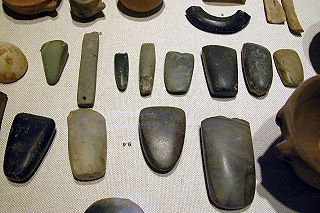
Back then residue analysis was just a fledgling science. Not only that, a considerable number of external influences seriously affected the accuracy of its findings. Artefacts were often affected by exposure, weathering, climatic conditions, post-depositional disturbance by human or animal or a combination of any and all of these factors.
If stone tools managed to survive that onslaught and still retain a skerrick of promising dirt they then had to endure occasionally questionable excavation procedures, post excavation handling and, the nemesis of all residue analysts; curation. Curation was that century’s old habit of washing, buffing and polishing artefacts, removing all visible and a huge proportion of microscopic residue in the process. The habit was hard to break.
Some of the more promising artefacts ended up in a laboratory for analysis. They were treated to 0.5cc of a 5% ammonium hydroxide cocktail to relax their molecules. This was followed by an invigorating ultrasonic clean, a darn good rotation and a quick spin. The subsequent ‘dishwater’ collected was then treated with a reverence bordering on idolatry. These dribbles were subjected to a plethora of mixes, applications, potions, procedures and shocks and DNA sequences began to expose themselves. As soon as they reared a barely distinguishable head we PCR’d the living daylights out of them.
Mind you, despite this trojan effort one still had to accept the possibility of cross-contamination of artefacts in the course of testing, flaws in the testing process or human error. As a result, if and when a result of any magnitude was achieved, the hopeful student had to clutch their hard earned results close to their heart and run the gauntlet of responses ranging from guarded opinion to doubt, disbelief or pure distain from supervisors, professors, scientific colleagues. That was the ultimate rite of passage.
Dante Gabriel Rosetti’s Pandora
Nonetheless residue analysis became increasingly popular, and rightly so. It was the smoking gun of prehistory. Pregnant with promise it continued to attract serious and sustained attention from many over the years. We had a huge supply of artefacts to tinker with at the time. The mother lode lay in Upper Palaeolithic sites in the South of France. Abri Pataud, Pech Merle, Font de Gaume, La Madeleine, Laussel and of course Chauvet Cave. Serology Laboratories joined the cause, as did Departments of Forensic Sciences from Canada to Australia. Notes were traded, secrets shared and alliances made in corridors of academia on six continents.Under the microscopic ministrations of science tiny micro cracks in the tools begun to expose themselves. Weapons that had been curated to a fine sheen were also found to contain enough residues in these cracks to obtain DNA sequences. The stones surrendered their secrets, in detail. We learned that at some point in time many of those little and not so little stone tools had embedded themselves in sheep, bear, caribou, musk ox, and the ubiquitous woolly mammoth.
Besides impaling the hides of a wide range of species a number of these tools were found to have scratched, pierced or poked the hands that made them. We had ancient human DNA.
Progress continued, exponentially. It continued in tandem with developments in cloning. Long story short, we slowly opened Pandora’s Box. By 2030 we had out first fully fledged wooly mammoth. Then came the sabre tooth. That horrid business with the giant sloth is best forgotten.
Venus of Abri Pataud, carved 21,000 years ago.
Success came at a price, for me. During an excavation at Font de Gaume, Les Ezyies I slipped descending from the cave and whacked, walloped and bounced my way down the slope. I slashed my head open on a rock and ended up senseless at the feet of a hysterical tourist. The local guide was very decent particularly as I wasn’t part of his group. I was watered, bandaged hospitalised, released and returned to my hotel quicker than you could say litigation. Not that I would, though I did pinch a nerve in my spine which successfully hampered movement for the rest of my natural life.
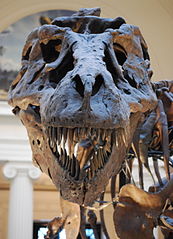
Close up of “Sue” T-Rex replica skull at the Field Museum of Natural History in Chicago, IL. ScottRobertAnselmo
I wasn’t as upset as I thought I would be. A University degree makes one very attractive to the Public Service, and vice versa I suppose (particularly if sitting seems the least painful way to spend a day). I learned that having Master’s increased my wages exponentially. A PhD meant an office with a view. I was glad to kiss goodbye to the world of archaeology. I spent the next twenty-five years shuffling between departments secure in the reliable arms of our glorious Government.
In hindsight, I should never have got involved in archaeology. What was I thinking? It had the lowest intake on campus, the scruffiest staff and a reputation for profound weirdness. Indiana Jones wasn’t re released until I was in second year. It was a golden oldie – it came out the year my mother was born. It hit cult status fast. In the blink of an eye we went from being University nerds to the coolest kids on campus. That was fun. Then came the remakes of Jurassic Park I, II, III and IV. Those made us demi-gods. Still, I should have walked away sooner, That fall at Font de Gaume..that fall… I came, I saw, I fell, I bled. Most importantly, I bled. When I fell at Font de Gaume, there was lots of sharp gravel. When I woke I was confused, like you are when you faint and wake up and wonder why you seem to be in a strange position. I was on my side, dazed. Someone had turned me while they waited for an ambulance. My head was cut. I remember the blood, seeping, onto the stone, into the stone. Into the cracks.
Residue analysis has come a long way. They can identify, isolate, retrieve, amplify almost anything. They can clone, and they can copy. Except, I don’t know who they are. I’m not myself. I can’t see properly, can’t hear properly. From time to time amorphous blobs drift across the blurred line of my vision. I try to speak but it’s like my head has melted yet, they are privy to my thoughts. Like now. They’re listening in. Taking notes. Forcing my reflections from me. I never thought that possible. Then again, no one thought residue analysis was possible once, or cloning. Seems I got the best of both worlds.
There’s no pain, no sensation at all really. Sometimes groups of blobs surround me and a vague feeling of pressure suggests I’m being moved. That used to hurt, badly, I remember.
Residue analysis.
Cloning. Cloning in parts at least.
Wonder what year it is?




 The Burren and Beyond