The Adelaide Times, Saturday May 11, 1850 p.8 Mr Thomas Birmingham, writing to Mr. J. Grattan, from London says:- I have accidentally discovered since my arrival here, that influential parties are projecting the purchase of the town of Galway, the entire town, nothing else will satisfy them, at a fair price, and then to establish the packet station for steamers &c. I cannot doubt my authority for this information, though undoubtedly this is a most desirable project to have realised; but would it not be advisable for Government and the representatives of Connaught to enable the proprietors of land and other property, in and about Galway, to estimate the prospective value of their properties before they are called upon to part with them, by declaring at once Galway a packet and commercial station? Then they could, with some degree of certainty, place a value on that property somewhere near the mark. I can hardly think this circumstance occasioned the failure of the meeting at Ballinasloe; but, at all events, it is high time that the public should know a little of what is going on here rather ‘sub-rosa’.
The Adelaide Times, Saturday May 11, 1850 p.8 Mr Thomas Birmingham, writing to Mr. J. Grattan, from London says:- I have accidentally discovered since my arrival here, that influential parties are projecting the purchase of the town of Galway, the entire town, nothing else will satisfy them, at a fair price, and then to establish the packet station for steamers &c. I cannot doubt my authority for this information, though undoubtedly this is a most desirable project to have realised; but would it not be advisable for Government and the representatives of Connaught to enable the proprietors of land and other property, in and about Galway, to estimate the prospective value of their properties before they are called upon to part with them, by declaring at once Galway a packet and commercial station? Then they could, with some degree of certainty, place a value on that property somewhere near the mark. I can hardly think this circumstance occasioned the failure of the meeting at Ballinasloe; but, at all events, it is high time that the public should know a little of what is going on here rather ‘sub-rosa’.
At the last meeting of the guardians of the Gort Union (J.A.Joyce Esq., in the chair) a letter was read from the Poor Law Commissioners, in consequence of a memorial which had been addressed to them by certain parties complaining that some families, who were actually starving, had been refused relief in consequence of the father of the family having refused to give up his land, though the other members of the family were anxious that he should do so.
The commissioners informed the board that it was the opinion of eminent counsel that the other members of the family could be legally relieved under such circumstances, although the parent refused to give up his holding. A conversation then ensued on this subject in which it was admitted that such cases of hardship might arise, but that it would be likely to cause great abuses and imposition if the practice of thus giving relief were adopted. The chairman inquired of the relieving officer why he had not taken the application of the family referred to in the memorial – to which he replied that it was because they held land. The chairman informed him that it was his duty to receive all applications made to him and leave it to the board to decide how far they were entitled to relief. If any of them held land he(the relieving officer) should, of course state that as well as all other facts which he knew concerning them to the board.
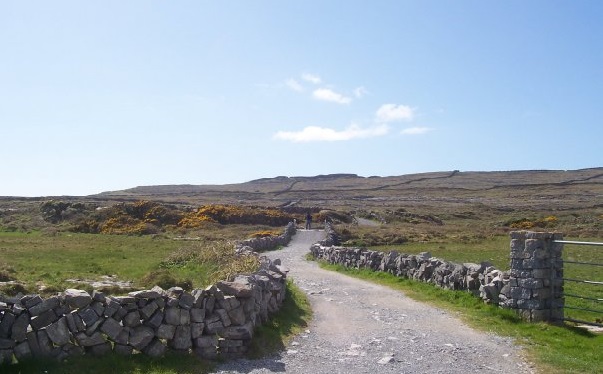
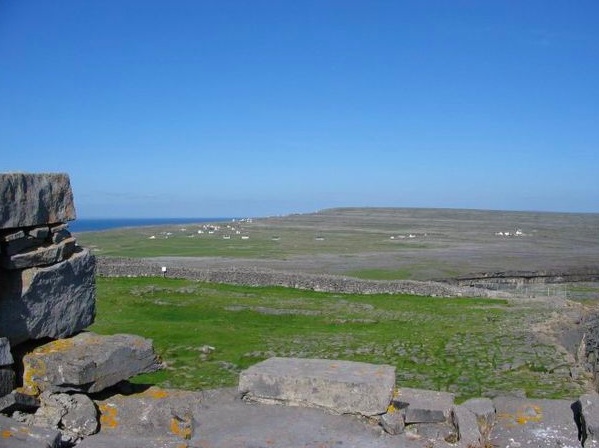
Innismore, Aran Islands, County Galway Photo: Jansena1
A correspondent of the Mail states that the Viceroy carried 1,120 letters and 33 passengers. We find in the same journal the subjoined letter from Mr. Evans, the pilot of Galway;
Galway, June 2, 1850 Sir, At the request of Mr. Leigh, chief officer of coast guards, I beg leave to inform you that I proceeded as far as the Sound, on the north island of Arran, on board the Viceroy, on yesterday morning, a distance of twenty-seven miles from Galway, which she steamed in the wonderfully short space of two hours and ten minutes. I left her at 12 o’clock precisely, and at one p.m., she was completely out of sight. During all night it was perfectly calm, and at six o’clock this morning a nice breeze sprung up at S.S. East. The wind is now (three o’clock, p.m.) due south, fresh breeze. I have crossed the Atlantic several times by the Cunard steamers from Liverpool, and I am happy to inform you that the Viceroy exceeded any of them in speed at our starting; and I feel quite confident she will realise the hopes entertained of her making a speedy passage. I am, Sir, your most obedient servant, Joseph Evans, Master Pilot.
Mr. William Davis departed this life on the 17th of August, 1843, aged 78 years. He was one of the last survivors of those who were exiled without the formality of a trial, for the Irish Political Movement of 1798. He was an upright and honest man — zealous in the cause of Religion, and a generous benefactor to its Institutions. He ended his days in sentiments of true piety. May he rest in peace, Amen. — Epitaph.
Within this damp, contracted, silent cell,
The relics of a patriot Exile lie;
His faults amid its depths of darkness dwell
His virtues live — they could not with him die.
And when the moon just risen flings her gleam,
As if a smile from Heaven on his tomb,
The burnish’d epitaph, heart-rending theme,
To me’s a history of my country’s doom!
He lov’d his native land — and this was sin
He rose to save that land — and this was crime
He fought — but happened not the prize to win
Hence must he lose the Patriot’s name sublime.
Though ’twas not thine to break the fatal chain
That rankles in old Erin’s wounds so long,
To unfurl her *”Sun-burst” banner once again,
And waken in her glens blest Freedom’s song,
Yet thou didst strive and strain and fling away
Thy youthful vigour in her sacred cause;
If e’er she springs a phœnix from decay,
Thou shalt obtain thy prize, her full applause.
For us poor wanderers from that Isle of Love
Must now suffice a prayer, a tear, a sigh,
Oh, happy! if such worthless offerings prove
Thy memory lives — can never never die?
FOYRAN. Geneva Bower, November 1850. * The “Sun-burst of Battles” was the highly imaginative national standard of the ancient Irish.
Sketch of the proposed Washington Monument by architect Robert Mills circa 1836. Wikipedia.org
Freeman’s Journal 21st November, 1850 p3
The Washington Monument.
This grand memorial originated as follows.
In 1783 Congress resolved to erect an equestrian statue to Washington. In 1804, after his death, the subject was again broached, but nothing was done. In 1833 the Washington National Monument Society was organized with Chief Justice Marshall at its head, and measures were taken to collect the necessary funds.
During seven years, however, only 30,000 dollars were obtained, and still nothing was done. In 1847 new measures were taken, new men and leaders arose: the collection reached 80,000 dollars, and the corner-stone was laid on the 4th July, 1848.
The idea is an obelisk 55 feet square at the base, and 600 feet high. This will exceed in height any steeple or monument in the world. From a thickness of 15 feet the wall diminishes to 30 inches leaving an open space of 25 feet square. The top is to be reached by flights of iron steps at the four sides; and the hand rail, being hollow, will serve as a conductor of gas, so that the whole of this prodigious cavern will be rendered as light as day.
The work is rapidly progressing, and the funds are coming in steadily. Agents are canvassing the country in every direction. No country has ever presented a similar spectacle when all classes so unceasingly united to do honour to one man. It will be truly a national work and worthy of the American people. — Illustrated News.
================
Irish Encumbered Estates Commission
The proceedings under this commission are still in full operation, and the list already published contains some of the most picturesque portions of the country. The county of Galway has a large share in these sales, and numbers many a beautiful range of lake and mountain, with a fine sea view. In some instances upwards of 100 islands will form part of the purchase. No less than 100 sales are now in prospect. An office entitled ‘Allnutt’s registrations offices,’ has been established in Grafton Street, Dublin for the purpose of extending the facilities of vendors and purchasers and as a medium to obtain tenants.
This is under the superintendence of an English Engineer, who has been employed for four years past in Government works. Agents are also employed in England and Scotland to forward communications to or from capitalists wishing to become purchasers. From this office, a monthly list issues.
It is to be hoped that a new era is opening for ‘ould Ireland’, that her picturesque features may be known and appreciated either by her own sons or by those who will give her productive soil a chance of redeeming itself from the dark cloud of penury which has so long and so unjustly hung over it.
Nuns on bicycle pass in front of the Cathedral of Wroclaw, Poland Photo: Yarl Wikimedia Commons
South Australian Register 21st November 1850
ACTION AGAINST THE SISTERS OF MERCY (abridged)
The following is a compendium report of a recent remarkable trial in the Galway Record’s Court, Ireland. Such was the public anxiety to hear this very novel trial, that at an early hour the Court was densely crowded. Mr Fitzgibbon, Q.C., stated the case. This was an action brought by the administrator of Mrs Eliza McDonnell, to recover the sum of £500 given by her to the Sisters of Mercy, in the town of Galwav. The circumstances were these :—
In March, 1846, Miss Harriet McDonnell, the daughter of Mrs McDonnell, was desirous of becoming a Nun of the Order of the Sisters of Mercy. Her sister, Mrs Ireland, at the request of Mrs McDonnell, called at the Convent of Mercy, to enquire as to the terms of the convent, and to settle with the nuns. The Mother Abbess, stated that it was absolutely necessary that Miss McDonnell should spend six months as a postulant in the convent previous to her reception as a novice. After the ceremony of her reception had taken place, she should pass two years in the convent as a novice before she could be professed. She added that they could not, on any account, shorten the time of her profession, and that it could not be done without a dispensation from the Pope. They agreed to take the sum of £500 from Mrs McDonnell for the daughter, and that it should be left in the hands of her brother-in-law, Mr Ireland, until after her profession. In the meantime they should receive the interest for her support.
In the month of May, 1846, the Rev. Peter Daly called on Mr Ireland, and told him that it would be of great service to the nuns if the family would give them the money at once, as they were going to invest some money on very favourable terms. Mrs McDonnell agreed to give them the money, on their undertaking to return it in case either her daughter should wish to leave the convent before the regular time of her profession, as stated by themselves, or, in case of her death, before then. They agreed to give the strongest guarantee to that effect, and Mrs White entered into the following agreement : —
Mrs Eliza M’Donnell— Madam, you have handed the Rev. Peter Daly, on behalf of the Sisters of Mercy, £500 sterling, the sum agreed to be received from your daughter, Harriet McDonnell, on her being professed a nun in her community, which sum we engage to return you free of interest, should either the nuns or your daughter change their minds before the period of her said profession arrives, or in the event of her decease before then.
In the month of August, 1847, Miss McDonnell took a malignant fever. After all hopes of recovery were over, the nuns had her professed a nun. They now contend that, as she was professed on her dying bed, they have complied with the terms of the agreement – they rely on the ambiguity of the word profession, although it was clearly provided in the agreement, that in case of her death the money should be returned.
Counsel for the case contended that it would be absurd to put any other construction upon the words, ‘period of profession’ – as it was always in the power of the nuns, by that construction, to make the money their own, and to render their guarantee a mere mockery, by professing her dying. They were permitted by the Bishop to profess her dying, merely as consolation; and, if she survived, she should be professed again.
The Bishop of Galway directed them to return the money but they preferred taking their chance in a court of law, thinking to evade the agreement by some ambiguity on the face of it. They were unsuccessful.
The Jury returned a verdict for the plaintiff, with £500 damages and 6d. costs.
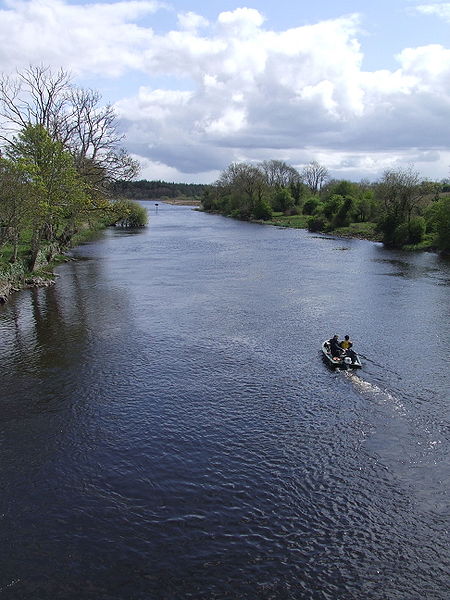
River Shannon Photo: Laurel Lodged Wikimedia commonsUnder the influence of the Shannon Commissioners the inland steam navigation of Ireland has been prosecuted with vast success, amidst all the difficulties presented by a state of social and political disorganization. The navigation of the Shannon has been effected, and that magnificent pride of Irish waters is now open for all purposes of traffic.
The father of the Shannon navigation improvements, Charles Wye Williams, Esq., lately enjoyed the highest pleasurable satisfaction in steaming nearly to the Lough Allen source of that noble river, and to the head of one of its great tributaries’ the Boyle Waters, within an English mile of the important town of Boyle.
At Athlone there is a new bridge, capped with masses of Cashel marble, each weighing from 10 to 15 tons; and a lock has been constructed, capable of passing any steamer suited to the navigation of the line. Near Lanesborough a branch canal is being cut to Roscommon. In Lough Forbes a dangerous shoal has been removed, and the works and clearances in Lough Boderg, the Carnadoe waters, and the Jamestown Canal, prove the difficulties, expense, and labour involved in the undertaking.
Near to Battle bridge, a new canal to Lough Allen commences, named after the earl of Clarendon, and the works partake of the same durable and admirable character as on every other portion of the navigation. The facilities of intercourse opened out by these improvements are still to be extended, and in a year or two the water communication between Limerick and Belfast will be complete by means of Lough Neagh, and the Logan and Ulster navigation with Enniskillen by means of Lough Erne.
As every fact connected with the mysterious disease which steals away the food is of importance, we give the following singular statement which appears in the Galway Vindicator:
A woman named M— M——- ages thirty three, was brought a few days ago on a car to the work-house gate. She appeared to be suffering from acute pain; her hands and face presented the appearance of having been severely burned, as if they had been held over the flame of a strong fire.
In reply to the questions put to her, she made the following statement;
She was employed by a man to weed potatoes, and was at work on Friday, the 18th ultimo, in her perfect health, when a sudden blast of burning air came over her, and she was thrown back. She felt as if a quantity of pungent snuff had entered her nostrils. She also stated that the stalks of potatoes where she was at work were burned to a cinder, and the tubers made soft and black. It is thought the parts of the poor woman’s body which were affected will mortify.





 The Burren and Beyond