Tuam, August, 27, 1847 Dear Sir, When your kind invitation to the Galway dinner,in honour of the triumphant candidates for Repeal, reached me, I could not either attend or send my apology. This I regretted much, sympathising most cordially with the object of the festivity. You will not, then, I am sure, put my silence to the account of indifference to the respected invitation with which I have been honoured by the patriotic men of Galway. Had I been at home, I should have made an effort to be present on the interesting occasion, both to show my respect for the individuals returned, and my zeal for the cause which they personified. The town has made some atonement for the shameful apathy with which the enemies of Ireland’s only chance of prosperity, were permitted to walk over the course in the county of Galway. They may thank the more sacred duties that entirely absorb the attention of those who would not have been indifferent to the calls of their country for the protection of a native legislature. However, before the recurrence of a similar period, it is well that candidates should be impressed with the conviction that they can entertain no hope of representing Galway, unless they associate themselves with the noble national phalanx, who have proved that Repeal, far from being a chimera, is one of those lofty, enduring, and growing aspirations, which cannot be appeased except by the enjoyment of that legitimate freedom for which it is panting. Believe me, my dear Sir, your very faithful servant,
John Archbishop of Tuam.
Martin Geoghegan, Esq., & c., High Street, Galway.
Kinvara, Killina and Duras, Galway – Reverend F. Arthur (abridged)
Deaths by famine, 148, in addition to 98 occasioned by a melancholy subsistence on sea weed, nettles, “Bliskane,” & c. Last year the mortality was 52, so that the increase amounted to within a fraction of 400 per cent. Over 1,100 persons were cast out to perish by the order of reduction. There is the parade of relief under the act, but the committee are fastidiously select. Out of a population of 10,000 “there is not 100 who would not be ranked under the first class paupers.”
The reverend gentleman regrets the absence of a Protestant rector “to assist in the great work of charity,” a regret inspired with the most sublime Christianity. And yet the Mail not long since made merry, with that divine desire which proved how well the Rev. Mr Arthur could share the brotherhood of benevolence with one of a difference creed. We seek to introduce no unworthy bickering into the neutral ground of charity, or to interrupt the “truce of God,” with reflections derogatory to any class embarked in the sacred cause of humanity; but if stones have been cast, the Catholic clergy did not originate or perpetuate the quarrel. They calmly bore the faint ebullitions of the old intolerance – which even the fate of thousands of perishing fellow Christians could not altogether repress.
Seventy labourers, with their families, employed on works of reclamation by Mr P. Creagh in Burren, County Clare, have employed a clerk or storekeeper to distribute or re-sell provisions to them without any profit, under the surveillance of a committee of management from among themselves, thus making a saving of about 30 per cent.
Anti-slavery bugle, 25th June, 1847 p4
We find the following poem in a late Irish paper.
Tides EO’D
I’m loth to wake ye, Art, my dear
But the steps of a stranger are drawing near
Up the rickety stair they come,
Making, I think, for our wretched room;
Rise, Art, rise! the last shilling’s spent
Art, it’s the sheriff – the rent – the rent!
See, daylight has lit on the window-sill
Art! is it you to be slumbering still?
Ye know that at last we must quit or pay,
Though ye didn’t expect the distress today!
Rise, Art, rise! the last shilling’s spent
Art, it’s the sheriff – the rent – the rent!
At the door! Oh a month to make up what’s due!
The landlord, he knows, Art, your word is true;
If he saw how we strive, he’d put off the sale;
’Twas the will of God that the trade should fail!
Rise, Art, rise! the last shilling’s spent
Art, it’s the sheriff – the rent – the rent!
By the shore EO’D
In days gone by it was Ireland’s pride
To be decked in the web that our looms supplied:
Those were the times, Art, ye took me home,
And told me that love would make business come.
Rise, Art, rise! the last shilling’s spent
Art, it’s the sheriff – the rent – the rent!
It’s hunger, Art, that has made ye weak
What can I think of, your fast to break?
Here, Art, here is my wedding ring,
The lodgers will lend on the blessed thing!
Rise, Art, rise! the last shilling’s spent
Art, it’s the sheriff – the rent – the rent!
God forgive me! my heart is torn
To drag ye from bed this bitter morn;
The bed that they’re coming to seize and sell
Where I’ve nursed and prayed by ye, sick and well!
Rise, Art, rise! the last shilling’s spent
Art, it’s the sheriff – the rent – the rent!
How silent he sleeps! not a stir, or breath!
Poor famishing husband, you’re work’d to death!
At the shuttle before and after the sun
And a morsel of meal when the day is done!
Rise, Art, rise! the last shilling’s spent
Art, it’s the sheriff – the rent – the rent!
Dead! Oh, my God! it is over at last
The wearisome struggle is past – is past!
The heavens be praised! ‘tisn’t you need fear,
’Tis your widow that’s desolate, husband dear!
Rise, Art, rise, to the happy skies,
Where the tear is wiped from the poor man’s eyes!
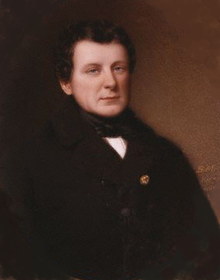
O’Connell, MP for Clare 1828 – 1930 Painting by Bernard Mulrenin 1836
The Warning
Hear you not that wild wind moaning,
Shrieking o’er our withered land?
Hear you not our mountains groaning
To tell us sorrow is at hand?
See you not our people dying.
Young and old are swept away ;
The proud and strong around are lying,
Ere life ebbs out they turn to clay!
Hear you not that Ocean storm?
Convulsed Atlantic shows her sorrow:
See you not that shipwreck’d form?
All, all portends of grief to-morrow.
List, oh list, the Banshee crying
Around the walls of Derrynane;
Away from us our Chieftain’s dying,
The Mileslan dirge her midnight wail.
Alas! alas! the morn looks sad,
The sun lies hid behind yon cloud,
In deepest dye of mourning clad,
Close wrapped as in a grave-like shroud.
Hush, oh hush, all hearts are breakiig
Weep, oh weep, his spirit’s fled.
Hark! a mighty voice is speaking
“Slaves, your friend O’Connell’s dead.”
Poland grieved o’er Kosciusko’s pall;
Columbia wept her Washington;
Each nation’s mourned her hero’s fall,
Proud England still has Wellington;
But ours – oh ours – the wide worlds’ friend,
In every clime the tyrants’ dread;
What slaves shall now know sorrow’s end,
Their champion all, O’Connell’s dead.
Yes; his fall through every clime will ring,
The myriads shout his hallowed praise;
And those will weep his funeral song,
Who heeded not his glorious rays;
Aye, they will seek a borrowed fame,
As earth is brightened by the sun;
And those will claim O’Connell’s name!
Whose every deed his bosom wrung.
https://widgetworld3.wordpress.com/podcasts/Photo: EO’D
THE MAITLAND MERCURY AND HUNTER RIVER GENERAL ADVERTISER
20th March, 1847 p4
FEMALE INTREPIDITY.-On Monday, as the Misses Crow, of Derriwillan, were returning from the sea shore, to their lodge, at Curranrue, they heard a shriek, and, on turning, saw a little boy running towards them, exclaiming that his brother was drowning in the sea. Both young ladies hastened to the spot, and arrived as the youth made his appearance a second time on the surface of the water. In a moment he was down again, and Miss Crow, throwing away her cloak and bonnet, rushed into the water to save him, but the place being very steep, before she was able to reach him she got beyond her depth, and down she went also.
Miss Lucy Crow, seeing her sister in such imminent danger, plunged into her rescue, but had not proceeded many yards when she found she could not go further without placing herself in the same perilous position, and that then all would be lost. In agonising suspense she stretched forth her hand to save her; alas! it was useless; they were too far asunder, and down her sister went again, overpowered by the weight of the little boy, who got entangled with the grasp of the dying in her hair and neck. But as if Providence would have it so, this time she was carried by the force of the waves on to a rock in the water, and, for a moment, resting her foot upon it, the brave girl reached forward so as lo be enabled to meet the outstretched arm of her intrepid sister, who, at length, succeeded in bringing herself and her young charge in safety to the shore.
One is at a loss which to admire, the intrepid bravery of the one or the judgment and presence of mind of the other of these young ladies, who, on returning to Derriwillin, will carry with them the blessings of the parents and friends of the youth whose life they thus, at the risk of their own, pro-videntially saved.- Galway Mercury. [What a beautiful subject for the poet and the painter.]
Adapted from
William Bennett, Narrative of a Recent Journey of Six Weeks in Ireland. London: C. Gilpin, 1847, pp. 25-9.
We spent the whole morning visiting these hovels, followed by an ever increasing group of wretched creatures, who begged for help. We avoided houses known to contain the fever. Some were easily identifiable by the small coming from them.
And now language utterly fails me in attempting to depict the state of the wretched inmates. I would not willingly share the harrowing details; but these are the FACTS as they stand. It is our responsibility as Christians, in a Christian land, under a Christian Government to take note.
My hand trembles while I write. The scenes of human misery and degradation we witnessed haunt my imagination, with the vividness and power of some horrid and tyrannous delusion, rather than the features of a sober reality.
We entered a cabin.
Stretched in one dark corner, scarcely visible, from the smoke and rags that covered them, were three children. They huddled together, too weak to rise, pale and ghastly, their little limbs perfectly emaciated. Their eyes were sunken, voices gone, evidently in the last stage of starvation.
Crouched over the turf embers was another form, all but naked. It stirred not, nor noticed us.
On some wet straw, strewn on the floor lay a shrivelled old woman. She moaned piteously, imploring us to give her something. Above her, on something like a ledge, was a young woman, with sunken cheeks. A mother I have no doubt. She scarcely raised her eyes in answer to our enquiries, but pressed her hand upon her forehead, with a look of unutterable anguish and despair.
Many cases were widows, whose husbands had recently been taken off by the fever. The only source of income for these women died with their partners. In other homes the husbands or sons were prostrate, under that horrid disease. Their suffering was the result of long-continued famine and low living, in which first the limbs, then the body, swell most frightfully, and finally burst.
We entered upwards of fifty of these tenements. The only difference between them was the number of the sufferers within. It was difficult to count them until-the eye adapted itself to the darkness, or they were pointed out, or were heard, or some filthy bundle of rags and straw was perceived to move.
The children were the most heart-rending spectacle. Many were too weak to stand, their little limbs attenuated, – except where the frightful swellings had taken the place of previous emaciation.
The childlike expression had left their faces. Many of them were remnants of families, crowded together in one cabin; orphaned little relatives taken in by the equally destitute, and even strangers.
These poor people are kind to one another to the end.
In one cabin was a sister, just dying, lying by the side of her little brother, just dead.
I have worse than this to relate, but it is useless to multiply details, and they are, in fact, unfit.
These people hardly complained. When I asked what was the matter, the answer was the same -‘Tha shein ukrosh,’ – ‘we are hungry’. We truly learned the terrible meaning of that sad word ‘ukrosh’.
My friend the clergyman distributed tickets for meal as best he could. He told me that wherever we went it would be the same. All over the country. Even worse in the far off mountain districts. We had visited near the town, where some relief could reach. It was my full impression that one-fourth of those we saw were dying. They were beyond the reach of any relief. Many more would follow.
This day can never be effaced from my memory.
These were our fellow-creatures.
Children of the same Parent.
Born with our common feelings and affections.
With an equal right to live as any one of us.
With the same purposes of existence.
The same spiritual and immortal natures.
The same work to be done.
The same judgment-seat to be summoned to.
And the same eternal goal.
Ar dheis Dé go raibh a n-anamnacha.
Photo: Norma Scheibe
We remember them. At the rising of the sun and at its going down, we remember them.
At the blowing of the wind and the chill of winter, we remember them. At the opening of the buds and in the rebirth of spring, we remember them.
At the blueness of the skies and in the warmth of summer, we remember them. At the rustling of the leaves and in the beauty of autumn, we remember them.
At the beginning of the year and when it ends, we remember them.
As long as we live, they too will live; for they are now a part of us, as we remember them.
When we are weary and in need of strength, we remember them.
When we are lost and sick at heart, we remember them. When we have joy we crave to share, we remember them.
When we have decisions that are difficult to make, we remember them. When we have achievements that are based on theirs, we remember them.
As long as we live, they too will live; for they are now a part of us, as we remember them.





 The Burren and Beyond