We have seen in the ultra portion of the Dublin Papers a statement of depredations committed by some Ribbonmen of the County of Galway, on the house and concerns of a Mr. Power of Mount Equity. We confess that the paragraph astonished us, knowing, as we do, that the County of Galway enjoys at this moment the most perfect tranquility. We shall not take it on ourselves to contradict the statement, until we shall have an opportunity of enquiring into the truth or falsity of it; but this we may be allowed to say, that we very much doubt the entire story. If the Gentleman’s house and concerns were attacked, that is no reason that the midnight ruffians should be termed Ribbonmen – for the Dublin Editor should know that there are others than Ribbonmen who can draw a trigger, or set fire to a hay-stack. Those who live by the insubordination of the “mere Irish,” overcharge their faults and vices, and look through green glasses upon the offences which they commit. We shall enquire about this circumstance; and we are of opinion that matters will be cleared up satisfactorily. This, we can assure the public, that the conversations which we occasionally hold with the County Magistrates are of a most agreeable nature, and induce us to think that the County of Galway might dispense with the services of the Police Gentry, whose “valuable labours” are now confined to the extermination of puppy dogs and untraceable scarecrows – may, sometimes, the grouse and wigeon come within the calibre of the loyal cartouche-box.
Hobart Town Gazette and Van Diemen’s Land Advertiser 3rd September, 1824 p.2
Photo: EO’D
The attention of the English capitalists has at length been drawn to Ireland. A company has been for some time forming under the auspices of the leading Irish houses, for working collieries and mines in that country, which has been ascertained to abound in coal and minerals. The undertaking is warmly seconded by the most distinguished of the nobility and gentry connected with Ireland, as also by the principal London companies holding large landed property in the island. From the progress already made, there is every prospect of a favourable result. The bill for incorporating the company is to be read a second time in the house this evening. (March 12).
THE CONNAUGHT JOURNAL
16th December 16, 1824 (abridged)
In the year 1816, the Duke of Devonshire, the present noble proprietor of the ancient Castle of Lismore, in the County of Waterford, gave directions, that that venerable edifice should be repaired and restored to its pristine state and splendour. In pursuance of his Grace’s command, workmen were employed on the building; and, on taking down a wall that had been built in the place of a door; they discovered an ancient Manuscript Book, beautifully written in the Irish Character and Language, on vellum of the largest size.
Some parts of the beginning and latter end of the book were entirely decayed. There are also some leaves wanting in different places in the middle; and , in some other places, the mice have eaten away a part of the upper margin, which leaves a few lines defective on some of the pages. The folios of the book were originally numbered with Arabic figures. The last folio, now legible, is marked 293, which would, if the book were perfect, be equal to 473 pages. The number of the pages now remaining are only 260.
This precious relic of Irish genius contains a variety of Tracts, both curious and interesting. As it stands at present, it begins with the life of St. Patrick, which is followed by those of St. Columbhill, St. Brigid, St. Seanan, St. Finin, of Clonard, and St. Fionaches of Brigoone. These are followed by an account of the establishment of the festival of All Saints; a treatise on King David; the history of Charlemagne; the history of the Lombards; the history of Altrisson of Cashal; son of Fiongaine, King of Munster; Adventures and Wars of Callaghan of Cashel, King of Munster; History of Teigne; Historical Poem on Finin M’Carthy, the M’Carthy reign, the battle of Calonan, Story of Crimthan Cas, King of Connaught; the victory of Drom-dumhghoire; a long tract on Dispersion and Destruction of the Finian Host, or famous Irish Militia; and some other tracts of minor importance.
Saint Brigid’s cross Photo: Culnacreann Wikimedia Commons
The last named Tract is extremely curious, and is most interesting in the Irish Antiquity. It commences at the original folio 201, a sol. 1, now page 185, and continues to folio 239 or present page 260 where it is left imperfect by the loss of the concluding leaves of the book. It is carried on by way of dialogue between various persons; the principal speakers of whom are St. Patrick and Coolte Mac Ronan. The chief subjects treated of are, the unities of the Feal or Irish Militia, in which the great actions of Fionn Mac Cubball (Finn Mac-Coo-all), the Fingal of Mac-Pherian Ossian; Coll Mac-Moran, and his brother, Conan the bold; the Thereafter of the Irish Nisin; Desmond O’Dabhan, and other famous heroes are recited in the course of this Tract are introduced many popular tales of the Irish, and the origin of many ancient customs is accounted for; and, what is most important to the ancient Irish Topographer, the names of innumerable places remarkable in the History of Ireland, but the sites of which are almost totally unknown to the modern Historian, are given; together with the names by which they are called in latter times.
There is nothing in the book, that served to ascertain the period at which it was written, but it contains a poem in the M’Carthy rough, which helps to throw some light on the subject and shows that it could not be written earlier than the 15th century.
THE CONNAUGHT JOURNAL
Galway, 13th September, 1824
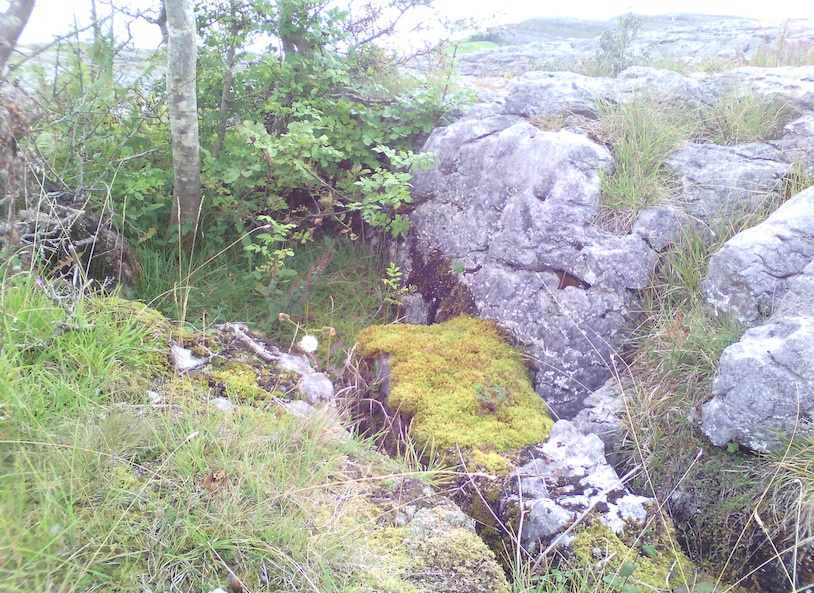
RURAL SPORTS – The crowds now at the Burren Spa are beyond any calculation in that country. – The numbers assembled to see the best Irish jig dancers was immense and the contest so equal between two of the fair competitors, that the judges could not decide between them, and therefore directed the silver watch to be given to those very interesting girls, to be disposed of as they pleased. Immediately after the dancing, four horses were started, and there was a most excellent race. – On yesterday a fox was to have been shook at the well, and it was so arranged, that the ladies should witness “his funeral tears;” and on Sunday next there will be another race, and afterwards a hurling match, consisting of twenty-one men at each side – one party dressed in blue jackets and caps, and the other in red.–Limerick Paper.
‘Pneumonia strikes like a man eating shark” by WPA Artist: “G S Jr” Wikimedia Commons
20th September, 1824
At this time of the year colds are easily caught, and difficult to cure. The following will be found effectual: –
After a quick walk in the evening, sit in the draft to cool; the consequence will be a severe cold, attended with cough; the next day hoarseness, short breath, and much expectoration; in the evening, at seven, go to a well-frequented tavern, and drink three or four glasses of strong punch, or stiff rum and water; stay till eleven, walk home cosey, and go to bed; you need not get up the next day, but send for the apothecary, the following day for the physician, and the third day your friends will send for the undertaker. You will never feel the effects of an autumnal cold afterwards.
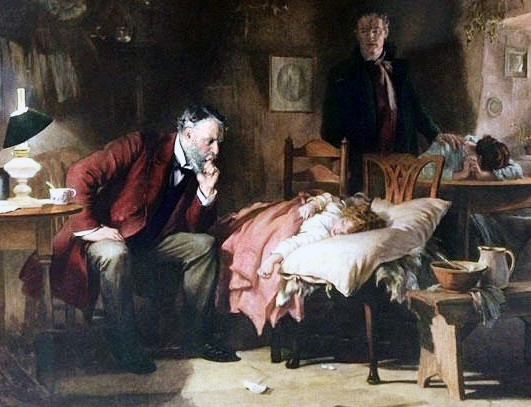
The Doctor – 1891 Luke Fildes (1843–1927) Wikimedia CommonsTHE CONNAUGHT JOURNAL 2ND DECEMBER, 1824
The most prevalent maladies in this town (Galway) and neighbourhood for the last year, are stated from the following Report of Dr. O’MALEY, whose practical intercourse with them through the medium of the Dispensary, affords him an unlimited facility of offering the most correct observations:
Fever has been on the decline; however, many cases have occurred sporadicaly, of the intermediate type, termed Synochus; the remainder mild Typhus, with a few instances of the malignant variety. Pneumonia, (inflammation of the lungs and its coverings,) has occasionally existed; Cattarh, with Pleuralgia, (pain of breast, &c.) being exceedingly frequent. A few cases of Pneumonia Typhoides (inflamed lungs with Typhus fever) have also taken place during the autumn.
Inflammatory sore throat often presents itself, owing to the vicissitudes of our atmosphere; and Hepatitis (liver complaint) is a frequent assailant from the same cause, aerial inclemency, and another powerful agent, immoderate spirituous potation.
That Morbid Proteus Rheumatism, acute or chronic, doth constantly uphold a relentless sway, and concentrates, in many individuals, the keenest pangs of enfeebled humanity. Dispepsia (indigestion) and Corrdialgia (spasmodic pain of stomach) in its different varieties, have been, and must be, incessantly frequent in occurrence, until the scanty food of our squalid poor be succeeded by a more generous and abundant measure. Of all diseases which engage the attention of Nosologists, Dysentery & Diarhoea have for the last months stalked with relentless gripe through these wretched domiciles of incomprehensible misery, the hovels of the poor.
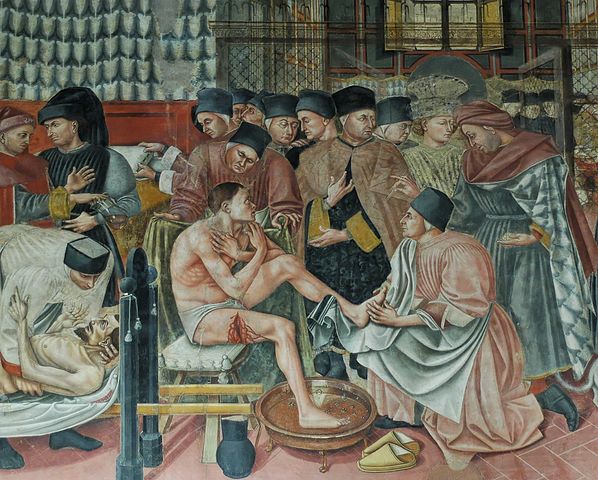
Healing the sick, fresco by Domenico di Bartolo. (1400-1447) Sala del Pellegrinaio (hall of the pilgrim), Hospital Santa Maria della Scala,Siena Wikimedia CommonsThese diseases, so different in their nature, have been principally excited by the same causes, namely, no wholesome diet, and deficiency of warm vesture; dysentery indubitably becoming contagious among them, from the limited extent and offensive uncleanliness of their dwellings. This circumstance is worthy of remark, as the Dysentery of these latitudes is seldom contagious, unless under the conditions already mentioned, or when concomitant with epidemic Typhoid affections.- Colic is a malady that next in order rears is stand and among the indigent; frequent cold and wet and indigestible esculents act as its occasional causes. In many instances it has yielded its grasp in the last mentioned genus Dysentery, and in a few has been the precursor of a more certain harbinger of death, Enteritis (inflammation of the bowels.)
The Cholera of our climate, though comparatively imbecile to that of the southern part of the Asiatic region, is a formidable malady, that has occasionally occurred during the estival and autumnal seasons, but in an immediate and decisive practice has invariably yielded.
Hoemophilis (spitting blood) often appears here, but when unconnected with any other affection, is seldom fatal. It, or inflamed lungs, sometimes is a variety of consumption named Inposthumutous, Phthisis, which, with another variety (Tubercular) have occurred here within the last year much less frequently than could be expected from the vicissitudes of atmospheric temperature. It has been computed that in England this disease carries off one-fourth of the population, in Paris, one-fifth, in Vienna, one-sixth, while in Russia it is by no means common, and in tropical climates still less so, from the greater uniformity of their atmosphere, either frigid or torrid. Asthma also constantly presents itself, and unless when produced from malformation, is generally a senile disease, sometimes closing its career with the induction of others.
Dropsy is one of frequent occurrence among the lower class, because it is for the most part a disease of debility. We usually find that it has been preceded by some species of fever, and in other instances it is nurtured by an abuse of ardent spirits, inanition, hard labour and a long exposure to wet and cold. These sap the body and induce affections of the stomach, particularly the liver, weakening the digestive organs becoming frail and instituting in various ways the complaint in question.
Another opportunity shall be taken to illustrate the most prevalent diseases of females and children.
Wood Engraving by Elinor Monsell, on title page of ‘Twenty One Poems’ by Katherine Tynan, Dun Emer Press 1907 Wikimedia CommonsTHE CONNAUGHT JOURNAL 28TH OCTOBER, 1824 (abridged)
EXTRAORDINARY OCCURRENCE
The following singular occurrence which took place a few days since in the neighbourhood of Woodford, has excited a very considerable sensation there: Elizabeth C—, an interesting young woman about nineteen years of age, who lived in the service of _____ Forrest, Esq. a gentleman residing at Woodford, in consequence of getting her feet wet, caught a severe cold, which brought on a fever. She was confined to her bed for several days, when she, to all appearance, died! An undertaker was sent for, and the next day, she was placed in a coffin. The intelligence of her supposed death was transmitted to her mother, an industrious woman, with a large family, who was almost broken-hearted at the melancholy tidings.
From her good conduct while in the service of Mr. Forrest, that gentleman resolved to defray the expenses of the funeral, which, it was arranged, should take place on Sunday last, a week after her supposed death. On that day, her mother, and several other relatives came to pay the last tribute of respect to her memory. Prior to the coffin being screwed down, they went to take a look at the body. One of them observed that she had not undergone the change usual on such occasions, and that her face appeared rather flushed. She suggested the propriety of sending for a surgeon, which was immediately done. He ordered her to be placed in a warm bath, and applied the remedies usually resorted to, to recover persons apparently drowned, and which were happily crowned with success! The young woman was so far recovered in a few hours to be able to speak, and is now in a fair way of recovery. The anxiety with which her friends witnessed the progress of the means resorted to for her restoration, and their joy at its success, may be more easily conceived than described.






 The Burren and Beyond