Posted in Posts and podcasts

By the roadside – 1893

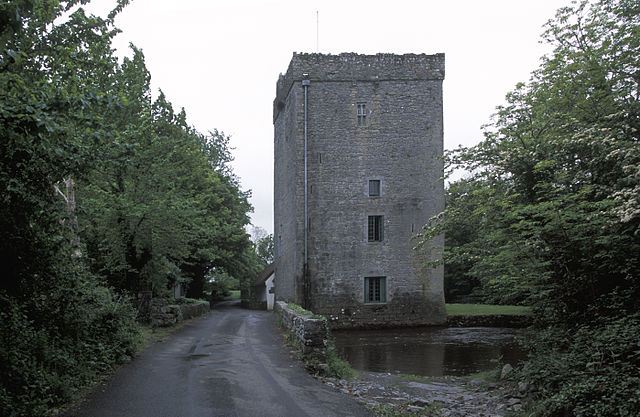
Thoor Ballylee Photo: Jerzy Strzelecki Wikimedia Commons
Thoor Ballylee
Photo: Jerzy Strzelecki
Wikimedia Commons
Excerpt from The Celtic Twilight – W.B. Yeats (1893) abridged
p232/3
LAST night I went to a wide place on the Kiltartan road to listen to some Irish songs. While I waited for the singers an old man sang about that country beauty who died so many years ago, and spoke of a singer he had known who sang so beautifully that no horse would pass him, but must turn its head and cock its ears to listen. Presently a score of men and boys and girls, with shawls over their heads, gathered under the trees to listen. Somebody sang a Muirnín Díles, and then somebody else Jimmy Mo Mílestór, mournful songs of separation, of death, and of exile. Then some of the men stood up and began to dance, while another lilted the measure they danced to, and then somebody sang Eiblín a Rúin, that glad song of meeting which has always moved me more than other songs, because the lover who made it sang it to his sweetheart under the shadow of a mountain I looked at every day through my childhood.

The voices melted into the twilight and were mixed into the trees, and when I thought of the words they too melted away, and were mixed with the generations of men. Now it was a phrase, now it was an attitude of mind, an emotional form, that had carried my memory to older verses, or even to forgotten mythologies. I was carried so far that it was as though I came to one of the four rivers, and followed it under the wall of Paradise to the roots of the trees of knowledge and of life. There is no song or story handed down among the cottages that has not words and thoughts to carry one as far, for though one can know but a little of their ascent, one knows that they ascend like medieval genealogies through unbroken dignities to the beginning of the world.

Folk art is, indeed, the oldest of the aristocracies of thought. Because it refuses what is passing and trivial, the merely clever and pretty, as certainly as the vulgar and insincere, and because it has gathered into itself the simplest and most unforgetable thoughts of the generations, it is the soil where all great art is rooted.

Posted in Posts and podcasts

Curranroo and beyond – 1867

Photo: Bart Braun Wikimedia Commons
Photo: Bart Braun
Wikimedia Commons
A Walking Tour Round Ireland in 1865 by an Englishman
London: Richard Bentley, New Burlington Street. 1867 p181/2
(abridged)
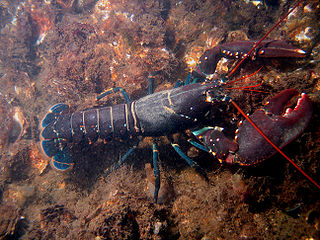
I left Kinvarra at half-past nine o’clock this morning. I pass to the right on leaving the town a round tower, and on the left you have the hills of Clare. Then to the right there is the Kinvarra National School, a neat looking building, erected in 1840. Shortly afterwards I meet an industrious boy who has been making good use of his time by catching a fine lobster. Though he knows a house further on where they generally buy the lobsters, on the principle of the bird in the hand being worth two in the bush, he offers it to me. I excuse myself from the purchase on the ground of travelling. I tell my young friend of the story of the lobster which seized a man’s hand and held it so fast he was drowned by the rising tide. The boy says he is aware of this propensity on the part of the lobster and takes due care.
I then pass through the village of Corranroo, where you have fairly passed out of the county of Galway into Clare. Then on to the foot of some hills from whence a fine view is obtained of the arm of the sea and surrounding country. There are three roads here; one to the left leading to the south, one to the right being a road longer by two miles, leading to Ballyvaghan, and a road in the centre over the hill being the shorter one to the same place.
Further up the hill you have a still better view of the bay, and an immense expanse of table-land with a round tower on an island to the left, and the town of Galway in the distance on the other side of the bay.

Posted in Posts and podcasts

Kinvarra and beyond – 1865

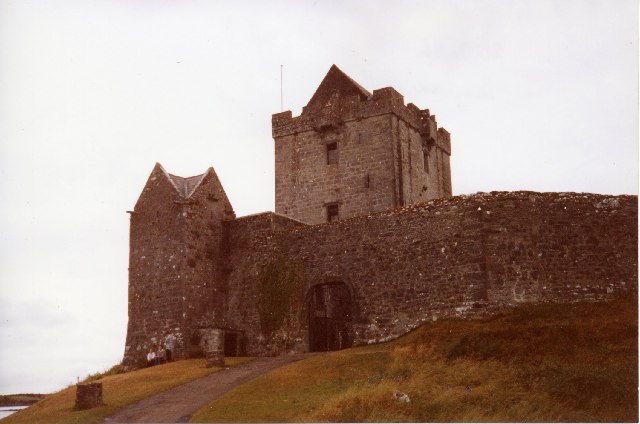
Dunguaire Castle, Kinvara Photo: Angella Streluk Creative Commons
Dunguaire Castle, Kinvara
Photo: Angella Streluk
Creative Commons
A Walking Tour Round Ireland in 1865 by an Englishman
London: Richard Bentley, New Burlington Street. 1867 p181/2
excerpt – abridged
I (then) leave the main road, leading to Gort, Ennis and Limerick and take a road to the right, and pass through the village of Ballinderreen, and then for miles through a bleak and desolate country until I reach Kinvarra. This place is distance from Galway about seventeen miles. There is a castle here called Dungoury, (sic) which is in a very good state of preservation. I ascended to the top from which a fine view is obtained. Below is the village town of Kinvarra, prettily situated on a small bay and with some appearance of trade. Around is a stone covered country, wild and uncultivated.
On walking into the town a storm of rain fell and I offered a share of my umbrella to a gentleman in the road. He kindly showed me the inn and on learning that my mind was a blank as to my course of travel from this place, he wrote on a slip of paper a prescribed route as far as Kilkee. He kindly asked me to join his circle to tea in the evening at eight o’clock and then left me meanwhile to my own resources.
It was still early in the afternoon, so I walked to the end of the bay and bathed as well as the weeds (which were gathered thickly) would permit. On my way back an old woman told me a story of a girl of the village, some time since, who was accustomed to swim across the bay, put some wheat-ears between her teeth from the field on the other side, and then swim back again. The distance to and fro would be about a mile.
On my return to the inn I found a turf fire lighted without any direction of mine, a mode of welcome not at all acceptable this warm weather. The hostess is a stout well-meaning woman, though rather too fussy. She places before me some oysters and eggs, scanty fare enough. She tells me she is the mother of eighteen children. Oh fancy!
My hostess tells me a pretty story of one of her eighteen, a boy. He went to London en route for Australia, and wrote from the metropolis to say, that though he had seen all the sights there, he still thought no place equal to Kinvarra.

Posted in Posts and podcasts

Sounds familiar – 1822

photo credit: <a href="http://www.flickr.com/photos/new_and_used_tires/6842127
The letter below is among the registered papers of the Chief Secretary’s Office; National Archives 1822

NAI REFERENCE:
CSO/RP/1822/1779

TITLE:
Arthur French St George, Oranmore, County Galway: on public works projects in region for alleviation of poor

SCOPE & CONTENT:
Letter from Arthur French St George, Tyrone, Oranmore, County Galway, to Henry Goulburn, Chief Secretary, Dublin Castle, indicating strong disappointment at failure to carry out repairs to road from Galway to Kinvarra, considered a worthwhile public works project.

Posted in Posts and podcasts

Ireland in America – 1902

Bald Eagle W. Lloyd MacKenzie via Flickr @ http://www.flickr.com/photos/saffron_blaze/ Wikimedia Commons
Bald Eagle
W. Lloyd MacKenzie via Flickr @ http://www.flickr.com/photos/saffron_blaze/
Wikimedia Commons
New Zealand Tablet, Volume XXX, Issue 30, 24 July 1902, Page 20

Ireland in America. (abridged)

In view of the triumphal progress of the Irish delegates in America, it may be interesting to give some figures showing what Irish-America really means:-
The city of New York contains more Irish than Dublin, Cork and Belfast combined.
The city of Brooklyn contains more Irish than Galway and Waterford put together.
There are more Irish in Boston than in Dublin, and more in Philadelphia than there are in Belfast – but it is in the Irish names in America that the greatest proof is evinced of the devotion of the Irish exile to the old land.

There is an Ireland in Alabama, another in West Virginia, another in Indiana and another in Minnesota.
The are three Hibernias situated in Florida, New Jersey, and New York.
There are five Erins scattered throughout the States of Georgia, New York, Tennessee, Texas, and Wisconsin.
There is an Irishburg in Virginia, an ‘Irish Ridge’ in Ohio, an ‘Irish Ripple in Pennsylvania, an ‘Erina’ in Nebraska, ‘Erin Shades’ in “Virginia, and ‘Erin Spring’s’ in Indian Territory.

The names of Irish provinces are illustrated by Munster in Illinois, and Munster and Ulster in Pennsylvania.
In New York there is an Ulster Park, an Ulsterville, and an Ulster County.
There are 17 Dublins in the States, 18 Waterfords, 9 Tyrones, 7 Limericks, 5 Clares, 4 Mayos, 4 Sligos, 3 Corks, 3 Wexfords, 6 Antrims, 9 Derrys (four of which are called Londonderry), a Roscommon. a King’s County, a Queen’s County, a Galway, a Wicklow, a Longford, Kilkenny, Kildare, Donegal, Carlow, Monaghan and Armagh.

There are 12 places called Avoca, and 6 places called Avondale in honor of Parnell. There are also several places called after Parnell himself. There is a Garryowen in lowa, a Tullamore in Illinois, a Rathdrum in Idaho, an Achill in Roscommon County, Michigan; a Ballina in California, a Doneraile in Kentucky, a Strabane in Dakota, an Ardee in New York and in Tennessee, a Kinsale in Virginia, a Kincora in New Jersey, a Tara in lowa, a Navan in lowa, and another in Michigan, a Queenstown in Maryland and Pennsylvania while there are twelve towns called Westport, four called Newry, thirty called Newport. There’s a Valencia in Kansas and Pennsylvania, four places called Ennis, a Kilmichael, a Kilmanagh, Lismore, Lisburn, and eleven Bangors.

There are ten places called Belfast, a Boyne in Michigan, a Bandon in Minnesota and in Oregon, a Clontarf in Minnesota, a Dungannon in Ohio and twenty-five, Milfords.

Almost every State in the Union has counties called after the famous Irish-Americans of revolutionary fame. There are two counties eight towns, and seven places called after Jack Barry, ‘the father of the American Navy’ who was a County Wexford man. It would be almost impossible to enumerate the towns and places named after ‘Old Ironsides,’ Parnell’s grandfather. The ‘Starktowns are also very numerous, some in honor of General Stark and some in honor of his wife, ‘Irish Molly Stark,’ as she was always lovingly described, who took her husband’s place when he was killed at his gun, and remained in command of the gun till the end of the war. She was created captain for bravery in action, but never lost the title to ‘Irish Molly.’

In honor of O’Brien, of Machias Bay fame, there ia an O’Brien County in lowa, and an O’Brien in Glynn County, Ga. In honor of Patrick Henry we have 10 counties and 18 towns. There are towns and counties ad libitum called M’Donough, Sullivan, M’Cracken, Calhoan, O’Brien, Emmet, Meagher, Dougherty, Murphy, etc. Phil Sheridan has no fewer than 3 counties and 17 towns named in his honor while there are several Colorans, Burkes Shields, Kearney, Clebarn, Mulligan, Moran, Lynch, Kelly Mai one, etc.

Posted in Posts and podcasts

Conflict at Kilbeacanty – 1891

Photo: Jon Sullivan Wikimedia Commons
Photo: Jon Sullivan
Wikimedia Commons
New Zealand Tablet 24th April, 1891 p9

A conflict took place between two armed police and a number of people at Kilbeacanty. The police, who were protecting an emergency man, entered a public house on their way to Loughgraney, when the party inside, it is alleged, took their rifles and injured them. Assistance having come to the aid of the police, four arrests were made. The names of the prisoners have not yet transpired.

Posted in Posts and podcasts

The Sea-divided Gael – 1903

View from Dunguaire Castle Kinvara Photo: Angella Streluk Creative Commons
View from Dunguaire Castle Kinvara
Photo: Angella Streluk
Creative Commons
Freeman’s Journal 4th Juy, 1903 p9

The Sea-Divided Gael
(abridged)
From the Galway ‘Express’ of May 16th we extract the following :

Mr. M. J. O’Loughlin, Collector of Inland Revenue, Head Distributor of Stamps, and Receiver of Crown Quit Rents for the Counties of Galway, Clare, Mayo, Roscommon. etc., has been appointed to the important Collectorship of Inland Revenue at Manchester.

Mr. O’Loughlin will enter on his new duties on the 26th inst. The many friends of Mr O’Loughlin, while they will be glad to learn of his promotion, will be sorry that it means his removal from Galway. Mr O’Loughlin has been collector here for over three years, and has made himself very popular with all classes of the community. To all public movements of a deserving character he has always been willing to lend a helping hand and to cite only one instance his services in connection with the Claddagh Disaster Fund will not soon be forgotten.

Mr. O’Loughlin is a native of Kinvara . He was educated at Mungret College Limerick, has been 20 years in the Inland Revenue and, during that time, has served in many places in the three Kingdoms. He is one of the best known science men in the service. He is an honorary member of Lord Armstrong’s Ordnance Works at Newcastle-on-Tyne, and in the Royal School of Mines, London, won a scholarship, coming out first of 300 students. In addition to that Mr. O’Loughlin is a recognized authority on taxation, revenue and kindred subjects, having on several occasions taken the first prize offered by the ‘Civilian’ for the best essay on subjects connected with taxation. The best wishes of Mr. O’Loughlin’s many friends and acquaintances in Galway will follow him to Manchester, and his future career will be watched with interest in the City of the Tribes. (Mr. P. O’Loughlin. a brother, is the present District-Secretary of the Hibernian, A. C. B. Society, Sydney.)

Posted in Posts and podcasts

Kinvara – Timbarra – North Queensland – 1917

Townsville, North Queensland c 1870 Richard Daintree (1832-1878) John Oxley Library, State Library of Queensland. Wikimedia Commons
Townsville, North Queensland c 1870
Richard Daintree (1832-1878)
John Oxley Library, State Library of Queensland.
Wikimedia Commons
The World’s News 21st April, 1917 p21

Will you tell me? (abridged)

Adjenda says:

“I see a correspondent (‘Kinvara’, Brisbane) asks, I presume for the meaning f the word Kinvara.

When I was a young man I was among the blacks of North Queensland and New South Wales; also for many years had them working for me. I can speak the language of both, but I never heard the word Kinvara, nor do I know the meaning of it. I think he refers to ‘Timbarra,’ which means ‘track him’. There is very little difference in the pronunciation of the words if uttered quickly.

Posted in Posts and podcasts

Kinvara – 1920

<Kinvara, County Galwaystrong>The Richmond River Herald and Northern Districts Advertiser 13th July, 1920 p4

LABORER SHOT.

On Sunday- morning, at. 2 o’clock, the house of John Killeen, a laborer, living near Kinvara, was fired into. One bullet lodged in Killeen’s chest, and tho other fell beside him in tho bed. Dr. Connolly immediately was on the scene and had him removed to the County Infirmary, whore the bullet was extracted. Killeen is a laborer employed by Mr Fergus O’Dea, Kinvara, who held some land at Seamount from Mrs Nally, Kinvara, for the division of whose property a strong agitation has sprung up among the surrounding tenants. Mr. O’Dea surrendered part of his land, and Killeen and others took up an acre or so each. On Monday Killeen walled in his portion.

Posted in Posts and podcasts

A daring attempt – Kinvara – 1876

Relic of the True Cross, Decani Monastery, Kosovo Wikimedia Commons
Relic of the True Cross, Decani Monastery, Kosovo
Wikimedia Commons

Freeman’s Journal 21st October 1876 p 17

A daring robbery was attempted on the 10th of August, at Kinvara, near Ennistymon (sic.). The administrator of the parish, Father Molony, was attending a diocesan retreat of the clergy, and in his absence a burglar entered the oratory and abstracted a beautiful gold cross and silver pedestal, the latter containing a gold box set with precious stones enclosing a piece of the true cross. It was a treasured relic in the parish, being the gift of a French Catholic nobleman, Baron de Bastrot, whose ancestry, in the stormy days of the French Revolution, had acquired property in the locality. It is pleasant to say that the burglar was detected in his midnight depredations by some of the female inmates, who raised shrieks sufficient to awake the dead and appal the living. So terrible was their effect on the burglar that in his hurried exit through the window he dropped the booty in the dark, and did not consider it prudent, with Pandemonium at his heels, to stay and pick it up.