Supplement to the Cork Examiner 8th October, 1887 (abridged)
The Cottage Acrylic on Canvas EO’D
Cornelius and William K. Vanderbilt have decided to commence a rather curious business enterprise. They propose to build a large number of small houses in the suburbs of New York city, with every comfort and convenience, and sell them to working people at cost.
The houses will be sold on an installment plan, in monthly or yearly payments.
Payments will not amount to more than fair rental.
The life of the purchaser will be insured to the extent of the unpaid amount of the purchase price.
The policy will be held as mortgage. If the purchaser dies the policy pays off what is owing on the house.
The purchaser will be insured against the loss of property, if he meets with some misfortune before the whole amount is paid up.
A combined movement of various detachments from different parts of the county of Clare, and the county of Galway, was executed on the 22nd instant, for the purpose of surprising and surrounding the midnight legislators of county Galway.
The detachments from Clare consisted of those of the 74th Regiment. Those of Galway consisted of strong parties of the 28th, 56th and 59th Infantry and a squadron of 8th Hussars.
All these parties met at a given point at 6 o’clock on the morning of Monday and secured 261 Terry Alts. The combined parties of the 74th Regiment succeeded, after a long chase, in securing Michael Conolly, a chief leader of the Terry Alts, charged with having directed the late attack on Sir John Burke’s house at Marble Hill. All of the above prisoners were sent under strong escort to Loughrea. Of the above prisoners, several have been identified as being concerned in recent outrages. The investigation commenced on Wednesday and is still going on. Many most respectable witnesses have been summoned.
The Terry Alts were a secret society in County Clare who agitated for land rights, fair rent and against payment of tithes to the established church. The movement began in 1828.
On Monday night last, the country in this neighbourhood presented a most extraordinary appearance. About 9 o’clock an immense light suddenly appeared at a great distance to the southwest of Cork. In a few seconds after, another appeared in an opposite direction. The signal was rapidly answered, and in less than four minutes after the first appeared, we could, within that short period, count no less than 154 lights in the direction of the King’s County alone.
The signal was taken up and no less rapidly answered through the Counties of Westmeath, Longford, Roscommon, Galway and even in the distant hills of the Queen’s County, all of which were distinctly visible from Anchor’s Bower, a hill which overlooks the town. Although groups were assembled at several places through the town, gazing at the spectacle and giving their opinion on the subject, no one could say what the meaning of it was.
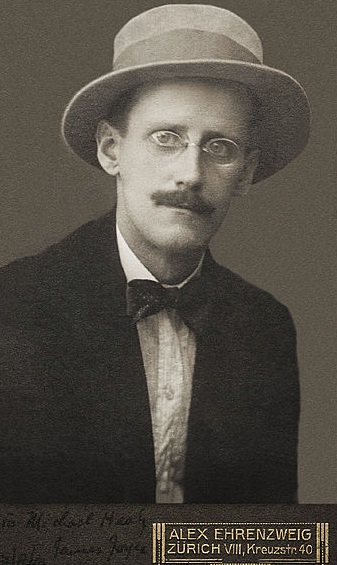
James Joyce Photo: Alex Ehrenzweig 1915 Wikimedia Commons
In a letter from our London correspondent, which appears in this issue, reference is made to a couple of plays which pretend to treat certain phases of Irish character. These plays bring into being a new “stage Irishman.” This mythical “gentleman” is far worse than the old “stage Irishman,” with his impossible simian countenance, his red nose, his “begobs” and “begorras” and his made-to-order jokes. The latter, being however absurd and ridiculous a mis-creation, was at any rate “clean” in his patter and in his characterisation. Not so the new “stage Irishman,” who is a repulsive and brutal type, a ruffian and a disgrace. And the worst of it is that he was created first by Irishmen.
Synge, for all his wonderful manner of making a new Kiltartan out of phrases made many of his characters outrageous. His own pessimism and irreligious characteristics are too often found in those characters.
Brinsley MacNamara and the insufferable James Joyce have, each in his own way, made Irish character repulsive and disgusting. We can hardly blame those responsible for the occasional appearance of the old stage Irishman – as the “Herald” in the case of a recent cartoon – when Irishmen themselves are found creating and exploiting that baseless monstrosity, the new and the worse, stage Irishman.
The harvest promises to be an average one, and all the misgivings that were felt during the course of the summer, as to the prospects of the potato crop, have, we are much gratified in stating, altogether given way. That crop will, perhaps, be more abundant this year than it has for several seasons previously. Public works are progressing in many places. The Shannon navigation, under the superintendence of that active, talented, and highly intelligent gentleman, Mr. Charles Williams, is advancing rapidly to a completion, thus opening the heart of the finest corn country in the world to the markets of England, and introducing the blessings of industry and civilization to what has been considered hitherto among the wildest districts of Ireland. In the west of Ireland, particularly in the counties of Mayo and Galway, an equal activity is shown in laying down roads through the mountainous districts, in building bridges and erecting piers. There can be no just complaint against government for want of aid.
Two Hundred Pounds Reward
Thomas Smith, a child aged ten years, was sent to the school of the Rev. Humphry Price, near Lichfield in May 1811. In September 1812 he was conveyed from thence, and, it is believed sent on board an Indian vessel. Letters sent home state that he had died of water on the brain; but his sister accidentally met with a letter that has convinced her an interested person is going between her and her brother.
Thomas Smith was under the guardianship of a gentleman of rank and fortune in Ireland, whose brother in law at present possesses the property of the said Thomas Smith, and who became entitled to it by his reported death.
Description of Thomas Smith on quitting this kingdom is as follows; Fair hair, fair complexion, freckled, light eyes, a small round mark on one write, a small cut over one eye.
Letters addressed to his sister J.B. or to T.B. Esq., Oranmore, County of Galway, Ireland will be carefully attended to.
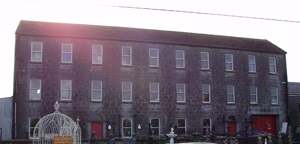
Former Military Barracks, Gort Photo: buildingsofIreland.ie NIA
The old police station, George’s street, Gort, was broken up on Monday, all the police changing into the military barracks. The latter place has undergone a complete restoration within the last few months, and is in future to be occupied by all the police stationed in the district, married men included.
The removal of the police leaves open one of the finest dwelling houses in the town and speculation is rife as to what use the old barrack will be put. It is understood that the premises have been acquired for an additional bank. This would prove a great boom to the business men of the town.
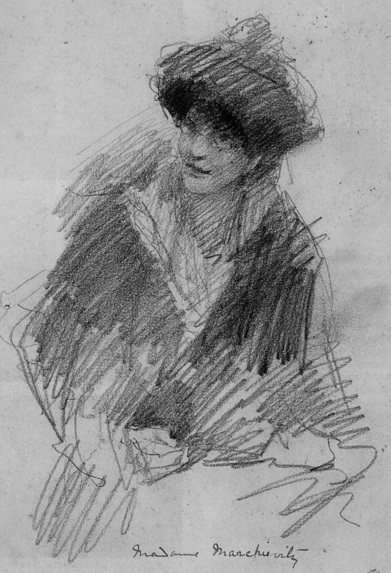
Countess Constance Markiewicz c.1922 by J.B.Yeats Wikimedia Commons
A striking figure in the rebellion was an elderly woman stated to be of high title, who carried a rifle with fixed bayonet. She is stated to be one of the leaders of the Sinn Feiners. It is reported that Professor John MacNeill, chief of staff of the the Irish Volunteers has been held prisoner since Monday, whether by the authorities or the insurgents, is unknown. MacNeill repeatedly warned the more active of the insurgents against the evil consequences of their policy.
At the last meeting of the guardians of the Gort Union (J.A.Joyce Esq., in the chair) a letter was read from the Poor Law Commissioners, in consequence of a memorial which had been addressed to them by certain parties complaining that some families, who were actually starving, had been refused relief in consequence of the father of the family having refused to give up his land, though the other members of the family were anxious that he should do so.
The commissioners informed the board that it was the opinion of eminent counsel that the other members of the family could be legally relieved under such circumstances, although the parent refused to give up his holding. A conversation then ensued on this subject in which it was admitted that such cases of hardship might arise, but that it would be likely to cause great abuses and imposition if the practice of thus giving relief were adopted. The chairman inquired of the relieving officer why he had not taken the application of the family referred to in the memorial – to which he replied that it was because they held land. The chairman informed him that it was his duty to receive all applications made to him and leave it to the board to decide how far they were entitled to relief. If any of them held land he(the relieving officer) should, of course state that as well as all other facts which he knew concerning them to the board.


 The Burren and Beyond