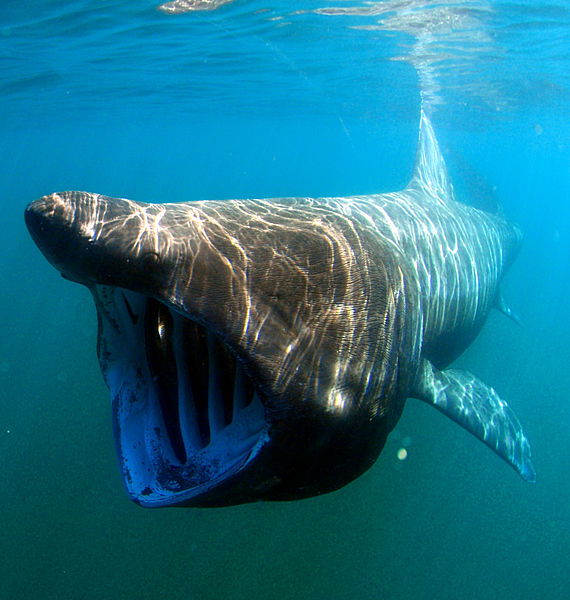
Photo: Greg Skomal/NOAA Fisheries Service Wikipedia.orghttps://widgetworld3.wordpress.com/podcasts/ The Argus 11th March, 1851 p4
ANOTHER EXTRAORDINARY FISH STORY (abridged)
A short time since, no small excitement was produced in Londonderry by a report that the Fenella iron steamer, on its way down the lough, had been piratically attacked off Ennishowen Head by some indescribable animal. It seized the vessel by the bow with its jaws and dragged it all the way into Portrush harbour – the very port to which the vessel was bound. The terror of the passengers and crew was greatly augmented by beholding the creature preparing to board. They were saved from the cruellest of all imaginable deaths by the prompt interposition of a party of the constabulary. With repeated volleys they compelled the monster to a hasty retreat.
It seems that when the Fenella was at the tail of the Tons, nearly opposite to Downhill, those on board felt as if she had grazed upon something, which they supposed might be a sunken wreck, though from the depth of the water, that was scarcely possible. Some observed an agitation about the bow as if caused by a huge animal. When the Fenella reached Portrush harbour (about seven miles further) it was observed by those on shore, as well as some on board, that an enormous fish had hold of the vessel by the bow with its jaws. It turned out that the marks of its teeth were distinctly imprinted in the paint of the bow (which, like the rest of the vessel is of iron).
It was then twilight, so that its shape could not be well observed; but it was judged to be fourteen teet in length, and of a very dark colour. We think that it may have been one of the basking sharks which are common off the coast of Galway.
Londonderry journal.
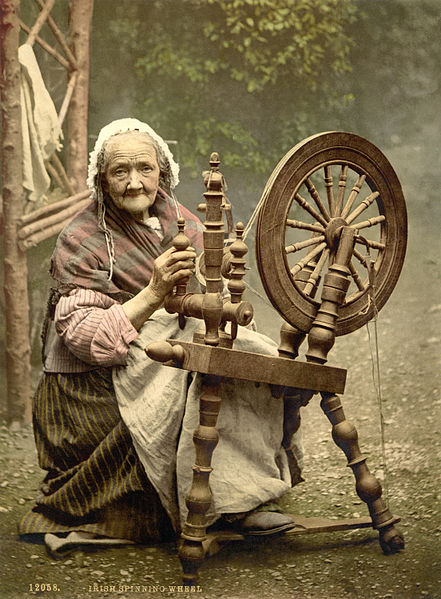
Irish spinning wheel – c 1900 Library of Congress Collection.https://widgetworld3.wordpress.com/podcasts/ Celtic Fairy Tales
Selected and edited by Joseph Jacobs (1892)
from Project Gutenberg
THE HORNED WOMEN (abridged)
One night a woman sat alone by her hearth carding and preparing wool. It was a wild night outside, scattering briar and twig against the door of her cottage. Suddenly above the wind she heard the clatter of a hard fist on the door frame. A low, husky voice called, “Open! open!”
“Who’s there?” said the woman of the house.
“I am the Witch of one Horn, bid me enter.”
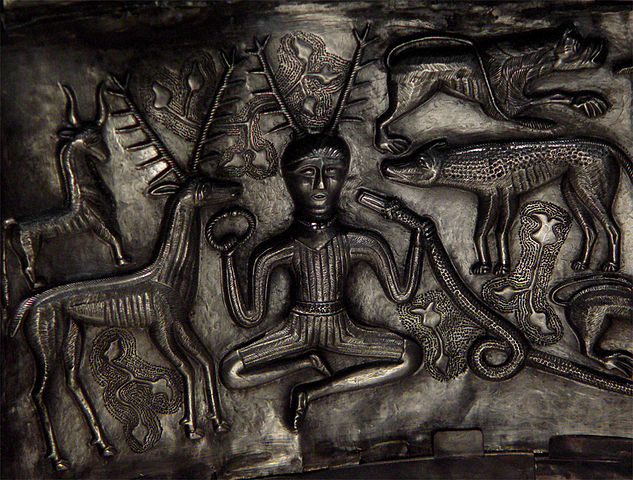
The mistress, startled and confused by the sudden interruption, opened the door. A woman entered, tall and wild, her black hair flying loose around her face. In her hand was a pair of wool-carders. On her forehead was a horn growing from a ridge between her brows.
She nodded abruptly at the woman of the house, sat down by the fire in silence, and began to card the wool with violent haste. The woman of the house closed the door quietly and returned to resume her work. If truth be known, she had little option as she feared this new presence in her home.
After a while the one horned woman paused in her work, and said aloud: “Where are the women? they delay too long.”
She had hardly spoken when a second knock came to the door, and a voice called as before, ”Open! open!”
Again the mistress felt herself obliged to rise and open to the call, and immediately a second witch entered, having two horns on her forehead, and in her hand a wheel for spinning wool.
“Give me place,” she said; “I am the Witch of the two Horns,” and she began to spin as quick as lightning.
And so the knocks went on, and the call was heard, and the witches entered, until at last twelve women sat round the fire—the first with one horn, the last with twelve horns.
And they carded the thread, and turned their spinning-wheels, and wound and wove, all singing together an ancient rhyme, but no word did they speak to the mistress of the house. Strange to hear, and frightful to look upon, were these twelve women, with their horns and their wheels; and the mistress felt near to death, and she tried to rise that she might call for help, but she could not move, nor could she utter a word or a cry, for the spell of the witches was upon her. Her family had succumbed to the spell also, for despite the clamour in the kitchen, they could not be woken. Antlered figure holding a serpent and a torc, depicted on the Gundestrup cauldron. (c. 200BC-300AD) The Gundestrup cauldron is housed at the National Museum of Denmark.One of the witches called to her in Irish, and said, “Rise, woman, and make us a cake.”
The mistress did as she was bid, glad of a reason to put some space between herself and her callers. She searched for a vessel to bring water from the well that she might mix the meal and make the cake, but she could find none.
With barely a glance in her direction, the one horned witch said, “Take a sieve and bring water in it.”
Against her better judgement the woman took the sieve and went to the well. Naturally the water poured from it as quickly as it was filled. She could fetch none for the cake. Finally, overcome by the horror and strangeness of her evening, the poor woman sat down by the well and wept. Her pain was felt.
From out of the mist that encircled her a voice spoke softly. It said, “Take yellow clay and moss, and bind them together, and plaster the sieve so that it will hold.”
This she did, and the sieve held the water for the cake. The voice spoke again:
“Return, and when thou comest to the north angle of the house, cry aloud three times and say, ‘The mountain of the Fenian women and the sky over it is all on fire.'”
And she did so.
When the witches inside heard the call, a great and terrible cry broke from their lips, and they rushed outside with wild lamentations and shrieks. Without acknowledgement or gesture they hurled past the women fled to Slievenamon, their home.
The voice spoke again – it was the Spirit of the Well who had helped her before. She bade the mistress of the house to prepare and protect her home against the enchantments of the witches should they return.
First, to break their spells, she sprinkled water in which she had washed her child’s feet, onto her threshold. Then she took the cake which in her absence the witches had made of meal mixed with the blood drawn from the sleeping family, and she broke it in bits. Each of the pieces she placed a bit in the mouths of her children and they were restored. She took the cloth the witches had woven, and placed it half in and half out of the chest with the padlock.
Finally, she secured the door with a great crossbeam fastened in the jambs, so that the witches could not enter. And she waited.
The witches came back. Finding their access barred they raged and called for vengeance.
“Open! open!” they screamed; “open, water!”
“I cannot,” said the water; “I am scattered on the ground, and my path is down to the Lough.”
“Open, open, wood and trees and beam!” they cried to the door.
“I cannot,” said the door, “for the beam is fixed in the jambs and I have no power to move.”
“Open, open, cake that we have made and mingled with blood!” they cried again.
“I cannot,” said the cake, “for I am broken and bruised, and my blood is on the lips of the sleeping children.”
The witches rushed through the air with great cries, and fled back to Slievenamon, uttering strange curses on the Spirit of the Well, who had wished their ruin. The woman and the house were left in peace, and a mantle dropped by one of the witches in her flight was kept hung up by the mistress in memory of that night. This mantle was kept by the same family from generation to generation for five hundred years after.
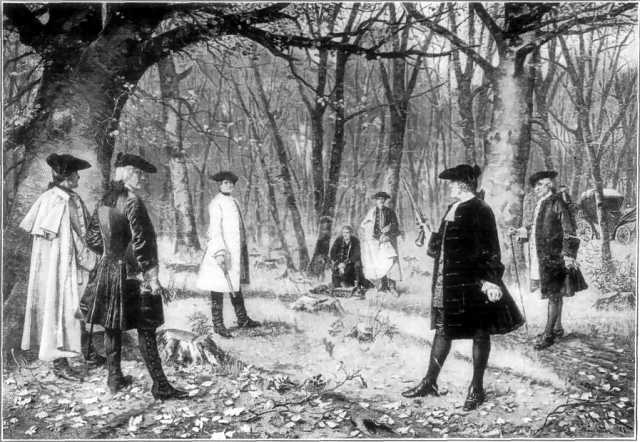
Alexander Hamilton- Aaron Burr Duel Gutenberg File of 1902 Book Wikipedia.orghttps://widgetworld3.wordpress.com/podcasts/ Launceston Advertiser 2nd November 1843
IRISH DUELLING (abridged)
No gentleman had taken his proper station in life till he had “smelt powder,” as it was called; and no barrister could go circuit till he had obtained a reputation in this way; no election, and scarcely an assizes, passed without a number of duels; and many men of the bar, practising half a century ago owed their eminence, not to powers of eloquence or to legal ability, but to a daring spirit, and the number of duels they had fought.
It was no unusual thing for the opposite counsel to fall out in court in discussing a legal point, retire to a neighbouring field, settle it with pistols, and then return to court to resume the argument in a more peaceable manner.
The public mind was in such a state of irritation from the period of 1780 to the time of the union, that it was supposed that three hundred remarkable duels were fought in Ireland during that interval. Counties or districts became distinguished for their dexterity at the weapons used – Galway for the sword; Tipperary, Roscommon and Sligo for the pistol; Mayo for equal skill in both.
Weapons of offence were generally kept at the inns for the accommodation of those who might come on an emergency unprovided. In such cases, ‘pistols were ordered for two, and breakfast for one,’ as it might and did, sometimes happen, that the other did not return to partake of it, being left dead in the field.
The laws by which duelling is punishable were then as severe as now, but such was the spirit of the times, that they remained a dead letter. No prosecution ensued, or if it even did, no conviction would follow. Every man on the jury was himself probably a duellist, and would not find his brother guilty.
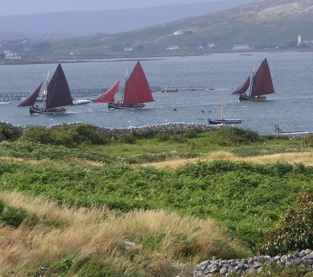
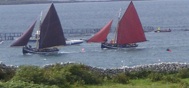
Galway Hookers Wikipedia.orghttps://widgetworld3.wordpress.com/podcasts/ COLONIAL TIMES 5TH NOVEMBER, 1844
EXTRAORDINARY OUTRAGE IN THE BAY OF GALWAY
On Tuesday, the 25th ult, while Mr J. H. Hynes, of New Quay, and the Rev Mr Fullam, Protestant clergyman, were out traul fishing, with a crew of three men, in the Bay of Galway, a fleet consisting of 80 to 100 boats from the Galway Claddagh, bore down on them, and nine or ten of the boats having surrounded the fishing boat, 50 0r 60 of the Claddagh fishermen suddenly boarded her, and, after cutting away the traul, rushed on Mr Hynes and his party with the most awful imprecations and savage yells, armed with open knives, poles etc., knocked them down, beat them most unmercifully, leaving them apparently lifeless on the deck.
Then then cut down the sails, which along with the anchor, cables, ropes, poles and oars, they threw overboard. Finally they tore up the deck, and with the stones that formed the ballast, made many fruitless attempts to scuttle the boat, after which they departed, leaving her a complete wreck to drift along the sea.
Fortunately she was rescued from her perilous situation by a New Quay boat, and towed into harbour. An investigation was held on Monday, at Correnrue, concerning this most daring outrage, before Messers Bell and Kernan, stipendiary magistrates, and G. Macnamara, Esq., J.P. Harbour – Hill. Although the lives of two of the crew and that of Mr Hynes were considered in imminent danger for four or five days, they are now supposed to be convalescent.
Clare Journal
https://widgetworld3.wordpress.com/podcasts/ THE MAITLAND MERCURY AND HUNTER RIVER GENERAL ADVERTISER 29TH JUNE, 1844
WAR STEAMERS ON THE IRISH LAKES
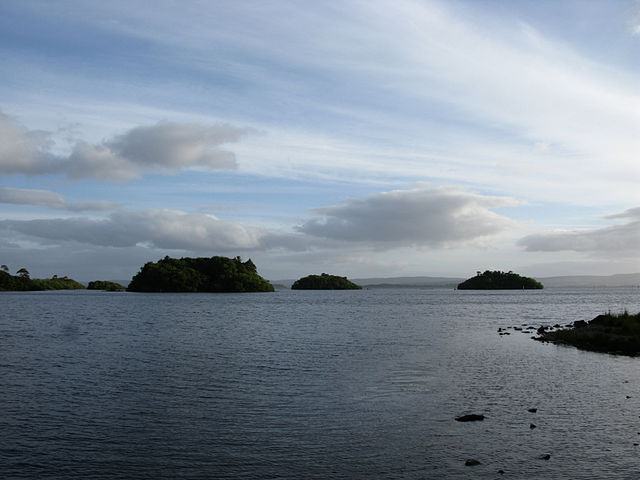
It is stated by an Irish paper that government have it in contemplation to place war steam boats upon all the large lakes in Ireland. A number are now being erected in Liverpool for this purpose and one is expected upon Lough Corrib early in spring. This will be the first step towards the navigation and other improvements of the lake, and thus open an immediate communication between Galway and the surrounding districts of Headford, Cong, Ballinrobe, Westport – in fact, the entire shores along this extensive and beautiful lake.Lough Corrib Photo: Jlahorn Wikipedia.org
Image from Hetzel copy of Twenty thousand leagues under the sea (Jules Verne) Wikipedia.orghttps://widgetworld3.wordpress.com/podcasts/ SUNDAY TIMES (PERTH) 23RD JUNE, 1935
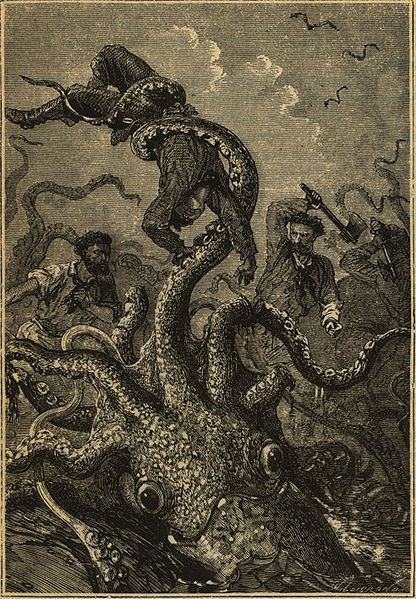
SEA MONSTER SHOT – MYSTERY CREATURE WITH TWO TAILS
A strange marine creature, twin brother of the Loch Ness monster – 48 feet long, 26 feet in circumference and weighing about four tons, has been shot by a lighthouse keeper in Galway Bay, Ireland.
The sea monster had got caught in the nets of one of the fishing boats off Mutton Island lighthouse. It carried boat and cargo, human and aquatic, for some distance until the nets gave way in shreds. A description of the monster seen once above the surface roused the entire city. Seamen and harbor officials immediatey proceeded to the beach armed with guns and gaffs.
FIVE SHOTS, THEN –
I went out in a hooker piloted by John Walsh, an old seaman of vast experience (writes the correspondent of “The People”).
As we approached Mutton Island in miserably cold rain five shots rang out from the direction of the lighthouse. We were just in time to see an aquatic King Kong leap bodily into the air, lashing the water into a miniature tidal wave as it rolled and twisted in its death agony. We anchored to one of the monster’s giant fins and John Crowley the lighthouse keeper, who had fired the shot explained that he spotted it while about to tend the lamps in the lighthouse. Rushing down armed with a rifle he took careful aim and shot the creature in the head several times.
TWO KNIFE-EDGED TAILS
Opinions were divided as to the nature of the strange creature. Crowley and my companion agreed it was neither shark nor whale. Walsh stated that in 50 odd years’ marine experience he had never come across a similar specimen.
It has a head of enormous dimensions, a long scaly body ending in two knife edged tails It is suspected that more than one of these strange creatures are in Galway Bay.
https://widgetworld3.wordpress.com/podcasts/ Pope Clement VII – (Giulio di Giuliano de’Medici) by Sebastiano del Piombo – circa 1531THE EXAMINER, 26TH MAY, 1849 P4
BRIAN BOROIHME’S HARP
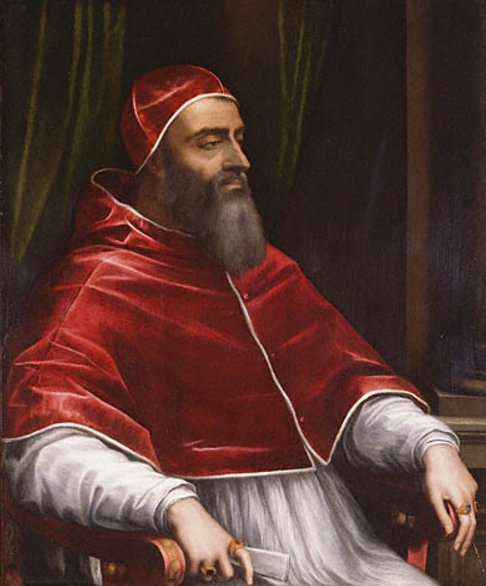
It is well known that the great monarch Brian Boroihme (Boru) was killed at the battle of Clontarf A.D. 1014. He left his son Donagh his harp, but Donagh having murdered his brother, Teige, and being deposed by his nephew, retired to Rome, and carried with him the crown, harp and other regalia of his father. These regalia were kept in the Vatican, till Pope Clement sent the harp to Henry VIII, but kept the crown which was of massive gold.
Henry gave the harp to the first Earl of Clanricarde, in whose family it remained until the beginning of the eighteenth century, when it came by a lady of the De Burgh family into that of McMahon of Glenagh in the county of Clare. Following his death it passed into the possession of Consellor (sic.) McNamara of Limerick.
In 1780 it was presented to the Right Hon. William Conyham who deposited it in Trinity College Museum where it now is. It is thirty-two inches high and of good workmanship – the sounding board is of oak, the arms of red sally – the extremity of the uttermost arm in part is capped with silver, well wrought and chiselled. It contains a large crystal set in silver, and under it was another stone now lost.
Tipperary Free Press
Galway Hookers Wikipedia.orghttps://widgetworld3.wordpress.com/podcasts/ FREEMAN’S JOURNAL 10TH MARCH 1877
THREE IRISH FISHERMEN ADRIFT IN MID OCEAN.
The Old Dominion, of the Old Dominion Steamship Company, arrived at New York recently, having on board seventeen men, fourteen of whom were Italians and three, natives of Ireland, who have strange stones, to tell of the recent storms at sea. The. Irishmen have a strange story to relate. One, of the three, Michael Moran, a well-built and hearty-looking man, made the following statement :
‘We are fishermen of a little village named Claddagh, near Galway, and but a short distance from where Father Burke resides. We are in the habit of going out to catch fish, which we sell in Galway. In this way we support our families. That young man there (pointing to one of his companions) is Michael Smith, who has been married but a few months. The older man is my fathor, Patrick Moran. Se is eighty-six years old. I am the father of a family of five. We are all most anxious to return to Ireland.
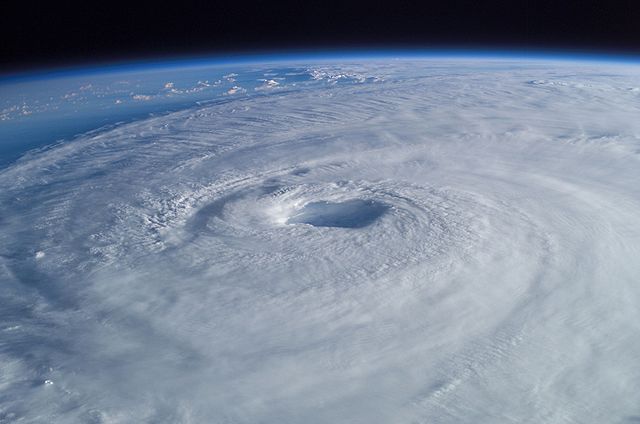
Hurricane Isabel – 2003 Photo: Astronaut Ed Lu via Mike Trenchard, Earth Sciences & Image Analysis Laboratory , Johnson Space Center.I was the captain of a fishing smack, or hooker, named the St. Patrick. Thinking that we might make a good haul of herring, with Michael Smith, Patrick Moran and my uncle, John Moran, I set sail in our nine ton hooker on Monday, the 4th of November, and made for Sline Head about sixty miles from Galway, where we thought the fishing would be good. We had no extra good fortune, and at night foggy weather overtook us.
The wind sprang up, blowing a perfect hurricane. My post was at the helm, where my hands became frozen. On Tuesday night the boat was half filled with water. It is our custom to light turf on setting out and keep the fire going. The water put it out. Although we had potatoes and fresh fish, we had no means to cook them. We were four days and four nights without eating. In order to break the speed with which we were driven we lowered a basket filled with stones and endeavoured to heave to, but the cable broke on Friday morning. We could not, previous to this, reach any sounding. About this time my uncle, John Moran, aged ninety- six, while we were asleep towards morning, must have been drowned by the lurching of the ship throwing him into the water. At any rate, we could discover no trace of him.
When one hundred and fifty miles out we were picked up by a Swedish bark, the Gorgian, Captain P. Olsen, bound for Hampton Roads. The ice drove the vessel into Norfolk, where we arrived on the 6th instant.
I am not a stranger to America, having been here about thirteen years ago. I have served on the Shenandoah. My father was also here twenty -five years ago, being engaged in shad fishing at Fort Lee. We are totally destitute of clothing, and have no means. We intend to see the British Consul to-morrow. We have acquaintances here, but we do not know where they live.’
She heard her name calledTHE HIGH DEEDS OF FINN AND OTHER BARDIC ROMANCES OF ANCIENT IRELAND
T. W. ROLLESTON, Crowell and Company, New York –
How Ethne Quitted Tir na nÓg (abridged)
By the banks of the River Boyne, where rises the great Fairy Mound of Newgrange, there once the shining Palace of a prince of the Danaan, named Angus. Of him it is that the lines are written—
“By the dark rolling waters of the Boyne Where Angus Óg magnificently dwells.”
When the Milesians invaded Ireland, and subdued the Danaans, the Danaans wrought magic by which rendered all their possessions invisible to mortals. Under their enchantments their palaces, dancing-places and folk-motes looked like green mounds or raths, lonely hillsides, or ruined shrines with nettles and foxgloves growing up among its broken masonry. In this way they were safe from humans.
After Angus, King of the Dananns and his folk had retreated behind this veil of invisibility, his steward’s wife had a daughter. She was named Ethne. On the same day Fand, the wife of Mananan the Sea God, also bore a daughter. Since Angus and Mananan were friends, Mananan sent his child to Brugh na Boyna, the noble dwelling-place of Angus, to be fostered and brought up. In turn Ethne, was fostered to Mananan.
In time Ethne grew into a fair and stately maiden at Mananan’s residence. As she was not of the mortal world there was always a store of food of the faery at her foster home. It was charged with magical spells, by eating of which one could never grow old or die. Curiously, after Ethne had grown up she rarely ate or drank of the fairy food, or of any other, yet she continued to seem healthy and well-nourished. Nonetheless a concerned Mananan reported this to Angus, and Angus visited to meet with Ethne.
A lord of the Danaans, who accompanied him was bewitched by Ethne’s beauty. He became quickly obsessed until he laid hands upon her and strove to carry her away to his own dwelling. Ethne escaped from him. However, the blaze of resentment at his behaviour towards her lit up Ethne’s soul. It burned to a point where it consumed her fairy nature. The nature of the children of Adam – the mortal – took its place. From then on she ate none of the fairy food, which is prohibited to man. Sensing Ethne’s transformation and her anger, Mananan and his Fand sought to protect her. They gave her a charm to wear around her neck, to keep her safe within the faery realm.
One very hot day not long after Ethne and her maidens went to bathe in the River Boyne. After they had refreshed themselves in the cool, amber-coloured water, they arrayed themselves in their silken robes and trooped back to the Brugh again; but ere they entered it, the maidens discovered that Ethne was not among them. So they went back, scattering themselves along the bank and searching in every quiet pool of the river and in every dark recess among the great trees that bordered it, for Ethne was dearly loved by all of them; but neither trace nor tidings of her could they find. Eventually they went sorrowfully home without her, to tell the tale to Angus and to her father.
What had befallen Ethne was this. In taking off her garments by the riverside she had mislaid her fairy charm, and finally became a mortal maid. Because of this she could no longer see her companions. Everything became immediately strange to her. The fairy track that had led to the riverside was overgrown with briars, the palace of Angus was gone, replaced by a wooded hill. Ethne did not know where she was, and pierced with sudden terror she fled wildly away, seeking for the familiar places that she had known in the fairy life, but which were now behind the Veil.
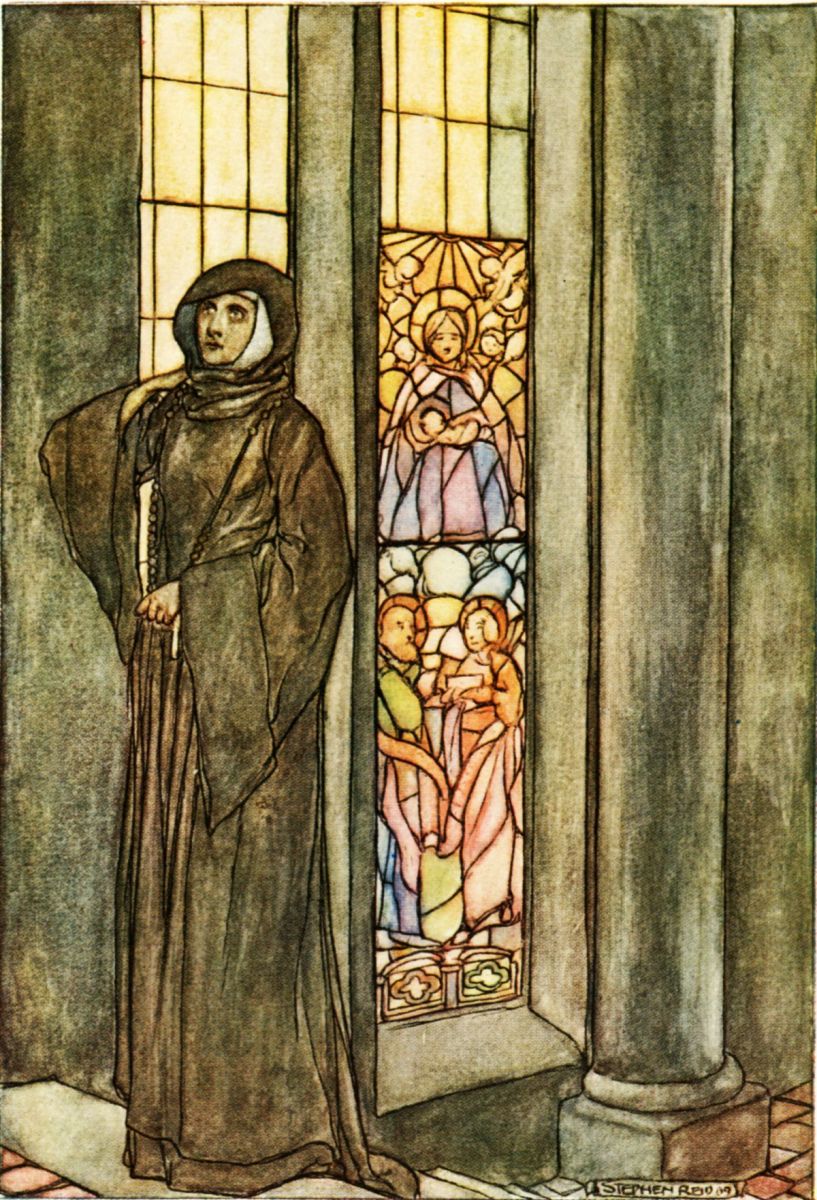
At length she came to a high wall wherein was a wicket gate, and through it she saw a garden full of sweet herbs and flowers, which surrounded a steep-roofed building of stone. In the garden she saw a man in a long brown robe tied about his waist with a cord. He smiled at her and beckoned her to come in without fear. He was a monk of Patrick, and the house was a convent church. When the monk had heard her tale, he marvelled greatly and brought her to St Patrick, who baptised her.
The following day Ethne went for a walk within the garden of herbs. She was lonely, thinking of her home. As she did, the sky darkened and she heard a sound like the rushing of a great wind. Mingled in it were cries and lamentations. She heard her name called again and again in a multitude of voices, thin and faint as the crying of curlews upon the moor. Ethne sprang up and gazed around, calling in return, but nothing could she see. Eventually the storm of cries died away, and everything was still again except the singing voice of Boyne and the humming of the garden bees.
Ethne sank down swooning. In that hour she fell into a sickness from which she never recovered. She was buried in the church where she had first been received by the monk; and the church was called Killethne, or the Church of Ethne, from that day forward until now.
Island Eddy as it appears on ‘A Map of the County of Galway in the Province of Connaught in Ireland’ by WIlliam Larkin (London 1818).FREEMAN’S JOURNAL 18TH OCTOBER, 1884 P6
AN IRISH SHIP CANAL.
The suggestion of constructing a ship canal across Ireland, from Dublin to Galway, or Dublin to the Shannon, has been warmly taken up by eminent and competent men in London. Elaborate plans and surveys have been made at considerable expense, which have been submitted by Captain Eades, the great American engineer. The plans for the Irish Canal have been prepared by Mr. T. A. Walker, Great George-street, Westminster, who recently bored a tunnel under the Severn, the largest undertaking of the kind in the country.
Silently but steadily a staff of engineers have levelled the country between Galway and Dublin Bays, and the plan, although carefully prepared, is largely tentative, its object being to show the practicability of a project of the kind. The proposed canal would be 127 miles in length and would contain upwards of 30 locks. The estimated cost is, of course, ruled by the tonnage of the ships it is intended to accommodate. Thus if for ships of 1,500 tons the cost would be eight millions, for ships of 2,500 twelve millions, and for ships of 5,000 and upwards twenty millions sterling. If built on this scale, and it is considered that anything smaller would be a mistake, the canal would be 200 feet wide on the surface and 100 feet at the bottom.
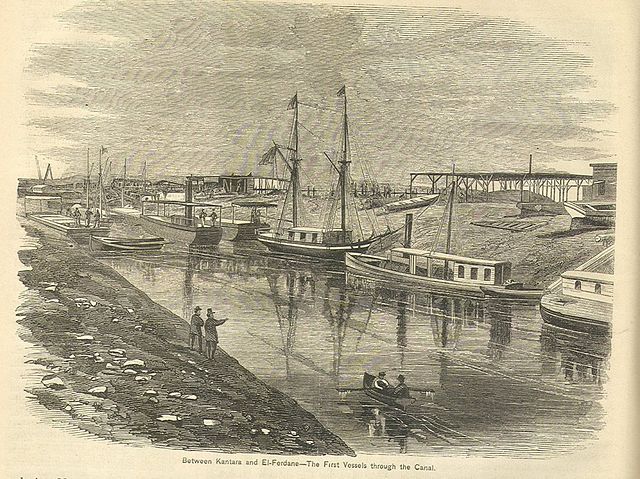
Suez Canal, between Kantara and El-Fedane. The first vessels through the Canal. 19th century image. From “Appleton’s Journal of Popular Literature, Science, and Art”, 1869.In considering these dimensions it must be remembered that the Suez Canal except at its mouth is not 80 feet wide. The depth would be from 30 to 35 feet, and the locks would be fitted with the newest hydraulic apparatus so as to make the process of lockage as simple and expeditious as possible. The passage through the canal would be effected through, a system of towage, although it is somewhat of an open question whether this would be preferable to permitting the steamers to work through.
It is estimated that the passage of a ship from Galway Bay to Kingstown would occupy between 24 and 36 hours. An alternative scheme of a ship railway, in which the ships would be carried in cradles, which, he says, could be constructed for ten millions by his plan, the duration of the passage through the island would, he declared, be reduced to 12 hours.
The proposed course of this great work will be of considerable interest.
The canal starts from Doores Strait (sic.), south of Islandeaddy, in Galway Bay, where the shallowness of the water necessitates the dredging of a channel for a considerable distance out. This proposed canal would give a depth of thirty feet at low water, and would be protected from the silting up of the sand by suitable works. The entrance to the canal would be by a sea lock 600 feet in length, capable of taking ships of 5000 tons. From this lock entrance would be gained to a dock of 29 acres in extent, constructed on an arm of the sea, known as present as Brandy Harbour. The first inland lock would be less than a mile up at Killemaran, (sic.) from whence the canal would pass close to Drumacoo, then turning slightly to the north by Kilcolgan on to Rahasane, and passing about five miles to the south of Athenry, and crossing the Athenry and Ennis Railway at Craughwell, where the fifth lock would be situated. The sixteenth mile of the canal brings it about one mile to the north of Loughrea, from which town there will be a feeder to supply fresh water from the lake which is ten feet above the level of the canal, the latter being 260 feet above sea level. From this point there is; a long straight line of canal without locks until it roaches Eyrecourt, whence an immense aqueduct is to be constructed to carry the canal over the Shannon