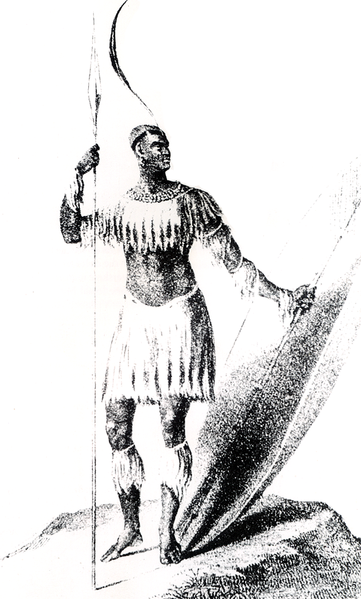
Shaka, king of the Zulu. After a sketch by Lt. James King, a Port Natal merchant.
Freeman’s Journal, Saturday 16 August 1879, page 6/ 7
(abridged)
The manner in which Irish men are turning up among the Zulu people is much noticed. John Dunne, Cetewayo’s Prime Minister, is ascertained to be from Ballymena in Ulster. Renter’s telegrams to-day brings news of a chief called M’Carthy (sic.), captured in a battle by the English is an Irish emigrant to the South African diamond fields. He arrived in the year of the Fenian rising.
The formidable chief, Moirosi, who is reported to be besieged by the British forces, is really one Morrissy.
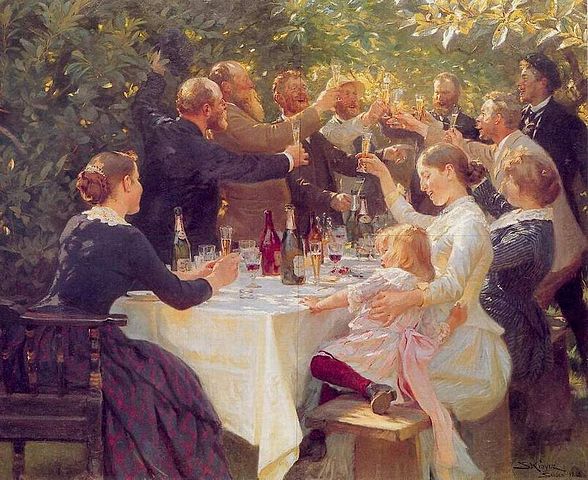
Hip, hip, hurra! Kunstnerfest på Skagen 1886 Peder Severin Krøyer (1851–1909) Gothenburg Museum of ArtThe Courier Mail – 21st December, 1935
In Galway, a Gaelic toast used to go round embodying all the ingredients of human felicity –
“May you have health and a long life with the good wife of your own choice;
your land without rent and death in Ireland.”
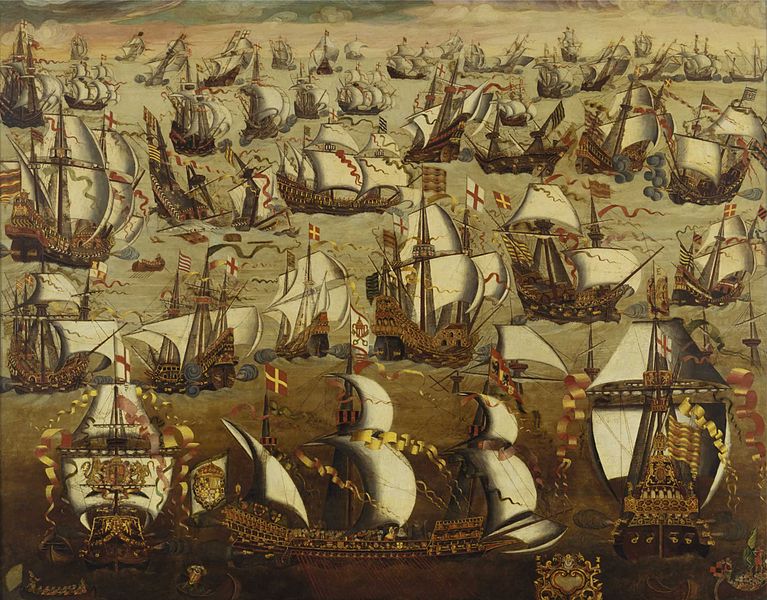
English ships and the Spanish Armada, August 1588. National Maritime Museum UK Wikimedia Commons
THE ADVERTISER (ADELAIDE) 25TH JUNE, 1932
(Abridged)
There is the case of the diver who was working on a wreck off the coast of Galway – a portion of the coast where, rumour had it, a Spanish galleon (one of the ships of the Armada) had gone down, centuries before.
An old fisherman told the diver about the galleon.
“You show me the treasure, and i’ll soon get it,” said the diver.
“We’ll share it if there’s any.”
He and the fisherman went out in a rowing boat, threw a grapnel over the stern and dragged it about the sea bed in the hope of striking the wreck.
For a month their efforts were fruitless. Then the grapnel held.
“We’ve got her,” said the diver. And they had.
The diver donned his suit and went down. He found the skeleton of the galleon of long ago – and also came across what appeared to be several small barrels. The barrels were actually solid stacks of Spanish doubloons, from which the wood had long since perished – leaving the coins still shaped like their containers.
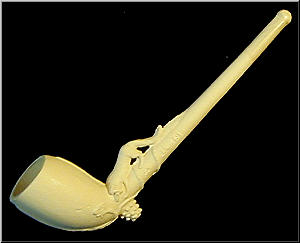
In the Abbey of Corcunrue (sic.) County Clare, the tomb of Donough O’Brien can still be seen, and on it there is a carved effigy of his ancient Majesty lying in state with an unmistakable pipe in his jaw.
This particular O’Brien died in 1267, two and a half centuries before Raleigh brought tobacco from America…
(The Sydney Gazette and New South Wales Advertiser 12th April 1836 p2
(abridged)
In the course of the summer, almost incredible quantities of brooms, made of heath, have been shipped from this port, chiefly tor Glasgow; and considerable gain must have been acquired by the persons engaged in that humble trade. How the brooms have been supplied with shafts is a great mystery to many.
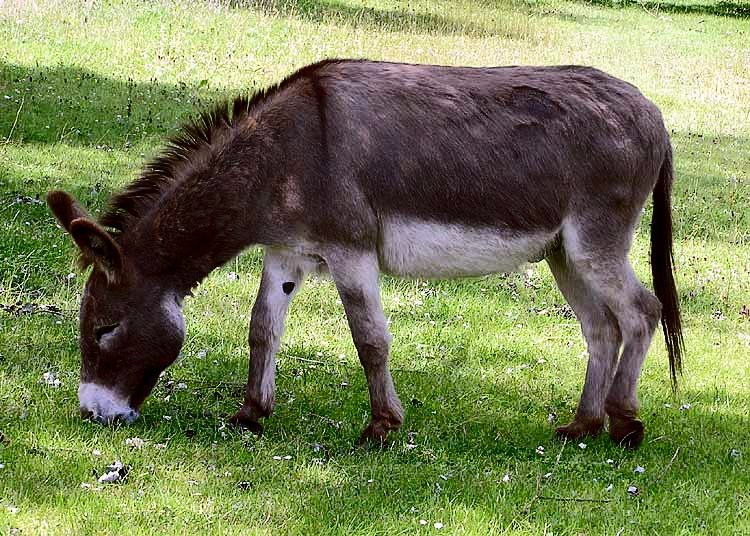
At present there is a large brig in the harbour, which is to be freighted with asses for the Cañadas, and 70 of the freight have been already secured. Imagine two or more hundred asses at sea, in the hold of a vessel, braying at the tops of their voices during a stiff gale!
Today six foxes, under cover, take their departure in a steamer for a gentleman’s seat in Scotland. No fewer than three score of these interesting animals were sent last spring to the same place, where, having been put into a kennel with young dogs, they caught the mange and died, strange as it may seem, from want of a supply of brimstone!
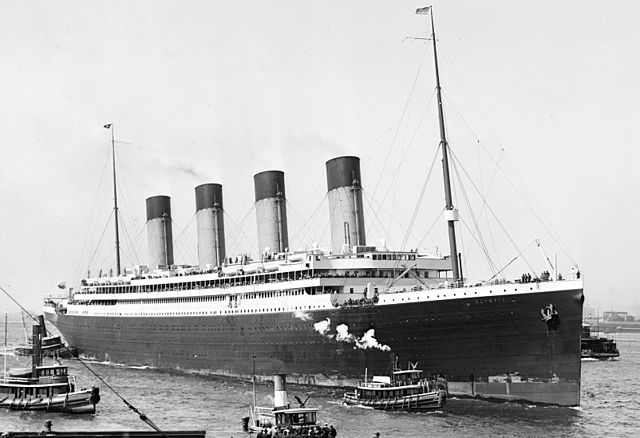
The limit in big ships is being reached here in the building of two great giants of the sea.
They are to be called the “Olympic” and the “Titanic”. When they go splashing through the ocean from New York to England and France, old Neptune himself, rules of salt water, will have to duck his head in fright.
These monsters will be 860 feet long, nearly 100 feet wide, and are so large that the harbors will have to be enlarged if they are sailed anywhere but in the biggest ports.
They will be four times as heavy as Uncle Sam’s biggest war vessels. An average city wouldn’t begin to hold the people that will be on board each ship. They’ll only have one mast apiece, and if a person wants to get a good view of them he would have to stand a mile away, like one looking at a mountain.
The Irish boat builders had to make a new shipyard for the work. Millions of dollars will be spend in the building, and the people who go to Europe every year will pay millions more to ride in them.
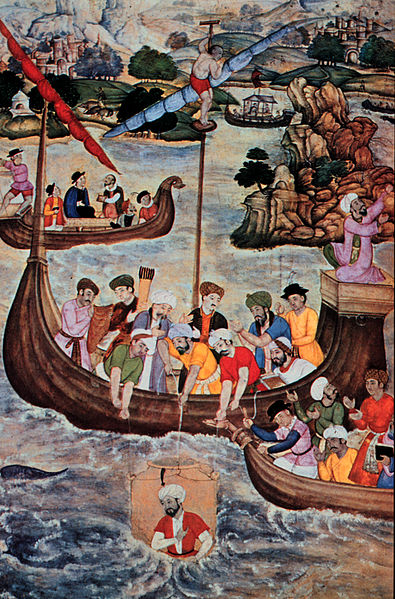
16th century painting of Alexander the Great, lowered in a glass diving bell OAR/National Undersea Research Program (NURP); “Seas, Maps and Men” Wikimedia commona
Colonial Times – 7 January 1831
Three brothers of the name of Owen, of Holyhead, lately invented a diving-bell, about the size and form of a churn, by which they can be dressed and remain for many hours in fifteen fathoms of water, moving from place to place with considerable facility. With this simple apparatus they lately proceeded to Donaghadee, on the coast of Ireland, to the spot where the brig Enterprize was lost in 1802, when homeward bound from South America with a large quantity of specie in gold and silver on board.
For the recovery of this valuable cargo they immediately commenced operations, and at the first descent the diver lit on the ship’s bell, having the name of the vessel, “The Enterprize,” engraved thereon, which he brought up with him. On this discovery the divers returned with reaping hooks, with which they employed themselves for three successive days in cutting the sea weeds about the vessel; and on the fourth day they succeeded in discovering a number of Spanish dollars of the coinage of Charles III. and IV. They continued their gallant exertions, from day to day, which were rewarded by a considerable quantity of the same valuable coin.
The three enterprising brothers were at Holyhead last week, displaying the fruit of their ingenuity, and are now on their way back to the silver shores which have already afforded so fair a return for their labour, and whence they hope still to reap a further and richer harvest.- North Wales Chronicle.
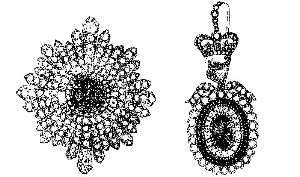
Image of the stolen Irish Crown Jewels, from Hue and Cry, Image published in 1907. Wikimedia comonshttps://widgetworld3.wordpress.com/podcasts/ THE SAN FRANCISCO CALL 1st December 1912
FUGITIVE TRAILED AROUND THE GLOBE
by Thomas Emmet
Dublin
The arrest in Angola, West AFrica, of Francis Shakleton, formerly Dublin herald and a brother of the famous Antarctic explorer, Sir Ernest Shackleton, has created a tremendous sensation throughout Ireland. It is expected that, at last, the famous mystery of the Irish Crown Jewels, which vanished from the strong room of Dublin castle in broad daylight, is to be unveiled.
Scotland yard detectives and an American sleuth in the pay of the British crown trailed Shackleton around the globe to his hiding place in Angola.
The ancient crown of the Irish Queen consort, which is worn only on great state occasions by the wife of the viceroy, three of the principal jewels of the order of St. Patrick and the gemmed hilt of the sword of “Silken Thomas,” prince of Leinster, disappeared from Dublin castle the day following an all night poker session in which Shackleton and other young ‘bloods’ officials at the castle, were hosts to people of not too savory repute. The loss was hushed up for a time.
Later Shackleton went bankrupt for $500,000 liabilities and scarcely any assets. Ugly rumors began to crop up. The bankrupt fled. Until his arrest was reported it was not known that the government was taking action.
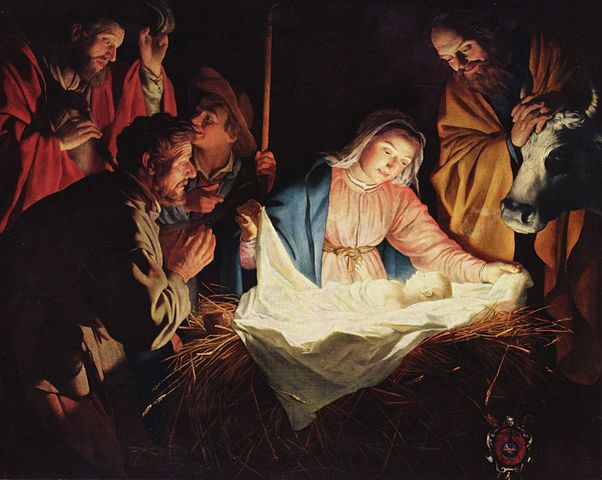
The Adoration of the Shepherds – 1622 Gerard van Honthorst (1590-1656) Wallraf-Richartz Museum Wikipedia.orghttps://widgetworld3.wordpress.com/podcasts/
Australian Town and Country Journal 24th December 1870 p16/17 “A Merry Christmas and a happy New Year.”
Could there be a heartier sentiment? Is not all that is genial, and kind, and friendly embodied in the sentence?
So should it be; for Christmas time is surely a period when the most generous promptings of the year should be indulged; a time when charity consists not in the cold deliberation of other times, but in the giving without doubt, without inquiry.
A time when none but a churl will cherish malice or hatred, but all good fellows will pocket ill-will for the nonce at any rate, and thrust forth their hands in friendship.
A time when the spirit frees itself from the thraldom of everyday petty cares and strifes, and comes forth in its earnestness and truth.
A time, in short, brief but healthy, when men and women may give way to the kindliness and charity of their nature, without being sneered at by their fellows, without feeling the shame of having done an absurd thing.

 The Burren and Beyond