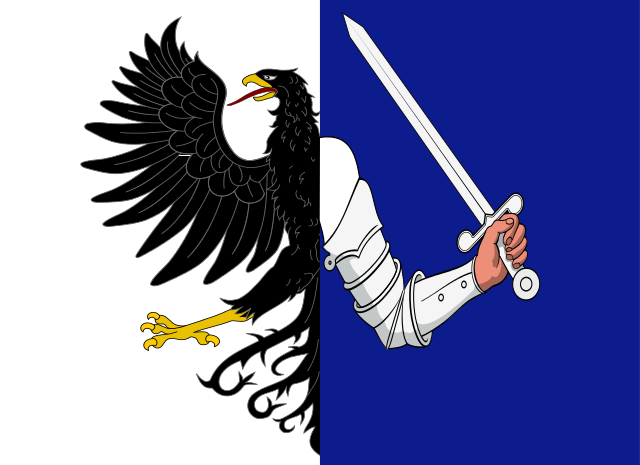
Flag of Connacht Caomhan27 Wikimedia CommonsTuam Herald, June 5th 1909
The first issue of the “Connacht Tribune,” a new Nationalist weekly newspaper, published in Galway, is a promising initial number of eight pages of eight columns each. Its local news supply is extemely full and diversified, the type good, and the printing very legible. Mr. William O’Malley, M.P. begins in the journal a series of articles entitled “Connemara Land League Reminisecnces.”
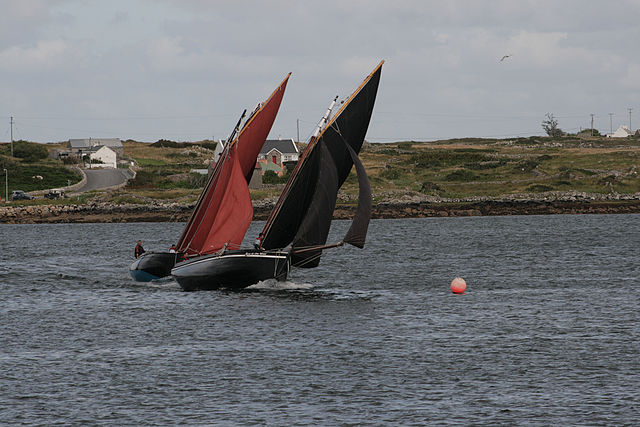
Roundstone, Connemara Photo: Julian MatzCOLONIAL TIMES 11TH JUNE, 1833
Dreadful Wreck of the Oporto Transport.(abridged)
At Clifden, in Galway, in December, a portion of a ship was seen floating near the entrance of Roundstone Bay. By the active exertions of the coast-guard, under the command of Lieutenant Hunter, R. N., it was secured. The following day, the remainder of the wreck was discovered, a few miles distance from the first-named place. Uniforms and several bodies have been washed ashore. A few trunks, with mutilated papers and other articles, found by Captain Busby, R. N, proved her a brig of about 350 tons burden.
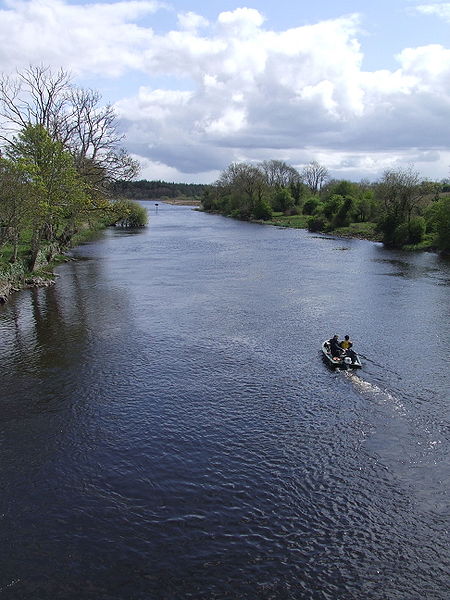
River Shannon Photo: Laurel Lodged Wikimedia commonsUnder the influence of the Shannon Commissioners the inland steam navigation of Ireland has been prosecuted with vast success, amidst all the difficulties presented by a state of social and political disorganization. The navigation of the Shannon has been effected, and that magnificent pride of Irish waters is now open for all purposes of traffic.
The father of the Shannon navigation improvements, Charles Wye Williams, Esq., lately enjoyed the highest pleasurable satisfaction in steaming nearly to the Lough Allen source of that noble river, and to the head of one of its great tributaries’ the Boyle Waters, within an English mile of the important town of Boyle.
At Athlone there is a new bridge, capped with masses of Cashel marble, each weighing from 10 to 15 tons; and a lock has been constructed, capable of passing any steamer suited to the navigation of the line. Near Lanesborough a branch canal is being cut to Roscommon. In Lough Forbes a dangerous shoal has been removed, and the works and clearances in Lough Boderg, the Carnadoe waters, and the Jamestown Canal, prove the difficulties, expense, and labour involved in the undertaking.
Near to Battle bridge, a new canal to Lough Allen commences, named after the earl of Clarendon, and the works partake of the same durable and admirable character as on every other portion of the navigation. The facilities of intercourse opened out by these improvements are still to be extended, and in a year or two the water communication between Limerick and Belfast will be complete by means of Lough Neagh, and the Logan and Ulster navigation with Enniskillen by means of Lough Erne.
Allan Line Royal Mail Steamers c 1890 Heritage Centre Cove Wikimedia CommonsThe Star 13th september 1858
IRELAND. (abridged)
(From the Times Correspondent.)
Dublin, Saturday, 22nd June.
The fine steamer Indian Empire, which was to leave Galway on the 18th June, with the first mails from Ireland to the United States, was run hard ashore near St. Margaret’s Rocks by the pilot who had charge of her from Southampton. Fortunately, however, the spot where she struck was not dangerous, and the ship eventually floated off and proceeded to Galway, having sustained but trifling damage. The damage will not impair or otherwise prevent her from sailing on her appointed date.
The authorities in Galway, on learning the particulars of the vessel’s going ashore, caused the pilot to be arrested, and after undergoing a preliminary investigation, he was committed to prison on a charge of having wilfully and knowingly run the Indian Empire on a hidden rock.
The somewhat sinister accident which befell the steamship on her first entrance into Galway Bay has created quite a sensation here, and the result of the trial of the two pilots is looked for with no ordinary anxiety. A Dublin journal (The Express) thus refers to the disaster : ” It remains for a jury to decide whether they were guilty or not of the crime of intending to destroy the steamer. It seems to be the general opinion in Galway that the facts cannot be accounted for except on the presumption of their guilt.”
This, however, should be left to the decision of a jury of their countrymen. If they should be found guilty, the crime is one of the foulest on record. But if they are guilty, others are guilty too. If they did run the steamer on the’ rock intentionally, they were the agents of a diabolical conspiracy, which should be traced out. If the chief criminals can be detected, no punishment would be too severe for them. Suspicion points to Liverpool as the seat of the conspiracy. The motives assigned are commercial jealousy.
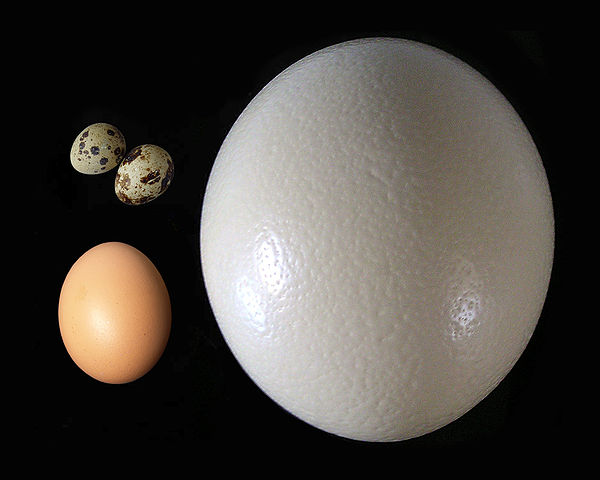
Ostrich egg, chicken egg and quail egg Photo: Rainer Zenz Wikimedia CommonsThe Central Record, 30th August, 1917 p10
(abridged)
Some in the west of Ireland, it is said, will never leave an egg shell open at one end only. They will always thrust a spoon through the lower end. Otherwise some wicked spirit will seize upon the shell and make a boat of it, in which to sail the soul of the careless person to destruction.
Photo: fir0002 – wikimedia commonsThe Sydney Gazette and New South Wales Advertiser 16th August, 1826
Latest English News.
[THE REPRESENTATIVE.]
(abridged)
On Thursday night the Earl of Darnley stated that, “without any fear of contradiction, he could assert the condition of the slave in the West Indies to be by no means so bad as the condition of the peasant in the West of Ireland.”
The Earl is intimately connected with Ireland. He is, in.fact, the owner of 30,000 acres of the land on which about 20,000 of the seven millions are fed. He is one of the few Irish proprietors who constantly reside upon their estates, who are indefatigable in promoting the improvement of their own property, while they humanely adopt every means of ameliorating the condition of their tenantry. He is, one of the few landlords who can speak from personal experience, and does not depend for his information upon the reports of agents and factors.
When his Lordship describes the condition of the Irish as infinitely more wretched than the state of the West India slave, his description is applicable, not, we presume, to his own tenantry, but to the tenants of less considerate landowners, who have deserted their estates.
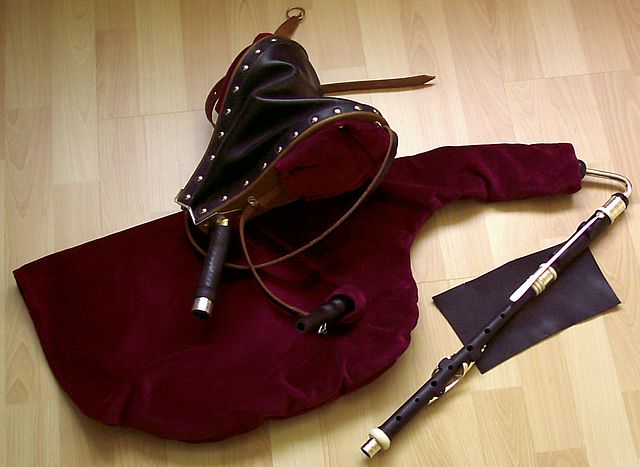
Uilleann pipes – practice set Wikimedia commonaTHE WASHINGTON TIMES 15TH FEBRUARY, 1922
(abridged)
Dear Sir,
Quite recently you used the phrase “more power to your elbow.” I wondered did you know the origin of it?
There were ten musical instruments in use among the ancient irish. Of these there were two kinds of bagpipes. The piob mor, or war pipes, referred to in the Brehon Laws of the fifth century, and the Uileann pipes, Shakespeare called them “woolen” which came into general vogue about the year 1760. They were called Uilleann because they were worked by the elbow, hence giving rise to the phrase you used, “more power to your elbow.”
Cathal O’Byrne
Violin Wikimedia CommonsTHE MORNING STAR AND CATHOLIC MESSENGER 21ST JUNE 1868 P3
Two men, named Thomas Green and Michael Flynn, house painters, were recently arrested on a charge of illegal drilling, near Ennis. At petty sessions evidence was given by the police that on Sunday night May 10th, they met a party of men marching two deep, with a fiddler in front playing a tune.
Such words as ‘forward’, ‘keep the step’, and ‘mind your wheeling at the cross’, were used. One by the name of Hogan appeared to be the captain.
A witness was procured for the defense to prove that the men were merely returning from a dance and had brought a fiddler with them.
Photo: Eric Jones Wikimedia CommonsTHE SYDNEY MONITOR 8TH MAY, 1830
The Lost Dragoon (abridged)
It is not generally known, that underneath the walls of Trinity College, Dublin, there is a range of gloomy vaults, in which are entombed many of the illustrious dead of the Irish capital. This cemetery has been shut for many years.
About the time when it began to be disused, a melancholy and affecting circumstance occurred. An officer of the 4th Dragoons, who had enjoyed the affec- tions of a fair Hibernian maid, chanced to be on guard at the Castle. A funeral procession passed him; and seeing that the remains of some person of consequence were about to be consigned to the earth in a private and un ostentatious manner, curiosity prompted him to follow in the melancholy train.
The procession took the direction of the College, and, passing under the archway, arrived at the entrance to the vaults. Here was seen the last of the gallant soldier.
He was, missed from his guard : his place at the mess table (which he used to enliven with his hilarity and good rnmour) remained empty that evening. The follow ing morning his mistress, in the figurative language of the East “dropped the an- chor of hope in a harbour of anxiety” and conjecture was at a stand-still to account for his protracted absence.
Months, a year rolled past, still no tidings of the absentee. At last another funeral winded its way towards the Trinity vaults. The mourners descended into their dark recesses. In passing along one of the sepulchral galleries, their feet crushed the bones of a skeleton. Imagine their astonishment, when they observed beside it a steel casque and rusted sabre. Bones, sword-belt and pouch lay near.
There followed a great deal of speculation as to the identity of the unfortunate individual, who evidently had strayed into the vaults and had lost himself in their gloom, to starve to death. It was eventualy found out to be the young and ill- fated dragoon.