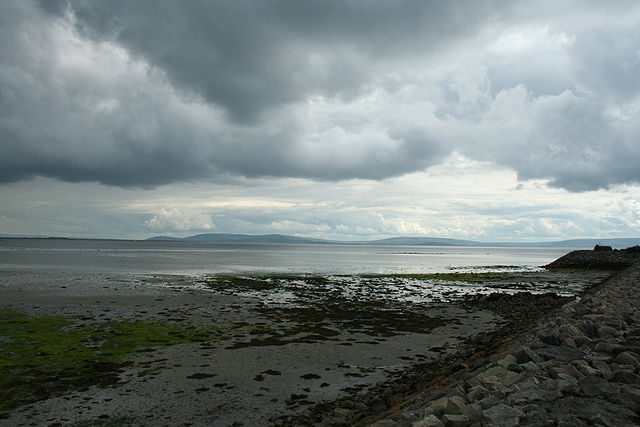
Galway Bay from Salthill Photo: Peter Clarke Wikimedia CommonwIRON COUNTY RECORD 7TH MARCH, 1913
“Cheek” in the sense of impudence is an old term. The earliest quotation in Sir James Murray’s dictionary is from Captain Marryat (1840). But it has lately been found in the sixteenth century records of Galway in the west of Ireland. The municipal rulers of that city decreed that any person giving “cheek” to the mayor should “forfeit 100 shillings and have his body put into prison.”
The Minneapolis Journal 14th March, 1905 p10 Aster amellus Wikimedia Commons
Kerosene emulsion, frequently and liberally applied will prevent black lice from injuring your asters. I have got rid of them many times by showering the plants and dusting tobacco dust over them.
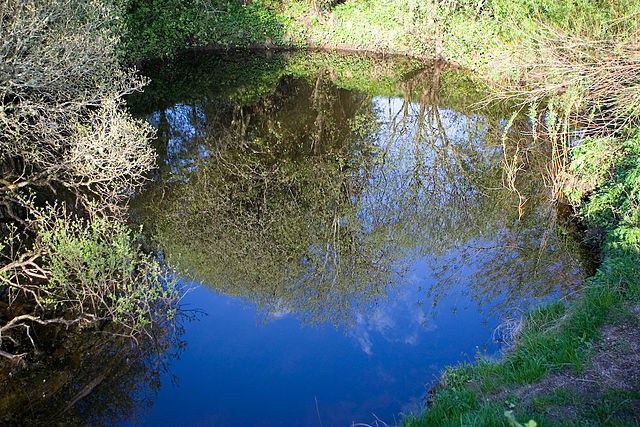
The Shannon Pot – traditional source of the River Shannon Photo: Gerard Lovett Wikimedia CommonsTHE SALT LAKE TRIBUNE 27TH MARCH 1910 P5
Ireland has had her share of floods and can sympathize with France. Along the Shannon in some places the water invaded the country for miles at each side, compelling people living near to hasten from their homes. In one or two places the inhabitants of entire villages sought shelter elsewhere. Some of these people suffered great loss as their entire farm produce was swept off on the swollen river. So great was the flood that the powerful cargo boats could scarcely make headway.
The district near Athlone suffered much and a considerable number of men were thrown out of work. The greatest sufferers are the inhabitants of the islands in Lough Ree, where the water rose to an alarming height. They were completely cut off from the mainland for days and unable to obtain supplies of food or fuel.
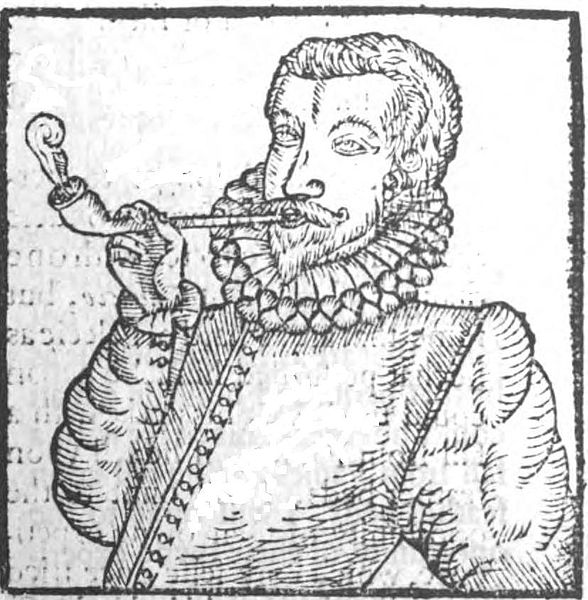
From Chute’s pamphlet “Tabaco” 1595 Parker Burnette Wikimedia CommonsTHE INTERMOUNTAIN CATHOLIC 1ST OCTOBER, 1904 P1
TOBACCO IN IRELAND – PART II
On this interesting subject a correspondent writes:
“A visit to The Farm, Kilmainham, Kells, County Meath, would satisfactorily show that there can bee little doubt as to the possibility or indeed, ultimate success of tobacco culture in Ireland. The plants are very fine and well grown, all seeming in robust health. The variet grown is Yellow Prior, an earlier and dwarfer variety than Virginian, hitherto planted.
The plants were raised under cover and planted out three feet apart. They promise to require all the space given and should indeed produce well. No pains seem to have been spared in their culture and the gratitude of all Irishmen is due to Colonel Everard for the practical philanthropy with which he has taken up and worked out to such a successful issue this important industry, which if carefully nurtured and upheld, will soon be the means of giving healthy employment to thousands of our rural population. Already numbers of women and children are being employed. It but remains for Irish tobacco manufacturers to prove themselves equal to the occasion and with the usual skill of the craft to second the efforts of Colonel Everard and the department of agriculture by producing a good sound Irish-grown tobacco”. Drogheda Independent.
Tobacco Flower, leaf and buds. Photo: William Rafti Wikimedia CommonsTHE INTERMOUNTAIN CATHOLIC, 10TH AUGUST, 1907 P1
TOBACCO IN IRELAND
Tobacco culture was introduced in Ireland by Sir Walter Raleigh during the reign of Elizabeth. County Cork can boast of being the first part of the country in which the plant was cultivated. The plant thrived and grew abundantly in the prolific soil of this country for some centuries.
During the reign of Charles II a law was passed prohibiting the culture of tobacco in Ireland. However, in the reign of George III the act was repealed. The people had forgotten all about its culture until some inhabitants of Wexford returned. This state of things continued till 1829. In this year 1,000 acres were under cultivation in Ireland. The industry is now flourishing in County Meath.
Waterspout off the Florida Keys Image ID; wea00308 Historic NWS Collection Dr. Joseph Golden, NOAA Wikimedia CommonsWestern Waterspout
The Times London, May 20, 1788
On the 6th inst. between two and three in the afternoon, a water-spout of considerable diameter made its appearance between Adare and Barnakill-bridge in the county of Limerick in Ireland. This phenomenon, which is rather uncommon in Ireland, is described to have been of a spiral storm, exhibiting a very dazzling brightness, and attended with a ???? somewhat resembling the clash of arms. It is added that the beasts of the field appeared terrified, and that several crows, as if suddenly killed, dropped to the earth. At the same hour a very heavy rain (accompanied with loud thunder and unusually vivid flashes of lightning) fell in the city and liberties of Limerick, but did not extend beyond them. We have not heard whether the bursting of the water-spout occasioned any particular injury to the part where it fell.
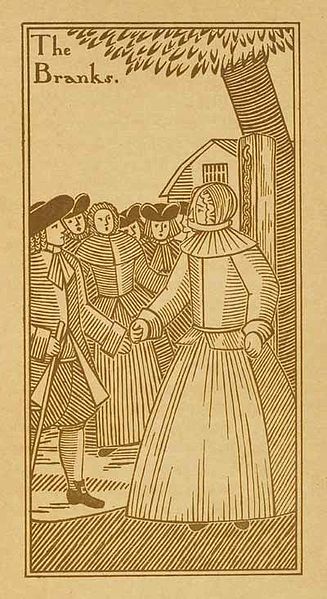
The scold’s bridle Artist: Frank Hazenplug from ‘Curious Punishments of Bygone Days (Project Gutenberg) Alice Morse Earle. Originally published Chicago. H.S. Stone 1896 Wikimedia CommonsTHE NEWS-HERALD 29TH DECEMBER, 1887 P3
PUNISHING SCOLDS (abridged)
Amongst the instruments of punishment introduced to Ireland was a kind of helmet formed of rods, a cage in fact, within which the heads of incorrigible scolding viragos were incased. Provision was made to stop any oral whirlwind of the patient by a counter tongue of metal extending inwardly from a frontal bar, and nicely adjusted to fit an average female mouth.
A fine and well-preserved specimen of a peace-maker of the kind in question, long used in Kiilkenny, at present forms an interesting and suggestive object amongst the antiquities preserved in the museum of the Royal Historical and Archaeological Association of Ireland.
Professor Ball, of the science and art department, Dublin, has had this tangible evidence reproduced in excellent work for exhibition in the national museum.
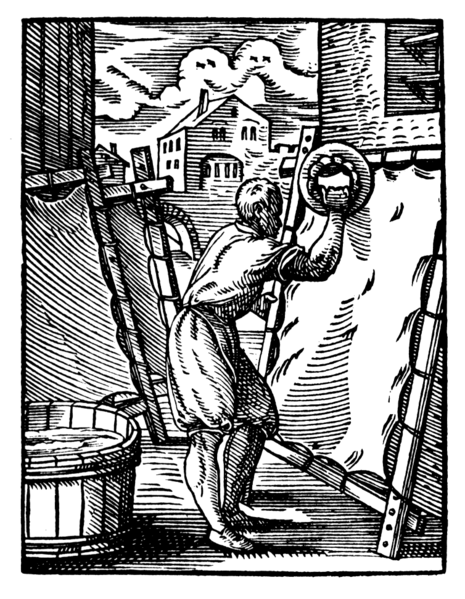
German parchmenter, 1568 Eygentliche Beschreibung aller Stände auff Erden, hoher und nidriger, geistlicher und weltlicher, aller Künsten, Handwercken und Händeln …” / from Jost Amman and Hans Sachs / Frankfurt am Main / 1568 / thanks to http://www.digitalis.uni-koeln.de Wikimedia CommonsThe Times London, Middlesex, England July 17, 1788
A short time since as some labourers were clearing the race ground of Loughmore, near Limerick, they found a small brass box, containing a piece of parchment five inches square, on which is written the admission of a fellow or scholar at Mungret University, which was at an early age, a famous one; at the top is a picture of St. Patrick, and it is signed Gulielmus Nophine, with the date A.D. 485. It was purchased for a guinea and sent as a present to a member of the Irish Academy.
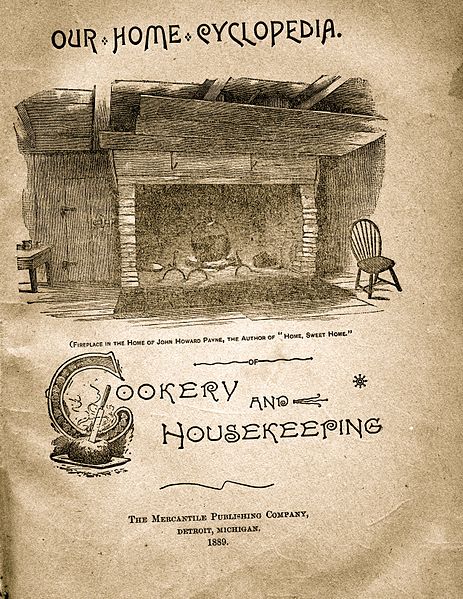
Title page of “Our Home Cyclopedia,” of “grocery and housekeeping – 1889 Mercantile Publishing Company Wikimedia CommonsTHE TIMES (LONDON)
28TH MARCH, 1788 (abridged)
Mr. Conolly of Ireland has brought forward a motion for abolishing the tax upon HEARTHS, and the Irish Ministry will not oppose it. In Ireland, hearth-money is at this day more oppressive than ever it was in England.
This tax has ever been hateful, and as the subject is again revived- we will give its history. In Doomesday-Book, compiled by order of William I. there existed a tax called fumages or fuage, which common people termed smoke farthings. This tax was paid by custom to the King, and was rated upon every chimney in a house.
Edward, the Black Prince, after his successes in France, in imitation of the English custom, imposed a tax, one florin upon every hearth in his French dominions. This tax is mentioned in the twenty-third volume and four hundred and sixty-third page of the Modern Universal History, and in Spelman’s Glossory under the word Fuage.
In the fourteenth year of the reign of Charles II, a statute was passed in Parliament that all houses liable to church and poor, should pay two shillings for every hearth. This payment was granted as an hereditary revenue to the king for ever. Subsequent statutes allowed a surveyor, appointed by the crown, a constable and two other inhabitants of the parish, to view the inside of every house in the parish.
Hearth-money was eventually abolished by a statute, passed in the first year of King William and Queen Mary. The statute declared-that hearth money is “not only a great oppression to the poorer sort, but a badge of slavery upon the whole people, exposing every man’s house to be entered into, and searched at pleasure, by persons unknown to him. To erect a lasting monument of their Majesty’s goodness in every house in the kingdom, the duty of hearth-money was taken away and abolished.”
Ireland awaits and the Minister will acquire well earned popularity by not opposing its annihilation.
NOTE: The hearth tax was abolished in England in 1689 – It was abolished in Ireland during the 19th Century.
Wood Engraving by Elinor Monsell, on title page of ‘Twenty One Poems’ by Katherine Tynan, Dun Emer Press 1907 Wikimedia CommonsTHE CONNAUGHT JOURNAL 28TH OCTOBER, 1824 (abridged)
EXTRAORDINARY OCCURRENCE
The following singular occurrence which took place a few days since in the neighbourhood of Woodford, has excited a very considerable sensation there: Elizabeth C—, an interesting young woman about nineteen years of age, who lived in the service of _____ Forrest, Esq. a gentleman residing at Woodford, in consequence of getting her feet wet, caught a severe cold, which brought on a fever. She was confined to her bed for several days, when she, to all appearance, died! An undertaker was sent for, and the next day, she was placed in a coffin. The intelligence of her supposed death was transmitted to her mother, an industrious woman, with a large family, who was almost broken-hearted at the melancholy tidings.
From her good conduct while in the service of Mr. Forrest, that gentleman resolved to defray the expenses of the funeral, which, it was arranged, should take place on Sunday last, a week after her supposed death. On that day, her mother, and several other relatives came to pay the last tribute of respect to her memory. Prior to the coffin being screwed down, they went to take a look at the body. One of them observed that she had not undergone the change usual on such occasions, and that her face appeared rather flushed. She suggested the propriety of sending for a surgeon, which was immediately done. He ordered her to be placed in a warm bath, and applied the remedies usually resorted to, to recover persons apparently drowned, and which were happily crowned with success! The young woman was so far recovered in a few hours to be able to speak, and is now in a fair way of recovery. The anxiety with which her friends witnessed the progress of the means resorted to for her restoration, and their joy at its success, may be more easily conceived than described.




 The Burren and Beyond