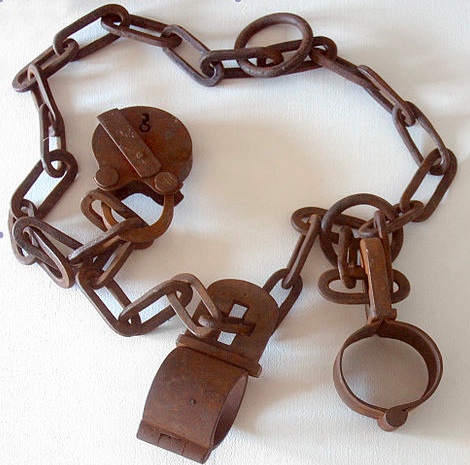
Old bracelets Photo: André Karwath (aka) Wikimedia Commons
Irish Slave Traffic (abridged)
For the next three Sundays at Robert schoolhouse Father Collins will lecture on ‘Irish Slaves and their Descendants.’
Over 6000 children of Catholic Irish were transported to the West Indies, to Carolina and Georgia, and raised as strangers to all they believed or knew. Over 100,000 adults were transported to Virginia and Kentucky where they were sold as slaves.
XX By the Hon P McM. Glynn K.C. Minister for Home and Territories (abridged)
Gort, August 12, 1916. I arrived here on August 10. Names, not much else, have changed. Some old people, some middle-aged, knew me; their faces are not those of the past. Newquay, twelve Irish miles from here, is changed. The four or five white cottages facing the beach of shingle and sand, looking across the opening of ihe Straits towards Aughinish, are in ruine. It was difficult to identify the location of the seaside cottage in which, during some summer months, we lived.
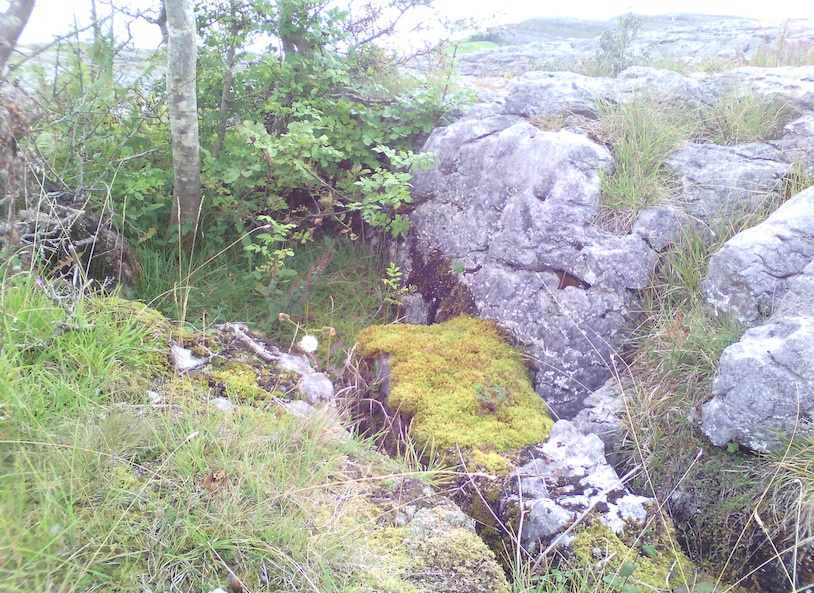
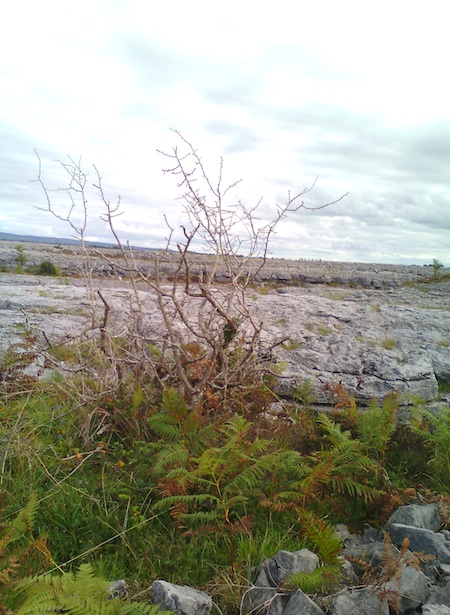
Driving round by the flaggy shore to Ballyvaughan and then across a gap in the Burren Mountains towards Kinvara, from which is a fine view of the inner-part of Galway Bay. The promontory of Aughinish and the swift current of the sea between it and the mainland is open; along dusty, limestone roads; the crumbling walls of deserted houses are seen in many places by the way. Most people of. the past seem to have gone to heaven or the United States.
Politics, as they go, are still matters of conversational interest here. The Sinn Fein movement is mentioned by some with sympathy for motive and contempt for methods and organization. The rising came as a surprise, if not a shock, to some persons, but there were, or are, scattered sympathisers or objectors to the more, drastic of the methods of repression among the middle as well as the working classes. For among those who paid the inevitable penalty of revolt in time of war were some leaders of ripe scholarship and. in other respects, stainless lives; ‘Poets of the Insurrection’ as they were called, whose mistakes of judgment, policy, and method are lightly regarded by those of emotional temperament to whom disinterestedness primarily appeals.
Discontent now turns on the recent check to Home Rule as expressed an the Government of Ireland Act, 1914. There is a feeling that the political system – Union Government – is still the source of any economic maladjustments, and that the country will at once flower under the working of autonomy.
At Loughrea, behind the house of my brother James, are the ruins of an old abbey, one of the finest of the monastic days, and the Abbey walk. Across the road is the Carmelite church and monastery, and beyond sloping country, with a good growth of meadow grass and trees. Loughrea is situated on a lake, on the far bank of which the historic or traditional Fian ma Cumhill had some of his escapades. It has an excellent cathedral church, built by the lake; finished in every point of architectural design.
The intermountain Catholic, 29th February, 1908 p6
Photo: EO’D
A Ballad of Galway
The market place is all astir,
The sombre streets are grey.
And lo! a stately galleon
Lies anchored in the bay
The colleens shy, and sturdy lads,
Are swiftly trooping down,
To greet the Spanish sailors,
On the quay of Galway town.
But Nora, golden Nora
What matters it to you?
There’s joy, long time a stranger,
In those gentle eyes of blue;
And wherefore deck your ringlets,
And don your silken gown.
For a crew of Spanish sailors,
That stride through Galway town.
Said Nora, golden Nora,
And her laughter held a tear.
I don my gown and laces
Because my love is near,
Among the Spanish crew is one
Should wear a kingly crown,
Although he walks a landless man,
Today through Galway town.
“Look forth! see yon his dusky head
Tower high above the throng.
Oh, brave is he, and true is he,
And so my lips have song.
For he’s no Spanish sailor.
Though he wears the jerkin brown,
But Murrough Og O’Flaherty.
Come back to Galway town.
He fought in Spain’s red sieges,
And he held a captain’s place,
Ah! would his arm were raised to strike
In battles of his race!
But his boyhood saw with bitter grief
Iar-Connacht lose renown.
When the Saxon crushed his valiant clan
In the streets of Galway town.
Tonight will be our wedding
With a holy priest to bless,
Shall we remember Cromwell’s law
Amid such happiness?
While my true love’s arm is round me.
Should they come with fighting frown,
His sword shall cleave a pathway
For his bride through Galway town.”
Then up the street stepped Murrough
And down stepped Nora Ban.
Had ever sailor fairer love,
Sweet, sweet as summer dawn?
Their glad lips clung together,
Such bliss old grief dost drown;
God guard the faithful lovers,”
Prayed we in Galway town.
Oh, far across the water
The gold ship’s speeding now,
And Murrough Og O’Flaherty
Stands tall beside the prow;
And Nora, golden Nora,
A bride in silken gown,
Hath sailed away forever
From her kin in Galway town.
Ethna Carberry in the Catholic press, Sydney, Australia.
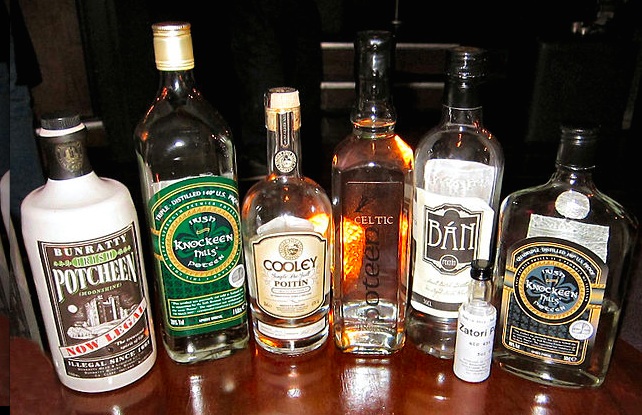
Poitin or Poteen Bottles Photo: Ethanbentley Wikimedia Commons
The County Galway police have made a large capture of ‘potheen’ barrels, tubs, and a fully working still at Gorumna Island. They left the mainland in the middle of the night and concealed themselves on the Island until they discovered smoke rising from the still, when they rushed the place. They captured three of the smugglers and 4,400 gallons of wash.
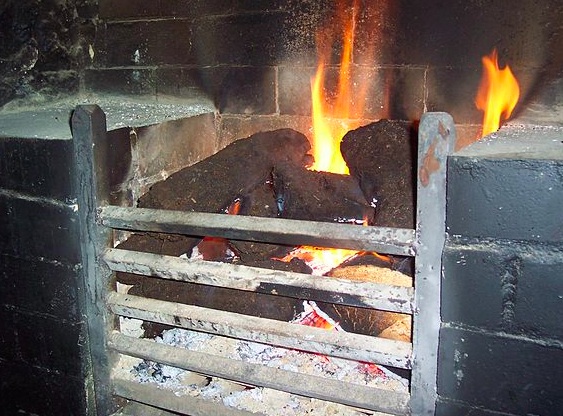
Feu de tourbe Photo: Cqui (talk) Wikimedia Commons
Many uses of Irish Peat
A large Dublin manufacturer has a room entirely furnished with irish peat. The carpets on the floors, the curtains at the windows and paper on the wall are made from this substance. For years he has experimented with the material, which is now very largely exported as fuel, and he has discovered that from it, it is possible to produce almost any kind of fabric.
THE CONNAUGHT JOURNAL
Galway, 13th September, 1824
RURAL SPORTS – The crowds now at the Burren Spa are beyond any calculation in that country. – The numbers assembled to see the best Irish jig dancers was immense and the contest so equal between two of the fair competitors, that the judges could not decide between them, and therefore directed the silver watch to be given to those very interesting girls, to be disposed of as they pleased. Immediately after the dancing, four horses were started, and there was a most excellent race. – On yesterday a fox was to have been shook at the well, and it was so arranged, that the ladies should witness “his funeral tears;” and on Sunday next there will be another race, and afterwards a hurling match, consisting of twenty-one men at each side – one party dressed in blue jackets and caps, and the other in red.–Limerick Paper.
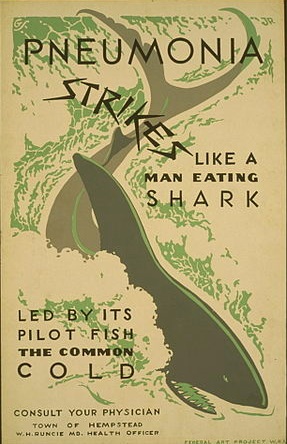
‘Pneumonia strikes like a man eating shark” by WPA Artist: “G S Jr” Wikimedia Commons
20th September, 1824
At this time of the year colds are easily caught, and difficult to cure. The following will be found effectual: –
After a quick walk in the evening, sit in the draft to cool; the consequence will be a severe cold, attended with cough; the next day hoarseness, short breath, and much expectoration; in the evening, at seven, go to a well-frequented tavern, and drink three or four glasses of strong punch, or stiff rum and water; stay till eleven, walk home cosey, and go to bed; you need not get up the next day, but send for the apothecary, the following day for the physician, and the third day your friends will send for the undertaker. You will never feel the effects of an autumnal cold afterwards.
A few years ago, during one of our often recurring “hard summers” the poorer classes in the neighbourhood of Mr. Patrick Lalor, of Tennkill, suffered severly from the scarcity and high price of potatoes; and Mr. Lalor (at first in a few instances) became security to a gentleman, then in the milling trade in the vicinity of Abbeyleix, for small quantities of oatenmeal, to keep actual starvation from some of those he saw most distressed. This of course became generally known, and numerous similar applications were speedily made to Mr. Lalor, who, perhaps with more benevolence than worldly wisdom, consented to become security in like manner for every applicant of good character. He was told he would himself have to pay for the greater portion of the debts incurred; but he measured the character of his countrymen by a different standard. He believed they could be honest, though coerced but by principle and gratitude, and the result was that when the season of plenty arrived-when abundant food and remunerative labors were again attainable, those relieved came forward to justify their benefactor’s confidence in them by paying, almost without exception, the debts they had contracted.
The number relieved amounted to some hundreds. Mr. Lalor had no security whatever from them-he could not, like the managers of a loan fund, apply to the law to aid him-he had nothing to look to but whatever trifle of honesty and gratitude he could hope for from a set of hungry beings whom he was in the almost daily habit of hearing reviled as the most unprincipled wretches on earth. Yet, though the sums which he became accountable exceeded nine hundred pounds, he can turn to the aspersers of his poor countrymen, and boast that amongst all who were relieved, there was not found enough of dishonesty and ingratitude to subject him to a loss of as many pence.–Kilkenny Journal.
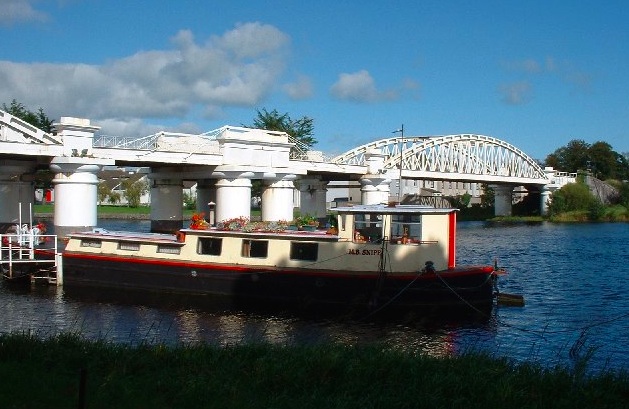
The crowning finish was given on Saturday the 19th of July to the great line of railway from Dublin to Galway, by placing the last rail on the Shannon Bridge. This splendid structure is 500 feet in length and constructed of wrought iron girders, with openings of 165 feet in the clear.
Mr Hermans, the chief engineer of the line, came with a staff of assistants to witness the completion of the bridge and test its strength by driving the locomotive over it. By ten o’clock at night, after great exertion, the closing rail was cut and laid in place, and amidst the cheers of a great crowd of spectators, the Venus engine was driven four times rapidly from end to end of the bridge, which bore the weight without the slightest apparent deflexion. The line was to be inspected for the Government in the course of the ensuing week and would be open to the public on the 1st of August
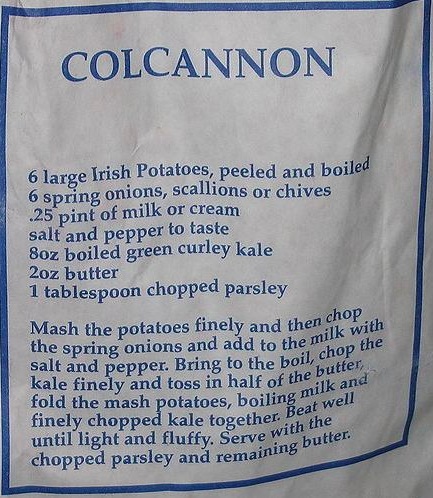
Colcannon recipe on bag of potatoes Photo: Sarah777 Wikimedia Commons
Colcannon
Six cups of boiled cabbage, three cups mashed potatoes, three heaped tablespoons butter, one cup of milk, seasonings.
Mix cabbage, potatoes, butter, milk and seasonings. Place in buttered baking dish. Dot with more butter and bake 40 minutes in hot oven. Serve with meat.
The Salt Lake Herald 14th June, 1903
Irish Colcannon
Peel and cut a large parsnip into small pieces, cook for fifteen minutes in boiling water; then add peeled potatoes and an onion. When the vegetables are very tender drain the mash, adding milk or cream until you have a smooth mess. Season to taste with salt and pepper.
The News and Herald 13th January, 1883 p4
Wash a head of white cabbage and put it over the fire to boil in plenty of salted boiling water Peel twelve large potatoes and put them to boil with the cabbage. When the cabbage and potatoes are done, drain of the water in which they were cooked, add to them four tablespoonfuls of butter, a cupful of good milk, or cream if it is plentiful, a level teaspoonful of pepper; chop all these ingredients together; then heat them and server the colcannon hot as a vegetable dish.
Philadelphia Colcannon

 The Burren and Beyond