Kerry Evening Post 31st January, 1877 p.2 (abridged)
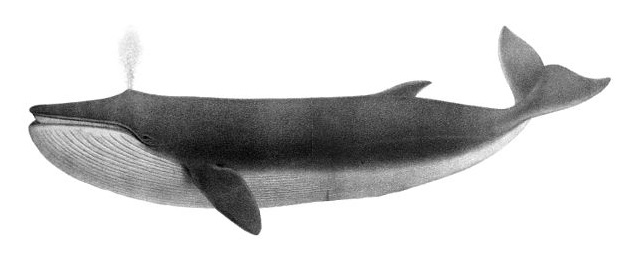
“The Finback” (Balaenoptera physalus) from Charles Melville Scammon’s Marine mammals of the western coast of North America (1874)
The Galway Express reports that a whale was got dead out at the sea on Friday night by a Claddagh man named John Donohoe; he gaffed and strung it to his boat, with the aid of another small boat’s crew. The night was extremely stormy and they got much knocking about, but succeeded in towing it in. It is a rather small fin-whale, about twenty-five feet long, and from three and a half to four tons weight. The blubber has been cut off, and is valued for about £40, a rather handsome booty.
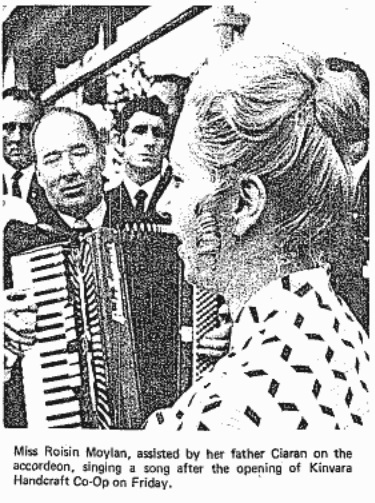
The Secretary of the Kinvara Handcrafts Society, Mr. Toddie Byrne, said last week that they now intend to launch out into crochet making. Mrs. Michael Corless of The Square, Kinvara, is busy designing wool crochet dresses and caps. Another product will be rush-work for which they’ve been inundated with offers from local women and women from neighbouring parishes. Up to now, he said, they had decided not to deal with rush-work because of involvement in the making of Aran jumpers and cardigans.
At present they have over two hundred of these garments in stock. Buyers from England have bought some of the local garments and a letter has been received by the Society from a housewife in England expressing appreciation of the workmanship, the pattern and potential market for these traditional garments. A small consignment has been dispatched to America. Negotiations are in progress for the purchase of a site for the construction of a display centre and offices in the town of Kinvara where a permanent staff will take charge of the daily affairs of the co-operative. A special display of the hand-made garments will take place in early February in the town for the benefit of buyers from Canada who are expected to make a great impression on the sales of the fine garments.
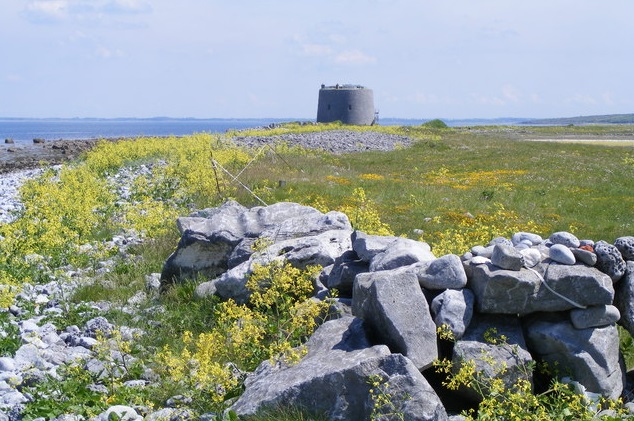
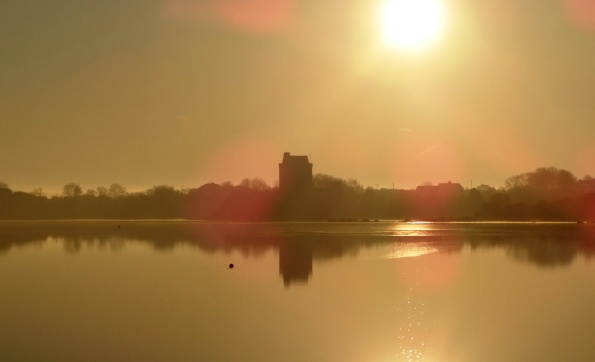
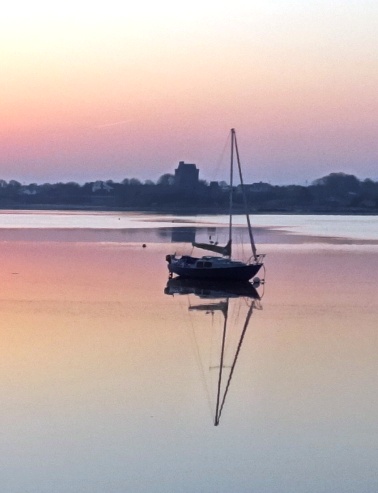
Martello Tower Aughinish Photo: A McCarron Wikimedia Commons
At Aughnish Point, a little fishing village in the wilds of Clare, on Monday last, two or three fishermen, with sorrowful faces, might be seen lifting off the strand, where it had been left by the receding tide, the lifeless corpse of a woman. From her long hair and humble garments, the sea water ran in streams over the friendly forms who bore their sad burden to a hut hard by. She whose lifeless form lay stretched upon the fisherman’s cabin floor had sought in death release from sorrow, not from shame. Over her story there hung no mystery, upon her memory no blot or blame. She had truly and faithfully given to society examples of heroism in affliction and fortitude in struggles where man’s endurance failed. Behind this record of its tragic close lies the story of a stainless life.
Twelve years ago, Mary McN. was the wife of an Irish farmer who tilled a little holding of four or five acres, which, with probably the proceeds of the fishing season, sufficed for all his wants. Death struck down her husband and left her single-handed to act a mother’s part with seven children. The black days of the Famine came. She had around her a young family, which, the evidence at the inquest tells us, she had always managed to bring up creditably and respectably. How hard she must have struggled. But now, indeed, the wolf was at the door, yet, she did not, even in that hour, despair. She wrought and wrought and toiled and slaved and never gave up the four acres nor deserted the little home beneath whose roof had passed the bright scenes in the drama of her humble life.
She came through those terrible famine years a victor. The little home still smiled, and still she had the ambition of bringing up her little boys and girls “respectably.” She achieved it all.
But, at last, a more terrible calamity than the Famine came upon her; one before which, all her striving was in vain. One against which, she strove until her honest heart broke in the struggle. The property upon which she was a tenant was sold in the Incumbered Estates Court. An envious eye was cast upon the little farm. In a perfectly “legal” manner Rev Mr J. outbid Mary for the spot which she had held for over twenty years. The spot she had struggled so hard, so bravely, to retain when the grave or the workhouse (to a heart less resolute) seemed inevitable. In vain she pleaded, begged, prayed. She was evicted.
The poor woman long refused to believe the fact. With passionate energy, she exhausted every possible means of retaining the farm. But the law was too strong. She had to quit. With her seven children she was adrift upon the world. The the strong mind gave way; the strained bow broke. For a long time, dejection settled upon her and she would ever keep talking of the humble home where once she had been happy, from which she had been driven forever.
Friends thought Time, the consoler, would calm the poor widow’s grieving; but alas her reason fled. The poor woman wandered about the fields, talking as of old, when they were her care; of the farming labours which she directed; of the hard struggles she fancied were still going on; of the old subjects of anxiety and foresight. She would shout out that she would not be reft of her humble home, that it was still hers.
But sometimes, as if a glimpse of the disastrous truth broke upon her, she would sink in prostration and talk dejectedly about the struggle in which she had been overthrown. Last Monday she was observed to wander to the waterside, pause for a moment, fold her arms, then plunge into the tide.
Take her up tenderly, kind neighbourly hearts; she was an Irish wife and mother, without stain and without reproach.
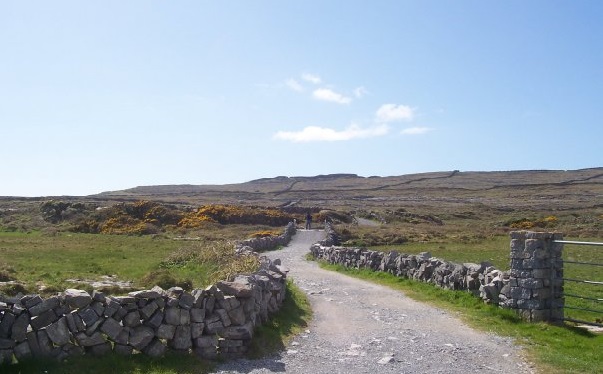
Innismore, Aran Islands, County Galway Photo: Jansena1
A correspondent of the Mail states that the Viceroy carried 1,120 letters and 33 passengers. We find in the same journal the subjoined letter from Mr. Evans, the pilot of Galway;
Galway, June 2, 1850 Sir, At the request of Mr. Leigh, chief officer of coast guards, I beg leave to inform you that I proceeded as far as the Sound, on the north island of Arran, on board the Viceroy, on yesterday morning, a distance of twenty-seven miles from Galway, which she steamed in the wonderfully short space of two hours and ten minutes. I left her at 12 o’clock precisely, and at one p.m., she was completely out of sight. During all night it was perfectly calm, and at six o’clock this morning a nice breeze sprung up at S.S. East. The wind is now (three o’clock, p.m.) due south, fresh breeze. I have crossed the Atlantic several times by the Cunard steamers from Liverpool, and I am happy to inform you that the Viceroy exceeded any of them in speed at our starting; and I feel quite confident she will realise the hopes entertained of her making a speedy passage. I am, Sir, your most obedient servant, Joseph Evans, Master Pilot.
Address of the parishioners of Kinvarra, Duras and Killinna to the Rev. Francis P.P. Croughwell and Ballimana.
Rev. Dear Sir,
We have been deputed by our fellow parishioners of the united parishes of Kinvarra, Duras and Killinna, to offer you in the first instance their sincere and heartfelt congratulations on your recovery from your late severe and dangerous illness, and in the next to convey to you their, and our own, deep regret at your having been so soon after removed from amongst us.
For four and twenty years have you discharged the onerous duties of Pastor to these parishes with a pious zeal truly edifying, and the benefits conferred on religion and morality by your counsel and teaching during that eventful period it is not in our power to convey an adequate idea of, but we fondly cherish the hope that they will be appreciated by Him whose faithful servant you have ever been and who is sure to reward those who faithfully do His work.
It would be difficult, Rev. Sir, to enumerate all the advantages which your late Parishioners have derived, both spiritually and temporally, from the interest you have ever evinced in their welfare.
Need we refer to your exertions in their cause when famine and all its sad consequences, fever, cholera, &c, &c, stalked abroad, and like and avenging angel was devastating the land. Then, indeed, it was that the good and zealous Priest of Kinvarra proved the interest he felt in his flock, in not only being found day and night in the midst of contagion and approaching dissolution, ministering to their spiritual wants, but also in relieving by his purse, and frequent appeals in their behalf to the charitable throughout the kingdom, their distressed condition.
We would be ungrateful and unworthy of the benefits conferred on the parish by him did we omit the name of your respected and beloved Curate in this address, of him who, which on the mission amongst us, has won for himself not only our esteem and affection, but the respect and regard of all those who had the happiness of hearing his exposition of the Word of God during his mission in the parish. We felt much, and were truly sorry to learn, that your respected Bishop had resolved on removing you, Rev. Sir, to another parish, but which removal we, however, sincerely hope will prove to you a well-merited reward for your past invaluable services in this.
We cannot give expression to the feelings of regret entertained by all when it was ascertained that his Lordship felt it necessary to remove the Rev. Mr McDonogh also from amongst us.
In conclusion, we beg to observe that, although the scene of your labours is now elsewhere and amongst other people, we are convinced that your prayers will still be offered to the Throne of Mercy for those who have commissioned us to present you with this Purse and its contents as a trifling token of the love and esteem in which you have ever been and will be held by them, as well as by your sincere and ever faithful friends.
Signed on behalf of the Committee.
Isacc B. Daly, Chairman
D.J. Hynes, M.D.(Vice Treasurer)
Martin Kerin (Vice Treasurer)
Arising out of a letter from Mr. J.J. Linnane, Bellharbour, that the potato crop in North Clare had been severely damaged by weather conditions this season, the Clare Farmers’ Party requested Dr. Ryan, Minister for Agriculture, to take steps to ensure that an adequate supply of seed potatoes would be available for farmers next season. P. Brassil said that farmers did not always grumble but they certainly made a protest when they saw their hay, corn and other crops flying in the wind and every crow from Kinvara to Bunratty having a peck at their property.
In Iniscaltra’s holy fane,
Once in the long ago,
In pious converse sat, their hearts
With love of God aglow,
Kevin, the abbot of the Isle,
From penance worn outright,
And he whom still Confert reveres,
Cumain the erudite;
And, with them, Guaire, Connaught’s King,
To Eire’s utmost bound.
For his beneficence to all
Who sought his aid, renowned.
“And now, O Guaire,” Kevin said,
“Did Heaven grant you your will,
With what, as most desired, would you
This house of prayer fill?”
With gold I’d fill it to the roof,
Nor then be satisfied,
Wishing it held as much again,”
The King to him replied.
“With gold,” said Kevin in surprise
“Guaire, can this be true?”
“With gold,” he answered, “for the good
That I, with it, would do.”
“Part to the churches; part I’d give
The saints, for me to plead;
And alms to all who’d ask me grant,
And no one leave in need.”
“Guaire,” said Kevin, “as to all
You’re helpful in their need,
God, in return, yourself will help,
And Heaven shall be your need.”
“Well be thankful,” Guaire said; “and now
Cumain, had you your will,
With what instead of gold, would you
This house of prayer fill?”
“I’d fill it all with books,” he said,
“For studious men to read,
And with the doctrine in them stored
Christ’s hungry flock to feed.”
“And now, O’Kevin”, said they both,
“With what, had you your will,
“Instead of books or gold, would you
This house of prayer fill?”
“I’d fill it,” Kevin to them said,
“With all the ills that be;
All human sorrows, ailments, pains,
And wish them all on me.”
Each had his wish. To Guaire gold
was in abundance given;
With books unnumbered Cumain gained
Unnumbered souls for Heaven.
And Kevin suffered. With disease
His flesh dissolved; with pain
His frame was racked till scarce a bone
Did in its place remain.
By Charity and doctrine true,
And, for our sins, by pain
Should God ordain it so – may we,
Like them, to Heaven attain.
P.S. Iniscaltra, now called Holy Island, is situated in Lough Derg, a few miles above Killaloe. The
“Great Church” there, destroyed by the English, was erected by St. Kevin
the Abbot of the island.
One morning when the earth was new
And rainbow-tinted lay the dew,
The Father came.
Upon his waiting flows he cast
A gentle glance, and as he passed,
Gave each a name.
The twilight deepening as before
He walked among his flowers once more
And asked each one
What name apart from all the rest
He gave, its faithfulness to test
When day begun.
The aster, columbine and rose
All answered – every flower that grows
In field or wood,
Save one wee blossom from whose eyes
Shone back the colour of the skies,
That silent stood.
The flowers were still, “I love thee so!”
She said, then trembling, withered low,
“Yet I forget!”
“Dear child, thy name thou may’st forget
And be forgiven – only yet
Forget “Me Not.”
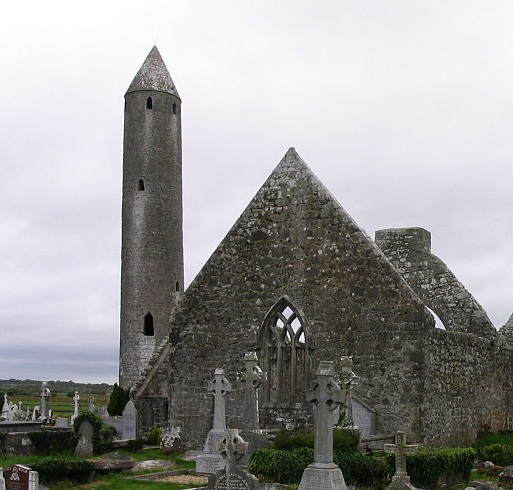
Kilmacduach (Cill Mac Duach – Mac Duach’s Church), County Galway, three and a half miles from Gort, is situated in rather bleak country on the Clare border. St. Colman Mac Duach founded a monastic settlement there in the seventh century. He spent the earlier part of his life as a hermit in the wilds of Clare, and many are the legends told about him and the holy wells dedicated to him in the neighbourhood. Then, having the good fortune, like most of the Connacht saints, to belong to a royal family, he received a grant of land at the present Kilmacduach from his kinsman, King Guaire.
There are several ecclesiastical ruins. The Cathedral of the old diocese of Kilmacduagh is a large building, but ruined. The west gable and doorway and part of the side-wall, built of large polygonal stones, are ancient, and probably part of St. Colman’s original church; but the rest of the church is fifteenth century. There is a good doorway in the north wall of the nave. North of the Cathedral is Teampal Iun (St. John’s Church) with a fifteenth century nave. The east windows, round-headed, displays the graceful Irish Romanesque style at its loveliest. The opes are only eight and a half inches wide but eight feet high, with rich mouldings on the internal jambs and external reveals. A slender torus encloses the whole window. The south windows, of one light, with a hood moulding, is almost as beautiful. The piers of the chancel arch are transepts, but preserve some of the best points of the Irish Romanesque style. They consist of three engaged pillars, with sculptural capitals and bases. There are quoinshafts to the chancel, beautifully pointed. This church was evidently built between the twelfth and thirteenth centuries, before the Norman invasion disturbed the place of the bishops of Kilmacduach.
There are remains of several other churches, and some tombs, notably those of the O’Shaughnessys, in whose territory the village stands. St. Colman’s reputed tomb is shown nearby.
The Round Tower is one of the finest in Ireland, and is nearly perfect. It belongs to the”fourth” type, with a typical semicircular arch to the doorway, built with three stones. It was probably built at the same time as Teampul Iun. It is 112 feet high with a base circumference of sixty-five and a half feet. The base has a plinth of large stones dressed to the round and the top has been restored with inferior masonry. The tower leans some four feet out of the vertical, the result probably of a subsidence of the foundations, though cannon balls fired at it by Cromwell’s soldiers is the reputed cause. The numerous windows are triangular, with inclined sides. From the tower there is a wonderful view, as the builders intended there should be, across miles of country, and over a good part of Galway Bay.


 The Burren and Beyond