One morning when the earth was new
And rainbow-tinted lay the dew,
The Father came.
Upon his waiting flows he cast
A gentle glance, and as he passed,
Gave each a name.
The twilight deepening as before
He walked among his flowers once more
And asked each one
What name apart from all the rest
He gave, its faithfulness to test
When day begun.
The aster, columbine and rose
All answered – every flower that grows
In field or wood,
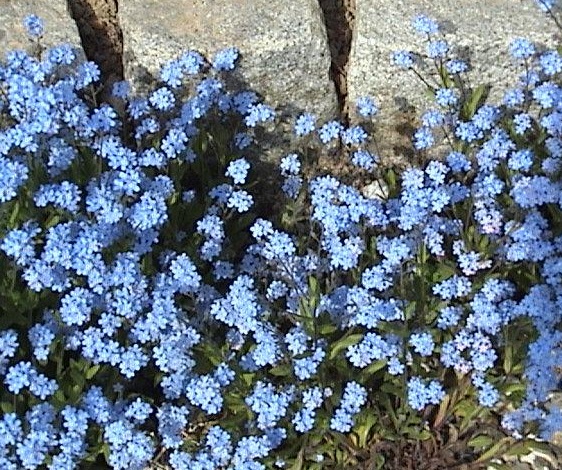
Save one wee blossom from whose eyes
Shone back the colour of the skies,
That silent stood.
The flowers were still, “I love thee so!”
She said, then trembling, withered low,
“Yet I forget!”
“Dear child, thy name thou may’st forget
And be forgiven – only yet
Forget “Me Not.”
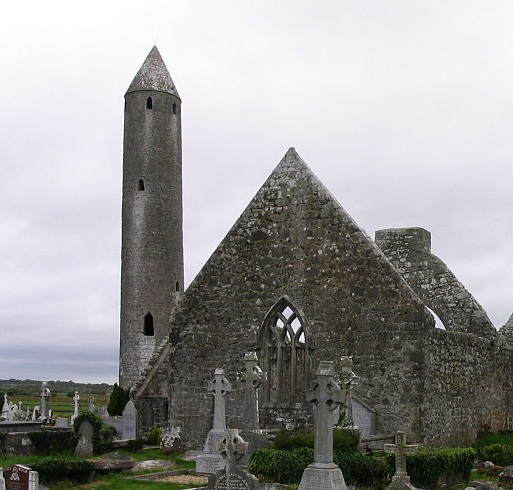
Kilmacduach (Cill Mac Duach – Mac Duach’s Church), County Galway, three and a half miles from Gort, is situated in rather bleak country on the Clare border. St. Colman Mac Duach founded a monastic settlement there in the seventh century. He spent the earlier part of his life as a hermit in the wilds of Clare, and many are the legends told about him and the holy wells dedicated to him in the neighbourhood. Then, having the good fortune, like most of the Connacht saints, to belong to a royal family, he received a grant of land at the present Kilmacduach from his kinsman, King Guaire.
There are several ecclesiastical ruins. The Cathedral of the old diocese of Kilmacduagh is a large building, but ruined. The west gable and doorway and part of the side-wall, built of large polygonal stones, are ancient, and probably part of St. Colman’s original church; but the rest of the church is fifteenth century. There is a good doorway in the north wall of the nave. North of the Cathedral is Teampal Iun (St. John’s Church) with a fifteenth century nave. The east windows, round-headed, displays the graceful Irish Romanesque style at its loveliest. The opes are only eight and a half inches wide but eight feet high, with rich mouldings on the internal jambs and external reveals. A slender torus encloses the whole window. The south windows, of one light, with a hood moulding, is almost as beautiful. The piers of the chancel arch are transepts, but preserve some of the best points of the Irish Romanesque style. They consist of three engaged pillars, with sculptural capitals and bases. There are quoinshafts to the chancel, beautifully pointed. This church was evidently built between the twelfth and thirteenth centuries, before the Norman invasion disturbed the place of the bishops of Kilmacduach.
There are remains of several other churches, and some tombs, notably those of the O’Shaughnessys, in whose territory the village stands. St. Colman’s reputed tomb is shown nearby.
The Round Tower is one of the finest in Ireland, and is nearly perfect. It belongs to the”fourth” type, with a typical semicircular arch to the doorway, built with three stones. It was probably built at the same time as Teampul Iun. It is 112 feet high with a base circumference of sixty-five and a half feet. The base has a plinth of large stones dressed to the round and the top has been restored with inferior masonry. The tower leans some four feet out of the vertical, the result probably of a subsidence of the foundations, though cannon balls fired at it by Cromwell’s soldiers is the reputed cause. The numerous windows are triangular, with inclined sides. From the tower there is a wonderful view, as the builders intended there should be, across miles of country, and over a good part of Galway Bay.
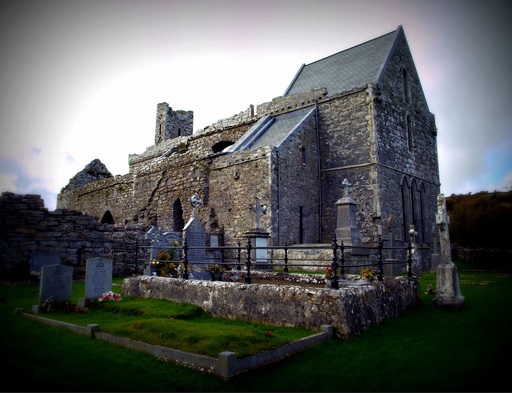
Corcomroe Abbey is in Co. Clare. It is about four miles from Kinvara and five miles from Ballyvaughan. “Corcomroe” (in Irish, Corcomoruadh) means the descendants of Moruadh who is said to have been a son of Queen Maeve. Corcomroe Abbey is a Cistercian abbey. Like other Cistercian abbeys, it was dedicated to the Blessed Virgin and had a special name – “de petra fertile” (of the fertile rock) or “de petra saxo” (of the green rock). In his Ordnance Survey letters, O’Donovan states that according to local tradition it was founded by the son of Conor na Siudaine O’Brien on the spot where Conor was killed c. 1267 by Guaire O’Shaughnessy of Dun Guaire, near Kinvara. In his “Manuscript Materials of Ancient Irish History,” O’Curry states that it was founded by Conor na Siudaine O’Brien. Ware and Archdall are in doubt as to whether it was founded in 1200 by Conor’s father, Donogh Cairbrech O’Brien, or in 1194 by Conor’s grandfather, Donal Mor O’Brien. Other writers state that it was founded by Donal Mór O’Brien in 1182. It is, therefore, certain that the abbey was provided by the O’Briens, and it is probable that it was founded by Donogh Cairbrech O’Brien about 1200.
The following are the most important historical events connected with the abbey;
Soon after its foundation it established a branch at Kilshanry in County Clare. In 1249 it became subject to the abbey of Furness in Lancashire. Not far from it, at Sindaine, which, according to the Ordnance Survey maps, is near Newtown Castle, a battle was fought in 1267 between Conor na Sindaine O’Brien and his uncle, Donal Connachtrach O’Brien who was aided by the O’Connors and the O’Loughlins of Burren. Conor was killed; he was buried in the chancel of the abbey church, and his grave was covered by a stone effigy which is still in existence. In 1317 another battle was fought near the abbey between Murtagh O’Brien, the Chieftain of Thomond, and his cousin, Donogh O’Brien, who endeavoured to depose him and who was assisted by the English. Donogh and the English were defeated, and the bodies of Donogh and his followers were interred in the abbey church. In 1418 the abbot, who seems to have been a very distinguished man, became Bishop of Kilmacduagh. In 1544 the abbey was dissolved, its monks were banished, and its possessions were granted to Murrough, Earl of Thomond.
The Kiltartan Society will meet at Duras House Kinvara, on Sunday next to celebrate the first anniversary of the rebirth of this romantic house, which was presented to the nation as a Youth Hostel by Denis and Adrian Elrill of Limerick.
A paper will be read entitled “The colourful de Basterots 1793-1904.” In “Dramatis Personae” Yeats wrote:
I first spoke to Lady Gregory in the grounds of a little country house at Duras, on the sea-coast, where Galway ends and Clare begins (1897). She had brought me to see the only person in Galway, perhaps I should say in Ireland, who was in any sense her friend – Florimond Count de Basterot. In his garden, under his friendly eyes, the Irish National Theatre, though not under that name, was born.”
Happily, since last year, a plaque commemorates that historic meeting. Lady Gregory wrote that her son and his young friends liked to go out in a hooker at Duras and see the seals showing their heads, or to paddle delicately among the jelly-fish on the beach. It was a pleasant place to pass an idle day.
When Count de Basterot died in 1904, Lady Gregory wrote:
I know that there is many a prayer said on the roads between Kinvara and Burren and Curranrue and Ballinderreen for him who was never without a bag of money to give in charity, and who always had a heart for the poor.
Guy de Maupassant and Paul Bourget, two eminent French writers of his day, spent holidays with the Count in this remote spot near Kinvara.
A report reached Ennis that the police barracks at Ballyvaughan was attacked. Military went from Ennis to the assistance of the garrison. All wires in the district were cut. A Republican flag floating from the roof of the Town Hall was removed by military and another which was replaced there was also removed.
(abridged)
Since our great woods were destroyed, mistletoe is not very common in this country. In ancient times mistletoe was one of the most famous of all plants. As it grows as a parasite on trees, and has no root in the ground, it was supposed to have come direct from the gods as the preternatural product of a sort of virgin birth. The Druids cut it with a golden sickle (for iron must not be used for the purpose) and they let it fall upon a sheet lest it should touch the common earth. The Druids sacrificed two white bulls in its honour. Pliny tells us that in Gaul they cut it on the sixth day of the moon, because then the moon was in its youthful strength and presumably this gave the plant more power or virtue. In north Italy they cut it on the first day of the moon for the same reason.
Church of St.Fachta and one of the Kilfenora High Crosses Photo: Eirian Evans Wikimedia Commons
To the editor of the Nation
Lisdoonvarna, County Clare, 13th July, 1864
Dear Sir,
Within the last ten days, in the vicinity of this far-famed watering-place, near the ancient town of Kilfenora, a statue of the Virgin and Child was discovered by a poor man who had been employed in cutting turf in an adjacent bog. The statue is of carved oak. The face of the Virgin is in perfect preservation, the folds of the dress most accurately delineated, and although the face of the infant in her arms is somewhat disfigured, it is wonderful how perfect the statue is after the lapse of perhaps several centuries. The statue is about two feet six inches in height, and was found some eight feet beneath the surface of the bog. Several persons, not only from this locality, but from the adjoining districts, have felt particular pleasure in observing this memorial of the past, which is now to be seen in the sacristy of the Catholic Church of Kilfenora, County Clare.
I am, dear sir, your obedient servant.
A. Visitor
No progressive or prideful village, however small it may seem to those who do not live in it, likes to be isolated from the main stream of traffic. Yet this is what will happen to the village of New Quay if the present scheme of steamrolling the road between the bridge at Currenroo on the Clare border and Ballyvaughan is persisted in. For the purpose of saving six hundred yards, it is proposed to make what would be virtually a new road through the Ballaghdhine boreen, once made by Barton Bindon for the purpose of watering his horses. Thus the level road to New Quay would be altogether ignored and traffic would be diverted from a village which is a fishing and seaside resort. It is obvious that little saving could be effected by the alternative road, for, inasmuch as the New Quay highway would still have to be maintained at the public expense, an additional stretch would be added to maintenance costs. Moreover, there are a number of ratepayers interested on the New Quay road, whereas there are one on the proposed new thoroughfare. In all the circumstances, it would seem that the wisest, if not the only, course would be to follow the line of the old road which possesses the added convenience of a post office and public telephone service – often a matter of importance on a lonely highway.
Eyre Square, Galway c.1885 National Library of Ireland
On Saturday night some soldiers of the Connaught Rangers, a detachment of which was under orders to proceed to Malta, on the 14th, attacked the police in Eyre Square with stones. Were it not for the timely arrival of assistance, Sergeant Redington would have been badly injured. Tuesday night the disturbance was renewed, and all the available police were brought out. Sergeant Boylan had his skull fractured from a stroke of a belt by one of the soldiers whose conduct was very violent. The police used their batons, and ultimately the soldiers were got to the barracks.
Ballyvaghan Harbour and Pier Photo: Dr Charles Nelson Wikimedia commons.
After a lapse of three years the popular Ballyvaughan races are being revived again. Owing to the scarcity of flappers (horses) for the past few years, the committee thought it advisable not to hold any meetings, but they are assured of good patronage this year, and on September 7, all roads will lead to this little next ‘mid the Burren mountains.