THE IRISH TIMES, Friday, June 13, 1862 – Page 1 Pursuant to previous notice, the inhabitants of Kinvara met in the Courthouse on Sunday, 1st of June, for the purpose of taking into consideration the present destitute condition of the poor in that town and neighbourhood. On the motion of Mr. Martin Linnane; seconded by Mr. Martin Kerins, the Chair was taken by the Rev. Francis Arthur, P.P. The Chairman having addressed the meeting, and explained to them the object for which it was called. The following resolutions were unanimously agreed to:- Proposed by Mr. Thomas Fahy; seconded by Mr. Francis Kilkelly: Resolved – That Denis Joseph Hynes Esq., M.D. &c, be requested to act as treasurer, and the Rev. Christopher Carroll, R.C.C. as secretary. Dr. Hynes then proposed, and Mr. Henry O’Flanagan seconded the following resolution: Resolved – That as every resource for the support of the labouring poor of this Parish is now exhaused, and as unfortunately this Parish has suffered seriously from the injury done to the Potato Crop last season, we, this day, form a committee to devise some means whereby we may be able with God’s aid to preserve the lives of the poor, for the next two months, when, we trust, a merciful Providence will relieve their wants with a bountiful harvest. Proposed by Mr. Peter Linnane: seconded by Mr. Daniel O’Dea: Resolved – That a subscription list be entered into and that our Secretary be requested to solicit subscriptions from the gentry and others connected with the district by property and otherwise. Proposed by Mr. William Flatley, and seconded by Mr. John Harney: Resolved – That the above Resolutions be published in the Galway Vindicator, Evening Freeman and Irish Times Newspapers. FRANCIS ARTHUR, P.P. CHAIRMAN. CHRISTOPHER O’CARROLL, C.C. Sec.
The following subscriptions were then handed in:-
Issac B. Daly, Esq £ 10. 0. 0; Daniel O’Dea £1.0.0; Rev. Mr Moran, Rector, Kilcolgan £2.0.0; Peter Linnane £1.0.0; Rev. Francis Arthur, P.P. Kinvara £3.0.0; Thomas Fahy £1.0.0; John Joyce £1.0.0; Rev. C. O’Carroll R.C.C. £1.0.0; Michael Healy £1.0.0; John Harney £1.0.0; Denis Joseph Hynes Esq., M.D. £2.0.0; John Nolan £1.0.0; Joseph Salmon £1.0.0; Dr. McCormick £1.0.0; Mrs Johnston, Maryville £1.0.0; Martin Linnane £2.0.0; Henry O’Flanagan £1.0.0; Peter Kelly £1.0.0; Martin Kerins £1.0.0; Mrs Alexander £0.5.0; Francis Kilkelly £1.0.0.
THE IRISH TIMES, Friday, June 13th, 1862 p.3 Pursuant to previous notice from the Rev. Mr. Arthur, P.P., a meeting was held in the Court house, Kinvara, on the 8th inst., for the purposes of devising some means whereby the labouring poor of the town and its suburbs could be supported for the next month or two, until Providence gave them by a bountiful harvest the means of warding off the present distressing destitute condition of the poor people. At three o’clock, on the motion of Mr. Martin Linnane, seconded by Mr. Kering,
The Rev. F. Arthur, P.P. was called to the chair. It was then resolved on the motion of Mr. Thomas Fahy, seconded by Mr. Frank Kilkelly, that Dr. Hynes, whose exertions were ever found available in the cause of the poor, should be requested to act as treasurer to our relief fund, and that the Rev. C. O’Carroll, be requested to act as secretary.
The rev. Chairman having observed in the first instance that having passed through the ordeal consequent on the famines of 1947, ’48 and ’49 in this parish, he had hoped that such things as then occurred would never occur again, the rev. gentleman in continuation said – But when I saw on looking around me, even in this potato growing district, that my poor parishioners were many of them on the verge of starvation – and when I remembered how great was their repugnance to seek that relief they so much required at the hands of the Poor Law Guardians – feeling also, that owing to the badness of the times how very ill able the shopkeepers and traders of Kinvara, generous though I know them to be, would be to support the destitution around them, I applied in the first instance to a member of the Mansion House Committee, explaining to him the peculiar circumstances of our cast; and although the committee very kindly then sent us some relief, I was given to understand that unless we established a committee no further funds could be had from that source. Feeling, then, as I thing every man in Ireland ought to feel, that, when every other resource failed, the Government were bound to come to the rescue, and to save the lives of the poor, I addressed a letter to Sir Robert Peel detailing, as well as I could, for it required neither eloquence nor oratorical power to do so, the destitute condition of the labouring poor of my district, and telling him, at the same time, that we wanted no charity – nothing but a loan, as I may say, to get us over the present crisis – a loan which, I felt satisfied, the ratepayers of the district would willingly repay if required to do so, as I wanted no advance except for works which would be beneficial to the barony and the public at large, and I particularly instances the parapet wall along the shore opposite Dr. Hynes’s lawn, as the most useful that could be effected, under the circumstances. You all know, gentlemen, that a man’s life is not safe driving along that road, without almost any protection on the sea side, having a parapet in many places not a foot high, and over which, if a stranger fell, he would precipitated into the deep ever so many feet. Well, to this I drew the Chief Secretary’s attention; and what does he do? He sends an inspector to inquire into the truth of my allegations. That gentleman accordingly came here, but how did he institute his inquiry? Within folded doors, allowing no more than one at a time to appear before him. Even Dr. Hynes, whom he wished to see, and who gave up a pressing engagement in the hope of being enabled to assist me in the inquiry, he told (when he called on him) that he would not want him until evening; but in the evening Dr. Hynes could not attend, and Mr. Bourke (the inspector) returned from the inquiry at Kinvara fully impressed, I am sure, with the applicability in his case to the old proverb of – “veni, vidi, vici” – I came, I saw, I conquered. What you may or have to expect from hiss visit among you, you will hear from Dr. Hynes and as it is noting to give us hope, I have ventured to call you together today in order that you may among yourselves devise some means whereby the poor of our district may be saved for the next two months.
Dr. Hynes then rose to propose the first resolution (which will be found in our advertising columns), and in doing so said – Before I enter on the purport of the resolution entrusted to me, I feel pleasure in being enabled to inform you that I received a very kind and courteous note from our worthy rector, the Rev. James, F. Moran, of Kilcolgan, in which he feelingly speaks of and sympathizes with our present destitute condition in Kinvara. He adds, that he would most willingly have taken a part in our proceedings here today if circumstances, over which he had no control, did not prevent him doing so; but as the sinews of war prove the mainsprings in matters of this kind, he send me what I consider a very handsome subscription from him, on whom there falls so many demands of this nature. I say, therefore, that we should all feel obliged to the Rev. Mr Moran. (Hear, hear.) And now, adverting again to the resolution entrusted to me by our worthy chairman, I do not know whether his recollection of the years 1847, ’48, and ’49, and the part I then took in alleviating the distress of my poorer fellow-townsmen of not which made my respected parish priest so anxious that I should be the mover of this resolution. But, my friends, whatever be his motives, I have felt it my duty to respond to his call. (Hear.) It is melancholy that, in a year like this, when plenty of food can be found in almost every market in the country, our poor should nevertheless be on the point of starvation. What is the cause? Chiefly want of employment. Henceforth, well, then, be it out business – be it our duty to provide employment for the next two months for all such as may require it. (Hear, hear.) I am very sorry that I had not the opportunity of meeting Mr. Bourke here on Friday last, and as I had not, I wrote to him my views of the present destitution, and the means whereby it might be relieved. To that letter, I received a kind and courteous reply, but there was one sentence in it which blasts all our hopes of Governmental aid. He says – “I do not anticipate that any steps whatever will be taken by the Government in consequence of my report”. What, then, are we to do? Let us adopt the good old motto – “Those that help themselves God will help,” and let us this day, and in this Courthouse, enter into a subscription that will enable our poorer townsmen to tide over the present crisis. It may be said that there are too many to be relieved, and that our resources are limited. Granted. But let us divide the responsibility with the poor law authorities. The poor law, even as it stands, empowers the guardians to give outdoor relief to widows, orphans, &c, &c, but denies that relief to the able-bodied labourer, &c. Let it therefore be our province to provide for the latter class, and let the Poor Law Guardians look to the class of persons I have specified. But in order to avoid abuse, we ill give no relief to any person will not give us some work in return for what we give him; in other words, we will provide works of public utility in and about the town, for such as are in the habit of supporting their families by daily labour; to such persons we will give 1s per day, but we will not undertake to maintain those that are entitled to out-door relief from the guardians, and who could not, of course, work for us. I hope the guardians will take care of them – we will take care of the other class, and now, having explained the principle on which we propose to act, I beg leave to propose the following resolution which, being seconded by Mr. Henry Flanagan, passed reni cor. Mr Peter Linnane then proposed, and Mr. Daniel O’Dea seconded, that a subscription list be opened, and that the secretary be requested to solicit subscriptions from the humane and charitable throughout the country, and a vote of thanks having been passed to the Rev. Mr. Arthur, the meeting separated.
We find the following under the year 1360, in the ‘Annals of the Four Masters’: Brien O’Brien of Thomond gave a very great overthrow to the English of Munster, and took Gerald, Earl of Desmond, and many of the English nobles, prisoners. This battle(?) was so decisive that the clans of Thomond burned Limerick, and Sioda Cam McNamara was appointed governor of it.
The voice of the war-trump rings loud on the gale, The clansmen are rushing from mountain and glen, And proud beats each heart, ‘neath its buckler and amil, At the slogan that summons to conflict again.
From the sheelings of Thomond (1) the kern come fast, From Cahir of banquets (2) – Kinvarra of storms, They’re strong as the red-deer (3), more fleet than the blast, Youth’s fire in their veins, and youth’s grace in their forms.
Beware, valiant Desmond! – Your Normans look pale, Tho’ boasting their carriage, tho’ haughty their mein, Like the light’nings red flash is the shock of the Gael, Their axes are heavy – their sabres are keen.
They have met, they have fought – and yon red battle field Tells the Norman invader was humbled that day, ‘Neath the spears of Dalcassia (4), the gauntlet, and shield Of their country in many a foray and fray. DALCASSIAN
(1) Thomond, or North Munster, at one time included Clare, Limerick and Tipperary, but latterly it came to designate Clare, especially, in which sense it is used here. (2) Cahir is a fine old ruin on the banks of the Shannon, near Killaloe. It belonged to the McNamaras – one of whose castles I have seen iin an old poem called ‘Of the Rich Banquets.’ (3) The Irish red deer, now extinct, were famous for their strength and fleetness. (4) Dalcassia, now Clare, was also called Swordland, having been a border territory in Munster, and retained at the point of the sword from the Kings of Connaught.
Irish Times, Saturday March 2nd, 1907 Amongst the last awards made by the Royal Humane Society are the names of Constable Michael Carbery, Kinvara, Co. Galway, for the bronze medal of the Society, for plunging into 15 feet of water in Kinvara Harbour at the risk of his own life, and saving that of a man named Keane, who was 76 years of age and who had fallen from the pier.
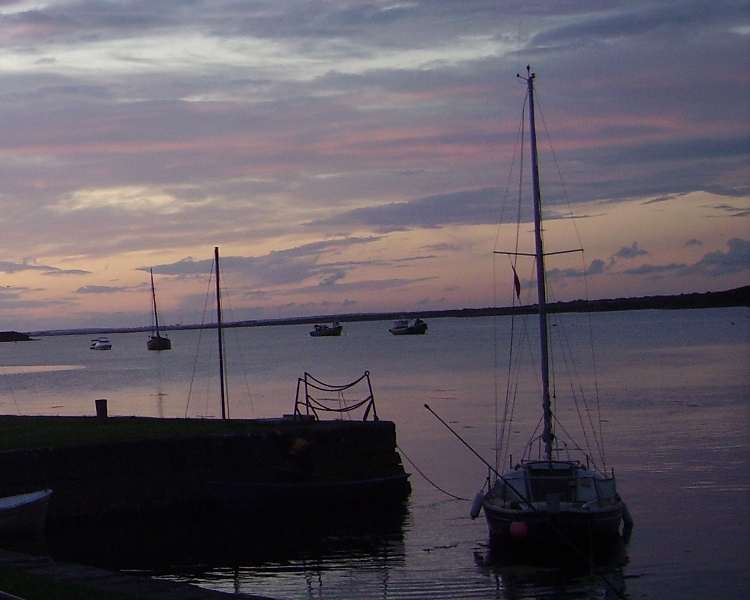
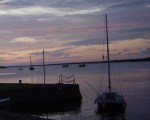
The Irish Times May 4, 1904 Kinvara Harbour and Pier After 34 years continuous effort on behalf of the inhabitants of Kinvara, a start is at length to be made with the new works. Hitherto the great difficulty has been that the pier was private property, but the trustees of the owner, Miss Sharpe, through Messrs. Kirwan and Sons, of Tuam have now consented to hand over the pier, with its tolls, to the Galway County Council. The County Council have agreed to raise £1,000 for the rebuilding of the pier and the dredging of the harbour. The Agricultural Board, through Sir Horace Plunkett, have given a grant of £1,000 and a further sum of £1,100 has been allotted under Mr. Wyndham’s Marine Works Act, thus bringing up the total to £3,300, the amount estimated as necessary by the County Surveyor, Mr. James Perry, C.E. At the last meeting of the County Council on the 26th ult. a communication was addressed to the Congested Districts Board asking them to undertake the completion of the work. On receipt of the news in Kinvara the town was brilliantly illuminated; bonfires blazed from the surrounding hills, and a procession of torchbearers and musicians paraded the principal streets, the Rev. T. Burke, P.P., and Mr. Thomas P. Corless, Chairman Gort Rural Council, who have been so largely instrumental in the successful negotiations, receiving an ovation. It is expected that Kinvara will now become a port of call for the new Glasgow service of steamers which are to visit the principal harbours of the west coast, and that in addition to a revived barley market and trade development, a regular tourist traffic with Galway by steamer will now be re-established.
The Schools’ Collection, Volume 0033B, Page 10_051 National Folklore Collection, UCD. Greta St. George, Ballinderreen NS
No 1 I’m thinking tonight of Kilcolgan That village far over the sea To the cottage wherein I was born My memory it brings back to me Im thinking tonight of Kilcolgan
No 2 The stile that I often climbed over The garden where many flowers grew And mother so patiently waiting How void was the picture to view
No 3 Kilcolgan I’m often times thinking If you look as I saw you of yoe’r For its twenty long years since I left it And came to Americas shore
No 4 I wonder If there’s any changes How many the friends I should know That I used to ramble about with In the dear happy days long ago.
No 5 Is Kilcolgan castle still standing Where I looked on with wonders so great And the house of Tyrone not far distant Where dwelt the St. Georges in state
No 6 The demaine with acres so many Got round by a very high wall The avenue where oft I did wander With trees so stately and tall
No 7 Does the tide still come upon the river How often I’ve watched it of yore Does the boatmen from Old Connemara Bring over the turf to our shore
No 8 Connemara I ne’er will forget you Where gaedhlach is spoken go leór Where fish and potatoes are plenty And a welcome is always in store.
No 9. A me will I e’re see you again Shall I visit the land of my birth Far dear to my heart is old Ireland The dear little Isle of the blest
No 10 Shall I e’er see the Kilcolgan I know not And still cherish hopes that may And yet cross the stormy Atlantic And sail into dear Galway bay.
No 11 To visit the home of my childhood Once more to lay foot on that shore And hear that glad welcome god save As I often times heard it before.
No 12 I’ll still keep on hoping and longing I’ll never give up in despair But patiently watch and keep waiting For the ship that will carry me there
Alabama Enquirer And Morgan County News Date: January 26 1888 p2
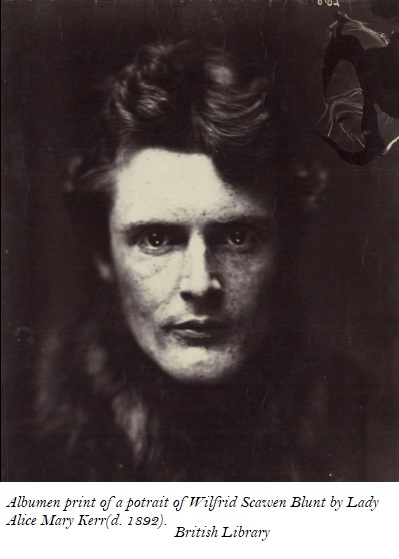
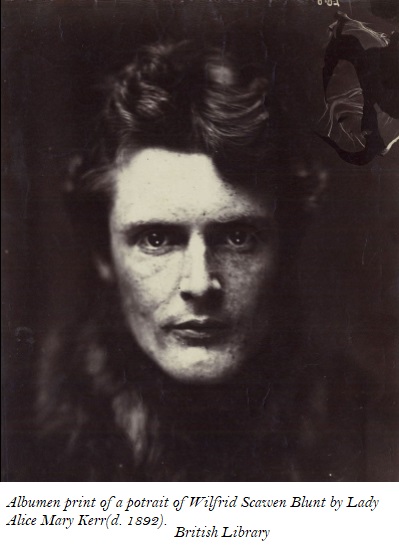
Wilfred Blunt has been moved to a warmer cell in the Galway prison, and his overcoat has been returned to him. A band tried to serenade him, but was prevented by the police. Mr. Blunt says that while staying at a country hotel in the south of England last September, he met Mr. Balfour, who made the statement that he intended to imprison six of the physically weakest of the Parnellites, adding: “I shall be sorry for Mr. Dillion, as he has some good about him. He will have six months, and as he had bad health he will die in prison.” In response to an inquiry, Mr. Balfour said: “The history is a ridiculous lie. I do not believe that Mr. Blunt ever made the assertion attributed to him.”
The Schools’ Collection, Volume 0047, Page 0159 National Folklore Collection, UCD. Gort N.S. In the mountains of Burren in the county Clare, about ten miles from here, there is a place called the Caves of Cill Corney. There are large caves and undermines (sic) there. Something over a hundred years ago, horses and foals used come out of them caves and graze the peoples land and cornfields. The neighbours made up their minds to catch the horses. The horses passed them by like the wind and they caught one mare’s foal at the mouth of the cave. They took the foal home and kept him in a dark stable for one year, until he was fit for training. He trained very quiet and did every sort of work. Every Saturday at twelve he would get out of work and no man could put him to work after that. His breed is still to be found and how you would know his breed is that every one has a whisker on the upper lip.
Sometimes when floods rise very high the water floods up on this cave and spreads round like a bowl. Some old people called it Tír na nÓg.
One time an old woman wanted to make a cake. The water was very low at the time. She took some of the water and made the cake. She put the cake baking on a griddle. Before the cake was baked, the flour dried on the griddle as it was on the bog. She went back to the pond and found it was gone down. Within the present generation with the past ten years. One man experimented on the water as it was going down. He took home some of the water and made a cake also and baked it on a griddle. Before the cake was baked the flour dried on the griddle as it was on the bog. About forty or fifty years ago.
The Old Mills Kiltartan N.S. The Schools’ Collection, Volume 0047, Page 0111 National Folklore Collection, UCD. c.1938 The Gort river which goes underground at “Poll Tuaithbheall” in Castletown worked four mills in and around Gort, one at Cannahown (1/2 mile to the South of the town, now derelict, one in Gort (Hynes’s, still working) one at Kinineha 1/2 mile to the N.East of the town (now derelict) and a fourth at Ballinamanton 1/4 mile farther on (derelict) Of rootcrops the principal kinds sown are turnips, mangolds, parsnips and beet. Turnips and mangolds are given as food to cattle and sheep. During the hard dry weather in spring and early summer sheep, and especially ewes, are fed on mangolds. Parsnips are grown only in small quantities for table use. Beet is sent away by Rail to the Beet Factory in Tuam. A Beet Train for Tuam leaves the Gort Station every night about 10.30pm, for about eight weeks before Christmas. The land is suitable for potatoes also. Any surplus potatoes are disposed of in the Gort marked every Saturday.




 The Burren and Beyond