Irish Times, Saturday March 2nd, 1907 Amongst the last awards made by the Royal Humane Society are the names of Constable Michael Carbery, Kinvara, Co. Galway, for the bronze medal of the Society, for plunging into 15 feet of water in Kinvara Harbour at the risk of his own life, and saving that of a man named Keane, who was 76 years of age and who had fallen from the pier.
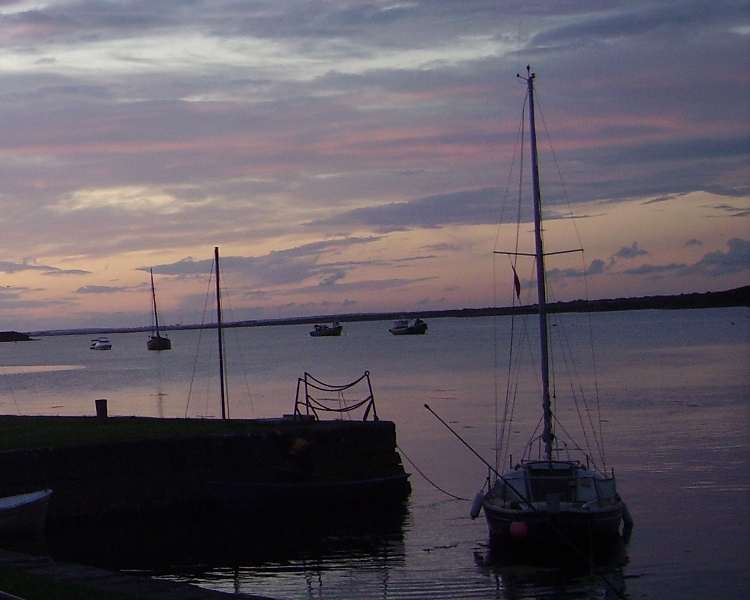
The Irish Times May 4, 1904 Kinvara Harbour and Pier After 34 years continuous effort on behalf of the inhabitants of Kinvara, a start is at length to be made with the new works. Hitherto the great difficulty has been that the pier was private property, but the trustees of the owner, Miss Sharpe, through Messrs. Kirwan and Sons, of Tuam have now consented to hand over the pier, with its tolls, to the Galway County Council. The County Council have agreed to raise £1,000 for the rebuilding of the pier and the dredging of the harbour. The Agricultural Board, through Sir Horace Plunkett, have given a grant of £1,000 and a further sum of £1,100 has been allotted under Mr. Wyndham’s Marine Works Act, thus bringing up the total to £3,300, the amount estimated as necessary by the County Surveyor, Mr. James Perry, C.E. At the last meeting of the County Council on the 26th ult. a communication was addressed to the Congested Districts Board asking them to undertake the completion of the work. On receipt of the news in Kinvara the town was brilliantly illuminated; bonfires blazed from the surrounding hills, and a procession of torchbearers and musicians paraded the principal streets, the Rev. T. Burke, P.P., and Mr. Thomas P. Corless, Chairman Gort Rural Council, who have been so largely instrumental in the successful negotiations, receiving an ovation. It is expected that Kinvara will now become a port of call for the new Glasgow service of steamers which are to visit the principal harbours of the west coast, and that in addition to a revived barley market and trade development, a regular tourist traffic with Galway by steamer will now be re-established.
The Schools’ Collection, Volume 0033B, Page 10_051 National Folklore Collection, UCD. Greta St. George, Ballinderreen NS
No 1 I’m thinking tonight of Kilcolgan That village far over the sea To the cottage wherein I was born My memory it brings back to me Im thinking tonight of Kilcolgan
No 2 The stile that I often climbed over The garden where many flowers grew And mother so patiently waiting How void was the picture to view
No 3 Kilcolgan I’m often times thinking If you look as I saw you of yoe’r For its twenty long years since I left it And came to Americas shore
No 4 I wonder If there’s any changes How many the friends I should know That I used to ramble about with In the dear happy days long ago.
No 5 Is Kilcolgan castle still standing Where I looked on with wonders so great And the house of Tyrone not far distant Where dwelt the St. Georges in state
No 6 The demaine with acres so many Got round by a very high wall The avenue where oft I did wander With trees so stately and tall
No 7 Does the tide still come upon the river How often I’ve watched it of yore Does the boatmen from Old Connemara Bring over the turf to our shore
No 8 Connemara I ne’er will forget you Where gaedhlach is spoken go leór Where fish and potatoes are plenty And a welcome is always in store.
No 9. A me will I e’re see you again Shall I visit the land of my birth Far dear to my heart is old Ireland The dear little Isle of the blest
No 10 Shall I e’er see the Kilcolgan I know not And still cherish hopes that may And yet cross the stormy Atlantic And sail into dear Galway bay.
No 11 To visit the home of my childhood Once more to lay foot on that shore And hear that glad welcome god save As I often times heard it before.
No 12 I’ll still keep on hoping and longing I’ll never give up in despair But patiently watch and keep waiting For the ship that will carry me there
Alabama Enquirer And Morgan County News Date: January 26 1888 p2
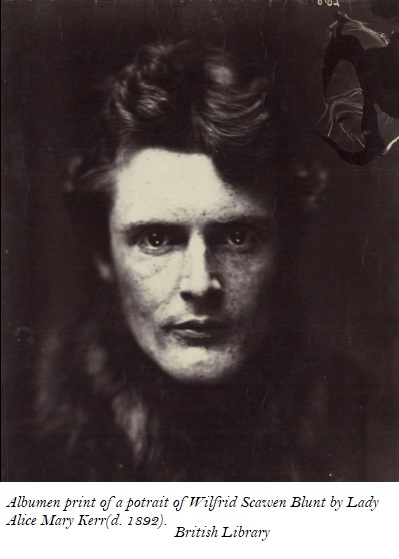
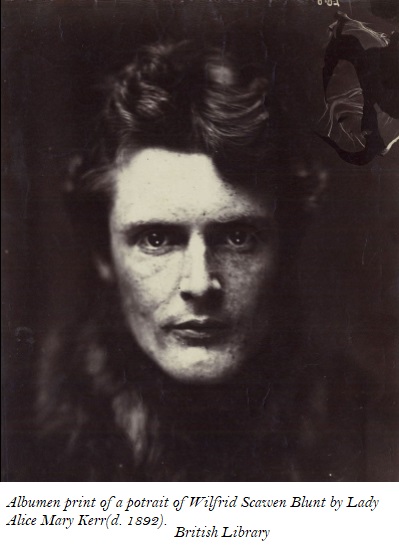
Wilfred Blunt has been moved to a warmer cell in the Galway prison, and his overcoat has been returned to him. A band tried to serenade him, but was prevented by the police. Mr. Blunt says that while staying at a country hotel in the south of England last September, he met Mr. Balfour, who made the statement that he intended to imprison six of the physically weakest of the Parnellites, adding: “I shall be sorry for Mr. Dillion, as he has some good about him. He will have six months, and as he had bad health he will die in prison.” In response to an inquiry, Mr. Balfour said: “The history is a ridiculous lie. I do not believe that Mr. Blunt ever made the assertion attributed to him.”
The Schools’ Collection, Volume 0047, Page 0159 National Folklore Collection, UCD. Gort N.S. In the mountains of Burren in the county Clare, about ten miles from here, there is a place called the Caves of Cill Corney. There are large caves and undermines (sic) there. Something over a hundred years ago, horses and foals used come out of them caves and graze the peoples land and cornfields. The neighbours made up their minds to catch the horses. The horses passed them by like the wind and they caught one mare’s foal at the mouth of the cave. They took the foal home and kept him in a dark stable for one year, until he was fit for training. He trained very quiet and did every sort of work. Every Saturday at twelve he would get out of work and no man could put him to work after that. His breed is still to be found and how you would know his breed is that every one has a whisker on the upper lip.
Sometimes when floods rise very high the water floods up on this cave and spreads round like a bowl. Some old people called it Tír na nÓg.
One time an old woman wanted to make a cake. The water was very low at the time. She took some of the water and made the cake. She put the cake baking on a griddle. Before the cake was baked, the flour dried on the griddle as it was on the bog. She went back to the pond and found it was gone down. Within the present generation with the past ten years. One man experimented on the water as it was going down. He took home some of the water and made a cake also and baked it on a griddle. Before the cake was baked the flour dried on the griddle as it was on the bog. About forty or fifty years ago.
The Old Mills Kiltartan N.S. The Schools’ Collection, Volume 0047, Page 0111 National Folklore Collection, UCD. c.1938 The Gort river which goes underground at “Poll Tuaithbheall” in Castletown worked four mills in and around Gort, one at Cannahown (1/2 mile to the South of the town, now derelict, one in Gort (Hynes’s, still working) one at Kinineha 1/2 mile to the N.East of the town (now derelict) and a fourth at Ballinamanton 1/4 mile farther on (derelict) Of rootcrops the principal kinds sown are turnips, mangolds, parsnips and beet. Turnips and mangolds are given as food to cattle and sheep. During the hard dry weather in spring and early summer sheep, and especially ewes, are fed on mangolds. Parsnips are grown only in small quantities for table use. Beet is sent away by Rail to the Beet Factory in Tuam. A Beet Train for Tuam leaves the Gort Station every night about 10.30pm, for about eight weeks before Christmas. The land is suitable for potatoes also. Any surplus potatoes are disposed of in the Gort marked every Saturday.
The Schools’ Collection, Volume 0597, Page 505. Collected by Michael Custy from James Custy. (abridged). Meelick N.S. National Folklore Collection, UCD On Christmas Eve night all the Catholic people light a candle or Christmas candle. The leave the candle lighting all night and they quench it in the morning. On Christmas night some of the people do not lock the door because the Holy Family were looking for shelter on that night All the people put up holly and ivy on Christmas Eve. The put a little branch of holly and ivy at the sides of every picture. Sometimes people get leaves of holly and ivy and put a twine through them all Then they nail the twine to the window in the form of a cross. The reason for putting up holly and ivy is, on the walls of the stable in which Our Lord was born there were holly and ivy growing. So when people see holly and ivy on the walls, it reminds them of the birth of Our Lord. On Christmas Eve and Christmas Night there is a big candle lighting on the kitchen window. It is to be lit by the eldest son of the family
Collected by Peggy Moran, Ballinderreen N.S. from Mrs Mannin (aged 67) 1938 The Schools’ Collection, Volume 0033B, Page 04_031 National Folklore Collection, UCD. There was once a stone in Clare, and every night, there used be a candle lighting on it. If anybody saw that candle lighting after sunset they would be dead next morning. It happened when St Patrick came to Ireland that he heard of the stone. One night He went and took lodging at the house nearst the stone. When he saw the man of the house locking the doors and bolting the windows he asked him what was the idea of doing that. Then he told St Patrick about the stone. The Saint said open thye windows and doors and come with me, to see the stone. The man was afraid, because if he looked at the candle he would be dead next evening St Patrick said not to fear while he was with him. Then the Saint put on his Stole and said prayers near the stone. He struck it with his Stole and broke it in two halves. A black bird flew out. He struck the blackbird with the Stole and it fell dead. It fell into the water which was near the stone. Saint Patrick turned it into wine because it was turned into blood at first when the bird fell into it. The man said if he left the water in wine people would be coming from all parts of Ireland and get drunk. At that moment it was changed into water. Ever since it is called Lough Ruadh or the Red Lake.
Collected by Patrick Nolan, Kiltartan N.S. The Schools’ Collection, Volume 0047, Page 0090 National Folklore Collection, UCD.
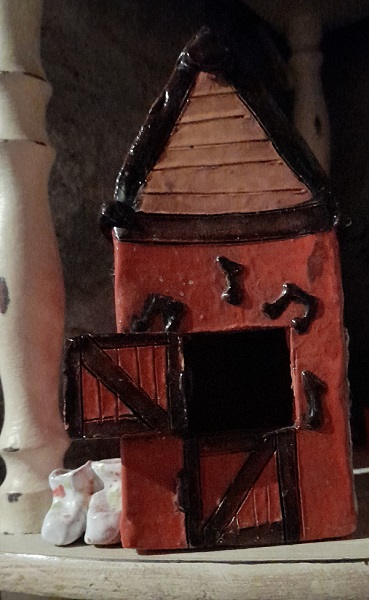
Clare’s Doll House Photo: EO’D
A Fob Gun
Nowadays toy guns, made in Germany or Japan can be bought for a penny. Long ago boys made their own guns. This is how they did it. First they got a piece of an elder tree. Then they would redden a piece of an iron and bore a hole through it. Then a piece of wet paper was got to act as a bullet. This was stuffed into one end of the gun. Next a stick was got to fit the hold. Another ‘bullet’ was inserted into the other end of the gun, and everything was ready. The stick was then pushed through the bore of the gun. The force of the air through the gun would make a shot.
Spinning Tops These were made by the boys themselves long ago. An empty thread spool was pared and shaped like a top. The hole through the centre of the spool was then filled with a piece of timber, and a nail (from which the head was removed) was then driven into the pointed end of the top. The top could be made spin by twisting several coils of twine around it.
This was composed by a local poet who’s name is unknown. It is about the Loughnane brothers, natives of Shanaglish beyond Gort. They were members of the I.R.A. and they were brutally burned by the English. They were dragged behind two carriers for three miles and they died near Kinvara. Their bodies were then thrown into a pond and were not discovered till ten days afterwards. The Tans that committed this outrage in Nov. 1920 (abridged)
As the winter’s wind blew wild on a cold November’s night, The sad news reached Kinvara of a mournful tragic sight,
It was the finding of two brothers pale corpses lay side by side, Far from their loving mother these true hearted brothers died, They were taken by our enemies while threshing their mother’s corn, And came back cold corpses to the place where they were born, They were taken in a lorry by a military escort, From their native home Shanaglish Three miles south-west of Gort. II They were dragged behind two carries for three miles and more, Till the blood gushed from their faces and their bodes bruised and sore, They were taken to Drimharsin on a clear November’s day, While the blood gushed from their faces and their roars were head for miles away. “What they suffered God only knows.” III Their bodies were brutally burned as they lay upon the ground, Then left into a pond to prevent them from being found, For ten long days in this desolate grave unblessed by any priest Those martyred brothers Loughnanes by God’s aid was released, To an old house near Kinvara the funeral marched next day, Under a body guard of I.R.A. who took the remains away. IV That day was a sorrowful day for their mother, To see the fresh blood oozing from a wound in Harry’s side, Poor Padraigh’s flesh was torn, o’er his eyes were boiled within, There was nothing left to recognize but a nose and half a chin, His brothers bones lay visible as cold corpses they did lie, Their bodies they were coffined and wrapped in brown and white, And left into the Church of God where they rested that night. V The following day was a mournful sight for the mother of the brave, To see her darling boys going to the bosom of the clay, Those brother nursed with tender care are now beneath the sod, Their spirits are despite their foes today before their God, In the church yard of Shanaglish those two young heroes lie, They gave their blood for Ireland and died for you I, (sic) And gave up all they had on earth and suffered all these pains, To strike for you anther blow and smash the Saxon chains. VI Is there any rebel here amongst you still to repeat those words again, To thread the path of dauntless men who have suffered without fear or disdain, But if you be true to England by obeying her Saxon laws, They you’ll soon forget our men shot down by the cold blooded murderers, the servants of the Crown, Let this ring throughout land and echo over the main, That our gallant Loughnane brothers were not sacrificed in vain.