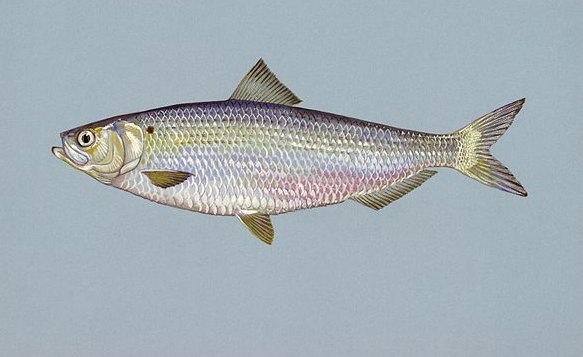
The Sydney Gazette and New South Wales Advertiser 8th October, 1835Blueback herring fish Photo: Duane Raver, U.S. Fish and Wildlife Service
Herrings – 1835
One of the most remarkable objections to the continuance of the tithe system was stated the other night in the House of Commons;
A clergyman, having obtained a post on the coast of Ireland, decided to take a tithe of the fish. His plan was short-lived. Not a single herring has ever since visited that part of the shore.
**a tithe was a tax of one tenth of annual produce or earnings. .
FREEMAN’S JOURNAL 3RD MARCH 1853 (abridged)Photo; BO’D
It is a curious historical fact that the Irish troops, who principally contributed to save the town of Louvain, in 1635, from the tremendous assault of the great French army under Marshals Chatillon and De Breze, were in that bloody contest marshalled and commanded in Irish. A Latin writer of the seventeenth century, who was conversant with most of the European tongues, tells us that the Irish language
“surpasseth in gravity the Spanish, in elegance the Italian, in colloquial charms the French;
it equals, if it does not surpass the German itself in inspiring terror.”
New York Tribune 15th June, 1900 p9c EO’D
Bridget Coughrey from Clifden County Galway landed here yesterday with only a shilling in her pocket and for a time she had the immigration officials puzzled.
She was so comely and so earnest in her endeavours to explain that there was universal sympathy for her. But she could not speak a word of English and Gaelic was not understood in the Barge Office. Finally one of the officials sent for Peter Groden. Peter relapsed into Gaelic the minute he saw Bridget. They talked it over and she told him she was the eldest of five children. Her family was struggling for a living at home in County Galway and she had come over here to earn money to send home to pay the rent of the farm, which amounts to $80 a year. Bridget said that she was on her way to see Patrick Coughrey her uncle who lives in Pittsburg. He would advance the money necessary for her transportation if he was informed of her predicament. Peter told the officials what she had said and they sent word to her uncle at once.
Four hundred and fifty girls leave Galway this week for Boston under a year’s engagement to New Hampshire cotton mill owners, who pay their expenses out. Several hundreds more wanted to go. There was an exciting scene on thursday at Limerick depot over the departure of 250 of them.
The Times, LondonGuinea Wikimedia Commons
17th July, 1788 (abridged)
A short time ago some labourers were clearing the race ground of Loughmore, near Limerick. They found a small brass box, containing a piece of parchment five inches square, on which is written the admission of a fellow or scholar at Mungret University. Mungret University was at an early age famous. At the top is a picture of St. Patrick. It is signed Gulielmus Nophine, with the date A.D. 485. It was purchased for a guinea and sent as a present to a member of the Irish Academy.
Lancaster, April 15, 1766. (abridged)
WAS committed to my Custody, on suspicion of being a runaway servant, a Girl, who calls herself Isabel Beard.
She was born in Ireland, and came in the Snow Pitt above two Years ago. She is about 4 Feet 8 Inches high, had on a blue Stuff Gown, striped Linsey Petticoat and Bed Gown, old Shoes and Stockings. She says she belongs to a certain William Grimes, a Jobber, and late of York County, where she says she left him.
Her Master therefore is hereby desired to come, pay her Charges, and take her away, otherwise she will be sold for her Fees, by MATTHIAS BOOGH, Goaler.
———————————————–
October 12, 1769 The Pennsylvania Gazette
New Castle County, October 3, 1769.
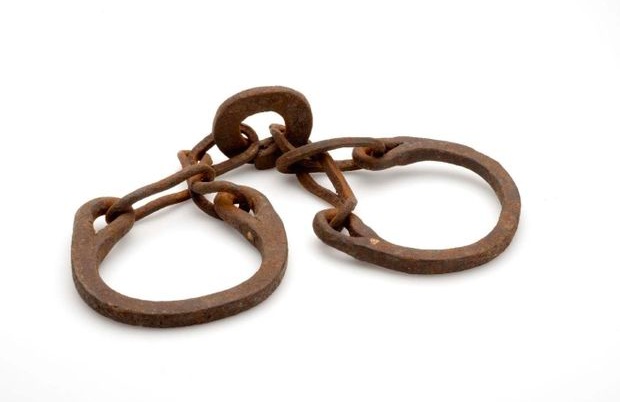
WAS committed to the goal of this county, upon suspicion of being runaway servants;
JOHN MONEY, born in Ireland, about 5 feet 6 inches high, black hair, pale complexion, by trade a weaver. When committed he had on a light coloured homespun cloth coat, linsey waistcoat, and coarse tow trousers.
ELIZABETH MOORE, a native Irish woman, about 30 years of age, fair complexion, brown hair. When committed, she had on a stampt cotton gown of a purple colour, a linsey petticoat, shoes, and stockings.
Their masters (if any they have) are desired to come, pay their cost, and take them away, in 6 weeks from this date, or they will be sold for the same by THOMAS PUSEY, Goaler.
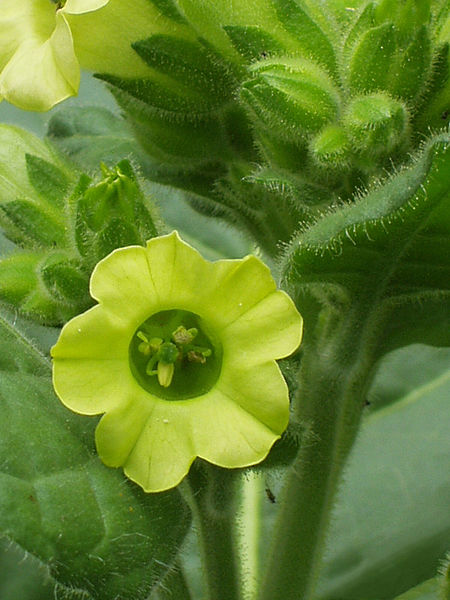
Native American Tobaccoo flower and buds Photographer: William Rafti of the William Rafti Institute Wikimedia Commons
London, Middlesex, England 23rd August, 1788
Last Saturday, Mr. Charles P. Bolton, surveyor of excise, assisted by Mr. Patrick Thally, guager, discovered in the town of Corrofin, an extensive tobacco manufactory, wherein they seized all the utensils used in that illicit trade; also a large quantity of loose leaf or four tobacco, in process of manufacture, which they lodged in his Majesty’s stores in that town.
Flax flowers Photo: D. Gordon E. Robertson Wikimedia Commons
Mr James Hill Dickson, for many years connected with the flax manufacture in the north of Ireland, has made a proposal to the chairman and directors of the Midland Great Western Railway, which they have favourably entertained – of erecting a mill on a platform, with wheels to run on the railway, to which will be attached a portable steam engine, of six horse power, with which to work the mill.
The mill, engine and workmen can be transported at the shortest notice to any given point along the line of railway from Dublin to Galway and into the country, to any farm or district along the line, at moderate distances, where flax may be grown, thus doing away with cumbrous and expensive fixed establishments hitherto so necessary to the successful cultivation of the flax plant and, in these depressed times, so difficult to erect and establish
Irish Cliff Fowlers (abridged)
I shall here outline the different methods I have witnessed on the coast of Ireland of descending steep rocks for birds or eggs. At the Gobbins, a climber has been going down the rocks occasionally in the season for above thirty years. He has a monopoly of the aerial exercise in consequence of being the only person in the vicinity supplied with a rope for the purpose. His preparation was the work of a moment; throwing his shoes off, and a noose of the rope over his head so as to embrace his body beneath the arms. Down he dropped from the summit, with much less concern than a lady steps from her carriage. Two or three men (generally his two brothers) ‘give out’ the rope, of which a coil is left back, some little distance from the summit of the cliff. They keep it tight until the egg-gatherer reaches the ledges containing the nests, when he gives a signal to slack it. The liberty thus afforded him to move to either side prevents the necessity of shifting the rope laterally at the summit of the cliff, where it is kept to the same place all the time.
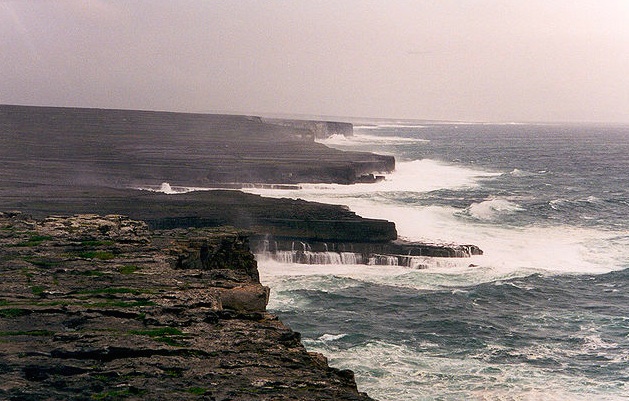
The method adopted at Arranmore, the largest of the islands of Arran off Galway Bay was different. When Mr R. Ball and I visited that island in July 1834 a rock climber – a tall athletic fellow – came up behind, unheard in his ‘pompootes’ . He was lowered over the loftiest limestone cliffs of the island, perhaps five hundred feet in height. His manner of descent was free and easy. He sat upon a stick, about a yard in length and two inches in thickness, to the middle of which one end of the rope was fastened, the other being held by men above.
When coming near his prey, he held the rope in one hand, and with the other threw a rope fastened to a rod around the birds. Several gulls so taken were brought up. When over the cliff he leapt as far into the air from the surface of the precipice as he could do without injury to himself from the rebound. He likewise performed various antics, and with the stick as a seat, looked quite comfortable and at his ease.
Thompson’s Natural History of Ireland.



 The Burren and Beyond