
Nollaig shona daoibh go léir.

Adoration of the Child
c. 1620
Wikimedia Commons
Nollaig shona daoibh go léir.
Project Gutenberg
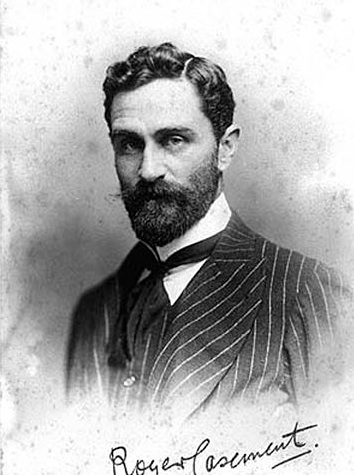
Editors – Joseph Dunn, Ph.D; P.J. Lennox. Litt.D., (Professors at the Catholic University of America)
THE ROMANCE OF IRISH HISTORY – by Sir Roger Casement, C.M.G.
The history of Ireland remains to be written, for the purpose of Irishmen remains yet to be achieved.
The struggle for national realization, begun so many centuries ago, is not ended; and if the long story offers a so frequent record of failure, it offers a continuous appeal to the highest motives and a constant exhibition of a most pathetic patriotism linked with the sternest courage.
Irish wars, throughout all time, have been only against one enemy, the invader, and, ending so often in material disaster, they have conferred always a moral gain. Their memory uplifts the Irish heart; for no nation, no people, can reproach Ireland with having wronged them.
When, at the dawn of the Christian era, we first hear of Ireland from external sources, we learn of it as an island harboring free men, whose indomitable love of freedom was hateful to the spirit of imperial exploitation.
Agricola’s advice to the empire-builders of his day was that Rome should “war down and take possession of Ireland, so that freedom might be put out of sight.”
It was to meet this challenge of despotism that the Scotic clans of Alba turned to their motherland for help, and the sea was “white with the hurrying oars” of the men of Erin speeding to the call of their Highland kinsmen, threatened with imperial servitude.
The first external record we possess thus makes it clear that when the early Irish went forth to carry war abroad, it was not to impose their yoke on other peoples, or to found an empire, but to battle against the Empire of the World in the threatened cause they held so dear at home.
In this early Roman reference to Ireland we get the keynote to all later Irish history—a warring down on the one hand, so that freedom might be put out of sight; an eternal resistance, on the other, so that it might be upheld.
It was this struggle that Ireland sought to maintain against every form of attack, down through Danish, Norman, Tudor, Stuart, and Cromwellian assault, to the larger imperialism of the nineteenth century, when, as Thierry, the historian of the Norman Conquest, tells us, it still remained the one “lost cause” of history that refused to admit defeat. “This indomitable persistency, this faculty of preserving through centuries of misery the remembrance of lost liberty and of never despairing of a cause always defeated, always fatal to those who dared to defend it, is perhaps the strangest and noblest example ever given by any nation.”
The resources Ireland opposed to her invaders have been unequal to the founding of a great state, but have preserved a great tradition. The weakness of Ireland lay in the absence of a central organization, a state machine that could mobilize the national resources to defend the national life. That life had to depend for its existence, under the stress of prolonged invasion, on the spontaneous patriotism and courage of individuals. At times one clan alone, or two clans, maintained the struggle. Arrayed against them were all the resources of a mighty realm—shipping, arms, munitions of war, gold, statecraft, a widespread and calculating diplomacy, the prestige of a great Sovereign and a famous Court—and the Irish clan and its chieftain, by the sheer courage of its members, by their bodily strength and hardihood and feats of daring, for years kept the issue in doubt.
When Hugh O’Neill, leagued with Red Hugh O’Donnell, challenged the might of Elizabeth, he had nothing to rely upon but the stout hearts and arms of the men of Tir-owen and Tir-Conail. Arms and armaments were far from Ulster. They could be procured only in Spain or elsewhere on the continent. English shipping held the sea; the English mint the coinage. The purse of England, compared to that of the Ulster princes, was inexhaustible. Yet for nine years the courage, the chivalry, the daring and skill of these northern clansmen, perhaps 20,000 men in all, held all the might of England at bay. Had the Spanish king at any time during the contest made good his promise to lend effective aid to the Irish princes, O’Neill would have driven Elizabeth from Ireland, and a sovereign State would today be the guardian of the freedom of the western seas for Europe and the world. It took “the best army in Europe” and a vast treasure, as Sir John Davies asserted, to conquer two Ulster clans three hundred years ago. The naked valor of the Irishman excelled the armed might of Tudor England; and the struggle that gave the empire of the seas to Britain was won not in the essay of battle, but in the assay of the mint.
It is this aspect of the Irish fight for freedom that dignifies an otherwise lost cause. Ever defeated, yet undefeated, a long-remembering race believes that these native qualities must in the end prevail. The battle has been from the first one of manhood against might. The State Papers, the official record of English rule in Ireland, leave us rarely in doubt. We read in that record that, where the appeal was to the strength or courage of the opposing men, the Irish had nothing to fear from English arms.
Thus the Earl of Essex, in a despatch to Elizabeth, explained the failure of his great expedition in 1599 against O’Neill and O’Donnell. “These rebels … have (though I do unwillingly confess it) better bodies and perfecter use of their arms than those men whom your Majesty sends over.” The flight of the Earls in 1607 left Ireland leaderless, with nothing but the bodies and hearts of the people to depend on. In 1613 we read, in the same records, a candid admission that, although the clan system had been destroyed and the great chiefs expropriated, converted, or driven to flight, the people still trusted to their own stout arms and fearless hearts:
“The next rebellion, whenever it shall happen, doth threaten more danger to the State than any heretofore, when the cities and walled towns were always faithful; (1) because they have the same bodies they ever had and therein they had and have advantage of us; (2) from infancy they have been and are exercised in the use of arms; (3) the realm by reason of the long peace was never so full of youths; (4) that they are better soldiers than heretofore their continental employment in wars abroad assures us, and they do conceive that their men are better than ours.”
And when that “next rebellion” came, the great uprising of the outraged race in 1641, what do we find? Back from the continent sails the nephew of the great O’Neill, who had left Ireland a little boy in the flight of the Earls, and the dispossessed clansmen, robbed of all but their strength of body and heart, gathered to the summons of Owen Roe.
Again it was the same issue: the courage and hardihood of the Irishman to set against the superior arms, equipment, and wealth of a united Britain. Irish valor won the battle; a great state organization won the campaign. England and Scotland combined to lay low a resurgent Ireland; and again the victory was not to the brave and skilled, but to the longer purse and the implacable mind. Perhaps the most vivid testimony to these innate qualities of the Irishman is to be found in a typically Irish challenge issued in the course of this ten years’ war from 1641 to 1651. The document has a lasting interest, for it displays not only the “better body” of the Irishman, but something of his better heart and chivalry of soul.
One Parsons, an English settler in Ireland, had written to a friend to say, among other things, that the head of a colonel of an Irish regiment then in the field against the English would not be allowed to stick long on its shoulders. The letter was intercepted by the very regiment itself, and a captain in it, Felim O’Molloy, wrote back to Parsons:
“I will doe this, if you please. I will pick out 60 men and fight against 100 of your choise men, if you do but pitch your campe one mile out of your towne, and then, if you have the victory, you may threaten my colonel; otherwise do not reckon your chickens before they be hatched.”
It was this same spirit of daring, this innate belief in his own manhood, that for three hundred years made every Irishman the custodian of his country’s honor.
An Irish state had not been born; that battle had still to be fought; but the romantic effort to achieve it reveals ever an unstained record of personal courage. Freedom has not come to Ireland; it has been “warred down and kept out of sight”; but it has been kept in the Irish heart, from Brian Boru to Robert Emmet, by a long tale of blood shed always in the same cause. Freedom is kept alive in man’s blood only by the shedding of that blood. It was this they were seeking, those splendid “scorners of death”, the lads and young men of Mayo, who awaited with a fearless joy the advance of the English army fresh from the defeat of Humbert in 1798. Then, if ever, Irishmen might have run from a victorious and pitiless enemy, who having captured the French general and murdered, in cold blood, the hundreds of Killala peasants who were with his colors, were now come to Killala itself to wreak vengeance on the last stronghold of Irish rebellion.
The ill-led and half-armed peasants, the last Irishmen in Ireland to stand in open, pitched fight for their country’s freedom, went to meet the army of General Lake, as the Protestant bishop who saw them says, “running upon death with as little appearance of reflection or concern as if they were hastening to a show.”
The influences that begot this reverence for freedom lie in the island itself no less than in the remote ancestry of the people. Whoever looks upon Ireland cannot conceive it as the parent of any but freemen. Climate and soil here unite to tell man that brotherhood, and not domination, constitutes the only nobility for those who call this fair shore their motherland. The Irish struggle for liberty owes as much, perhaps, to the continuing influence of the same lakes and rivers and the same mountains as to the survival of any political fragments of the past. Irish history is inseparably the history of the land, rather than of a race; and in this it offers us a spectacle of a continuing national unity that long-continuing disaster has not been able wholly to efface or wholly to disrupt.
To discover the Europe that existed before Rome we must turn to the East, Greece, and to the West, Ireland.
Ireland alone among western lands preserves the recorded tradition, the native history, the continuity of mind, and, until yesterday, of speech and song, that connect the half of Europe with its ancestral past. For early Europe was very largely Celtic Europe, and nowhere can we trace the continuous influence of Celtic culture and idealism, coming down to us from a remote past, save in Ireland only.
To understand the intellect of pre-Roman Gaul, of Spain, of Portugal, and largely of Germany, and even of Italy, we must go to Ireland. Whoever visits Spain or Portugal, to investigate the past of those countries, will find that the record stops where Rome began. Take England in further illustration. The first record the inhabitants of England have of the past of their island comes from Roman invasion. They know of Boadicea, of Cassivelaunus, the earliest figures in their history, from what a foreign destroyer tells them in an alien tongue.
All the early life of Celtiberians and Lusitanians has passed away from the record of human endeavor, save only where we find it recorded by the Italian invaders in their own speech, and in such terms as imperial exploitation ever prescribes for its own advancement and the belittlement of those it assails. Ireland alone among all western nations knows her own past, from the very dawn of history and before the romance of Romulus began, down to the present day, in the tongue of her own island people and in the light of her own native mind. Early Irish history is not the record of the clan-strivings of a petty and remote population, far from the centre of civilization. It is the authentic story of all western civilization before the warm solvent of Mediterranean blood and iron melted and moulded it into another and rigid shape.
The Irishman called O’Neill, O’Brien, O’Donnell, steps out of a past well-nigh co-eval with the heroisms and tragedies that uplifted Greece and laid Troy in ashes, and swept the Mediterranean with an Odyssey of romance that still gives its name to each chief island, cape, and promontory of the mother sea of Europe. Ireland, too, steps out of a story just as old. Well nigh every hill or mountain, every lake or river, bears the name today it bore a thousand, two thousand, years ago, and one recording some dramatic human or semi-divine event.
The songs of the Munster and Connacht poets of the eighteenth and nineteenth centuries gave to every cottage in the land the ownership as well as the tale of an heroic ancestry. They linked the Ireland of yesterday with the Ireland of Finn and Oscar, of Diarmid and Grainne, of Deirdre and the Sons of Usnech, of Cuchulainn the Hound of Ulster. A people bred on such soul-stirring tales as these, linked by a language “the most expressive of any spoken on earth” in thought and verse and song with the very dawn of their history, wherein there moved, as familiar figures, men with the attributes of gods—great in battle, grand in danger, strong in loving, vehement in death—such a people could never be vulgar, could never be mean, but must repeat, in their own time and in their own manhood, actions and efforts thus ascribed as a vital part of their very origin. Hence the inspiration that gave the name of Fenian, in the late nineteenth century, to a band of men who sought to achieve by arms the freedom of Ireland. The law of the Fenian of the days of Marcus Aurelius was the law of the Fenian in the reign of Victoria—to give all—mind, body, and strength of purpose—to the defense of his country, “to speak truth and harbor no greed in his heart.”
Some there are who may deny to Finn and his Fenians of the second and third centuries corporeal existence; yet nothing is surer than that Ireland claims these ancestral embodiments of an heroic tradition by a far surer title of native record than gives to the Germans Arminius, to the Gauls, Ariovistus, to the British, Caractacus. This conception of a national life, one with the land itself, was very clear to the ancient Irish, just as it has been and is the foundation of all later national effort.
“If ever the idea of nationality becomes the subject of a thorough and honest study, it will be seen that among all the peoples of antiquity, not excluding the Hellenes and the Hebrews, the Irish held the clearest and most conscious and constant grasp of that idea; and that their political divisions, instead of disproving the existence of the idea, in their case intensely strengthen the proof of its existence and emphasize its power.
In the same way the remarkable absence of insular exclusiveness, notwithstanding their geographical position, serves to bring their sense of nationality into higher relief.
Though pride of race is evident in the dominant Gaelic stock, their national sentiment centres not in the race, but altogether in the country, which is constantly personified and made the object of a sort of cult.
It is worth noting that just as the Brehon Laws are the laws of Ireland without distinction of province or district; as the language of Irish literature is the language of Ireland without distinction of dialects; as the Dindshenchus contains the topographical legends of all parts of Ireland, and the Festilogies commemorate the saints of all Ireland; so the Irish chronicles from first to last are histories of the Irish nation. The true view of the Book of Invasions is that it is the epic of Irish Nationality.” (Professor Eoin MacNeill, in a letter to Mrs. A.S. Green, January, 1914.)
The “Book of Invasions”, which Professor MacNeill here speaks of, was compiled a thousand years ago. To write the history of later Ireland is merely to prolong the “Book of Invasions”, and thus bring the epic of Irish resistance down to our own day. All Irish valor and chivalry, whether of soul or of body, have been directed for a thousand years to this same end. It was for this that Sarsfield died at Landen no less than Brian at Clontarf. The monarch of Ireland at the head of a great Irish army driving back the leagued invaders from the shores of Dublin Bay in 1014, and the exiled leader in 1693, heading the charge that routed King William’s cause in the Netherlands, fell on one and the same battlefield. They fought against the invader of Ireland.
We are proudly told that the sun never sets on the British Empire. Wherever an Irishman has fought in the name of Ireland it has not been to acquire fortune, land, or fame, but to give all, even life itself, not to found an empire, but to strike a blow for an ancient land and assert the cause of a swordless people. Wherever Irishmen have gone, in exile or in fight, they have carried this image of Ireland with them. The cause of Ireland has found a hundred fields of foreign fame, where the dying Irishman might murmur with Sarsfield, “Would that this blood were shed for Ireland”, and history records the sacrifice as made in no other cause.
Ireland, too, owns an empire on which the sun never sets.
REFERENCES:
Sigerson: Bards of the Gael and Gall; O’Callaghan: History of the Irish Brigades; Mitchel: Life of Hugh O’Neill; Green: The Making of Ireland and its Undoing, Irish Nationality, The Old Irish World; Taylor: Life of Owen Roe O’Neill; Todhunter: Life of Patrick Sarsfield; Hyde: Love Songs of Connacht, Religious Songs of Connacht; O’Grady: Bog of Stars, Flight of the Eagle; Ferguson: Hibernian Nights’ Entertainment; Mitchel: History of Ireland, in continuation of MacGeoghegan’s History.
Autumnal Rambles about New Quay, County Clare

Thomas L. Cooke (abridged)
In this sultry weather the wearied tourist can enjoy a grateful cool beneath the cimmerian recesses of the cavern known by the name of Pouloushe, an appellation taken from the Irish word Pollach, which signifies “hollowed” and the Irish word uisce, which signifies “water”. This truly remarkable cavern is a short distance from the road leading to Kilmacduach church, and about two miles from the town of Kinvarra, to which the reader has been led in one of our former rambles. The entrance to it bears due south-west of Northampton, the neat residence of Mr. Mahon, and east of the cottage of a farmer named Killikelly, on the way leading from Kinvarra to Kilmacduach.
The entire of the district surrounding Pouloushe is a lime-stone one, and it consequently abounds in those underground recesses and caves common to such description of country. The river, which flows through the demesne of Lord Gort at Loughcouter, runs there against a very high and nearly perpendicular rock, beneath which it sinks so instantaneously and completely as seemingly to elude all further observation, and baffle geologists in discovering the course it subsequently takes. It is remarkable to find a large river thus suddenly swallowed up, and, therefore Loughcouter demesne demands a visit from the curious, even though it had not presented any other subject to compensate for the journey from New Quay to Gort. The river subsequently shows itself at some distance, at what are denominated the “Punch-Bowl” and the “Churn,” both of which are well deserving of attention. They are situate about half-a-mile beyond Gort. It afterwards breaks forth again into a full river, from beneath a fine natural arch at a considerable distance, from the Churn and Punch-Bowl. Another river (the name of which I do not remember), flows near to Isert-Kelly, from the direction of Loughrea, and also occasionally hides itself from the light of day in dark underground passages. In all probability, the waters of both rivers unite, and pursue jointly their subterranean meandering until they reach Kinvarra, at which place the reader has been already informed that a flood of fresh water shews itself bursting forth when the tide is out.
The observant eye, although it cannot see the water, can distinctly trace the direction of the Gort river from the last-named place towards Kinvarra, by means of the concave and sunken face the limestone country presents along the line of its course. This sunken and collapsed appearance extends to the breath of about two hundreds yards, and is particularly observable in the neighbourhood of Pouloushe cavern. After passing Killikelly’s farm-house, the tourist proceeds about a quarter-of-a-mile over a bed of limestone, scantily clothed here and there with a mixture of grass, and those small herbs and wild flowers, which delight in attaching themselves to limestone. In traversing this locality you must, however, be cautious where you place your foot, for many and deep narrow fissures open, concealed amongst the rocks and tangled herbage.
The mouth of Pouloushe Cavern is a hole nearly perpendicular, and in the centre of a large and level field of limestone. You descend about thirty feet by this yawning entrance, formed apparently by the accidental falling in of part of the roof of the cavern. Having descended thus far, the traveller enters the mouth of the cave beneath a large, flat, and natural arch of limestone rock. This cavern, which runs from south-east towards north-west, differs, as far as my observation goes, from any yet described in print. As far as the eye can penetrate through the surrounding gloom, nothing presents itself to view save scattered rocks, and an inclined rugged surface of slippery clay beneath the feet. Overhead hangs a stupendous flat ceiling of rock, not resting on pillars or any other visible means of support capable of sustaining the weight of such an expanse of massive stone. The ceiling being flat, low, and smooth, appears almost as if it were the work of art. I have not remarked much stalactite or stalagmite matter here. This, probably, is owing to the river washing it away in winter; but, at all events, as I was not prepared with torches for an underground excursion when I visited it, I felt no disposition to pursue too far an unknown journey amidst darkness, rocks and precipices. The danger too was, perhaps, magnified by the awful view of an impending sheet of rock close overhead apparently unsupported, and ready every moment to fall from above, and bury for ever the too daring foot which had imprudently ventured beneath it. Added to this was the noise of waters wending their way in darkness amongst the rocks, and threatening to bear off in their unknown and gloomy course him who should make a single false step. I could dimly see the river, deep and dark, by the fitful glare thrown from burning straw, which served the place of torches. It seemed to be a considerable stream of water, very deep in some places, and revolving round in many eddies.
During 1842-43 Cooke wrote a series of articles for the Galway Vindicator on the area around New Quay in north Clare. A scrapbook of these articles, with notes (given here in itallics) and illustrations by the author, was donated to Clare County Library.
The Story of the Eureka Stockade
The Catholic Press 1st December, 1904 p 8
Saturday next, December 3rd; is the 50th anniversary of the miners’ fight for freedom at Eureka Stockade and a brief narrative of that memorable event at this stage will not be amiss. Specially interesting is it to the Irish-Australians, for the number of Ireland’s sons who took part in the affray and who gave their lives in the effort to cast off the yoke of oppression and tyranny under which the mining classes of Australia then laboured.
Not only were they the leading figures at the Stockade, their names are prominent among the discoverers of the historic goldfields.
In. his ‘History of Ballarat,’ Mr. Withers says ‘the “honour of discovery seems to be tolerably evenly balanced between the two parties (Patrick Connor and Thomas Dunn), though it may perhaps be held, that the balance of priority inclines to tho side of Connor’s party.” It is said in support of Connor’s claim that he was always regarded as leader of the diggers at the meetlngs held in those first days when the authorities made their first demand for licence fees.
It was an Irishman, also Cavonagh by name who made known the deeper and greater treasures that were concealed beneath the pipeclay which had hitherto been considered bottom. This led to such rich discoveries that people poured from all parts of the world on to the Yarrowee, where, in a month or two, 1200 cradles were rocking in one line.
How the Diggers Were Persecuted.
For a time the Victorian Government, taken by surprise, was utterly powerless in tho presence of this unexpected influx of population. It eventually recovered its self-possession, proclaimed the right of the Crown’ to the gold, despatched officials to preserve order, and issued licenses to dig for the, precious metal.
At first the license fee was fixed at £1 10s. per month, but it was soon doubled in the hope of thinning the crowds that continued to travel to the goldfields from all points of the compass. In the course of time this poll-tax, as it really was, assumed a most arbitrary and unjust character. It was levied on every digger, whether successful or unsuccessful. The brutal and insulting manner In which it was enforced became an insupportable grievance and led to a bloody conflict between the outraged diggers and the tyrannical authorities.
The ridiculous idea seemed rooted in tho minds of the governor and his advisors that the goldfield’s population could only be ruled and regulated on military principles. Hence the diggers were allowed no representation whatever in the Victorian Parliament, although the great majority of them were respectable men of good families and education. They were tyrannised over by ignorant and insolent officials, many of whom were originally, expatriated for their crimes, and were afterwards promoted into the ranks of the colonial constabulary. Those ex-convicts took a demonic delight in annoying and insulting the freeborn diggers and straining their petty authority to tho utmost. No sooner had an intending digger arrived on the field than he was compelled to appear before one of these insolent officials, hand over his first monthly payment of £8, and receive in return a licence to the following effect :
GOLD LICENSE:

No: Date:
The bearer _______________ having paid to me the sum of £3 Sterling on account of the terrltorial revenue, I hereby licence him to dig search for, and remove gold on and from, any such Crown lands as I shall assign to him for that purpose during the month of ____________, 185__. This licence is not transferable and must be produced whenever demanded by rne or any other person acting under the authority of the government.
Slgned _________
Commissioner.
Those licences were demanded suddenly and unexpectedly at all times and places by the officials who were supported by bodies of mounted troopers. Unfortunates who didn’t happen to have their documents on them at the moment would be arrested and chained to logs at the Government camp until friends came forward with monetary assistance. A couple of incidents out of hundreds will show the coarse, reckless and unjustifiable manner in which these ignorant officials carried out the duties entrusted to them, and which eventually drove the gold-fields’ population into open rebellion.
In the Hands of Brutal Troopers
Father Patrick Smyth was one of the first of the Irish priests to arrive on the Ballarat goldfields. He had a devoted personal attendant named John Gregory, who was one day paying a visit of charity to some Catholic friends. A license hunting party of troopers came up, surrounded the tent in which they were, and the officer in charge “commanded the wretches to come out of the tent and show him their licenses.” Gregory quietly told him that he was the servant of Father Smyth, and had no such document. Tho troopers thereupon profusely damned both him and Father Smyth, and took him into custody. As Gregory was not a very able-bodied man, he asked his captors to take him to the Government Camp at once and not drag him after them all over the diggings in their search for unlicensed miners. This reasonable request was refused with many curses and blows and the poor fellow was compelled to follow the brutal troopers through the whole of the day’s campaign.
Next morning, although it was evident at a glance that Gregory was physically unable to dig for gold, he was fined £5 for having no licence and an additional £5 for having committed an imaginary assault on one of the troopers!
The late Venerable Archdeacon Downing, who came up to Ballarat almost simultaneously with Father Smyth, was frequently the victim of the harsh tyranny of the insolent officials of those early days. On one occasion Father Downing had pitched his tent at the Brown Creek diggings, and, with his coat off, was hard at work digging a trench round it to carry off the water. A brutal trooper, coming up, insisted that the priest was a digger, bailed him up, demanded his license, and subjected him to the grossest indignities.
How the Insurrection Began.
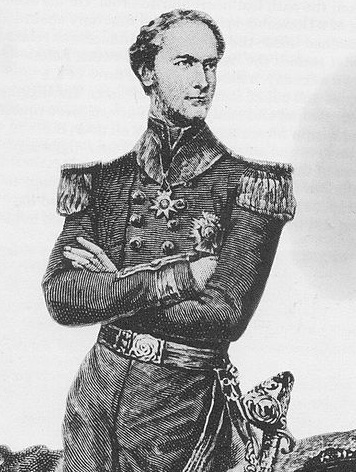
In addition to this persecution, no miner was allowed to cultivate the smallest portion of land for the maintenance of himself and family. The irresponsible regime soon became intolerable. Tho diggers organised a peaceful and constitutional agitation, having for its purpose the abolition of the oppressive monthly licence fee and the representation of the goldfields in Parliament. They were contemptuously rejected by the new Governor, Sir Charles Hotham, who succeeded Latrobe in June, 1854.
A retired navy captain, he tried to rule the colony like a martinet and, by his headstrong and senseless policy towards the exasperated diggers, he precipitated a collision with the authorities. He professed to regard the agitation on the goldfields as the result of the machinations of foreigners and, in the true spirit of the quarter-deck, defiantly declared his intention to put down all seditious manifestations with a stern hand. The raids by the troopers upon diggers became more numerous and irritating than ever. At last the utmost limits of patience were reached and the probability of a successful insurrection was openly discussed on the goldfields. The agitation came to a crisis on November 29th, 1854 when 12,000 diggers held a meeting on Bakery Hill, Ballarat under the presidency of Mr.Timothy Hayes, one of the most genial and popular Irlshmen on the diggings.
After carrying a series of resolutions setting forth the grievances of the goldfield’s population, and the unavailing efforts to induce the authorities to redress them, the meeting unanimously determined then and there to burn all their licences, and thus bid open defiance to the government. Amidst enthusiastic cheering a huge bonfire was made, and every dlggor, consigned his Crown permit to the flames.
Four of the principal speakers were Lalor, Qulnn, Murnane and Brady, and the most Important resolution agreed to was couched as follows,:—
‘That this meeting being convinced that the obnoxious licence fee is an imposition and an unjustifiable tax on free labour, pledges itself to take immediate steps to abolish the same by at once burning all their licences, and that, in the event of any party being arrested for having no licences, the united people under all circumstances will defend and protect them.’’
The Last Digger-Hunt.
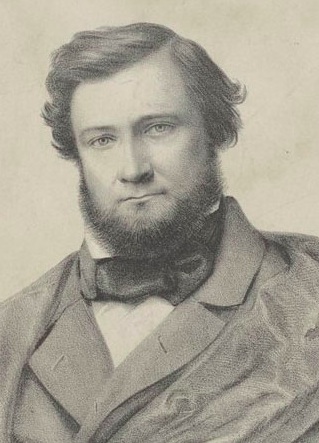
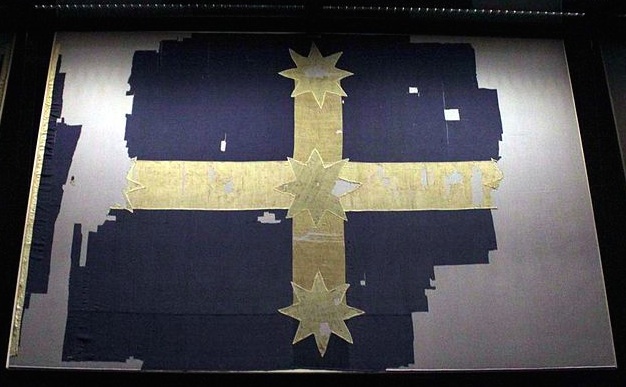
The next day witnessed the last “digger hunt” on the Australian goldfields. It was carried out with a great military display in the hope of striking terror into the hearts of the rebellious diggers. Taken unawares, the latter retired as the troops advanced, rallying occasionally and receiving the enemy with a mingled fire of stones and bullets, the day’s work resulting in open war between the miners and the Crown. No sooner had the police and military returned to camp with a number of prisoners than the diggers assembled en masse on Bakery Hill, appointed a council of war, and elected Peter Lalor (son of a late member for Queen’s County, and brother of the then-present member) as their commander-in-chief. A declaration of independence was drawn up and signed, and a blue flag bearing the Southern Cross, in silver, was unfurled.
Under this Lalor took his stand and administered the following oath to his men :
‘We swear by the Southern Cross to stand truly by each other, and fight to defend our rights and liberties.’
Encamped With Guns and Pikes.
It was on that part of the field known Eureka, principally inhabited by Irish diggers, that the fortified camp of the ‘rebels,’ as they were now officially described, was erected. It consisted of an entrenched stockade that was capable of being made a place of great strength if the diggers had had time to utilise its natural advantages. It occupied an area of about an acre, rudely enclosed with strong slabs. Within the stockade drilling now became the main business of the hour; the diggers’ council of war sat almost continuously; blacksmiths were kept at work night and day forging pikes. “Let those who cannot provide themselves with firearms procure a piece of steel five or six inches long, attached to a pole, and that will pierce the tyrants’ hearts,” were the words of the commander-in-chief to his men.
Patrick Curtain was the chosen captain of the pikemen, and Michael Hanrahan was their lieutenant. Meanwhile the authorities were grievously alarmed at the spectre their stupidity, barbarity, and truculent insolence had created. They had never reckoned on the persecuted diggers turning and presenting an unbroken military front to their oppressors. Sir Charles Hotham and his ministers were in an agitated state of perplexity. Melbourne, the capital, was in a panic. The Mayor was swearing-in citizens by the hundred as special constables to resist the victorious diggers. The wild rumour of the hour was that they were marching in a body from Ballarat to pillage the city.
The rebellion was also spreading. Men of the other goldfields were hastening to the relief and assistance of their Ballarat comrades. The authorities of the Government Camp decided to attack the diggers’ stronghold before any of these reinforcements could arrive.
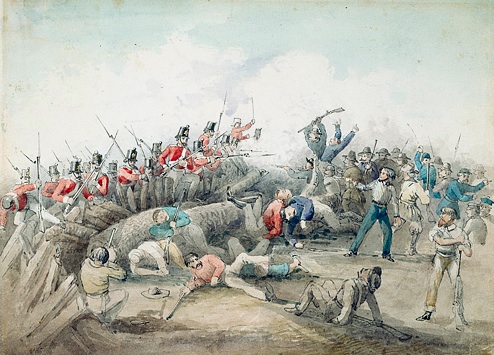
Early on the morning of Sunday, December 3rd, 1854, the assault was made by the combined forces of the military and the police under the command of Colonel Thomas, of the 40th Regiment. The insurgent diggers, commanded by Mr. Peter Lalor, made a brave and desperate resistance. The pikemen (an almost exclusively Irish detachment) stood their ground in double file around the enclosure and repelled several charges of cavalry.
Volley after volley was poured into the stockade and answered by the diggers until their want of ammunition and comparative unpreparedness became apparent. After half an hour’s desperate hand-to-hand fighting, the Eureka stockade was surrounded and carried by storm.
After the Battle: Tho Killed and Wounded.
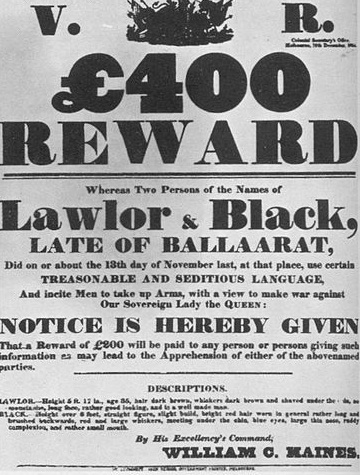
The scene that followed was of a brutal and barbarous character. The ruffianly soldiers and troopers behaved towards their discomfited opponents in the most cowardly fashion. Not content with making a large number of them prisoners, they did not scruple in their savage glee even to shoot non-combatants down in cold blood.
The official list of casualties on the diggers’ side reports;
22 killed
12 wounded
125 taken prisoners
These figures must not be accepted as literally accurate. Many lives were sacrificed and many persons wounded in the encounter whose names were not officially recorded. Subjoined are some of the Irishmen who fell or were wounded in this first struggle for freedom on Victorian soil :
KILLED.
John Hynes, County Clare;
John Diamond, County Clare;
Patrick Gittings, County Kilkenny;
Patrick Mullens, County Kilkenny ;
Thomas O’Neil, County Kilkenny;
George Donaghy, County Donegal;
Edward Qulnn, County Cavan ;
William Quinlan, County Cavan.
MORTALLY WOUNDED;
Thaddeus Moore, County Clare;
James Brown, County Wexford;
Edward M’Glynn, County Wexford.
WOUNDED AND SUBSEQUENTLY RECOVERED;
Michael Hanly, County Tlpperary;
Michael O’Neil, County Clare;
Thomas Callanan, County Clare;
Patrick Callainan, County Clare;
James Warner, County Cork;
Luke Sheehan, County Galway;
Michael Morrison, County Galway;
Denis Dynon, County Clare.
Peter Lalor, Queen’s County;
Patrick Hanofln, County Kerry;
How Lalor Fell.
Lalor fought with conspicuous bravery until he received a bullet near the left shoulder. His men then placed him under some protecting slabs in the stockade, where he was found by friends after the engagement lying in a pool of blood. He was taken to a safe retreat and the wounded arm was amputated by a friendly surgeon. Then, under the protection of Father Patrick Smyth, arrangements were made to remove him speedily from the vengeful pursuit of the authorities.
A few days after the storming of the stockade, Patrick Carroll, an Irish carrier, arrived in Ballarat with a load of goods from Geelong, and on the return trip he had a solitary passenger, the man for whose body, dead or alive, the Government emissaries were scouring the country in all directions. Carroll did his best to conceal the fugitive leader under a tarpaulin and the boughs of trees. By keeping as far as possible from the frequented roads and driving through lonely bush tracks, he succeeded in reaching Geelong without having attracted any hostile notice. Camping outside the town until night came on, the faithful Irishman drove his distressed compatriot to the appointed place of refuge.
Though a large money reward was offered by the Government for Lalor’s apprehension, and his place of concealment was well known to many, not a solitary scrap of information did the Government receive, so loyal and hearty was the sympathy of the people at large with the oppressed diggers and the cause for which they had suffered.
The Trial for High Treason.

The captured diggers were taken to Melbourne and tried for high treason. Though the authorities resorted to the hideous system of packed juries, and though every Irishman and citizen suspected of sympathy with the miners was told to stand aside, the current of popular opinion was so powerful that prisoner after prisoner was acquitted, amid tho ringing cheers of a crowded court and the more boisterous demonstrations of satisfaction from the thousands outside.
Freedom and Honours
Eventually the State trials were wisely abandoned by the Crown. The proclamations of outlawry against Mr. Lalor and his fellow leaders were unconditionally withdrawn. Tho concealed chiefs came forth into the light of day once more. A Royal Commission, with the late Sir John O’Shanassy as one of its principal members, was appointed to inquire into the grievances of the miners. The oppressive license fee was soon abolished on their recommendation. Parliamentary representation was given to the goldfields, and before the first anniversary of the storming of the Eureka stockade came round, Mr Lalor was one of the members for Ballarat, and the mining population was as quiet, law-abiding, and industrious as any other section of the community.
Peter Lalor became Speaker of the Victorian Parliament, and his statue in Speaker’s robes now stands in Stuart street, Ballarat, the proudest possession of the citizens. There is also a magnificent monument at Bakery Hill, Eureka, to commemorate the memory of those who lost their lives in the insurrection.
The armed resistance of the diggers paved the way for democratic freedom in the Australian colonies and Irishmen played the most important part in that exciting episode. To this day Irishmen continue to be the backbone and sinew of the flourishing city of Ballarat that has developed front he thousands of diggers’ tents in 1854.
THE TUAM HERALD, 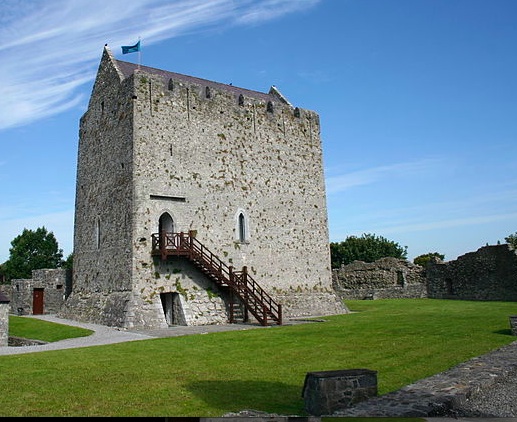
Photo : Ingo Mehling
Wikimedia Commons
14th August, 1909
The most interesting handball contest that ever was brought off in the West of Ireland will come off at the great tournament organised by the Athenry Handball Committee on Sunday, August 29th. All the great exponents of this grand old game in the country presently have promised to attend, and some fine games may be expected. The committee have left no stone unturned to make this tournament a success. They are offering three beautiful gold medals to the winners, and three very good silver medals to the runners-up; and the Athenry ball court has undergone a special course of preparation for the event, a large amount of money having been spent upon it.
The rubber is to be the best of five games, and teams to consist of three players each. All entries close with the Hon. Sec, Mr L Lardner, Church Street, Athenry, on Wednesday, August 25th. Entrance fee, 5s, each team. We understand that a team from Tuam will compete at the handball tournament and will be represented by J. Sheehy, M. Flannelly and M. Hession.
Wikimedia Commons
The Ogden Standard, 22nd January, 1918 p12
The Irish World, The Gaelic-American and the Freeman’s Journal, three of the leading weekly publications in this country espousing the cause of Irish independence have been barred from the mails – it was learned from the editors of these papers today.
From the Roll of Honour, the 1916 Sinn Fein Rebellion Handbook and the Frongoch Camp list
The Roll of Honour, the 1916 Sinn Fein Rebellion Handbook and the Frongoch Camp List identifies men and women who fought in the 1916 rebellion in Dublin and countrywide. The list runs to over 6,000 names and is not exhaustive. It details where men and women were interned/exiled in the aftermath of the rebellion.
Kinvara/Gort/Kilcolgan/Ardrahan/Loughcurra/Doorus/Peterswell volunteers are listed below. Please contact me if you see an error or omission and I will update immediately.
John Glynn Duras, Kinvara Co. Galway, Richmond Barracks to Wandsworth May 8th 1916
John Glynn Kinvara, Co Galway, Frongoch Detention Camp June/July 1916
P Rian Forde, Kilcolgan, Co. Galway Richmond Barracks to Glasgow 19th May, 1916
P Hanbury Dongoran, Kinvara, Co. Galway Richmond Barracks to Wandsworth May 8th 1916
Patrick Hanbury, Kinvara, Co Galway Frongoch Detention Camp June/July 1916
Daniel Kelleher, Gort, Co. Galway Frongoch Detention Camp June/July 1916
James Kelleher, Gort, Co. Galway Frongoch Detention Camp June/July 1916
John Kelleher, Gort, Co. Galway Frongoch Detention Camp June/July 1916
Martin Kelleher, Gort, Co. Galway Frongoch Detention Camp June/July 1916
Daniel Kelleher, Gort, Co. Galway Frongoch Detention Camp June/July 1916
Martin Kellerker (sp), Gort Richmond Barracks to Perth May 19, 1916
Thomas Kelley, Peterswell, Co. Galway Frongoch Detention Camp June/July 1916
J Callinan, Kinvara, Co. Galway Frongoch Detention Camp, June/July 1916
James Coen, Ballycholin, Gort Richmond Barracks to Perth 19th May, 1916
John Coen, Ardrahan, Co Galway Frongoch Detention Camp, June/July 1916
John Coen, Ballymaguire, Ardrahan, Farmaer Richmond Barracks to Lewis, 19th May, 1916
John Coen, Gort, Co. Galway Frongoch Detention Camp, June/July 1916
Martin Coen, Gort, Co Galway Frongock Detention Camp, June/July 1916
Patrick J Fahy, Kinvara, Co. Galway Richmond Barracks to Wandsworth, 8th May 1016
Henlon David Loughcurra, Kinvara Galway Richmond Barracks to Wakefield June 1st 1916
Peter Howley, Peterswell, Co. Galway Frongoch Detention Camp June/July 1916
William Howley, Peterswell, Co. Galway Frongoch Detention Camp June/July 1916
Thomas McInerney Kinvara Co Galway, Frongoch Detention Camp June/July 1916
Thomas McInerney, Cashenmoore, Kinvara, Richmond Barracks to Knutsford June 1 1916
Michael O’Conlon Kinvara Co. Galway Frongoch Detention Camp June/July 1916
Michael O’Dea, Kilcolgan Co. Galway Frongoch Detention Camp June/July 1916
Michael O’Dea Stradbally Kilcolgan, Richmond Barracks to Wandsworth June 1, 1916
Patrick Joseph O’Dea, Kilcolgan Co. Galway Frongoch Detention Camp June/July 1916
Thomas O’Dea, Kilcolgan, Co. Galway Frongoch Detention Camp June/July 1916
Thomas O’Dea Stradbally Kilcolgan, farmer, Richmond Barracks to Knutsford June 15 1916
David O’Hanlon Kinvara Co Galway Frongoch Detention Camp June/July 1916
Michael Silver Rathbairn Ardrahan farmer Richmond Barracks to Knutsford June 6 1916
Patrick Silver Ardrahan Richmond Barracks to Knutsford June 1 1916
John Whelan, Duras Kinvara, Co Galway Richmond Barracks to Wandsworth May 8th 1916
John Whelan Kinvara Co Galway Frongoch Detention Camp June/July 1916
Patrick Burke, Kinvara, Co Galway Frongoch Detention Camp June/July 1916
Patrick Burke, Kinvara, Co Galway Frongoch Detention Camp June/July 1916
Peter Burke, Kinvara, Co. Galway Frongoch Detention Camp June/July 1916
Thomas Burke, Gort, Co. Galway Frongoch Detention Camp June/July 1916
Thomas Burke, Lurgin, Gort Richmond Barracks to Perth 19th May 1916
John Bindon, Kilcolgan, Co Galway Frongoch Detention Camp June/July 1916
Thomas Bindon, Kilcolgan, Co. Galway Frongoch Detention Camp June/July 1916
Michael Cuniffe, Gort, Co Galway Frongoch Detention Camp June/July 1916
Thomas Cuniffe, Gort, Co. Galway Frongoch Detention Camp June/July 1916
Martin Hynes, Durns, Kinvara Co. Galway farmer Richmond Barracks to Woking 19th May 1916
Martin Hynes Kinvara Co Galway Frongoch Detention Camp June/July 1916
Stephen Leech Kinvara, Co. Galway Frongoch Detention Camp June/July 1916
Stephen Leech Loughcurra Kinvara Co. Galway Richmond Barracks to Wandsworth 8th May, 1916
T Stephenson Gort Co Galway Richmond Barracks to Glasgow may 19, 1916
Thomas Stephenson Gort Co Galway Frongoch Detention Camp June/July 1916
Michael Sylver Ardrahan Co. Galway Frongock Detention Camp June July 1916
Patrick Sylver Ardrahan Co. Galway Frongoch Detention Camp June/July 1916
Bryan O’Connor, Gort, Co Galway. Frongoch Detention Camp June/July 1916
John Loughrey Gort Co Galway, Frongoch Detention Camp June/July 1916
John Kilkelly, Canshow, Kinvara (sp) Richmond Barracks to Knutsford 1st June, 1916
John Kilkelly, Kinvara, Co. Galway Frongoch Detention Camp June/July 1916
Michael Kilkelly, Kinvara Co. Galway Richmond Barracks to Glasgow 19th May, 1916
Michael Kilkelly, Towna, Kinnaird (sp) Richmond Barracks to Wandsworth 8th May 1916
P Kikelly, Kilcolgan, Co. Galway Richmond Barracks to Glasgow 19th May, 1916
Patrick Kilkelly, Kinvara, Co. Galway Frongoch Detention Camp, June/July 1916
T Kilkelly, Kilcolgan, Co. Galway Frongoch Detention Camp, June/July 1916
John Fahey, Lurgin, Gort Richmond Barracks to Perth 19th May 1016
Michael Fahey, Lurgin, Gort Richmond Barracks to Perth 19th May 1916
Thomas Brennan, Kilcolgan, Co. Galway Frongoch Detention Camp June/July 1916
for more information, see http://the1916proclamation.ie/the-roll-honour/g/

Elyria Democrat, Ohio
1st December, 1887
Dennis McNamara, a shopkeeper at Ennis, Ireland, has been sentenced to twenty weeks’ imprisonment for selling copies of United Ireland, William O’Brien’s paper, the selling of which has been proclaimed. This is the first instance in which a person has been prosecuted for selling papers.
Decatur Daily Republican 24th February, 1888
(abridged)
An exhibition of the cruelty of the present rule in Ireland was afforded Wednesday in the adjoining towns of Milltown and Millbay, over in County Clare. A number of people of the neighboring parishes attempted to distribute two hundred and sixty car-loads of turf and the same amount of potatoes among the families of eleven men, who are at present serving terms of imprisonment, having been sentenced for alleged crimes against the coercion law. The police, however, stopped the proceedings, and would not allow the humane work to continue.
——————————-

