Kinvara, December 1. My Dear Dr. Gray, I shall feel obliged by your inserting in your next publication the following: The Rev. Francis Arthur, Kinvara, begs to acknowledge the sum of 35/ from his Grace the Archbishop of Tuam, through the Rev. James Waldron and the Rev. James Magee, for distribution among the priests in the distressed parishes of the diocese of Kilmacduagh, according to the directions of the bishop, the Most Rev. Dr. Fallon. I remain, my dear Dr. Gray, your much obliged, Francis Arthur P.P.
O, to have a little house!
To own the hearth and stool and all!
The heaped up sods upon the fire,
The pile of turf against the wall!
To have a clock with weights and chains
And pendulum swinging up and down!
A dresser filled with shining delph,
Speckled and white and blue and brown!
I could be busy all the day
Clearing and sweeping hearth and floor,
And fixing on their shelf again
My white and blue and speckled store!
I could be quiet there at night
Beside the fire and by myself,
Sure of a bed and loth to leave
The ticking clock and the shining delph!
Och! but I’m weary of mist and dark,
And roads where there’s never a house nor bush,
And tired I am of bog and road,
And the crying wind and the lonesome hush!
And I am praying to God on high,
And I am praying Him night and day,
For a little house – house of my own –
Out of the wind’s and the rain’s way.
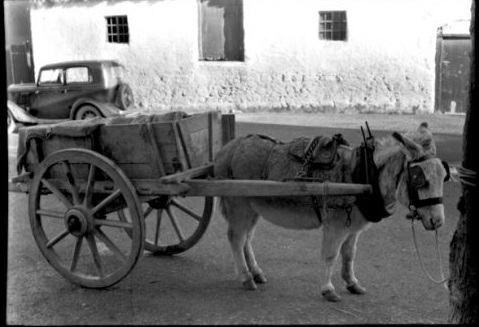
Donkey and Cart, Kinvara c.1950 Cresswell Archives
A large and representative meeting of the Gort District Council and Board of Guardians was held on Saturday at which the following resolution was proposed by Mr. Michael Mitchell D.C. and seconded by Mr. M O’Donohoe, D.C.;
Resolved; That we, the members of the Gort District Council, beg to congratulate Messrs J.W.Brady Murray, J.P. and J.W. French, J.P.(chairman of Galway District Council) for having the courage of their convictions in attending at great personal inconvenience the Kinvarra Petty Sessions and refusing to be a party to the successful attempt made to penalise the Irish language by the recent prosecution of Bartley Hynes for having his name in Irish characters on his cart, and we hope as a result of this prosecution, thousands will follow. That copies of this resolution be sent to J.W.Brady Murray J.P; J.W.French J.P; the Galway County Council, the Gaelic League, the “Irish Daily Independent and Nation,” and the “Freeman’s Journal.” The resolution was strongly supported by the Ven. Archdeacon Daly M.A. who said it was the greatest pity to let the Irish language die out; every country had its own language – the Welsh had their own language, and every Irishman should have his and not be ashamed of it.
T.P. Corless D.C. followed in support of the resolution, and expressed a hope that in future a preference of appointments in the Gort Union be given to those who would speak the Irish language and not be ashamed of it. The resolution was carried amid loud applause, some of which was expressed in Irish.
We agree with all our County contemporaries that there is a general, and to our mind, a justifiable complaint made of the want of a regular service between Galway and Kinvara across the bay. The present inland mode of communication cannot be regarded as calculated to foster or improve commercial relations between the two towns concerned. too much time would be occupied for transit purposes and no railway line touches nearer than seven miles to Kinvara. This adversely affects both Kinvara and Galway, for at the present time transit facilities very largely govern the volume of trade between any two centres of population. It is held by shrewd business men that if there was a regular three-day or two-day service between Galway and Kinvara the trade between the two ports would be very considerable, for Kinvara Harbour would be made the outlet for a very large tract of country that presently lies in a most undeveloped condition for want of such facilities as a regular service with Galway would offer.
There are now two boards to hand with practically plenary powers to deal with such matters, the Congested Districts Board and the Board of Agriculture, and if these were approached by a committee representing the interests of Galway and Kinvara respectively, there need hardly be a doubt that the project outlined would come off. Both these Boards undertook to contribute three-fifths of the cost of the ferry at Kilbeg, and it is but reasonable to expect that they would favourably entertain any feasible representation made to them in respect of the project under consideration. It would, at any rate, be an experiment well worth the while of the places that would be affected by such a transit service to take combined action and see what can be done.
On Sunday last a large and influential meeting of the people of Kinvarra and the surrounding districts was held in the chapel yard after last Mass. The meeting was convened to consider the present general depression, which is telling very severely on the tenant farmers in the neighbourhood. Kinvarra is essentially an agricultural district and the principal crops, being potatoes and barley, have been very seriously damaged by the constant wet and the late severe storms. The Rev. John Molony P.P., presided and Mr. James Curtin acted as secretary. The following resolutions were unanimously adopted:
Proposed by Mr. Henry Fanagan, Esq., and seconded by Mr. John Lynch; That this meeting is of opinion that the agricultural produce of this district, on which the people have almost entirely to depend for the payment of their rents and the support of their families, has been so much injured by the unprecedented wet summer and the late storms as to render it impossible for the tenant farmers to pay their present rents; and moreover to give just grounds for learning that the coming winter and spring will find many of them almost destitute.
Proposed by Mr. William Flatley and seconded by Mr. Stephen Leech; In the face of the great losses we have sustained, caused by three successive bad harvests and the depreciation of agricultural produce arising from foreign importation, we are compelled to make an earnest but respectful appeal to our landlords to make such a reduction in our rents as will enable us to pass through the present severe crisis and save us from utter ruin.
Proposed by Mr. Thomas Corless and seconded by Mr. Michael Kelly; That we feel we have good grounds to hope that our appeal will meet with a favourable response, as many of our landlords reside outside the parish, and consequently there is not so much employment given to the labouring classes in the district, nor that encouragement to local trade which might naturally be expected from resident proprietors.
Proposed by Mr. Peter Burke and seconded by Mr. John Burke; That copies of these resolutions, signed by their respective tenants, be forwarded to the landlords of the parish, and that another copy, signed by the chairman and secretary, be sent to the Freeman’s Journal, the ever-faithful friend and advocate of the rights of the tenant farmers in Ireland.
(signed)
J. Molony, P.P., Chairman
James Curtin, Hon. Sec.
Kerry Evening Post 31st January, 1877 p.2 (abridged)
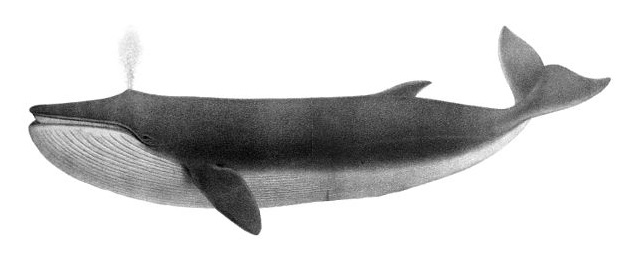
“The Finback” (Balaenoptera physalus) from Charles Melville Scammon’s Marine mammals of the western coast of North America (1874)
The Galway Express reports that a whale was got dead out at the sea on Friday night by a Claddagh man named John Donohoe; he gaffed and strung it to his boat, with the aid of another small boat’s crew. The night was extremely stormy and they got much knocking about, but succeeded in towing it in. It is a rather small fin-whale, about twenty-five feet long, and from three and a half to four tons weight. The blubber has been cut off, and is valued for about £40, a rather handsome booty.
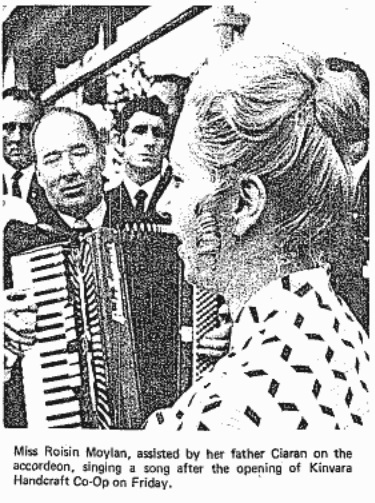
The Secretary of the Kinvara Handcrafts Society, Mr. Toddie Byrne, said last week that they now intend to launch out into crochet making. Mrs. Michael Corless of The Square, Kinvara, is busy designing wool crochet dresses and caps. Another product will be rush-work for which they’ve been inundated with offers from local women and women from neighbouring parishes. Up to now, he said, they had decided not to deal with rush-work because of involvement in the making of Aran jumpers and cardigans.
At present they have over two hundred of these garments in stock. Buyers from England have bought some of the local garments and a letter has been received by the Society from a housewife in England expressing appreciation of the workmanship, the pattern and potential market for these traditional garments. A small consignment has been dispatched to America. Negotiations are in progress for the purchase of a site for the construction of a display centre and offices in the town of Kinvara where a permanent staff will take charge of the daily affairs of the co-operative. A special display of the hand-made garments will take place in early February in the town for the benefit of buyers from Canada who are expected to make a great impression on the sales of the fine garments.
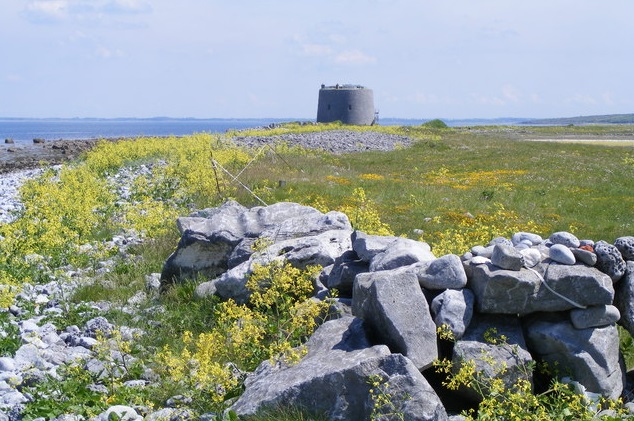
Martello Tower Aughinish Photo: A McCarron Wikimedia Commons
At Aughnish Point, a little fishing village in the wilds of Clare, on Monday last, two or three fishermen, with sorrowful faces, might be seen lifting off the strand, where it had been left by the receding tide, the lifeless corpse of a woman. From her long hair and humble garments, the sea water ran in streams over the friendly forms who bore their sad burden to a hut hard by. She whose lifeless form lay stretched upon the fisherman’s cabin floor had sought in death release from sorrow, not from shame. Over her story there hung no mystery, upon her memory no blot or blame. She had truly and faithfully given to society examples of heroism in affliction and fortitude in struggles where man’s endurance failed. Behind this record of its tragic close lies the story of a stainless life.
Twelve years ago, Mary McN. was the wife of an Irish farmer who tilled a little holding of four or five acres, which, with probably the proceeds of the fishing season, sufficed for all his wants. Death struck down her husband and left her single-handed to act a mother’s part with seven children. The black days of the Famine came. She had around her a young family, which, the evidence at the inquest tells us, she had always managed to bring up creditably and respectably. How hard she must have struggled. But now, indeed, the wolf was at the door, yet, she did not, even in that hour, despair. She wrought and wrought and toiled and slaved and never gave up the four acres nor deserted the little home beneath whose roof had passed the bright scenes in the drama of her humble life.
She came through those terrible famine years a victor. The little home still smiled, and still she had the ambition of bringing up her little boys and girls “respectably.” She achieved it all.
But, at last, a more terrible calamity than the Famine came upon her; one before which, all her striving was in vain. One against which, she strove until her honest heart broke in the struggle. The property upon which she was a tenant was sold in the Incumbered Estates Court. An envious eye was cast upon the little farm. In a perfectly “legal” manner Rev Mr J. outbid Mary for the spot which she had held for over twenty years. The spot she had struggled so hard, so bravely, to retain when the grave or the workhouse (to a heart less resolute) seemed inevitable. In vain she pleaded, begged, prayed. She was evicted.
The poor woman long refused to believe the fact. With passionate energy, she exhausted every possible means of retaining the farm. But the law was too strong. She had to quit. With her seven children she was adrift upon the world. The the strong mind gave way; the strained bow broke. For a long time, dejection settled upon her and she would ever keep talking of the humble home where once she had been happy, from which she had been driven forever.
Friends thought Time, the consoler, would calm the poor widow’s grieving; but alas her reason fled. The poor woman wandered about the fields, talking as of old, when they were her care; of the farming labours which she directed; of the hard struggles she fancied were still going on; of the old subjects of anxiety and foresight. She would shout out that she would not be reft of her humble home, that it was still hers.
But sometimes, as if a glimpse of the disastrous truth broke upon her, she would sink in prostration and talk dejectedly about the struggle in which she had been overthrown. Last Monday she was observed to wander to the waterside, pause for a moment, fold her arms, then plunge into the tide.
Take her up tenderly, kind neighbourly hearts; she was an Irish wife and mother, without stain and without reproach.
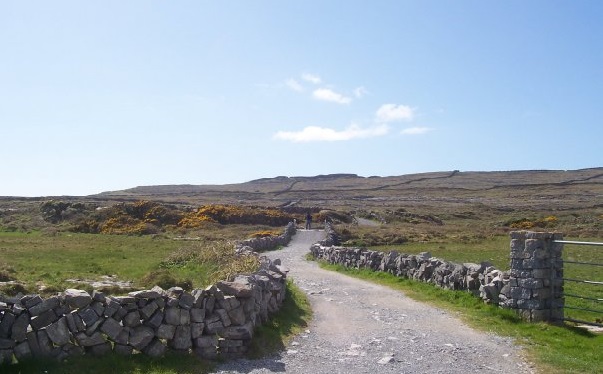
Innismore, Aran Islands, County Galway Photo: Jansena1
A correspondent of the Mail states that the Viceroy carried 1,120 letters and 33 passengers. We find in the same journal the subjoined letter from Mr. Evans, the pilot of Galway;
Galway, June 2, 1850 Sir, At the request of Mr. Leigh, chief officer of coast guards, I beg leave to inform you that I proceeded as far as the Sound, on the north island of Arran, on board the Viceroy, on yesterday morning, a distance of twenty-seven miles from Galway, which she steamed in the wonderfully short space of two hours and ten minutes. I left her at 12 o’clock precisely, and at one p.m., she was completely out of sight. During all night it was perfectly calm, and at six o’clock this morning a nice breeze sprung up at S.S. East. The wind is now (three o’clock, p.m.) due south, fresh breeze. I have crossed the Atlantic several times by the Cunard steamers from Liverpool, and I am happy to inform you that the Viceroy exceeded any of them in speed at our starting; and I feel quite confident she will realise the hopes entertained of her making a speedy passage. I am, Sir, your most obedient servant, Joseph Evans, Master Pilot.
Address of the parishioners of Kinvarra, Duras and Killinna to the Rev. Francis P.P. Croughwell and Ballimana.
Rev. Dear Sir,
We have been deputed by our fellow parishioners of the united parishes of Kinvarra, Duras and Killinna, to offer you in the first instance their sincere and heartfelt congratulations on your recovery from your late severe and dangerous illness, and in the next to convey to you their, and our own, deep regret at your having been so soon after removed from amongst us.
For four and twenty years have you discharged the onerous duties of Pastor to these parishes with a pious zeal truly edifying, and the benefits conferred on religion and morality by your counsel and teaching during that eventful period it is not in our power to convey an adequate idea of, but we fondly cherish the hope that they will be appreciated by Him whose faithful servant you have ever been and who is sure to reward those who faithfully do His work.
It would be difficult, Rev. Sir, to enumerate all the advantages which your late Parishioners have derived, both spiritually and temporally, from the interest you have ever evinced in their welfare.
Need we refer to your exertions in their cause when famine and all its sad consequences, fever, cholera, &c, &c, stalked abroad, and like and avenging angel was devastating the land. Then, indeed, it was that the good and zealous Priest of Kinvarra proved the interest he felt in his flock, in not only being found day and night in the midst of contagion and approaching dissolution, ministering to their spiritual wants, but also in relieving by his purse, and frequent appeals in their behalf to the charitable throughout the kingdom, their distressed condition.
We would be ungrateful and unworthy of the benefits conferred on the parish by him did we omit the name of your respected and beloved Curate in this address, of him who, which on the mission amongst us, has won for himself not only our esteem and affection, but the respect and regard of all those who had the happiness of hearing his exposition of the Word of God during his mission in the parish. We felt much, and were truly sorry to learn, that your respected Bishop had resolved on removing you, Rev. Sir, to another parish, but which removal we, however, sincerely hope will prove to you a well-merited reward for your past invaluable services in this.
We cannot give expression to the feelings of regret entertained by all when it was ascertained that his Lordship felt it necessary to remove the Rev. Mr McDonogh also from amongst us.
In conclusion, we beg to observe that, although the scene of your labours is now elsewhere and amongst other people, we are convinced that your prayers will still be offered to the Throne of Mercy for those who have commissioned us to present you with this Purse and its contents as a trifling token of the love and esteem in which you have ever been and will be held by them, as well as by your sincere and ever faithful friends.
Signed on behalf of the Committee.
Isacc B. Daly, Chairman
D.J. Hynes, M.D.(Vice Treasurer)
Martin Kerin (Vice Treasurer)