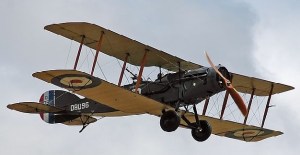
Bristol F.2B D-8096 (The Shuttleworth Trust) Kogo;Wikimedia Commons
Three Bristol fighter aeroplanes left Dublin at 5.20 p.m. yesterday and flew to Galway, landing at Oranmore aerodrome exactly one hour and ten minutes after their start, having, in addition, encircled Galway Bay and the City. They were in charge of Col. Fitzmaurice and carried a staff photographer. A detachment of men from Renmore guarded the ‘planes last night.
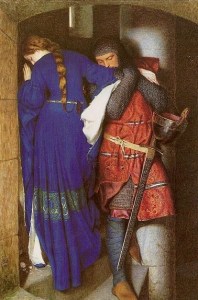
Hellelil and Hildebrand, the Meeting on the Turret Stairs Frederick William Burton (1816-1900) National Gallery of Ireland
I stand in the gallery quaint and old,
And there on the tapestried wall,
I read the names of the knights and dames
Who have passed beyond recall:
And a faint dream-perfume comes to me
That carries me, ere I know,
Back to the world that used to be,
Two hundred years ago.
Out of her ruffle of costly lace,
And out of his armour old,
Look down a maid with a smiling face
And a cavalier brave and bold.
And I know that she was his lady fair.
And he her courtly beau;
They were lovers true in the days that were,
Two hundred years ago.
I recall the legend that links her name
To his in a wreath of gold –
How he died to save his love’s fair fame
In the chivalrous days of old,
And her eyes still gleam with love’s deep trust,
And his with courage glow,
Though her spirit and his were laid to dust
Two hundred years ago.
As they gaze at me from their place on high,
“Believe” they seem to say,
“Though centuries pass and customs die,
Love passeth not away!”
And as long as men are true and bold,
And women that high trust know,
Shall Love be the gift that it was of old
Two hundred years ago.
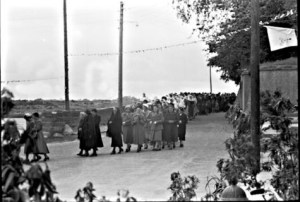
Corpus Christi procession passing Seamount gate (on right) c. 1950 Photo: Cresswell archives
About one hundred years ago Dr. Hynes of Kinvara purchased from Lord Inchiquin a shooting lodge overlooking Galway Bay between Kinvara and Dungora Castle. Here Dr. Hynes built a residence for himself and his family and, dying, bequeathed it to his daughter, Elizabeth, who had married his successor as M.O. of Kinvara, Dr. Nally.
During Easter Week 1916 this residence was occupied by Kinvara Company of the I.R.A. and during the War of Independence it was the secret meeting place of the wanted men. Again, during the Civil War, on account of its fine accommodation and commanding position, it was occupied in turn by both of the warring forces. At that time too, Mrs Nally, now a widow, set in motion the chain of circumstances which has brought it to its present proud position by presenting it to the Sisters of the Convents of Mercy of Gort and Kinvara. The Sisters had long wished to establish a secondary school for girls. Now they had the building with which to make a start but their resources were meagre.
By 1926 a room in one of the stables had been converted into a classroom and some members of the Gort Community took up residence in Seamount House. The work was inaugurated with fifteen boarders and thirteen day-pupils. By 1928 the rest of the stable had been converted into two more classrooms and a large corridor was added to the building. As the fame of the College grew so did the numbers of boarders and day pupils, and so too, did the need for extra accommodation.
In 1938 a fine three storey building was erected which contained dormitories, class-rooms, dressing rooms, and a magnificent recreation hall with a permanent stage. Despite these extensions the sisters were unable to cope with the ever-growing volume of demands for admission and again they had to face the question of expansion of the College buildings. The old buildings were adequate for the 140 pupils in residence there in 1952 but many, many applications had to be refused. So in 1952 Mr. Ralph Ryan, M.E. Galway, prepared plans for the great extension and the work was put in the hands of Messrs. kBurke and Clancy, Galway.
And so, in thirty years, the nuns of Seamount have written a success story of which any large corporation might be proud.
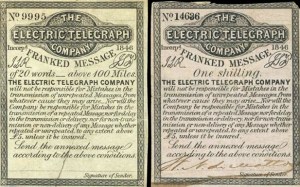
1854 stamps of the Electric Telegraph Company. Wikimedia Commons
Arrangements are far advanced towards completion for laying down a submarine telegraph between the United Kingdom and America. It is intended to connect the two countries, or rather, the Old and New Worlds by means of Galway and Halifax, those being the two nearest points of communication. The distance is about 1,600 miles. The perfect practicability of the thing has been guaranteed under the hand of nearly all the eminent engineers of the day, and various parties have sent in estimates for the execution of the work. These estimates vary from £800,000 down to £300,000 and it is a remarkable fact that some of the lowest estimates have been sent in by some of the most respectable firms in the country. When this extraordinary project has been carried out, we shall be able in half an hour to send messages from London to New York, and receive messages from the United States in about half an hour. And not, we ought to add, from New York alone, but from the interior of America, the electric telegraph being laid down for upwards of 2,000 miles up the country.
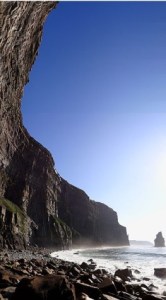
Cliffs of Moher Photo: Bjørn Christian Tørrissen Wikimedia Commons
Mr Rd. Humphries of Cork, who recently exported ten tons of stone from Blarney for the purposes of the organisers of the World Fair at San Francisco, America, was on a visit to Lisdoonvarna, Co. Clare, during the weekend. In an interview, he stated that an additional ten tons would be exported in November next.
Asked exactly what the stone would be used for, Mr. Humphries said he did not really know, but he did know that the organisers of the Fair or Exhibition may be interested in other Irish exhibits.
The Treaty Stone at Limerick was suggested to Mr. Humphries, and he said it was extremely improbable that the Treaty Stone would ever be allowed to be removed from its present site. The American organisers would not be so much interested in the Treaty Stone as in the material from which it was composed.
“Would your friends be interested in a stone replica of the famous Cliffs of Moher,” asked the interviewer.
“They may be,” replied Mr. Humphries, with a smile.
The newly explored fishing ground about one mile off-shore from “Old Kinvara Quay,” is yielding wonderful sport. Mr John Counihan of the National Bank, Gort, got in two hours there, three skate and three dog fish totalling 47lbs. On a previous visit he got five tope and four dog fish. Monk fish come there and very large skate. In the Autumn there are large porbeagle sharks.
As well as Kinvara there are three other quays in perfect repair only three miles form the fishing ground. There are ParkMore, Tarrae, and Newtownlynch.
At a special meeting of the Kinvara Town Tenants’ Association held on Wednesday evening, under the Chairmanship of Mr. Thomas P. Corless, D.C., the following resolution was unanimously adopted;
That we, the members of Kinvara Town Tenants’ Association, urge upon Mr. John E. Redmond, the able and distinguished leader of the Irish Parliamentary Party, the advisability of giving the town tenants of Ireland, who were always the backbone of the National movement, direct representation in Parliament, and that with a view to that end, we respectfully suggest that Mr. Coghlan Briscoe, T.C. the energetic and popular Secretary of the Town Tenants’ Association, will be nominated for the vacancy in the representation of North Galway.
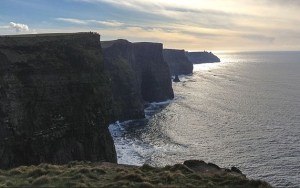
Cliffs of Moher Photo: Michal Osmenda Creative Commons
A plea for the preservation of the public right of access to the Cliffs of Moher, one of Clare’s most famous tourist sights, was made by Mr. P.McGuire and Mr. P. Burke, Lisdoonvarna, to the Clare County Council. They pointed out that the land leading to the cliffs was being divided. A gate erected to facilitate the entry of tourists had been removed and the entrance built up. It was suggested that the attention of the Land Commission be directed to the matter, and portion of the land be vested in the Office of Public Works, who should be asked to convert it into a public park.
The Council adopted the suggestion of the deputation and decided to make representations to the Land Commission and Board of works on the matter.
Gardai carrying out searches following the robbery of the Galway – Ballyvaughan mail car found in a house at Cahermore, Gort, two Mills Bombs, a large quantity of gelignite, a shotgune, sword, pike, and 40 rounds of rifle ammunition.
In raids in Kinvara district revolvers, gelignite and revolver ammunition were discovered. Two men were arrested in connection with the find.
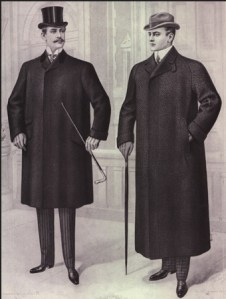
Image: Sartorial Art Journal, December 1900 Wikimedia Commons
To the Editor, Connacht Tribune
Sir,
I would suggest to the police doing protection duty on the Tyrone estate to watch the sky; they may catch Jack Dunne’s air-ship, the “Hope of Europe,” and they might find the hope of the tenants on the Tyrone estate. The R.I.C. are very good to the people of Ballinderreen. Lately, some person found a coat, and gave it up at the barracks at Kinvara, and the Kinvara police are making a house-to-house visit to find out if any of the inmates lost it.
H.G. St. Birds.