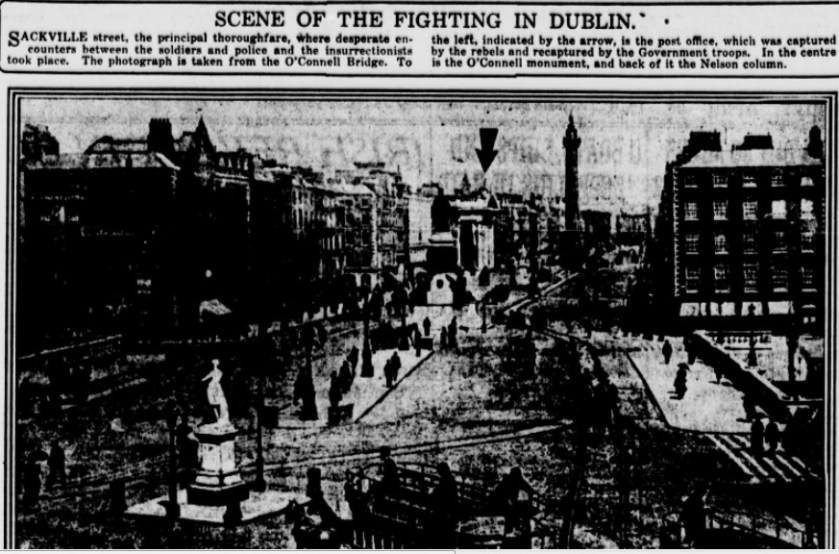
The Daily Gate City and constitution – Democrat April 25th, 1916 By J.W.T. Mason, Written for the United Press New York – April 25, p.1
WELL ORGANISED IRISH MUTINY
There can no longer be any doubt but that a grave situation of rebellion now exists in Ireland.The frustration of Sir Roger Casement’s efforts at gun running, has been only partly successful and it is practically certain that his expedition landed munitions on the Irish coast before the British naval forces intervene. More disquieting than Casement’s exploit, for the British government, is the fact that a well organized movement was ready in Ireland to make instant use of the arms imported from Germany. The “grave riots” announced in the house of commons this afternoon, are undoubtedly the work of pro-German agitators in Ireland whose propaganda the Dublin castle authorities have been unable to put down.
For many months there have been indications that a irreconcilable part of Ireland’s population has been preparing for a seditious uprising. The difficult of getting proper war equipment has been very great, owing to the stringent regulations of the British government. The Casement expedition provided for the first time sufficient munitions to influence the Irish leaders into ordering an uprising.
It is highly probable that the Germans ordered today’s naval raid on the British coast for the purpose of encouraging the Irish and throwing the British government into added confusion. How sweeping may become the Irish rebellion depends largely on the quantity of munitions that Sir Roger Casement was able to get ashore. The British government’s announcement that Casement’s operations covered two days and that only one vessel was employed, suggests only a limited amount of material was landed. When this is expended, it is difficult to determine where other important supplies can be obtained unless the troops quartered in Ireland mutiny. The most advantageous consequence of the Irish uprising for Germany will probably be the permanent detention with Great Britain of large bodies of troops that otherwise would be sent to the France-Belgium front.
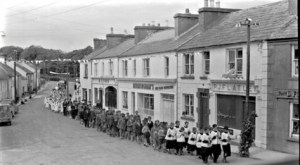
Corpus Christi procession, Kinvara c.1950 Photo: Cresswell archives
We deeply regret the death on the 27th of December at the Parochial House, Kinvara, of the Rev. Thomas Burke, P.P. Deceased was universally respected. He was a native of Ardrahan parish and educated at Maynooth. He had a thorough and intimate knowledge of the history of his country and was a lover of its past, and was particularly well up in the history of his native county of Galway. Few men living better knew the story of the past of this province or of the fall and rise of its families. Father Tom was in delicate health for some years and unable to actively discharge the duties of his sacred office. While able to work he wa zealous and untiring in his daily devotion to duty.
It was but a fitting thing that Dr. MacEvilly should have appointed Father Burke to so historic a parish as Kinvara, where we find the union of ancient parishes of Kiloveragh, Kilena and Duras. On a site given by James de Basterot, of Duras, the present church was erected, and it was one of the first Catholic churches built in these parts. Thus the pro-Cathedral, Galway, was not commenced until 1819 and Tuam Cathedral till 1827 and Gort church until 1828. It cost £2,000 in those days. The parish priest in 1798 was the Rev. Nicholas Archdeacon who was afterwards Bishop of the Diocese of Kilmacduagh, of which Kinvara was a part. He was succeeded by Father O’Fahy, who was followed by Father Acton, a regular, who afterwards became P.P. of Ballindereen and after him came Rev. John Fahy of Peterswell, whose successor was the Rev. Thos Shannon, afterwards P.P. of Gort.
Father Forde succeeded Father Shannon and he died a victim to duty in black ’47 and is buried in the church at Kinvara close to the B. Virgin’s alter. After him came Father Francis Arthur, who hospitably entertained John Blake Dillon when flying from Tuam dressed as a priest in clothes lent him by Father O’Brien, then Professor of St. Jarlath’s, and on a car given and driven by Richard Kelly, Esq., J.P. of Tuam.
He fled to Kinvara from Tuam to go to America, intending to leave as an emigrant in a ship that was sailing from Galway to Boston. He was brought out in a boat from Kinvara by John Holland, a native, to try and catch the ship on its outward journey ere she sailed away for the Far West. The vessel was the brig “Barbara.” The sea, however, was too rough for Holland’s boat, so regretfully he had to put in at Aran from which John Dillon ultimately sailed for the great Republic. Father Burke often related at his hospitable board the story of the sailing which he had fromeyewitnesses. Father Moloney succeeded Father Arthur and after him Father Tom Burke came.
Kinvara saw in the time of these last four deceased priests many sad changes for the worst. It lost its primacy as a bishopric – the old see at Kilmacduagh being united to the modern one of Galway. It lost its shipping trade. The only thing that did not decline was the rent the people had to pay. The old landlords, the Gregorys of Coole Park, and the De. Basterots were obliged to sell out and the new class of speculator came along.
A Mr. Comerford, a timber merchant in Galway, bought the town that belonged to Mr. Gregory and raised the rental from £335 to £1,150, but it did not and could not revive with him or his successors. A Mr. Murray, a pawnbroker in Galway, came along and was equally active in promoting depopulation. The townlandlord of Northampton decreased from 25 families to 11. But Mr. Murray left a bequest of £2,000 for a convent and to him Kinvara owes its present beautiful foundation built on a site given by Captain Blake Foster.
Kinvara was once a thriving market town, but its tolls declined from 200 to 60. It had in 1872 a population of 689 families and in 1890 this sank to 451. Its barley market for Persse’sDistillery in Galway brought in a good deal of money, but Persse’s Distillery, having been closed down owing to the narrow policy of the Bank of Ireland, that industry was lost to Galway and Kinvara.
Father Tom was universally esteemed, and while of recent years his delicate health did not allow him to go about, he was always glad to meet a brother priest or other friend and chat over old times. The regret felt at his demise was manifested in every possible way by the parishioners who felt they lost in him a good priest and friend. There was a great gathering at the funeral and Requiem Mass on Monday at the Parish Church of the priests of the diocese and the people of the district.
R.I.P.
The Catholic Press 31st July, 1919 p.21 (abridged)
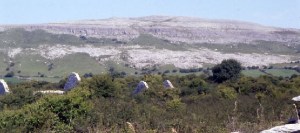
Burren Gate Photo: EO’D
A SOLDIER’S SONG
Barricade song of the Irish Volunteers, 1916
Composed in 1907, with words by Peadar Kearney and music by Kearney and Patrick Heeney. Translated into Irish by Liam Ó Rinn in 1923
We’ll sing a song, a soldier’s song,
With cheering, rousing chorus
As round our blazing fires we throng,
The starry heavens o’er us;
Impatient for the coming fight
And as we wait the morning’s light,
Here in the silence of the night,
We’ll chant the soldier’s song.
chorus
Soldiers are we, whose lives are pledged to Ireland,
Some have come, from the land beyond the wave,
Sworn to be free; no more our ancient sireland
Shall shelter the despot or the slave,
To night we man the Bearna Baoghail
In Erin’s cause come woe or weal,
‘Mid cannon’s roar, and rifle’s peal,
We’ll chant the soldier’s song.
Burren Gate Photo: EO’D
In valley green, on towering crag,
Our fathers fought before us,
And conquered ‘neath the same old flag
That’s proudly floating o’er us;
We’re children of a fighting race,
That never yet has known disgrace,
And as we march the foe to face,
We’ll chant the soldier’s song.
Sons of the Gael, men of the Pale,
The long-watched day is breaking,
The serried ranks of Innisfail
Shall set the tyrant quaking.
Our camp-fires now are burning low
See in the East the silvery glow,
Out yonder waits the Saxon foe,
Then chant the Soldier’s song.
————————————-
Seo dhíbh, a chairde, duan Ógláigh
Caithréimeach bríomhar ceolmhar
Ár dtinte cnámh go buacach táid
‘S an spéir go mín réaltógach
Is fonnmhar faobhrach sinn chun gleo
‘S go tiúnmhar glé roimh thíocht don ló
Fé chiúnas chaomh na hoíche ar seol
Seo libh, canaídh Amhrán na bhFiann
Sinne Fianna Fáil
atá faoi gheall ag Éirinn,
Buíon dár slua
thar toinn do ráinig chugainn,
Faoi mhóid bheith saor
Seantír ár sinsear feasta,
Ní fhágfar faoin tíorán ná faoin tráill.
Anocht a théam sa bhearna baoil,
Le gean ar Ghaeil, chun báis nó saoil,
Le gunna scréach faoi lámhach na bpiléar,
Seo libh canaídh amhrán na bhfiann
Cois bánta réidhe, ar ardaibh sléibhe
Ba bhuadhach ár sinsir romhainn
Ag lámhach go tréan fén sárbhrat séin
‘Tá thuas sa ghaoth go seolta
Ba dhúchas riamh dár gcine cháidh
Gan iompáil siar ó imirt áir
‘S ag siúl mar iad i gcoinne námhad
Seo libh, canaídh Amhrán na bhFiann
Sinne Fianna Fail…
A bhuíon nach fann d’fhuil Ghaeil is Gall
Sin breacadh lae na saoirse
Tá sceimhle ‘s scanradh i gcroíthe námhad
Roimh ranna laochra ár dtíre
Ár dtinte is tréith gan spréach anois
Sin luisne ghlé sa spéir anoir
‘S an bíobha i raon na bpiléar agaibh
Seo libh, canaídh Amhrán na bhFiann
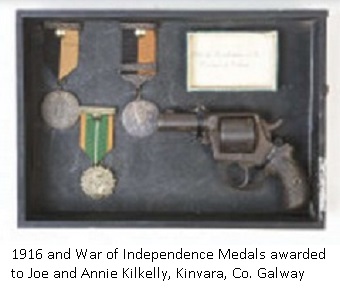
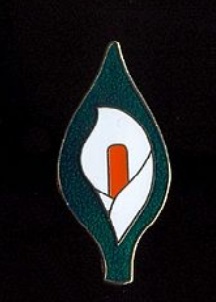
The Easter Lily, worn at Easter in memory of Irish combatants who died during or were executed after the 1916 Easter Rising.
A.O.M. sends us the following extract from an account of the Easter Week 1916 Rising in Galway, written by Comm.Gen Liam O’Maoiliosa, published in Gaelic-American, January 1917:-
At 7 a.m. (Easter) Tuesday, the Clarinbridge and Killeeneen Corps attacked the police, who acted on the defensive in their barracks. An attempt to rush the place failed and firing on both sides went on for over an hour. Then several bombs were exploded in the barracks. To do this, Captain Eamonn Corbett, who volunteered for the job, had to rush up to the windows of the barracks, under fire, and throw the bombs inside the barracks. This he did successfully six times.
Kinvara Branch of Cumann na mBan had eight members, including:
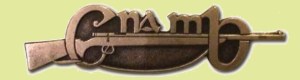
Cumann na mBan clasp
Miss Kate Fogarty
Mary Hynes, Dungora, Kinvara
Miss Aggie Staunton, Clooas, (sic.) Kinvara
Miss Mary Fogarty, Kinvara
Miss P. Regan, Kinvara
Margaret Johnston, Kinvara
The Soldiers of Cumann na mBan
by Brian O’Higgins
All honour to Óglaigh na hÉireann
All praise to the men of our race,
Who, in days of betrayal and slavery,
Saved Eire from shame and disgrace.
But do not forget in your praising,
Of them and the deeds they have done,
Their loyal and true-hearted comrades,
The Soldiers of Cumann na mBan!
Chorus
They stand for the honour of Ireland,
As their sisters in days that are gone,
And they’ll march with their brothers to freedom,
The Soldiers of Cumann na mBan.
No great-hearted daughter of Ireland,
Who died for her sake long ago,
Who stood in the gap of her danger,
Defying the Sassenach foe,
Was ever more gallant or worthy,
Of glory in high sounding rann,
Than the comrades of Óglaigh na hÉireann
The Soldiers of cumman na mBan!
Chorus
O, high beat the hearts of our Mother,
The day she had longed for is nigh,
When the sunlight of joy and of freedom,
Shall glow in the eastern sky;
And none shall be honoured more proudly,
That morning by chieftain and clan,
Than the daughters who served in her danger,
The Soldiers of Cumann na mBan!
Chorus
Brian O’Higgins (1882-1963) penned the lyrics of
The Soldiers of Cumann na mBan in the week immediately prior the 1916 Rising
This song has been arranged and recorded by Joseph Forde.
ST. PATRICK’S DAY
[From the Irishman] (abridged)
We do not believe the memory of our Patron Saint was ever more honoured in the town of Belfast than it was on Wednesday last. Parties of 12,20,30 and 40 met to celebrate the christian labours of our Irish Saint. A large and highly respectable party, containing about 40 persons, dined at Falloon’s Tavern, in Sugar-house entry. The chair was filled on this occasion by James M’Clean, Esq.- Vice President, John Lawless, Esq.
It was a night of harmony, good humour, and good sense. The following toasts were given alternately by the President and Vice-President:-
“The Memory of St. Patrick.”
“The People-the only legitimate source of Royal authority.”
“Civil and Religious Freedom to all men of all climes and denominations.”
“The Friends of Freedom in Spain-may they soon resume the station they
deserve in their native land.”
“The People of Greece-may their great name be once more restored to the
world they have so long illuminated.”
“The United States of America-the unanswerable proof to mankind that their
peace and happiness are ever best secured by the participation of equal rights
and privileges.”
“A Free Press- the poor man’s protection-the Tyrant’s terror.”
“The President of the United States, James Monroe-may the Country over
which he presides for ever be the terror of the Tyrants of Europe.”
“The memories of Grattan, and Curran, and Ponsonby, the eloquent and
uncorrupted advocaters of Ireland’s Freedom.”
“Charles Sugrue, Esq., and the Chamber of Commerce of Cork.”
“The Independent Citizens of Galway.”
“Doctor Tennent.”
“The Stewards who regulated the present celebration of St. Patrick.”
Tuam Herald 26th May, 1888 p4
In 1501 a Bull of excommunication against certain malefactors in the College of St Nicholas at Galway was addressed by Pope Alexander to the Archbishop of Tuam and the bishops of Clonfert and “Melipotamus.” The document details the full penalties of that dread punishment, and is too long for reproduction here. The mention of this See carries our mind to the great Irishman Cardinal Wiseman who before his translation to Westminster held this title in “partibus infidelium”.
Another Bull relating to the parish of Tiraglas and the Vicariates of Kynmara (Kinvara) and Ballinclare (Ballyclera) is addressed by same Pope to three canons of Clonefert, Florence O’Genwayn, Thaddeus Macyachayn, and Gubertus Macmylord. It issued from Rome and bears date 9th of December, 1502
Although there was no disturbance of any kind in Kinvara or district during the recent Rising, the entire population maintaining an attitude of perfect calm throughout, over a score of arrests were made by the local police. In spite of representations by Mr. W.J.Duffy M.P., and others, scarcely any of those interned have as yet been released. During the week Ml. Stanton of Cloonasee, was released and arrived home quite unexpectedly on Tuesday evening.