At the first meeting after the summer recess, the Kinvara Youth Club elected officers of the coming year. They are;
Mr. John Conneely, chairman;
Miss Josette Brogan, secretary;
Miss Elizabeth Murphy, assistant secretary
The recently ordained Father F. Larkin C.C., Spiritual Director.
The programme for the year was outlined: there will be weekly meetings at which it will be possible for the youths of the parish to address the attendance.
There will be table tennis championships, debates, concerts and parties.
From Margaret Cavanagh – aged 10
For constant “splitting” headache the people here (Killina) get their heads “measured” by Pat Linane Cappacasheen or by Pat Joynt Poulataggle, to cure them. They do it with a piece of twine. They say certain prayers about the Blessed Trinity when they do this cure.
This snippet of lore comes from the duchas.ie website. It comprises part of the National Folklore Collection, property of University College Dublin held in trust for the people of Ireland. Content was collected by local children in 1937 and 1938, carefully transcribed under the supervision of their teachers and forwarded with great pride to form part of the Collection.
The clans are embattled at dark Corcomroe, And proudly their trumpets and warhorns blow; The blood, bone and strength of all Thomond are there, With lances in rest and broad-swords bare. The chivalrous powers of Clan Cullein march on, With the proud MacNamaras, like towers, in the van; The plumes of their legions are nodding on high, Like tall forest-tops waving dark in the sky. (The Bard of Thomond)
The clans encamped for the night, securing their cattle within the boundary walls of the monastery. Many slept on the floor of the church, some in cubicles, but others passed the night in mirth around their blazing bivouac fires. They were the MacInerneys, Lorcains, O’Claras, Mannions, O’Molonys, O’Hallorans, O’Currys, O’Slatterys, O’Hassetts, O’Malleys, O’Hartigans, O’Haleys, O’Condergans, O’Conways, O’Meehans, O’Mahons, MacMahons, O’Lynchs and O’Kellys of Galway. O’Regans, O’Griffys, O’Howards, Mahownas, MacEncros of Inagh, O’Galvins, O’Liddys, O’Doyles, O’Kellihers, O’Cunneens, O’Gerans and the clan Giolla Maoel.
Donough Brian Rua’s followers were assembled on the Burren hills to the westward of the abbey. At early morning he marshalled his forces, and marched to meet his foes. Reaching the shores of Lough Raska he and his men met with a strange apparition, described by MacGrath as “the monstrous and distorted form of a lone, ancient, hideous hag, that stooped over the bright lock’s shore. The creature’s semblance was this; she was thatched with elf locks, foxy-grey and rough as heather; long as sea-wrack, inextricable tangled; that had a bossy, wrinkled, foully ulcerated forehead, every hair of her eyebrows was like a strong fishhook, and from under them, bleary dripping eyes peered with malignant fire between lids all rawly crimson-edged. The crone had a cairn of heads, a pile of arms and legs, and a load of spoil, all of which she rinsed and diligently washed, so that by her labour the water of the lake was covered with hair and gory brains. The army, hushed, intently and long gazed at her, but the chief spoke to the beldame;
“What is thy name, what people are thing, or whome are, these the so maltreated dead on this moist shore?”
She nothing loth replied; “The Dismal of Burren I am named always, ’tis of the tuatha de Danann I declare myself, and royal chief; this pile stands for your heads, in their midst thine own here; which now thou carriest it, yet no longer is thine. Proudly as thou goest to battle, the time is not far from thou when all to a very few ye must be slain.”
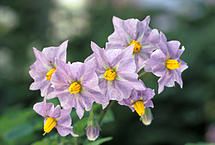
Potato Flowers Photo: Keith Weller Wikimedia Commons
Sir,
I think it right that I should make public what I know on the all-important subject of the threatened potato blight.
On the 19th instant I inspected a field of potatoes on the estate of Comte de Basterot, in the County of Galway, at Duras, in the locality of Kinvara. The crop is a very heavy one, and the field is much sheltered by trees. On the 3rd inst. one rood was well dressed with the preparation of ‘Bonillie Borderlaise’ and quicklime. The remainder of the crop – about half an acre – was not sprayed. On the part dressed not a sign of disease appeared; on the rest of the crop it was quite evident. The “knapsack” used is the light Vermorel spraying machine.
Mr. John Quinn, Duras, Kinvara, Comte de Basterot’s agent and manager, prepared and used the mixture. A letter received from him today informs me that the experiment up to this is a complete success.
I shall be glad to give the recipe for preparation of mixture to anyone applying to me.
Yours,
J. Murray Walker, Land Valuer
73 Waterloo Road,
28th August, 1891
Tom May, Churches of Galway, Kilmacduagh and Kilfenora, Galway 2000
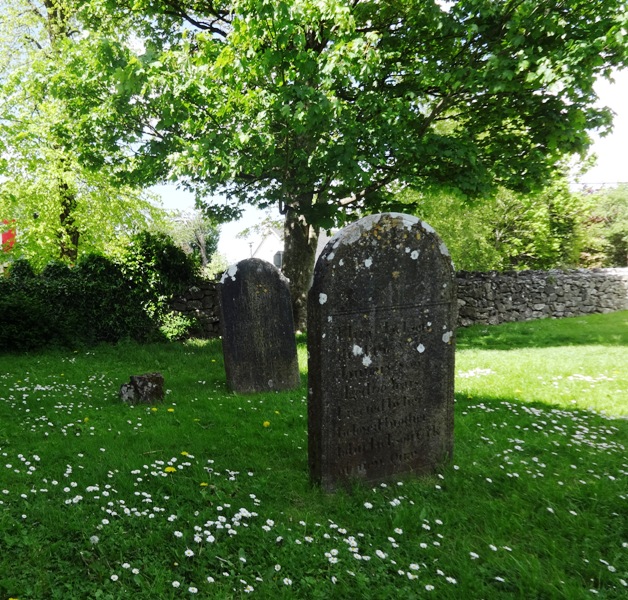
Church of England Graveyard, The Glebe, Kinvara Photo: EO’D
In 1939 Bishop Browne purchased a Church of Ireland building in Kinvara for 25 pounds and transferred
it to Noughaval, roofing the new structure with timbers from Galway gaol!
South Galway, which has already succeeded in having most of its parishes entirely or almost entirely electrified, is now moving steadily towards the completion of the scheme.
Kinvara Guild, Muintir na Tire, has already completed the preliminary spade work necessary for the launching of the scheme. The area hoped to be electrified comprises the entire parish of Kinvara, plus the northern part of Ardrahan parish not included in the primal electrification done in the district. In order to arouse interest the Parish Council of the Guild secured the services of Messrs. Treston and Carlin of the E.S.B. who showed films in Kinvara illustrating the many advantages of electricity. Mr. D. Treston, a member of the well-known Gort family, gave an excellent commentary on the films and explained the scheme of rural electrification. The members are conducting a house to house canvass prior to the official house to house visits of the officials of the E.S.B
The Privy Council met yesterday in the Council Chamber at 3.30.
Present:
Excellency the Lord Lieutenant, the Lord Chancellor, the Recorder, Right Hon. J.Napier, Mr. Justice O’Hagan, the Chief Secretary, Mr. Justice George, and the Lord Bishop of Meath. The Attorney-General and Solicitor-General attended.
In re the Churchyard of Kinvara, County Galway;
This matter came before the council on an application by the Poor Law Guardians of the Gort Union, for an order to close the ancient churchyard of Kinvara, on the ground of its being in a state dangerous to the public health of the district.
Mr. Blackburne and Mr.Mullins appeared on behalf of the parishioners of Kinvara, who memorialled (sic.) the Privy Council against the closing of the churchyard. The memorial against the closing was signed by Dr. McEvilly, the Roman Catholic Bishop of the diocese; by the Parish Priest; Mr. Lynch, a magistrate and upwards of 200 families living in the district, all testifying that it was not necessary to close the churchyard, that it was not overcrowded and that up to the present some portions of it had not been used for the purpose of interment. There was no danger of its becoming overcrowded, as the population of the district had very much diminished. The people of the district, counsel stated, were most anxious that the right of interment in this ancient burial ground should be preserved to them, for there were few families in the district who had not relative interred in it. If it were closed they would be under the necessity of having a new burial ground opened, for which it would be difficult to get a suitable site. It was admitted that some ten or twelve of the graves were scantily covered with earth, but that was a matter which a few workmen could remedy in a short time.
The Parish Priest of Kinvara was then examined by Mr. Blackburne, and his evidence was with a view of showing that the graveyard was not injurious to public health. He admitted portion of the earth in the eastern end had given way, but the bones exposed were the bones of persons interred at a remote period, from which no injurious miasma could possible arise. There was but little mortality in the district and it was not likely the graveyard would become overcrowded. The claim of the parishioners to the churchyard was on the ground of their ancestors being interred there.
The Recorder said it was very natural the parishioners should entertain a strong feeling on the subject. He inquired if upwards of 700 persons did not still claim the right of sepulture there. The Parish Priest, in reply, stated it was not likely more than 200 would claim the right. The Recorder said that there was no doubt as long as the churchyard was left open all would have the liberty.
After some discussion the Council determined not to grant the request of the Gort guardians, so the cemetery will remain open as usual.
Kinvara Swimming Club’s Green Island Swim was held later than usual this year. Nineteen keen competitors lined up for the start at Kinvara Pier on an overcast September afternoon. However, if bright sunshine was lacking there was no want of excitement as the men’ s race provided the most thrilling finish in the history of the competition for the Toddie Byrne trophy. Paul Monahan led the field at the half-way marker at the Green Island but as he headed for home on the last quarter mile stretch he was passed by last year’s winner, Pat Quinn. With a hundred yards to go the holder of the trophy was still in the lead. But by this time Pat’s schoolteacher and club veteran, Stan MacEoin had also passed Paul Monaghan and be succeeded in drawing level with his pupil. With twenty yards to go teacher and pupil matched stroke for stroke but neither of them could pull himself ahead of the other, and at the end of the half mile race both touched the finishing wall simultaneously. The ladies race was won convincingly by the holder of the Paddy Geraghty Trophy, Miss Elva Bermingham. Second was Caroline McCormack while there was an exciting battle for third place between Michelle McCormack and Laura Kelly with Ms. McCormack just touching before Ms. Kelly.
There was a man in our village Cloonasee once and he was blind. One day a woman came in and said that she would cure him if he gave her a bundle of straw: he said he would. She took a cup off the dresser and went out and began to pluck the leaves off the daisies and came in and put two spoons of water in it. She told the man to rub it to his eyes and he got cured.
“If you refused me for the straw you would never get back your sight,” she said


 The Burren and Beyond