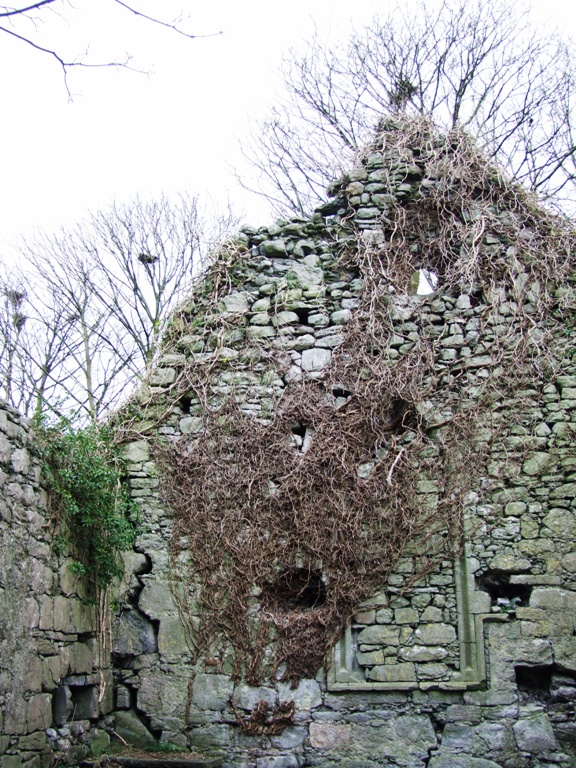
Tom May, Churches of Galway, Kilmacduagh and Kilfenora, Galway 2000
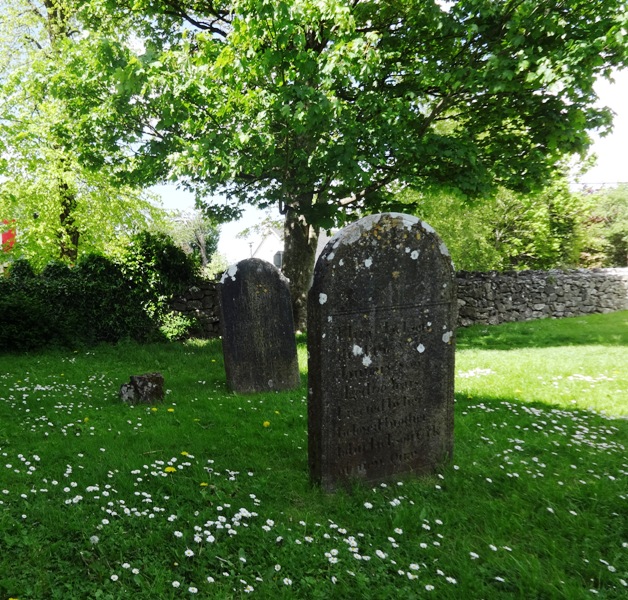
Church of England Graveyard, The Glebe, Kinvara Photo: EO’D
In 1939 Bishop Browne purchased a Church of Ireland building in Kinvara for 25 pounds and transferred
it to Noughaval, roofing the new structure with timbers from Galway gaol!
South Galway, which has already succeeded in having most of its parishes entirely or almost entirely electrified, is now moving steadily towards the completion of the scheme.
Kinvara Guild, Muintir na Tire, has already completed the preliminary spade work necessary for the launching of the scheme. The area hoped to be electrified comprises the entire parish of Kinvara, plus the northern part of Ardrahan parish not included in the primal electrification done in the district. In order to arouse interest the Parish Council of the Guild secured the services of Messrs. Treston and Carlin of the E.S.B. who showed films in Kinvara illustrating the many advantages of electricity. Mr. D. Treston, a member of the well-known Gort family, gave an excellent commentary on the films and explained the scheme of rural electrification. The members are conducting a house to house canvass prior to the official house to house visits of the officials of the E.S.B
The Privy Council met yesterday in the Council Chamber at 3.30.
Present:
Excellency the Lord Lieutenant, the Lord Chancellor, the Recorder, Right Hon. J.Napier, Mr. Justice O’Hagan, the Chief Secretary, Mr. Justice George, and the Lord Bishop of Meath. The Attorney-General and Solicitor-General attended.
In re the Churchyard of Kinvara, County Galway;
This matter came before the council on an application by the Poor Law Guardians of the Gort Union, for an order to close the ancient churchyard of Kinvara, on the ground of its being in a state dangerous to the public health of the district.
Mr. Blackburne and Mr.Mullins appeared on behalf of the parishioners of Kinvara, who memorialled (sic.) the Privy Council against the closing of the churchyard. The memorial against the closing was signed by Dr. McEvilly, the Roman Catholic Bishop of the diocese; by the Parish Priest; Mr. Lynch, a magistrate and upwards of 200 families living in the district, all testifying that it was not necessary to close the churchyard, that it was not overcrowded and that up to the present some portions of it had not been used for the purpose of interment. There was no danger of its becoming overcrowded, as the population of the district had very much diminished. The people of the district, counsel stated, were most anxious that the right of interment in this ancient burial ground should be preserved to them, for there were few families in the district who had not relative interred in it. If it were closed they would be under the necessity of having a new burial ground opened, for which it would be difficult to get a suitable site. It was admitted that some ten or twelve of the graves were scantily covered with earth, but that was a matter which a few workmen could remedy in a short time.
The Parish Priest of Kinvara was then examined by Mr. Blackburne, and his evidence was with a view of showing that the graveyard was not injurious to public health. He admitted portion of the earth in the eastern end had given way, but the bones exposed were the bones of persons interred at a remote period, from which no injurious miasma could possible arise. There was but little mortality in the district and it was not likely the graveyard would become overcrowded. The claim of the parishioners to the churchyard was on the ground of their ancestors being interred there.
The Recorder said it was very natural the parishioners should entertain a strong feeling on the subject. He inquired if upwards of 700 persons did not still claim the right of sepulture there. The Parish Priest, in reply, stated it was not likely more than 200 would claim the right. The Recorder said that there was no doubt as long as the churchyard was left open all would have the liberty.
After some discussion the Council determined not to grant the request of the Gort guardians, so the cemetery will remain open as usual.
Kinvara Swimming Club’s Green Island Swim was held later than usual this year. Nineteen keen competitors lined up for the start at Kinvara Pier on an overcast September afternoon. However, if bright sunshine was lacking there was no want of excitement as the men’ s race provided the most thrilling finish in the history of the competition for the Toddie Byrne trophy. Paul Monahan led the field at the half-way marker at the Green Island but as he headed for home on the last quarter mile stretch he was passed by last year’s winner, Pat Quinn. With a hundred yards to go the holder of the trophy was still in the lead. But by this time Pat’s schoolteacher and club veteran, Stan MacEoin had also passed Paul Monaghan and be succeeded in drawing level with his pupil. With twenty yards to go teacher and pupil matched stroke for stroke but neither of them could pull himself ahead of the other, and at the end of the half mile race both touched the finishing wall simultaneously. The ladies race was won convincingly by the holder of the Paddy Geraghty Trophy, Miss Elva Bermingham. Second was Caroline McCormack while there was an exciting battle for third place between Michelle McCormack and Laura Kelly with Ms. McCormack just touching before Ms. Kelly.
There was a man in our village Cloonasee once and he was blind. One day a woman came in and said that she would cure him if he gave her a bundle of straw: he said he would. She took a cup off the dresser and went out and began to pluck the leaves off the daisies and came in and put two spoons of water in it. She told the man to rub it to his eyes and he got cured.
“If you refused me for the straw you would never get back your sight,” she said
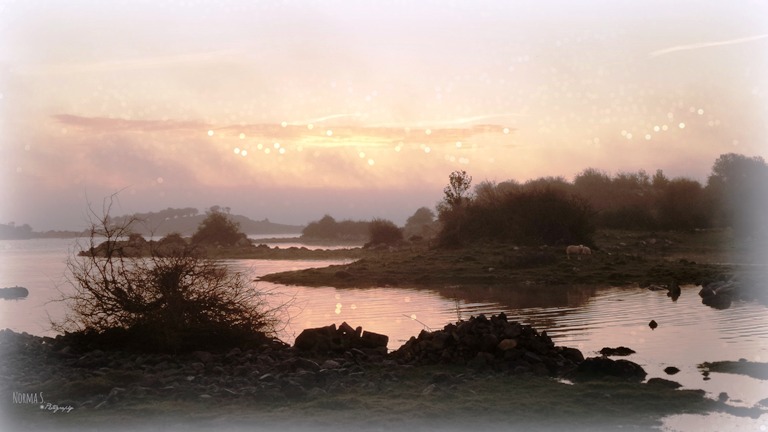
Oh for the gift of a fairy brush
And magic to guide my hand.
I’d paint, in the peace of a spell-bound hush,
This strange and lovely land.
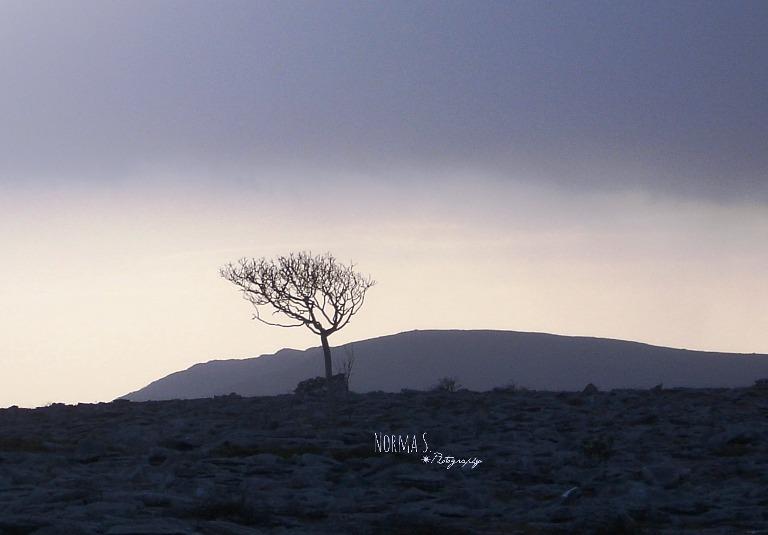
Cloud shadows on a barren hill,
On the rocky coast of Clare.
A watered sky, that goes drifting by,
And salt in the morning air.
Small fields of stone with rocks around;
A smiling woman at a door.
And always on our ears the sound
Of the sea, on the murmuring shore.
A grey keep in a field of green *
Swans on Kinvara’s blue
White pebbles on the sand washed clean,
Age old, but ever new.
A wheeling gull, a curling wave,
The hiss of spreading foam,
Cliffs, and a distant secret cave,
Some ancient hero’s home.
Long ago about eighty years ago there was a great battle fought in our village. There was a Queen from the North also at the battle. She was fighting among the people and the Queen got killed in the middle of the battle. She had a great lot of precious jewellery. The men buried her standing up in the grave. The people say that it is in Burke’s field she is buried. The men planted a hawthorn tree over her grave and the people say that there are four black cats guarding the treasure there always. Cilleení was the name of the Queen. The grave is still there and plain to be seen.
From the National Folklore Collection, property of University College Dublin held in trust for the people of Ireland. Content was collected by children in 1937 and 1938, carefully transcribed under the supervision of their teachers and forwarded with great pride to form part of the Collection.
From Margaret Cavanagh (c.1937)
When the women of our village “Clúin-a-see” would be leaving a cake out to cool on the window-sill they would first take a bite of it. The fairies would take it only for that.
There is a field near my house it is called poll-a-Feóla. It is called that name because in olden times robbers used to steal sheep from farmers and kill them and hide them there. There is a great big heap of stones in the middle of the hole.
There is another hole near our house and it is called pollac-na-mbó. It is called that because since it was made there are cattle going into it for water. One time people were trying to make a road down to it. Every night the stones used to be put back to the place they cleared. One night they stayed there after six and they saw a stick pointing towards them. Nobody tried to “ready” it since because they think it is haunted.
There is another hole near my house. It is called poll-beacháchán it is so-called because a man was following a fox on horse-back and they fell into the water and got drowned. There is another field called poll na Choonach. There are badgers living in it.
There is another field and my father said there was war in it once. There is another hole called poll-eidhin. It was choked by ivy long ago. The people filled it up with stones for fear the cattle would fall into it.
There are some people great for putting “the bad eye” on things. They would say “Isn’t that a fine child” and would not say “God bless him”. There was a woman and a boy coming home from town at ten in the night and every step she took there used to be a candle-stick before her on the road and she put them in her basket and kept one in her hand and when she reached home she had only the one that she had in her hand and people say that it is in Gort yet.
There is a “lios” near my house and it is down in history. The name is liosin-a-mheala.
(abridged)
1. Asses’ milk for “consumption” (taken fasting).
2. Goat’s milk for “consumption”.
3, Sheep’s milk for sore throat (heated).
4. Carry 3 small potatoes in your pocket for rheumatism or for toothache.
5. Foam of new milk for toothache.
6. Ferrets “leavings” – cure for measles.
7. Fox’s tongue to take out a thorn.
8. Dog’s lick for a sore.
9. Fairy mushroom to stop bleeding.
10. Cobweb to stop bleeding.
11. “Goose gall” rubbed on lumps cure them.
12. Goose grease as an embrocation for stiff knees or joints.
13. Snail in shell rubbed to a corn cures it.
Rub snail on corn – hang up on tree seven days. Repeat if corn is not cured first.
14. Cure for boils – plaster made of sugar soap and soda. Apply on linen rag to boil.
15. Leaf of new cabbage bandaged on sores.
16. Juice of dock leaves for stings – nettles, bees.
17. Rub gold wedding ring on a sty in the eye.
18. Rub penny on a fresh bruise to heal it – or piece of raw mutton.
19. Boiled garlic juice for rheumatism.
This selection of lore comes from the duchas.ie website. It comprises part of the National Folklore Collection, property of University College Dublin held in trust for the people of Ireland. Content was collected by local children in 1937 and 1938, carefully transcribed under the supervision of their teachers and forwarded with great pride to form part of the Collection