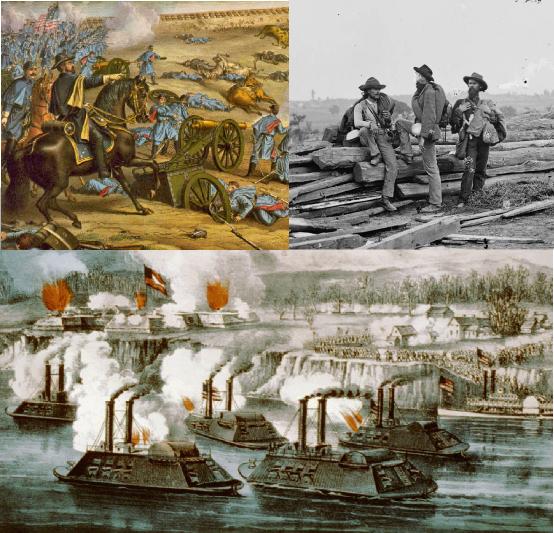
Scenes from the American Civil War. Top left: Battle of Stones River; top right: Confederate prisoners of war; bottom: Battle of Fort Hindman. Hal Jespersen at en.wikipediaHONOLULU STAR BULLETIN 20TH MAY, 1913 P5
Woman Vet, of Civil War has strange tale. (edited)
Quincy, III
The sex of Albert D. J. Cashier, civil war veteran and an inmate of the Soldiers’ and Sailors home here, has been revealed by Colonel J. O. Anderson, superintendent, as feminine.
The woman, whose real name probably never will be known, served three years in the Union army during the Civil war, as is shown by records. She was mustered out of the service in 1865 and a few years later was placed on the government pension roll.
She was born in Ireland, December 25, 1844, but the place of her birth is not known. It is thought by Colonel Anderson and officials of the home board that she ran away from home and came to the United States dressed in boy’s clothes, a stowaway on a British vessel.
She enlisted in Company G, Ninety-fifth Illinois Infantry, May 4, 1862. The regiment to which she belonged was stationed in the south during the last three years of the war, and she was actively engaged in several important battles, among them the siege against Hood’s forces in Tennessee, in which more than half of Company G was killed.
The revelation of the identity of her sex was made two years ago in Livingstown county, Ill., where she was employed as a chauffeur. One day she crawled under the car, which started suddenly and its wheels passed over her, breaking her right leg. When she was taken to a hospital her sex was revealed.
Photo: Fir0002 WikimediaCommonshttps://widgetworld3.wordpress.com/podcasts/ THE CORNWALL CHRONICLE (LAUNCESTON, TAS) 30TH OCTOBER, 1841, P2
It seems that Ireland has lately been visited by a terrific storm of thunder and lightning, accompanied at the same time by a severe shock of an earthquake. Cattle and horses were killed by the lightening, and in the county of Galway the lives of three individuals fell a sacrifice to the electric fluid. So frightful and devastating a storm has not been witnessed in Ireland in the memory of its oldest inhabitant, and it is to be hoped that it will be long before the occurrence of such weather.
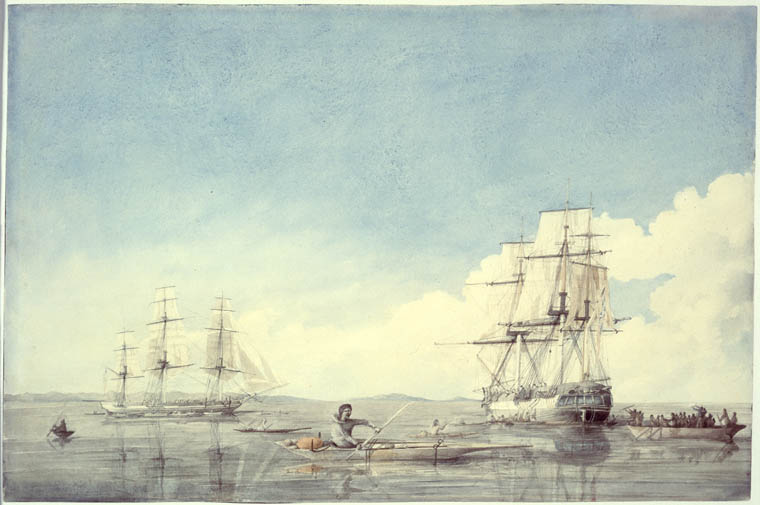
The Hudson’s Bay Company ships Prince of Wales and Eddystone bartering with Inuit off the Upper Savage Islands, Hudson Strait; Robert Hood (1819)South Australian Advertiser p3 DREADFUL SUFFERINGS IN THE POLAR SEA.(abridged)
The only survivor of the crew and passengers of the barque Kitty, a sailor named William Armstrong, arrived at Galway by the Prince Albert last August. Armstrong, on the 29th of June, 1859, shipped as mate of the barque Kitty, from Newcastle-on Tyne, which sailed with a cargo consigned to the Hudson’s Bay Company. She was commanded by Alexander Ellis, and besides her crew of able-bodied seamen she took a few passengers, who intended to settle in the locality.
The voyage from the outset was rather boisterous and protracted, for the vessel did not get off the American shore till the beginning of August. On the 11th of that month she was enveloped in a fog off Cape Resolution, and she was suddenly surrounded by huge mountains of ice, so as to render escape almost hopeless. The bergs could be seen through the fog, gradually drawing nearer and nearer, until at last the vessel was touched by them. Icebergs, Cape York, Greenland Wikipedia.org
The crew and passengers wore naturally panic-stricken, but they soon recovered, and commenced efforts to save their lives. Two boats were got out, and as much provisions as could be put into them in a hurry were stowed away. One was under the command of the captain. The other under Armstrong, the mate, left, the ship’s side, just as the bergs closed upon the ill-fated vessel, and crushed her into pieces. She then went down. The remaining boats managed to get through an opening, but only to find themselves in a field of ice, its pieces threatening destruction at every moment.
For days the two boats beat about making attempts to reach the open sea, with no success. The cold began to take effect, and the fearful symptoms of frost-bite became painfully apparent. Remedies such as were within their power were applied, but they were useless. The poor creatures gradually became worse, and dropped off one after another.
Finally the botls separated in a fog. The captain’s boat was never heard of again. Armstrong, with the few persons in his boat still surviving, pursued his course, the little crew in his boat getting fewer in number, while the survivors were becoming weak and sickly. Those who were sinking under the privations, as their hour approached, became maniacs. Two or three besides Armstrong only remained when the welcome cry of ” Land” was raised, and the men strained their eyes and asked one another could it be real. It was at length reached, but too late for some of them. The ecstacy of such a discovery, after being 62 days in an open boat and suffering such privations in a polar region, was too much for them, and all, with the exception of Armstrong, sank to the ground and died. It it is no wonder Armstrong dropped upon his knees, and returned thanks to his God that he had been spared.
Having obtained a little rest, he wandered along the shore, and was fortunate to fall in with some Esquimaux on a hunting expedition. They conducted him to their huts, and there kept him for a considerable time, until he had recruited his strength. They then brought him to a place where some Moravian missionaries were residing, who forwarded him to St John’s in the early part of August. Up to the present no tidings could be got of the vessel, and it was long since supposed that every soul had gone to the bottom.
Haslem Counties Herald.
Photo: John TreacyFreeman’s Journal – 8 January 1887
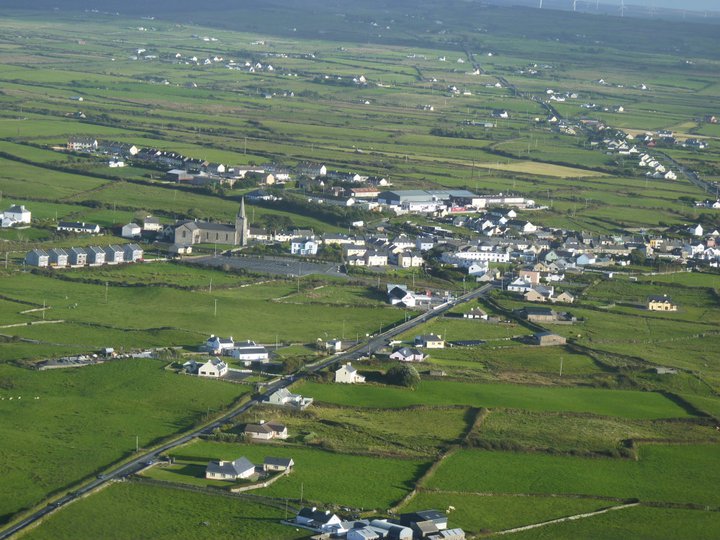
Two hundred and fifty women at Miltown Malbay, County Clare, lately baffled a force of police, bailiffs, and sheriffs. The posse came to seize cattle for rent. The women made prisoners of the peelers and bailiffs, while their husbands drove the cattle away.
Coole Mist EO’Dhttps://widgetworld3.wordpress.com/podcasts/ Freeman’s Journal Saturday 21st may, 1904
AN IRISH MINSTREL
THE BLIND BARD OF CONNAUGHT – RAFTERY THE ROVING POET (edited)
Anthony Raftery was born in Killedan, County Mayo in 1779. He was smitten with smallpox when he was a little lad and the disease left him blind.
Someone taught him to play the fiddle and when he was still a young man he left his native place to go tramping the Galway roads, fiddling and singing songs for his meat and lodging. He was a poet of a type then fairly common – there were over two hundred wandering Irish poets when Raftery was on the roads, and each one of them, wherever they went, was welcome at the fireside and the fair. Raftery was the most famous, a man one was proud to entertain. He would play dance music at Kiltartan Cross “of a Sunday evening'” and it is said he could “turn a marriage into a wedding” with his music. Out the back, Ballybuck EO’D
His chief poems are “Eanach Dhiun”, “Mairin Stanton,” and a long solemn poem of great beauty, called “The Vision of Death,” which he made from a vision that came to him some seven years before he died. Of his life, there were many anecdotes, telling how he was once worsted in a dispute with a farmer poet, called Callinan, how he liked whisky, and was ever too fond of money, and how, at his death, the poor house where he lay “was all lighted up as bright as the day, and a flame in the heavens above it.” Blind though he was, it was said he could walk the roads with neither dog or stick, taking the turns rightly and leaping the bog-holes without a guide.
Raftery died in Killeeneen in 1835 and was buried in the graveyard there, with all the villagers to play him home. Lovers of his poetry placed a simple white stone above his grave.
The Burren Photo; Norma ScheibeVisions and beliefs in the west of Ireland, collected and arranged by Lady Gregory: with two essays and notes by W. B. Yeats.
Second series, G.P. Putnam’s Sons, New York and London
The Knickerbocker Press 1920 https://widgetworld3.wordpress.com/podcasts/
A FAIRY FORT
A woman I know had business one time in Ballyvaughan, and when she was on the road beyond Kinvara a man came to her out of a fort and he asked her to go in and to please a child that was crying. So she went in and she pleased the child, and she saw in a corner an old man that never stopped from crying. And when she went out again she asked the man that brought her in, why was the old man roaring and crying. The man pointed to a milch cow in the meadow and he said, “Before the day is over he will be in the place of that cow, and it will be brought into the forth to give milk to the child.” And she can tell herself that was true, for in the evening when she was coming back from Ballyvaughan, she saw in that field a cow dead, and being cut in pieces, and all the poor people bringing away bits of it, that was the old man that had been put in its place. There is poison in that meat, but no poison ever comes off the fire, but you must mind to throw away the top of the pot.
A GATHERING OF SPIRITSStream near St. Colman’s The Burren Photo: Norma Scheibe
There’s a bad bit of road near Kinvara Chapel, just when you get within sight of the sea. I know a man has to pass there, and he wouldn’t go on the driver’s side of the car, for it’s to the right side those things are to be seen. Sure there was a boy lost his life falling off a car there last Friday week. And I knew him, a quiet boy, and married to a widow woman; she wanted the help of a man, and he was young. What would ail him to fall off the side of an ass-car and to be killed?
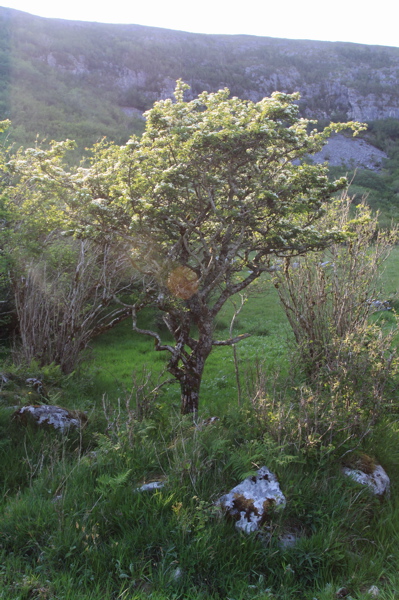
It’s by the big tree outside Raheen (where you take the turn to Kinvara) that the most things are seen. There was a boy living in Gort that was out before daylight with a load of hay in a cart, and he sitting on top of it. He was found lying dead just beside the tree, where he fell from the top of the cart, and the horse was standing there stock-still. There was a shower of rain fell while he was lying there, and I passed the road two hours later, and saw where the dust was dry where his body had been lying.
And it was only yesterday I heard a story of that very same place. There was a man coming from Galway with a ton weight of a load on his cart, and when he came to that tree the linching of his wheel came out, and the cart fell down. And presently a little man, about two and a half feet in height, came out from the wall. He lifted up the cart, and held it up till he had the linching put up again. And he never said a word but went away as he came, and the man came in to Gort.
The Old Castle, Kinvara Photo: Norma ScheibeTHE SHEE
I heard a churning one time in the hill up by the road beyond. I was coming back from Kinvara, and I heard it plain, no mistake about it. I was sorry after I didn’t call down and ask for a drink. Johnny M— did so, and got it. If you wish for a drink and they put it out for you, it’s no harm to take it, but if you refuse it, some harm might happen to you. Johnny H——— often told that he heard churning in that spot, but I wouldn’t believe the sun rising from him, he had so many lies. But after that, I said, “Well, Johnny H——– has told the truth for once.”
THE MONSTER
There is a monster of some sort down by Duras, it’s called the ghost of Fiddeen. Some say it’s only heard every seven years. Some say it was a flannel seller used to live there that had a short fardel. We heard it here one night, like a calf roaring.
THE BANSHEE
There is a boy I knew near Ballinderreen, told me that he was going along the road one night and he saw a dog. It had claws like a cur, and a body like a person, and he couldn’t see what its head was like. But it was moaning like a soul in pain, and presently it vanished, and there came most beautiful music, and a woman came out and he thought at first it was the Banshee, and she wearing a red petticoat. And a striped jacket she had on, and a white band about her waist. And to hear more beautiful singing and music he never did, but to know or to understand what she was expressing, he couldn’t do it. And at last they came to a place by the roadside where there were some bushes. And she went in there and disappeared under them, and the most beautiful lights came shining where she went in. And when he got home, he himself fainted, and his mother put her beads over him, and blessed him and said prayers. So he got quiet at last.
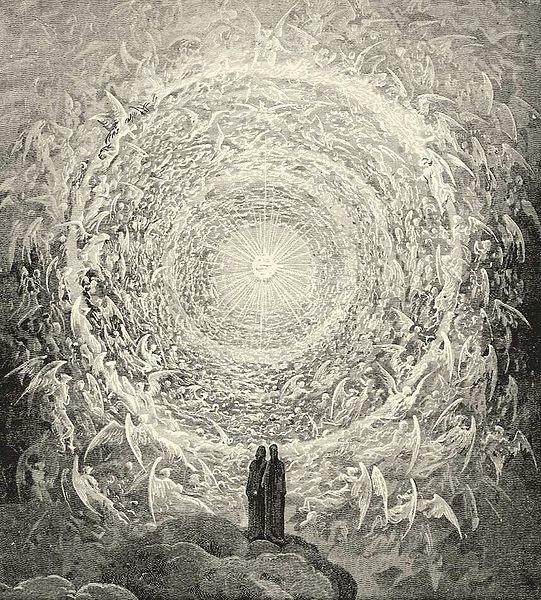
Dante and Beatrice gaze upon the highest Heaven – Gustave Doré (1832 – 1883) From Alighieri Dante; Cary, Henry Francis (ed) (1892) “Canto XXXI” The Divine Comedy by Dante, Illustrated, Complete. London, Paris and Melbourne; Cassell and Co., (Wikimedia Commons) https://widgetworld3.wordpress.com/podcasts/ A Book of Saints and Wonders – according to the Old Writings and the memory of the People of Ireland.
Lady Gregory – 1906
Book Five – Great wonders of Olden Times (edited)
The Seven Heavens
As to the Seven Heavens that are around the earth;
The first of them is both bright and cloudy. It is the nearest and has the shining of the moon and the scattering of the stars within.
Beyond that lie two flaming heavens, angels in one, the winds in the other.
Beyond those lie an ice-cold heaven, bluer than any blue, seven times colder than any snow. It is out of this comes the shining of the sun.
Two heavens lie above – bright like flame. It is out of them shine the fiery stars that put fruitfulness in the clouds and sea.
And the last – highest of all it is, having within it the rolling of the skies – the labour of music – and choirs of angels.
Within the belts of these seven heavens are hidden twelve shaking beasts. They have fiery heads upon their heavenly bodies and blow twelve winds about the world. And in these belts sleep dragons. Tower headed, blemished – their fiery breath give out the crash of the thunders and lightning blows from their eyes.
Photo: Waugsberg Wikimedia CommonsExcerpt from True Irish Ghost Stories
compiled by St John Seymour B.D
1914 (abridged)
One night in April 1821, two servants were sitting up to receive a son of the family, Cornelius O’Callaghan, who had travelled in vain for his health, and was returning home to County Clare. One of them, Halloran, said that the heavy rumble of a coach roused them. The other servant, Burke, stood on the top of the long flight of steps with a lamp, and sent Halloran down to open the carriage door. He reached out his hand to do so, saw a skeleton looking out, gave one yell, and fell in a heap. When the badly-scared Burke picked himself up there was no sign or sound of any coach. A little later the invalid arrived, so exhausted that he died suddenly in the early morning.
On the night of December 11, 1876, a servant of the MacNamaras was going his rounds at Ennistymon, a beautiful spot in a wooded glen, with a broad stream falling in a series of cascades. In the dark he heard the rumbling of wheels on the back avenue, and, knowing from the hour and place that no mortal vehicle could be coming, concluded that it was the death coach, and ran on, opening the gates before it. He had just time to open the third gate, and throw himself on his face beside it, when he heard a coach go clanking past. On the following day Admiral Sir Burton Macnamara died in London.
Photo: Wikimedia Commonshttps://widgetworld3.wordpress.com/podcasts/ THE BRISBANE COURIER 22ND JUNE 1867 P7
A CURE FOR CONSUMPTION (abridged)
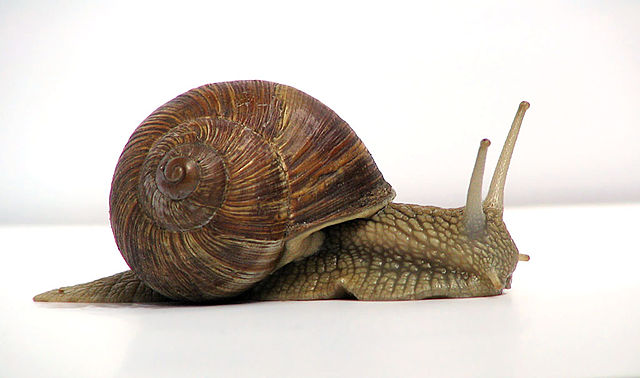
In Ireland some have great faith in the efficacy of snails as a cure for persons in decline, or consumption, but they do not in all places use them in the same way. A lady in Tipperary, who has as large a practice as the regular doctor, tells me that the way to administer snails is to “boil them in veal broth.” She herself knew a lady, who was taking cod liver oil with no result, grew strong with this remedy.
A daughter of a clergyman in Galway writes;
“The snails used for the broth, as you designate my very fine syrup, are the common large things that creep about the garden with their houses on their back. They are collected and placed on a large dish, and plentifully sprinkled with dark sugar, then another dish is turned over to prevent them running away, and the next morning the syrup which has been made in the night is to be drained off, and a tablespoon taken three times a day. A little lemon peel may be added to flavour the broth. The same snails should not be sugared twice. It is a really good thing, but of course will not cure in a day; but I know a lady who attributed her own cure to it.
Anon – 1866 New York Public Library Wikipedia.orgFairy and Folk Tales of the Irish Peasantry, edited and selected by W.B.Yeats
Walter Scott, London, New York (1888)
THE MERROW (abridged)
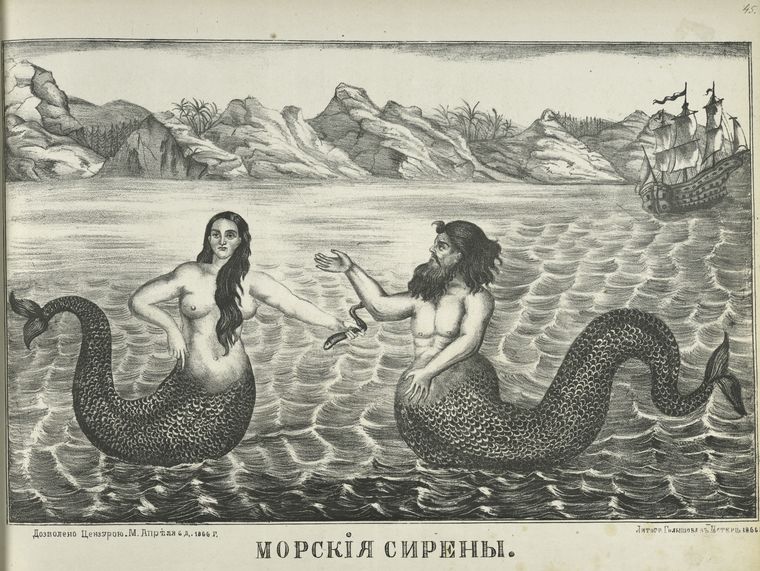
The Merrow, or Moruadh/Murrúghach, comes from muir, sea, and oigh, a maid, and is common, they say, on the wilder coasts of Ireland. The fishermen do not like to see them, for it always means coming gales. The male Merrows have green teeth, green hair, pig’s eyes, and red noses; but their women are beautiful, for all their fish tails and the little duck-like scale between their fingers.
Sometimes they prefer, small blame to them, good-looking fishermen to their sea lovers. Near Bantry, in the last century, there is said to have been a woman covered all over with scales like a fish, who was descended from such a marriage. Sometimes they come out of the sea, and wander about the shore in the shape of little hornless cows. They have, when in their own shape, a red cap, called a cohullen druith, usually covered with feathers. If this is stolen, they cannot again go down under the waves.




 The Burren and Beyond